“Grief is a love that has no place to go.”
— Leigh reflects on her mother's suicide and her own emotional turmoil.

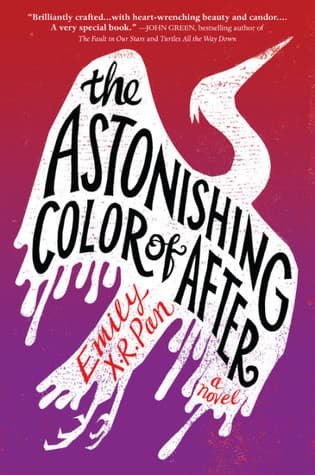
Emily X.R. Pan (2018)
Genre
Psychology / Fantasy / Young Adult / Romance
Reading Time
10-12 hours
Key Themes
See below
Sign in to track this book
Grief-stricken and convinced her mother’s spirit became a bird, a half-Asian teen travels to Taiwan, uncovering generations of family secrets and confronting the truth of love and loss through a quest for answers.
The story opens with Leigh Chen Sanders grappling with the suicide of her mother, Dory. Leigh is convinced that her mother's spirit has transformed into a large red bird that appears in their house. This belief is the central focus of her grief. The narrative also introduces a critical flashback: the day Dory died was the same day Leigh kissed her best friend and long-term crush, Axel, after years of unspoken tension. This juxtaposition of joy and loss creates a complex emotional situation for Leigh. Her father, a white American, struggles to cope with Dory's death and Leigh's erratic behavior, including her conviction about the bird.
Driven by her certainty that the red bird is her mother and that it has flown to Taiwan, Leigh decides to travel there. Her father, hoping a change of scenery and connection with Dory's family might help Leigh, agrees to the trip. Upon arriving, Leigh meets her maternal grandparents, Waipo and Waigong, for the first time. The language barrier is significant, as Leigh only knows basic Mandarin, and her grandparents speak little English. Despite the initial awkwardness and the weight of their shared grief, Leigh immediately feels a connection to her mother's homeland and a strong desire to uncover the truth behind Dory's life and death, believing her grandparents hold pieces of the puzzle.
As Leigh navigates Taiwan, she begins to experience powerful, often overwhelming, sensory flashbacks and visions that she interprets as encounters with ghosts, particularly her mother's spirit. These 'ghosts' manifest as colors, sounds, smells, and even physical sensations, transporting her back to specific moments in her mother's life. These visions are triggered by places, objects, and conversations, helping Leigh piece together fragments of Dory's past. She sees glimpses of her mother's childhood, her relationship with her own parents, and the challenges she faced growing up in Taiwan, all while continuing to search for the red bird she believes is Dory.
Through her visions and tentative conversations with her grandparents, Leigh gradually uncovers family secrets. She learns about Dory's difficult childhood, marked by a strained relationship with her father (Waigong), who disapproved of Dory's artistic aspirations and her desire to study abroad. A painful secret emerges: Dory had a younger brother, Fu, who died in a drowning accident when Dory was a child. This event impacted Dory and created a rift in the family, contributing to her eventual move to America and the emotional distance she maintained from her parents. Leigh realizes her mother carried deep wounds from her past.
Leigh discovers that her mother was an artist, a passion Leigh herself shares. She finds her mother's old art supplies, sketchbooks, and paintings, which provide insights into Dory's inner world and emotional struggles. Art becomes a medium for Leigh to connect with her mother's memory and process her own grief. She starts drawing and painting again, using colors to express her feelings, much like Dory did. This shared artistic language helps bridge the gap between mother and daughter, even after death, and allows Leigh to understand her mother's perspective and emotional situation more deeply.
While in Taiwan, Leigh receives a series of letters from Axel. His letters express his confusion, concern, and guilt over their kiss occurring on the same day Dory died, wondering if it somehow contributed to her mother's decision. Leigh herself struggles with this same guilt, replaying the moment of the kiss and her mother's subsequent death. The distance allows her to reflect on her feelings for Axel, the intensity of their connection, and the pressure placed on their new romance by the tragedy. The letters highlight the emotional fallout affecting not only Leigh but also those closest to her.
As Leigh's visions become more frequent and she gathers more fragments of her mother's past, she realizes that Dory's life was marked by sadness and untreated depression, stemming partly from the trauma of her brother Fu's death and her strained relationship with her father. Leigh finally confronts Waigong, pressing him for answers about Dory's unhappiness. Through a difficult, emotional conversation, Waigong admits his regrets and the family's past inability to understand or address Dory's mental health struggles. He reveals that Dory had been struggling with depression for much of her life, a fact that was often dismissed or misunderstood within the family.
After much searching and many visions, Leigh eventually comes to a realization about the red bird. While her initial belief was literal, she understands that the bird is not her mother's literal spirit but rather a symbol of Dory's essence, her artistic spirit, her longing for freedom, and the enduring love she left behind. The bird represents the often hidden aspects of her mother's personality and the way Dory continues to live on through Leigh's memories, her art, and the love shared with her family. This understanding marks a step in Leigh's grieving process, shifting from literal belief to symbolic interpretation.
With a deeper understanding of her mother's life, struggles, and artistic spirit, Leigh begins to find a path toward acceptance. She strengthens her bond with Waipo and Waigong, bridging the language and cultural gaps through shared stories and a renewed sense of family. She learns to forgive her grandparents for their past mistakes and begins to forgive herself for the guilt she carried regarding Axel and her mother's death. Leigh realizes that grief is a complex journey and that loving someone means accepting all facets of their being, including their pain. She starts to understand that her mother's death was not her fault, and that Dory's love for her was real and enduring.
Having processed much of her grief and gained an understanding of her heritage, Leigh returns to America a changed person. She is more at peace with her mother's death and has a clearer sense of her own identity, embracing both her American and Taiwanese roots. She is ready to confront her relationship with Axel, understanding that their connection, while born amidst tragedy, is still meaningful. The journey to Taiwan has allowed her to integrate the painful and beautiful colors of her mother's life into her own, giving her the strength to move forward and paint her own future.
The Protagonist
Leigh evolves from a grief-stricken, guilt-ridden girl obsessed with a literal interpretation of her mother's spirit to a more accepting, self-aware young woman who understands the symbolic nature of grief and her own heritage.
The Central Figure (deceased)
Though deceased, Dory's character arc is revealed retrospectively through Leigh's discoveries, showing her struggle with depression, her artistic passion, and her ultimate tragic end, allowing Leigh to understand her more fully.
The Supporting
Axel's arc primarily involves his struggle with guilt and his unwavering support for Leigh, culminating in a hopeful reunion.
The Supporting
Waipo moves from a reserved, grieving matriarch to a more open figure, sharing family history and offering solace to Leigh.
The Supporting
Waigong's arc involves moving from a seemingly unyielding figure to one who expresses profound remorse and opens up about his past, fostering a deeper connection with Leigh.
The Supporting
Peter's arc is less pronounced, focusing on his silent grief and his efforts to support Leigh through her own journey.
The Mentioned
Though deceased, Fu's story is integral to understanding Dory's past and the family's historical trauma.
The central theme is Leigh's journey through the complex stages of grief after her mother's suicide. The novel explores how grief manifests uniquely, from Leigh's literal belief in her mother as a red bird to her emotional numbness and guilt. It explores the long-term impact of loss on family dynamics, particularly the intergenerational grief within Dory's family stemming from Fu's death. Leigh's process involves confronting the pain, understanding its origins, and finding a path to acceptance and healing, demonstrating that grief is not a linear process.
“Grief is a house of cards, and one wrong move brings it all crashing down.”
Leigh's journey to Taiwan is about discovering her mother's past and understanding herself. As a biracial teenager, she grapples with her Taiwanese heritage, the language barrier, and cultural differences. Uncovering her mother's artistic passions and mental health struggles helps Leigh reconcile aspects of her own identity and artistic inclinations. Her experiences in Taiwan, particularly connecting with her grandparents and Dory's history, allow her to integrate her dual heritage and understand the 'colors' that make up who she is, moving toward a more complete sense of self.
“Maybe you had to break into a million pieces to understand where you came from.”
The novel unravels the layers of family secrets that contributed to Dory's depression and the overall family dynamic. The most significant secret is the death of Dory's younger brother, Fu, and the unspoken grief and potential blame that followed. Waigong's strained relationship with Dory due to his disapproval of her artistic dreams and perceived 'weakness' also represents a generational conflict. These unaddressed traumas and secrets are shown to have a lasting impact across generations, influencing Dory's mental health and Leigh's understanding of her mother and her heritage.
“Secrets were like colors, too. Some were dark and murky, others bright and sharp. And some were so intertwined, you couldn't tell where one began and another ended.”
Art is a pervasive theme throughout the novel. Both Dory and Leigh are artists, using colors and drawing to express emotions that are difficult to articulate. For Dory, art was an escape and a way to process her internal struggles, often clashing with her father's practical expectations. For Leigh, art becomes a tool for grief processing, connection to her mother's memory, and self-expression. The novel uses the metaphor of 'color' to represent emotions, memories, and the complex nature of life and loss, showing how creativity can be a pathway to understanding and healing.
“Maybe colors were like emotions, then. Maybe they could be mixed and layered, and become something new, something that wasn't just sadness or happiness or anger, but all of them at once.”
The novel addresses the theme of mental health, specifically Dory's lifelong struggle with depression and the tragic consequences of suicide. It highlights the stigma surrounding mental illness, particularly in traditional contexts, where Dory's sadness was often misunderstood or dismissed as a personal failing rather than a treatable condition. Leigh's journey allows her to understand that her mother's depression was a complex illness, not a choice or a reflection of her love. The book advocates for empathy and understanding towards those struggling with mental health issues and the importance of open communication.
“Sometimes the people who are gone are the ones who need to be found the most.”
Leigh experiences vivid, color-coded 'ghostly' visions that blur reality and memory.
Leigh's experiences with 'ghosts' and her mother's past are depicted through vivid, sensory, and often color-coded visions that blur the line between reality and Leigh's internal world. These are not literal ghosts but powerful manifestations of memory, emotion, and empathy, allowing Leigh to 'see' and 'feel' her mother's life. This magical realism device allows the narrative to explore complex emotions and historical trauma in a uniquely evocative way, making the past tangible and immediate for both Leigh and the reader, and serving as a mechanism for Leigh's psychological processing of grief.
Alternating between Leigh's present journey in Taiwan and flashbacks to Dory's past and Leigh's memories.
The story employs a non-linear narrative structure, constantly shifting between Leigh's present experiences in Taiwan and her 'ghostly' visions of Dory's past, as well as flashbacks to her own memories with Axel and Dory before her death. This fragmented timeline mirrors Leigh's fractured state of mind and the process of piecing together a life after a traumatic loss. It allows the reader to gradually uncover Dory's story alongside Leigh, building suspense and depth, and highlighting how past events continually influence the present.
The red bird represents Dory's spirit, freedom, and the enduring nature of love.
The red bird is the most prominent symbol in the novel. Initially, Leigh literally believes it is her mother's transformed spirit, driving her quest to Taiwan. As the story progresses, the bird evolves into a multifaceted symbol. It represents Dory's artistic soul, her yearning for freedom from the constraints of her past and depression, and the enduring, vibrant presence of her love in Leigh's life. The bird's color (red) often signifies passion, anger, and the intensity of Dory's emotions, ultimately becoming a metaphor for how Leigh learns to carry her mother's legacy without the burden of literal belief.
Colors are used metaphorically to represent emotions, memories, and Leigh's artistic expression.
Colors are a recurring motif throughout the novel, deeply intertwined with Leigh's identity as an artist and her emotional landscape. Leigh often associates specific colors with particular emotions, memories, or even the 'ghosts' she encounters. For example, red is often linked to Dory, love, and intense emotion, while other colors signify sadness, confusion, or hope. This motif emphasizes the artistic lens through which Leigh perceives the world and processes her grief, making the abstract concept of emotion tangible and visually rich for the reader, and highlighting the therapeutic power of art.
Axel's letters to Leigh provide emotional connection and external perspective.
Axel's letters to Leigh, received while she is in Taiwan, serve as a crucial plot device. They maintain his presence in the narrative despite his physical absence, providing an external perspective on the tragedy and Leigh's behavior. The letters allow Axel to express his guilt, confusion, and enduring affection, which in turn forces Leigh to confront her own feelings about their kiss and the burden of that day. They highlight the difficulties of long-distance communication and the emotional complexities of young love amidst profound grief, pushing Leigh to reflect on her future.
“Grief is a love that has no place to go.”
— Leigh reflects on her mother's suicide and her own emotional turmoil.
“Sometimes the truth isn't what you want it to be. Sometimes it's what you need it to be.”
— Leigh grapples with uncovering family secrets during her journey to Taiwan.
“The world is full of colors we can't see until we're ready to look.”
— Leigh discovers synesthesia and new perceptions after her mother's death.
“Memories are like ghosts. They haunt you until you learn to live with them.”
— Leigh confronts her past and her mother's legacy.
“Love isn't always about holding on. Sometimes it's about letting go.”
— Leigh learns to release guilt and embrace her mother's choices.
“In the silence between heartbeats, that's where the magic happens.”
— Leigh experiences mystical moments connecting with her mother's spirit.
“We are all mosaics of the people we've loved and lost.”
— Leigh realizes how her identity is shaped by family and grief.
“The most astonishing colors are the ones we create from our pain.”
— Leigh uses art and synesthesia to process her emotions.
“Home isn't a place. It's a feeling you carry inside.”
— Leigh navigates her Taiwanese heritage and sense of belonging.
“Sometimes the bravest thing you can do is ask for help.”
— Leigh learns to lean on friends and family during her grief.
“The past is a story we tell ourselves. The future is a story we have yet to write.”
— Leigh reflects on moving forward after loss.
“Love is the color that never fades, even in the darkest of times.”
— Leigh finds enduring connections through her synesthetic experiences.
“We are all searching for the missing pieces of ourselves.”
— Leigh's journey to understand her mother and her own identity.
“The heart has its own language, one that doesn't need words.”
— Leigh communicates with her mother's spirit beyond verbal means.
Ready to see how well you understood this book? Take our interactive quiz with 10 questions.

Rhonda Byrne
4.3

Menno Henselmans
4.3

Sylvia Plath
4.3
Elliot Aronson
4.3
Joseph Campbell
4.3
Erich Fromm
4.3
Irvin D. Yalom
4.2

Lucy Strange
4.2