BookBrief
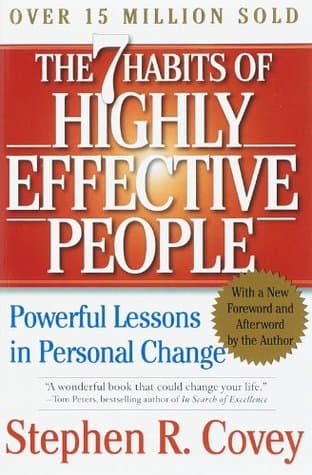
The 7 Habits of Highly Effective People: Powerful Lessons in Personal Change cover
Archivist's Choice

The 7 Habits of Highly Effective People: Powerful Lessons in Personal Change

Stephen R. Covey (1989)

Genre

Business / Productivity / Leadership / Philosophy / Self-Help

Reading Time

360 min

Key Themes

See below

Track Your Reading

Sign in to track this book

This book presents seven habits that help people live more effective, purposeful lives.

Core Idea

Stephen Covey says that true effectiveness in personal and professional life comes from a character ethic based on lasting principles, not a personality ethic focused on surface techniques. He shows seven connected habits that move people from dependence to independence (Be Proactive, Begin with the End in Mind, Put First Things First) and then to interdependence (Think Win/Win, Seek First to Understand, Then to Be Understood, Synergize). Continuous renewal (Sharpen the Saw) supports all these habits. By using these habits, people can match their actions to their values, which builds integrity, trust, and lasting success in all parts of life.
Reading time
360 min
Difficulty
Medium
✓ Read this if...
You want a foundational framework for personal and professional effectiveness based on principles, seeking to develop habits that foster integrity, improve relationships, and enhance productivity. Ideal for those looking for a holistic approach to self-improvement beyond quick fixes.
✗ Skip this if...
You are looking for specific, tactical productivity hacks or a purely theoretical academic read. This book requires introspection and a commitment to applying its principles, rather than just understanding them.

Core idea

The central argument and framework that powers the entire book.

Stephen Covey says that true effectiveness in personal and professional life comes from a character ethic based on lasting principles, not a personality ethic focused on surface techniques. He shows seven connected habits that move people from dependence to independence (Be Proactive, Begin with the End in Mind, Put First Things First) and then to interdependence (Think Win/Win, Seek First to Understand, Then to Be Understood, Synergize). Continuous renewal (Sharpen the Saw) supports all these habits. By using these habits, people can match their actions to their values, which builds integrity, trust, and lasting success in all parts of life.

At a glance

Reading time

360 min

Difficulty

Medium

Read this if...

You want a foundational framework for personal and professional effectiveness based on principles, seeking to develop habits that foster integrity, improve relationships, and enhance productivity. Ideal for those looking for a holistic approach to self-improvement beyond quick fixes.

Skip this if...

You are looking for specific, tactical productivity hacks or a purely theoretical academic read. This book requires introspection and a commitment to applying its principles, rather than just understanding them.

Key Takeaways

1

Shift from Personality to Character Ethic

True effectiveness stems from internal principles, not superficial techniques.

Quote

To change ourselves effectively, we first had to change our perceptions of ourselves.

Covey states that for much of the 20th century, self-help books changed from a 'Character Ethic' to a 'Personality Ethic.' The Character Ethic, common in early American success books, focused on virtues like integrity, humility, loyalty, self-control, courage, fairness, patience, hard work, simplicity, modesty, and the Golden Rule. In contrast, the Personality Ethic focuses on public image, attitudes, and behaviors, often using quick techniques for social influence and positive thinking. Covey says that real, lasting effectiveness and...

Supporting evidence

Covey traces the historical shift in self-help literature, noting that books prior to World War I predominantly focused on character, while post-WWI literature increasingly emphasized personality traits and public image.

Apply this

Evaluate your current self-improvement efforts. Are you focusing on quick-fix personality techniques (e.g., 'power posing' without internal confidence), or are you investing in developing core character traits like honesty, diligence, and empathy? Prioritize building a strong internal character over merely polishing your external persona.


character-ethicpersonality-ethicprinciples
2

Be Proactive: Own Your Response

Take responsibility for your choices and actions, rather than blaming external circumstances.

Quote

Between stimulus and response, man has the freedom to choose.

Being proactive is more than just starting things; it means recognizing that we are in charge of our own lives. Proactive people know they can choose how to respond to any situation, no matter what is happening outside. They do not blame circumstances, conditions, or past experiences for their behavior. Instead, they work within their 'Circle of Influence,' putting their energy into things they can control. Reactive people, however, are often affected by their surroundings and social mood, focusing on their 'Circle of Concern' (things...

Supporting evidence

Covey uses Viktor Frankl's experience in Nazi death camps. Despite unimaginable suffering, Frankl found the 'last of the human freedoms' — the freedom to choose his attitude and response, demonstrating that even in the most extreme circumstances, we retain the power of choice.

Apply this

Identify an area where you frequently feel reactive (e.g., traffic, a difficult colleague). Instead of complaining, list two specific actions you can take within your 'Circle of Influence' to improve or change your response to that situation. Practice using proactive language like 'I choose to...' instead of 'I have to...'.

proactivitycircle-of-influenceresponsibilitychoice
3

Begin with the End in Mind: Define Your Destination

Clarify your values and vision before you start working, ensuring your efforts lead somewhere meaningful.

Quote

By beginning with the end in mind, you can ensure that the things you are doing are not just efficient, but effective.

This habit stresses the importance of thinking about something before physically doing it. It means starting with a clear idea of your goal, knowing where you are going so you can better understand your current position and take the right steps. Covey suggests writing a personal mission statement – a guide for your life – that lists your main values, principles, and long-term goals. This mission statement acts as a personal plan, guiding your decisions and making sure your daily actions match your deepest values and ultimate vision. W...

Supporting evidence

Covey illustrates this with the metaphor of two creations: the first (mental) is the blueprint, and the second (physical) is the actual construction. A house is first designed in detail before construction begins. Similarly, our lives require a mental design.

Apply this

Draft a personal mission statement focusing on who you want to be, what you want to do, and the values that will guide your life. Use this statement to evaluate your current projects and commitments: Do they align with your 'end in mind'? If not, consider re-prioritizing or adjusting them.

personal-mission-statementvisionpurposevalues
4

Put First Things First: Prioritize Your Life

Focus on important, non-urgent tasks that build long-term value and prevent crises.

Quote

The key is not to prioritize what's on your schedule, but to schedule your priorities.

This habit is about managing yourself and putting your activities in order based on importance, not just urgency. Covey presents the time management matrix, which divides tasks into four groups: Urgent/Important (crises), Not Urgent/Important (planning, prevention, building relationships), Urgent/Not Important (interruptions, some emails), and Not Urgent/Not Important (small activities, time wasting). Very effective people spend most of their time in Quadrant II (Not Urgent/Important). This quadrant holds activities that help with you...

Supporting evidence

The time management matrix is the core evidence here. Covey explains that most people are stuck in Quadrant I (urgent/important) and Quadrant III (urgent/not important), leading to stress and ineffectiveness. Shifting focus to Quadrant II (important/not urgent) is the key to effectiveness.

Apply this

For the next week, categorize your daily tasks using Covey's time management matrix. Consciously schedule and dedicate time to Quadrant II activities like strategic planning, personal development, exercise, and relationship building. Observe how this shift impacts your stress levels and long-term progress.

time-managementprioritizationquadrant-iieffectiveness
5

Think Win/Win: Seek Mutual Benefit

Approach interactions with a mindset of collaboration and shared success.

Quote

Win/Win means that agreements or solutions are mutually beneficial, mutually satisfying.

This habit moves from independence to working with others, focusing on teamwork rather than competition. Thinking Win/Win means truly looking for solutions where everyone feels they have gained something good. It is not about being nice (Win/Lose) or compromising (Lose/Lose), but about finding a 'third option' that meets everyone's needs. This takes courage, thought, and a belief in abundance – the idea that there is enough success for everyone. A Win/Win agreement needs strong relationships, clear talks, and a commitment to shared go...

Supporting evidence

Covey presents six paradigms of interaction: Win/Win, Win/Lose, Lose/Win, Lose/Lose, Win, and Win/Win or No Deal. He argues that Win/Win or No Deal is the highest form, as it sets a clear expectation for mutual benefit and allows parties to walk away if a truly beneficial solution isn't found.

Apply this

Before your next negotiation or conflict, identify the key concerns and desired outcomes for all parties involved. Brainstorm at least three 'third alternative' solutions that could satisfy everyone's needs, aiming for a Win/Win outcome rather than just settling for a compromise.

interdependencecollaborationabundance-mentalitynegotiation
6

Seek First to Understand, Then to Be Understood: Empathetic Communication

Listen deeply and empathetically to others before presenting your own perspective.

Quote

Most people do not listen with the intent to understand; they listen with the intent to reply.

This habit is important for good communication and building strong relationships. It means listening with understanding – listening to truly get the other person's view, feelings, and way of thinking, instead of just waiting to speak. Most people hear things through their own experiences and biases, which causes misunderstandings and assumptions. By truly trying to understand, you build trust and open communication. Once others feel understood, they are much more willing to hear your side. This order is necessary: understanding first ...

Supporting evidence

Covey uses the analogy of diagnosing a physical ailment. You wouldn't trust a doctor who prescribes medicine without first thoroughly examining you and understanding your symptoms. Similarly, in communication, you must 'diagnose' (understand) before you 'prescribe' (offer your advice or perspective).

Apply this

In your next important conversation, consciously practice empathetic listening. Resist the urge to interrupt or formulate your response. Instead, paraphrase what the other person has said to confirm your understanding ('So, what I hear you saying is...'). Only after they feel understood, express your own thoughts.

empathetic-listeningcommunicationunderstandingtrust
7

Synergize: Create New Possibilities

Combine diverse strengths to achieve outcomes greater than the sum of individual parts.

Quote

The whole is greater than the sum of its parts.

Synergy is the result of all the previous habits, showing the best kind of working together. It means valuing differences and using them to create solutions that are better than what any one person could do alone. When people communicate respectfully and empathetically (Habit 5) with a Win/Win attitude (Habit 5), and a clear goal (Habit 3), they can go beyond their individual limits. Synergy involves being open-minded, creative, and willing to explore new ideas, which leads to breakthroughs and new solutions. It is not compromise (whe...

Supporting evidence

Covey often uses examples from nature, such as two plants growing close together whose roots intertwine, improving the quality of the soil for both, or a team whose diverse perspectives lead to an innovative solution that no single member could have conceived.

Apply this

In your next team meeting or collaborative project, actively seek out and value differing viewpoints. Instead of debating or trying to convince others, ask 'What if we combined X with Y?' or 'How can we leverage these different perspectives to create something entirely new?' Encourage brainstorming without judgment to unlock synergistic solutions.

synergycollaborationcreativityinnovationdiversity
8

Sharpen the Saw: Renew Yourself Regularly

Invest in continuous self-renewal across your physical, mental, social/emotional, and spiritual dimensions.

Quote

This is the habit of renewal, the habit that encircles all the other habits. It’s the habit that makes all the others possible.

This habit is about self-care and continuous improvement, making sure your effectiveness lasts. It means taking care of and improving your most important asset – yourself – by regularly renewing the four parts of your nature: physical (exercise, food, rest), mental (reading, learning, writing, planning), social/emotional (service, understanding, security, synergy), and spiritual (meditation, prayer, nature, clarifying values). Ignoring any of these parts leads to burnout, less productivity, and a dulling of your 'saw.' Sharpening the ...

Supporting evidence

Covey tells the story of a woodcutter furiously sawing down a tree, too busy to stop and sharpen his saw, even though a sharp saw would make his work much faster and easier. This illustrates the short-sightedness of neglecting self-renewal.

Apply this

Create a weekly 'Sharpen the Saw' plan. Dedicate specific, non-negotiable time slots each week for activities that renew you across all four dimensions: e.g., 30 minutes of exercise, 15 minutes of reading, a meaningful conversation with a loved one, and 10 minutes of quiet reflection. Track your energy levels and effectiveness.

self-renewalbalancewell-beingself-carecontinuous-improvement
9

The Upward Spiral: Constant Growth and Improvement

Embrace a continuous cycle of learning, committing, and doing to move towards higher effectiveness.

Quote

Growth is an upward spiral, a continuous process of learning, committing, and doing.

The seven habits are not a fixed list but a changing, connected system that helps with continuous growth. Covey calls this an 'upward spiral' of renewal, which happens by actively using the three parts of learning, committing, and doing. Learning means expanding your understanding and awareness of principles. Committing means making promises and setting goals to act on that learning. Doing is actually carrying out those commitments. Each time you go through this cycle, you move to a higher level of understanding and effectiveness. Thi...

Supporting evidence

Covey presents the seven habits as building upon each other, moving from dependence (Habits 1-3) to interdependence (Habits 4-6), and finally to continuous improvement (Habit 7), forming a holistic system for personal and interpersonal effectiveness.

Apply this

After reading this summary, choose one habit you want to focus on. Learn more about it, commit to practicing it in a specific way for a week, and then actively 'do' it. Reflect on your experience, learn from it, and then recommit to a higher level of practice, thus engaging in your own upward spiral.

continuous-improvementpersonal-growthlearningcommitmenthabit-formation

Critical analysis

Notable Quotes

Begin with the end in mind.

Habit 2: Envisioning what you want to achieve before taking action.

Seek first to understand, then to be understood.

Habit 5: Empathic communication as key to effective relationships.

The main thing is to keep the main thing the main thing.

Emphasizing focus and prioritization in daily activities.

I am not a product of my circumstances. I am a product of my decisions.

Discussing proactive responsibility versus reactive victimhood.

Private victories precede public victories.

Habit 3: Self-mastery as foundation for external success.

The way we see the problem is the problem.

Paradigm shifts in perception to solve challenges effectively.

Effectiveness lies in the balance of production and production capability.

The P/PC Balance principle for sustainable success.

Love is a verb. Love—the feeling—is the fruit of love the verb.

Redefining relationships through active commitment rather than passive emotion.

We see the world, not as it is, but as we are—or, as we are conditioned to see it.

Explaining how personal paradigms shape perception and behavior.

Synergy is better than my way or your way. It's our way.

Habit 6: Creative cooperation for superior solutions.

The key is not to prioritize what's on your schedule, but to schedule your priorities.

Practical application of Habit 3 for time management.

Between stimulus and response there is a space. In that space lies our freedom and power to choose our response.

Core principle of proactivity and human agency.

Treat a man as he is and he will remain as he is. Treat a man as he can and should be and he will become as he can and should be.

The power of expectation and belief in personal development.

Dependent people need others to get what they want. Independent people can get what they want through their own effort. Interdependent people combine their own efforts with the efforts of others to achieve their greatest success.

Continuum of maturity from dependence to interdependence.

Quiz

Test Your Knowledge

Ready to see how well you understood this book? Take our interactive quiz with 10 questions.

10
Questions
~5
Minutes
?
Best Score

Key Questions (FAQ)

The 7 habits are: 1) Be Proactive, 2) Begin with the End in Mind, 3) Put First Things First, 4) Think Win-Win, 5) Seek First to Understand, Then to Be Understood, 6) Synergize, and 7) Sharpen the Saw. These habits form a framework for personal and professional effectiveness, moving from dependence to independence to interdependence.

About the author