BookBrief
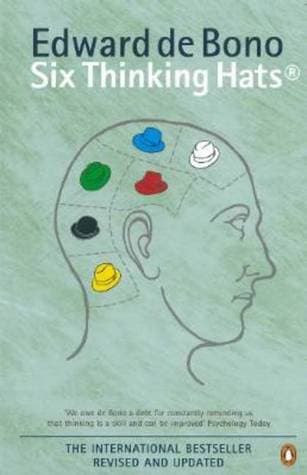
Six Thinking Hats cover
Archivist's Choice

Six Thinking Hats

Edward de Bono (1991)

Genre

Business / Productivity / Leadership / Philosophy / Self-Help

Reading Time

180 min

Key Themes

See below

Track Your Reading

Sign in to track this book

Use a different 'thinking hat' for each decision-making stage to make meetings focused and productive, and to help groups reach quick, unified conclusions.

Core Idea

Edward de Bono's "Six Thinking Hats" presents a method for structured, parallel thinking. This method improves decision-making, problem-solving, and idea generation. It assigns different thought modes to six colored hats: White (facts), Red (emotions), Black (caution), Yellow (optimism), Green (creativity), and Blue (process control). The book suggests deliberately separating thinking styles. This system prevents common problems of reactive, argumentative thinking. It allows individuals and groups to focus on one problem aspect at a time. This ensures complete analysis, reduces conflict, and creates a more productive and objective collaborative environment. The main idea is that by consciously directing attention through these distinct 'hats,' one can systematically explore all parts of an issue, leading to better decisions and new solutions.
Reading time
180 min
Difficulty
Medium
✓ Read this if...
You want a practical, structured framework to improve individual and group decision-making, foster creativity, and reduce conflict in discussions and meetings.
✗ Skip this if...
You prefer a purely theoretical discussion of cognitive processes without a prescriptive, actionable methodology, or you are looking for a quick fix without committing to a new thinking discipline.

Core idea

The central argument and framework that powers the entire book.

Edward de Bono's "Six Thinking Hats" presents a method for structured, parallel thinking. This method improves decision-making, problem-solving, and idea generation. It assigns different thought modes to six colored hats: White (facts), Red (emotions), Black (caution), Yellow (optimism), Green (creativity), and Blue (process control). The book suggests deliberately separating thinking styles. This system prevents common problems of reactive, argumentative thinking. It allows individuals and groups to focus on one problem aspect at a time. This ensures complete analysis, reduces conflict, and creates a more productive and objective collaborative environment. The main idea is that by consciously directing attention through these distinct 'hats,' one can systematically explore all parts of an issue, leading to better decisions and new solutions.

At a glance

Reading time

180 min

Difficulty

Medium

Read this if...

You want a practical, structured framework to improve individual and group decision-making, foster creativity, and reduce conflict in discussions and meetings.

Skip this if...

You prefer a purely theoretical discussion of cognitive processes without a prescriptive, actionable methodology, or you are looking for a quick fix without committing to a new thinking discipline.

Key Takeaways

1

Structured Parallel Thinking

Direct attention to one mode of thinking at a time to avoid unproductive arguments.

Quote

The main difficulty of thinking is confusion. We try to do too much at once. Emotions, information, logic, hope and creativity all crowd in on us. It is like juggling too many balls.

De Bono argues that traditional adversarial debate, where people defend their views at once, is ineffective. It often leads to ego-driven conflict instead of collaborative problem-solving. The Six Thinking Hats method uses 'parallel thinking,' a structured approach where everyone focuses on the same problem aspect (e.g., facts, feelings, benefits, risks) at the same time. This separation of thinking modes prevents the confusion of processing many views at once. It allows for a more complete exploration of each aspect before combining ...

Supporting evidence

De Bono's core premise is that the human brain, while capable of complex thought, struggles when forced to engage in multiple, often conflicting, thinking processes simultaneously. He contrasts this with the focused efficiency achieved when all participants are 'wearing the same hat' at a given moment.

Apply this

Before a meeting, assign a sequence of hats for discussion (e.g., White, then Red, then Yellow, then Black, then Green, then Blue). During the meeting, explicitly state which hat everyone is wearing and enforce adherence to that thinking mode for a set period. This ensures all relevant angles are explored systematically.


parallel-thinkingstructured-decision-makingmeeting-facilitation
2

The White Hat: Facts First

Prioritize objective information gathering before opinions or interpretations.

Quote

The White Hat is concerned with objective facts and figures. It is about information, not interpretation.

The White Hat is for objective information. When 'wearing' the White Hat, participants focus only on available data, statistics, past trends, and known facts. This phase does not include opinions, interpretations, or arguments. The goal is to build a common, factual base for discussion. This ensures everyone understands the situation the same way. By separating facts from feelings or judgments, the White Hat helps prevent early conclusions based on incomplete or biased information. It promotes a more reliable and evidence-based decisi...

Supporting evidence

De Bono emphasizes that much conflict arises from differing factual bases or assumptions. By dedicating a specific phase to pure information gathering, groups can identify gaps in knowledge, clarify misunderstandings, and establish a shared reality before moving to more subjective analyses.

Apply this

Start a critical discussion with the White Hat. Ask questions like: 'What information do we have?' 'What information do we need?' 'How can we get it?' 'What are the facts?' Document all known facts and identify information gaps before moving to other hats.

data-collectionobjective-analysisinformation-gathering
3

The Red Hat: Emotions and Intuition

Legitimize and express feelings, hunches, and intuition without justification.

Quote

The Red Hat is for feelings, intuitions, and hunches. You do not have to explain or justify these feelings.

The Red Hat provides a place for emotions, intuition, and gut feelings. This is a key part of decision-making that is often overlooked. De Bono argues that emotions are always present and affect thought. In traditional settings, they are often hidden or disguised as logic, leading to subtle biases and unaddressed concerns. By letting participants openly express their feelings – 'I like this idea,' 'I have a bad feeling about this,' 'My intuition says no' – without needing immediate reasons, the Red Hat recognizes the human element. Th...

Supporting evidence

De Bono highlights that while emotions are often seen as antithetical to 'good' decision-making, they are an integral part of human cognition. Suppressing them doesn't eliminate their influence; it just makes them harder to address. The Red Hat brings them to the surface constructively.

Apply this

After presenting facts (White Hat), dedicate a few minutes for Red Hat thinking. Ask, 'What are your gut feelings about this?' 'How does this make you feel?' Encourage brief, unfiltered expressions, emphasizing that no justification is needed. Then, move on.

emotional-intelligenceintuitiongroup-dynamics
4

The Yellow Hat: Optimism and Value

Focus on the positives, benefits, and value proposition of an idea.

Quote

The Yellow Hat is optimistic and covers hope and positive thinking. It looks for the values and benefits.

The Yellow Hat is for constructive thinking. It explores the positives, benefits, and value of an idea or proposal. This is not simple optimism, but a deliberate effort to find worth, advantages, and potential for success. Many people tend to criticize, but the Yellow Hat makes a conscious shift to identify why something could work, what opportunities it offers, and what good outcomes might happen. This positive exploration is important for innovation and for ensuring good ideas are not dismissed too soon because of too much focus o...

Supporting evidence

De Bono notes that critical thinking is often easier and more common than constructive thinking. The Yellow Hat counteracts this natural bias by demanding a focused effort on identifying strengths and opportunities, ensuring a balanced perspective.

Apply this

When evaluating an idea, dedicate time for Yellow Hat thinking. Ask: 'What are the benefits?' 'What value does this create?' 'Who would profit from this?' 'What are the opportunities?' 'Why might this work?' Brainstorm all potential positives, even if they seem minor.

positive-thinkingopportunity-identificationvalue-proposition
5

The Black Hat: Caution and Risk Assessment

Identify potential problems, risks, and negative consequences critically.

Quote

The Black Hat is the hat of caution. It points out the difficulties, the weaknesses, the dangers and the risks.

The Black Hat is the critical hat. It focuses on possible problems, risks, weaknesses, and negative results. It identifies why an idea might fail, what obstacles exist, and what ethical or practical issues could arise. This is not being negative for its own sake, but a careful, logical assessment of possible problems to avoid mistakes. The Black Hat is essential for risk management and for creating strong solutions that foresee and reduce problems. However, it must be used constructively, after Yellow Hat thinking, to avoid stopping g...

Supporting evidence

De Bono acknowledges the importance of critical thinking but argues it's often misapplied or used out of sequence. The Black Hat provides a structured channel for this vital skepticism, preventing it from dominating the entire discussion and allowing its insights to be properly considered.

Apply this

After exploring benefits (Yellow Hat), shift to Black Hat thinking. Ask: 'What are the risks?' 'What could go wrong?' 'What are the weaknesses?' 'What are the potential downsides?' 'Is this feasible?' This helps in proactively identifying and addressing challenges.

risk-managementcritical-thinkingproblem-identification
6

The Green Hat: Creativity and New Ideas

Generate new options, alternatives, and creative solutions.

Quote

The Green Hat is for creative thinking. It is where we look for new ideas, alternatives, possibilities and solutions.

The Green Hat is for creative thinking. It involves brainstorming new ideas, exploring alternatives, and finding new solutions. When wearing this hat, participants are encouraged to think differently, question assumptions, and generate many new concepts without judgment. This is the place for 'lateral thinking' – breaking from old patterns to find new approaches. The Green Hat helps overcome impasses, develop breakthrough strategies, and ensures that a problem is not just solved, but possibly solved in a better, more creative way. It ...

Supporting evidence

De Bono's concept of 'lateral thinking' is central here. He argues that traditional logical thinking (vertical thinking) is excellent for refining ideas, but less effective for generating truly new ones. The Green Hat provides a deliberate mechanism for lateral exploration.

Apply this

When facing a challenge or needing fresh perspectives, put on the Green Hat. Use brainstorming techniques, 'what if' scenarios, or random word association to generate new ideas. Encourage divergent thinking and avoid criticism during this phase.

lateral-thinkingbrainstorminginnovationcreative-problem-solving
7

The Blue Hat: Process Control and Management

Oversee the thinking process, set agendas, and summarize conclusions.

Quote

The Blue Hat is concerned with the control and organization of the thinking process itself. It is the thinking about thinking.

The Blue Hat is the 'control hat.' It manages the thinking process itself. The facilitator or leader usually wears it, but anyone can use it. The Blue Hat sets the agenda, defines the focus, keeps discussion on track, summarizes what has been done, and decides which hat to wear next. It is the group's self-awareness. It ensures the process is efficient, productive, and leads to clear results. Without the Blue Hat, discussions can easily become chaotic, losing the benefits of the other hats. It ensures the other thinking modes are used...

Supporting evidence

De Bono highlights that even brilliant individual thinkers can struggle in groups without clear process management. The Blue Hat formalizes this role, ensuring that the group's collective intelligence is applied systematically rather than haphazardly.

Apply this

As a meeting facilitator, you primarily wear the Blue Hat. Begin by setting the agenda and the hat sequence. During the meeting, intervene to guide the group ('Let's switch to the Black Hat now'), summarize progress, and ensure everyone understands the current focus. Conclude by outlining next steps.

meeting-facilitationprocess-managementmeta-cognitionagenda-setting
8

Improved Decision Quality & Speed

Structured thinking leads to more comprehensive, faster, and better-accepted decisions.

Quote

The purpose of the Six Thinking Hats is to simplify thinking by allowing a thinker to deal with one thing at a time. All problems are simpler if we do not try to do too much at once.

The main benefit of the Six Thinking Hats is a big improvement in decision quality and speed. By systematically exploring facts, feelings, positives, negatives, and creative alternatives, groups ensure all important angles are considered without the usual conversational mess. This complete approach reduces the chance of missing important information or possible problems. Also, by separating thinking modes, unproductive arguments are minimized. Group agreement is easier to reach because everyone has had a chance to share their view in ...

Supporting evidence

De Bono's work with numerous corporations and governments demonstrates that organizations adopting the Hats method report significant reductions in meeting times and an increase in actionable, well-supported decisions. For example, Siemens reportedly cut meeting times by 50% using this method.

Apply this

Implement the Six Hats in your next important team meeting. Observe how quickly the group moves through complex issues and how much more satisfied participants are with the clarity of outcomes. Track meeting duration and decision acceptance rates over time.

decision-making-efficiencyconsensus-buildingproblem-solving-effectiveness
9

Reduces Conflict and Ego

Depersonalize ideas by focusing on the hat, not the individual.

Quote

The hats allow us to switch roles, to explore different perspectives, and to do so without ego getting in the way.

A powerful, often overlooked, benefit of the Six Thinking Hats is its ability to make discussions less personal and reduce ego-driven conflict. When someone points out a negative, they are not 'being negative' but 'wearing the Black Hat.' When they offer a wild idea, they are 'wearing the Green Hat.' This change in language and mindset allows people to express views that might otherwise seem confrontational or unhelpful. It creates a safe space for different views by presenting contributions as part of a group exploration rather than ...

Supporting evidence

De Bono observed that in traditional meetings, individuals often become identified with their ideas, making criticism feel like a personal attack. The Hats provide a psychological buffer, allowing people to 'try on' different perspectives without owning them permanently.

Apply this

When conflict arises, gently remind participants, 'Let's remember we're all wearing the Black Hat right now to explore risks, not to attack ideas personally.' Or, 'Let's put on our Yellow Hats and see if we can find any positives in this challenging situation.'

conflict-resolutionteam-collaborationego-management

Critical analysis

Notable Quotes

The main difficulty in thinking is the confusion of what we are trying to do.

Introducing the need for structured thinking.

The purpose of the Six Thinking Hats is not to label thinkers, but to label thinking.

Explaining the core principle of the method.

White Hat thinking is concerned with facts, figures, information, and questions.

Describing the function of the White Hat.

Red Hat thinking is about feelings, intuition, hunches, and emotions.

Describing the function of the Red Hat.

Black Hat thinking is about caution, risks, difficulties, and why something may not work.

Describing the function of the Black Hat.

Yellow Hat thinking is about benefits, advantages, value, and why something will work.

Describing the function of the Yellow Hat.

Green Hat thinking is about creativity, new ideas, alternatives, and possibilities.

Describing the function of the Green Hat.

Blue Hat thinking is about process control, managing the thinking, and the agenda.

Describing the function of the Blue Hat.

Thinking is the ultimate human resource.

Emphasizing the importance of effective thinking.

You cannot dig a hole in a different place by digging the same hole deeper.

Arguing for the need for new approaches to problem-solving.

The greatest danger in life is not taking too many risks, but taking too few.

Encouraging a proactive approach to ideas and possibilities.

The quality of our future depends on the quality of our thinking.

Highlighting the long-term impact of thinking skills.

We spend 80% of our time on what is wrong and 20% on what can be done.

Critiquing traditional problem-solving approaches.

The hats are not categories of people, but modes of thinking.

Reiterating a fundamental distinction of the method.

Quiz

Test Your Knowledge

Ready to see how well you understood this book? Take our interactive quiz with 10 questions.

10
Questions
~5
Minutes
?
Best Score

Key Questions (FAQ)

The Six Thinking Hats method is a simple, powerful technique developed by Edward de Bono that categorizes different modes of thinking into six distinct 'hats'. Each hat represents a specific type of thinking, helping individuals and groups to structure their thoughts, improve communication, and make more effective decisions by focusing on one aspect at a time.

About the author