BookBrief
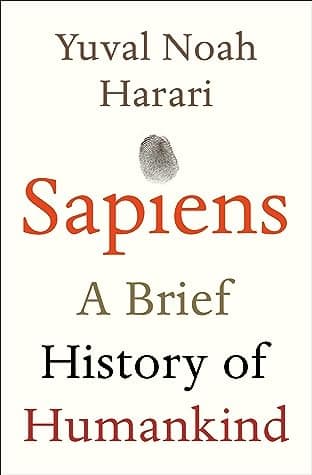
Sapiens: A Brief History of Humankind cover
Archivist's Choice

Sapiens: A Brief History of Humankind

Yuval Noah Harari (2011)

Genre

Psychology / History / Science / Philosophy

Reading Time

15-20 hours (estimated for 498 pages)

Key Themes

See below

Track Your Reading

Sign in to track this book

Sapiens tells the story of Homo sapiens, showing how our ability to create shared fictions helped us go from an ordinary ape to the planet's main species, changing Earth and our future.

Core Idea

Yuval Noah Harari's "Sapiens" argues that Homo sapiens' unique ability to create and believe in shared fictions (myths, gods, nations, money, human rights) has been the main reason for our species' success. This 'cognitive revolution' allowed us to work together in large groups, something other animals cannot do. Harari follows humanity's path from a simple ape to a global leader, looking at how agricultural, monetary, and scientific revolutions, while bringing progress, have often reduced individual happiness, damaged the environment, and caused suffering for other species. The book questions common ideas about history, progress, and the future, asking if our constant search for power and knowledge will make the world better or change what it means to be human.
Reading time
15-20 hours (estimated for 498 pages)
Difficulty
Medium
✓ Read this if...
You are curious about the grand sweep of human history, from our origins to our potential future, and enjoy challenging your fundamental assumptions about society, religion, and economics.
✗ Skip this if...
You prefer highly detailed historical accounts focusing on specific periods or events, or if you are uncomfortable with broad generalizations and speculative philosophical arguments.

Core idea

The central argument and framework that powers the entire book.

Yuval Noah Harari's "Sapiens" argues that Homo sapiens' unique ability to create and believe in shared fictions (myths, gods, nations, money, human rights) has been the main reason for our species' success. This 'cognitive revolution' allowed us to work together in large groups, something other animals cannot do. Harari follows humanity's path from a simple ape to a global leader, looking at how agricultural, monetary, and scientific revolutions, while bringing progress, have often reduced individual happiness, damaged the environment, and caused suffering for other species. The book questions common ideas about history, progress, and the future, asking if our constant search for power and knowledge will make the world better or change what it means to be human.

At a glance

Reading time

15-20 hours (estimated for 498 pages)

Difficulty

Medium

Read this if...

You are curious about the grand sweep of human history, from our origins to our potential future, and enjoy challenging your fundamental assumptions about society, religion, and economics.

Skip this if...

You prefer highly detailed historical accounts focusing on specific periods or events, or if you are uncomfortable with broad generalizations and speculative philosophical arguments.

Key Takeaways

1

The Power of Fictional Realities

Our unique ability to believe in shared myths allowed Homo sapiens to dominate.

Quote

Any large-scale human cooperation – whether a modern state, a medieval church, an ancient city or an archaic tribe – is rooted in common myths that exist only in people’s collective imagination.

Harari says that the main thing that makes Homo sapiens different from all other species is our ability to create 'fictional realities' or 'inter-subjective myths.' Unlike other animals that can only talk about real things, humans can create and believe in shared stories about things that do not physically exist: gods, nations, money, human rights, companies. These myths are not lies; they are shared fictions that, because everyone believes them, become very powerful. They allow many strangers to work together flexibly. This ability t...

Supporting evidence

The shift during the Cognitive Revolution, where Sapiens developed language capable of discussing not just lions and rivers, but also spirits and tribal laws. This enabled the creation of larger, more cohesive groups than Neanderthals could manage.

Apply this

When trying to build or understand large-scale organizations, recognize the foundational myths (e.g., company values, national identity, legal frameworks) that bind individuals together. To inspire collective action, articulate a compelling shared story.


cognitive-revolutionintersubjective-realitycollective-fiction
2

The Agricultural Revolution: History's Biggest Fraud

What seemed like progress led to a worse life for the average human and ecological devastation.

Quote

The Agricultural Revolution was history’s biggest fraud. Who was responsible? Neither kings nor priests nor merchants. The culprits were a handful of plant species, including wheat, rice and potatoes.

Harari states that the Agricultural Revolution, often seen as humanity's biggest step forward, was actually a major setback for the average person. Instead of making life easier, it led to constant hard work, worse diets, more disease, and greater social inequality. While it allowed for more people, the individual farmer often worked harder than their hunter-gatherer ancestors, ate a less varied diet, and was more likely to face famine. Also, this revolution started a human drive to change and control nature, causing suffering for man...

Supporting evidence

Archaeological evidence showing that early agriculturalists had higher rates of disease, malnutrition, and skeletal stress compared to their foraging counterparts. The example of wheat 'domesticating' humans rather than the other way around, forcing them into a sedentary, laborious lifestyle to care for it.

Apply this

Question narratives of 'progress' that focus solely on population growth or technological advancement. Consider the hidden costs and unintended consequences of societal shifts, especially concerning individual well-being and ecological impact.

agricultural-revolutionsedentary-lifestylehuman-enslavement
3

The Illusion of Progress and Happiness

Despite immense advancements, it's unclear if modern humans are happier than our ancestors.

Quote

History’s only iron law is that 'things change.' And the only thing we can be certain of is that our current beliefs and ways of life will soon appear to us as antiquated and strange as those of the Sumerians.

Harari looks closely at the idea that historical progress always makes people happier. He points out that while we have more material wealth, longer lives, and less violence than in many past times, it is very hard to measure how happy people were thousands of years ago. Hunter-gatherers might have had richer social lives, more free time, and less worry about the future, even with their physical difficulties. The constant desire for more, driven by consumerism, might leave us always feeling unsatisfied. Harari suggests that happiness ...

Supporting evidence

Comparison of hunter-gatherer diets and leisure time with the arduous, monotonous work and limited diet of early farmers. Modern psychological studies on the 'hedonic treadmill,' where increased wealth or comfort often only temporarily boosts happiness before expectations reset.

Apply this

Re-evaluate personal and societal definitions of 'success' and 'progress.' Prioritize experiences, community, and meaning over the accumulation of material goods. Be wary of the consumerist cycle that promises happiness through acquisition.

hedonic-treadmillsubjective-wellbeingconsumerism
4

The Arbitrary Nature of Justice and Rights

Concepts like human rights are powerful fictions, not biological realities.

Quote

There are no gods in the universe, no nations, no money, no human rights, no laws, and no justice outside the common imagination of human beings.

Harari argues that many of our most important ideas (human rights, equality, justice) are not natural biological truths or divine rules. Instead, they are powerful 'inter-subjective myths' created and kept alive by human agreement. While they help us work together in large groups and create social order, their truth depends entirely on collective belief. There is no scientific proof for 'rights' in our DNA or the laws of physics. Understanding that they are fictional does not make them less important; instead, it shows that we can sha...

Supporting evidence

The Declaration of Independence's claim that 'all men are created equal' and endowed with 'certain unalienable Rights' is contrasted with biological reality, where humans are not born equal in abilities or circumstances. The historical evolution of rights, from divine mandates to secular ideals, demonstrating their constructed nature.

Apply this

Engage critically with prevailing narratives of justice and rights, recognizing their human origins and potential for redefinition. Advocate for the continuous re-evaluation and improvement of these shared fictions to better serve humanity, rather than treating them as immutable truths.

human-rightssocial-constructcollective-imagination
5

The Path to Global Unity: Empires and Money

Empires and monetary systems were crucial, albeit often brutal, forces for human unification.

Quote

Money is the most universal and most efficient system of mutual trust ever devised.

Harari identifies two main forces that gradually broke down tribal and local divisions, leading to one global human culture: empires and money. Empires, often formed through conquest and violence, brought together different peoples, cultures, and lands. They spread common laws, governments, and languages across large areas. Money, on the other hand, created a way for complete strangers to exchange goods and trust each other, going beyond cultural, religious, and political differences. Its ability to be exchanged for anything allowed f...

Supporting evidence

The Roman Empire's ability to integrate diverse populations across Europe and the Middle East under a single legal and administrative system. The invention of coinage and its ability to facilitate trade between people who spoke different languages and worshipped different gods.

Apply this

Understand how global systems (economic, political) emerged from historical forces that prioritized scale and integration, even at the cost of local autonomy or diversity. Recognize the power of abstract systems like currency in fostering trust and cooperation.

globalizationimperialismeconomic-unification
6

The Scientific Revolution: Ignorance as a Virtue

The admission of ignorance, coupled with observation and mathematics, fueled unprecedented progress.

Quote

The Scientific Revolution was not a revolution of knowledge but above all a revolution of ignorance. The great discovery that launched the Scientific Revolution was the discovery that humankind does not know the answer to its most important questions.

Harari says that the Scientific Revolution was not just about new discoveries, but a big change in how we seek knowledge. Older ways of thinking often claimed to know all basic truths, leaving little room for scientific study. The scientific method, however, started with the idea that we do not know everything and that our current understanding might be wrong. This humility, along with careful observation, experiments, and using math, led to a huge increase in knowledge and new technologies. It shifted authority from old texts and rel...

Supporting evidence

The shift from medieval scholasticism, which sought to reconcile all knowledge with existing religious texts, to the scientific method exemplified by figures like Isaac Newton, who used observation and mathematics to derive laws of nature, often challenging existing beliefs.

Apply this

Cultivate intellectual humility and a willingness to admit 'I don't know.' Embrace continuous learning and critical thinking, grounding beliefs in evidence rather than tradition or dogma. Apply iterative, experimental approaches to problem-solving.

scientific-methodepistemologyempirical-evidence
7

Capitalism's Feedback Loop: Credit and Growth

Trust in future prosperity, fueled by credit, became the engine of the Scientific Revolution and empire.

Quote

Credit is the economic engine of the world. It enables us to build the present at the expense of the future.

Harari points out how important credit was in powering the Scientific Revolution and the age of empire. Before modern economies, people often viewed the future with doubt, thinking resources were limited. The capitalist revolution, however, was based on the idea that future resources would be more plentiful than current ones, thanks to science and technology. This hope allowed for credit, letting business owners fund big projects, scientists do expensive research, and empires pay for large expeditions and wars. The money made from the...

Supporting evidence

The Dutch financing of global trade companies (e.g., VOC) and scientific expeditions through public credit. The British Empire's ability to fund wars and industrialization through its sophisticated financial system and national debt.

Apply this

Understand the power of future-oriented thinking and trust in economic systems. Recognize how investment in innovation and infrastructure, even through debt, can drive exponential growth and societal change. Be aware of the risks associated with unchecked credit and growth assumptions.

capitalismcredit-economyscientific-funding
8

The Plight of Domesticated Animals

Human success came at an immense, often overlooked, cost to other species.

Quote

The Agricultural Revolution certainly enlarged the sum total of food at the disposal of humankind, but the extra food did not translate into better diets or more leisure. Rather, it translated into a population explosion and pampered elites. But above all, it translated into a worse life for most individual humans, and an even worse life for domesticated animals.

Harari makes us face the moral problems of human control, especially concerning domesticated animals. He argues that while human numbers grew, the lives of billions of animals like chickens, cows, and pigs became very bad. Their lives were reduced to serving human needs, often with much suffering, genetic changes, and lives without natural instincts or freedom. From an evolutionary view, their 'success' in terms of population numbers is a sad joke, as it comes at the cost of individual well-being and a complete loss of control over th...

Supporting evidence

The description of modern factory farming practices, where animals are confined, bred for specific traits that cause suffering (e.g., chickens too heavy to stand), and slaughtered en masse. The historical account of domestication, which often involved brutal control and selective breeding.

Apply this

Confront the ethical implications of our consumption choices and agricultural systems. Consider the suffering of animals as a direct consequence of human history and our perceived right to dominate other species. Advocate for more humane and sustainable practices.

animal-welfarefactory-farmingspeciesism
9

The Biotechnical Future: Redefining Humanity

Emerging technologies threaten to fundamentally alter Homo sapiens, potentially creating new species.

Quote

We are on the verge of replacing natural selection with intelligent design, not the intelligent design of some god above the clouds, but our intelligent design.

Harari looks into the future, saying that Homo sapiens, as we know ourselves, will likely change, not by dying out, but by redefining ourselves through biotechnology, bionic engineering, and artificial intelligence. We are getting the power to change life itself, to redesign our bodies, minds, and even our feelings. This brings up big ethical questions: Who will control these technologies? Will they cause great inequality, creating 'superhumans' and 'useless' groups? Will we accidentally destroy what it means to be human in our search...

Supporting evidence

Advances in genetic engineering (CRISPR), brain-computer interfaces, and AI that could potentially enhance human cognitive and physical abilities or even create artificial consciousness.

Apply this

Engage in critical dialogue about the ethical implications of emerging biotechnologies. Consider the potential for both unprecedented human flourishing and radical societal division. Advocate for responsible innovation and equitable access to future enhancements.

genetic-engineeringartificial-intelligencepost-humanism
10

The Question of Meaning and Purpose

Despite our power, we still struggle to define what we want and what makes life meaningful.

Quote

We are more powerful than ever before, but have very little idea what to do with all that power.

Harari ends with a serious thought: while humanity has gained great power to shape the world and ourselves, we mostly lack a clear idea of what we truly want, or what makes life meaningful. We have learned 'how' to advance technologically and scientifically but still do not know 'why.' Our search for power and comfort has often caused unexpected suffering for ourselves and other species. As we are about to change life itself, this lack of a shared goal or guiding moral framework becomes very dangerous. The main challenge for Homo sapi...

Supporting evidence

The historical examples of the Agricultural Revolution and the rise of capitalism, where seemingly beneficial advancements led to unforeseen negative consequences for human well-being and the environment. The current global crises (climate change, inequality) despite immense technological capability.

Apply this

Prioritize philosophical inquiry and ethical considerations alongside scientific and technological advancement. Foster collective dialogue about humanity's long-term goals and values. Seek a deeper understanding of personal and collective purpose beyond material acquisition or power.

existential-crisismeaning-of-lifeethical-governance

Critical analysis

Notable Quotes

The real difference between us and chimpanzees is the mysterious glue that enables millions of humans to cooperate effectively.

Discussing the cognitive revolution and human cooperation.

Money is the most universal and most efficient system of mutual trust ever devised.

Explaining the role of money in human societies.

Happiness does not really depend on objective conditions of either wealth, health or even community. Rather, it depends on the correlation between objective conditions and subjective expectations.

Analyzing the pursuit of happiness in modern society.

The Agricultural Revolution was history's biggest fraud.

Critiquing the transition from foraging to farming.

Large numbers of strangers can cooperate successfully by believing in common myths.

Describing how shared beliefs enable large-scale human cooperation.

The most important impact of writing on human history is precisely this: it has gradually changed the way humans think and view the world.

Reflecting on the cognitive effects of written language.

Biology enables, culture forbids.

Contrasting biological capabilities with cultural constraints.

We study history not to know the future but to widen our horizons, to understand that our present situation is neither natural nor inevitable.

Arguing for the value of historical perspective.

The romantic contrast between modern industry that 'destroys nature' and our ancestors who 'lived in harmony with nature' is groundless.

Challenging nostalgic views of pre-modern human ecology.

Consumers are constantly bombarded with advertisements whose main message is that life is not worth living unless you buy this or that product.

Critiquing consumer culture and its psychological effects.

The capitalist-consumerist ethic is revolutionary in another respect. Most previous ethical systems presented people with a pretty tough deal.

Comparing modern economic ethics with historical moral systems.

The human collective knows far more today than did the ancient bands. But at the individual level, ancient foragers were the most knowledgeable and skillful people in history.

Contrasting collective vs. individual knowledge across history.

We did not domesticate wheat. It domesticated us.

Reversing the traditional narrative of agricultural domestication.

The romantic contrast between modern industry that 'destroys nature' and our ancestors who 'lived in harmony with nature' is groundless.

Challenging nostalgic views of pre-modern human ecology.

Quiz

Test Your Knowledge

Ready to see how well you understood this book? Take our interactive quiz with 10 questions.

10
Questions
~5
Minutes
?
Best Score

Key Questions (FAQ)

Sapiens traces the entire history of Homo sapiens, from our origins among multiple human species to modern civilization. It examines key revolutions (Cognitive, Agricultural, Scientific) that shaped societies, beliefs, and structures like money, laws, and nations, blending insights from history, biology, and economics.

About the author