“For who would not be a Highlander were it but for the sake of the name?”
— Frank Osbaldistone reflects on the romantic image of the Highlanders.

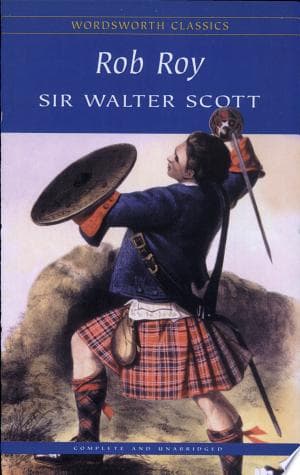
Walter Scott (1995)
Genre
General
Reading Time
15-20 hours (based on 404 pages at average reading speed)
Key Themes
See below
Sign in to track this book
In the Scottish Highlands, a young Englishman's journey into a world of cattle rustling, clan loyalties, and Jacobite plots forces him to confront his courage and the power of the outlaw, Rob Roy MacGregor.
Francis 'Frank' Osbaldistone, the main character, is a young Englishman who loves poetry and dislikes business. His father, William Osbaldistone, a rich London merchant, disinherits him for not joining the family business. Frank is sent to Osbaldistone Hall in Northumberland, the home of his father's estranged brother, Sir Hildebrand Osbaldistone. On his journey north, Frank meets Andrew Fairservice, a Presbyterian clergyman who becomes his guide. He also has a brief, unsettling meeting with a Highlander, later revealed as Rob Roy MacGregor.
At Osbaldistone Hall, Frank finds a household run by his rough uncle, Sir Hildebrand, and his six loud, fox-hunting cousins. The only refined person is Diana Vernon, Sir Hildebrand's beautiful, intelligent, and independent niece. She is a governess and intellectual companion to Frank. Diana, a staunch Catholic and Jacobite, quickly impresses Frank with her wit. She becomes his confidante, warning him about dangers and secrets in the house, especially concerning his cousin, Rashleigh Osbaldistone, who is also there.
Frank's cousin, Rashleigh Osbaldistone, a cunning schemer, had been sent by Frank's father to manage the family's finances in London. However, Rashleigh, driven by jealousy and ambition, betrays their trust. He steals a large sum of money in the form of important bills of exchange, which are vital to William Osbaldistone's business. This act of theft threatens to ruin Frank's father and cause financial disaster. Frank feels responsible and guilty, believing his initial refusal to join the business made the family vulnerable.
Determined to recover the stolen bills and clear his father's name, Frank, with Andrew Fairservice, travels to Glasgow, Scotland, where Rashleigh is thought to have fled. In Glasgow, Frank encounters the city's complex political and social currents. He meets Bailie Nicol Jarvie, a shrewd Glasgow merchant, who becomes an unexpected ally. During this pursuit, Frank formally meets Rob Roy MacGregor, the Highland outlaw, who first appears as a cattle drover but shows himself to be a powerful and influential man, living outside the law but following his own code of honor.
Rob Roy, interested in Frank's situation and perhaps seeing a chance to help himself, takes an interest in Frank's quest. He offers Frank vague advice and promises of help, hinting at his knowledge of the Scottish underworld and his connection to the events. Meanwhile, Rashleigh, having fled to Scotland, is shown to be involved in Jacobite plots, using the stolen money to fund a rebellion against the government. He tries to manipulate events further, including using Diana Vernon in his schemes.
Political tensions rise, leading to the 1715 Jacobite Rising, a historical event in the novel. This rebellion directly affects Frank and Diana. It is revealed that Diana is not just Sir Hildebrand's niece, but the daughter of a Jacobite nobleman, and deeply committed to the Stuart cause. Her guardian, Father Vaughan, is a key figure in the conspiracy. Her family's involvement in the uprising, and her own strong beliefs, put her in a difficult position, complicating her relationship with Frank and showing the dangers they both face.
During the chaos of the uprising and his pursuit of Rashleigh, Frank is captured by government troops, who suspect him of being a Jacobite supporter due to his connection with Diana and the Osbaldistones. Imprisoned and facing severe punishment, Frank's situation seems hopeless. However, Rob Roy, showing his loyalty and skill, plans a daring rescue. Leading his clan, the MacGregors, Rob Roy ambushes the soldiers, freeing Frank and strengthening their bond. This event shows Rob Roy's power and his role as a protector.
Frank, guided by Rob Roy, pursues Rashleigh into the Scottish Highlands. A tense confrontation occurs where Rashleigh, cornered, tries to escape with the bills. With Frank's determination and Rob Roy's help, the stolen bills of exchange are finally recovered from Rashleigh. This recovery is a turning point, as it means Frank's father's business can be saved. The scene shows the conflict between Frank's English legal approach and Rob Roy's more direct, often violent, methods of justice in the Highlands.
Despite helping Frank, Rob Roy remains an outlaw, pursued by the Duke of Montrose and other authorities. He continues to avoid capture, relying on his intelligence and his clan's loyalty, but his future is uncertain. Meanwhile, because of her family's involvement in the failed Jacobite Rising, Diana Vernon must flee Scotland to avoid capture. She says a sad farewell to Frank, unable to openly express her feelings due to her circumstances and religious vows. She leaves for a convent abroad, leaving Frank heartbroken.
Frank returns to Osbaldistone Hall to find a changed environment. His uncle, Sir Hildebrand, and most of his cousins have died, either in the rebellion or from natural causes, leaving the estate in disarray. Through unexpected revelations, it is discovered that Diana Vernon, as the true heir, had made a will leaving the estate to Frank. With the family business saved and the Osbaldistone estate now his, Frank's future is secure. He takes on his new responsibilities, showing a maturity he lacked earlier, reflecting his growth through hardship.
After the bills are recovered and his father's business stabilizes, Frank fully reconciles with William Osbaldistone. His father, seeing Frank's new maturity, courage, and business sense, acknowledges his son's growth and accepts his choices. With the Osbaldistone family line at the Hall mostly gone, and Diana's generous will, Frank becomes the rightful heir to the Osbaldistone estate. He embraces his role as a responsible landowner, combining his intelligence and poetic sensibility with a practical understanding of his duties, fulfilling the destiny that began with his journey north.
The Protagonist
Frank transforms from an idealistic, somewhat naive youth into a responsible, courageous, and pragmatic man, capable of managing both his inherited estate and his own destiny.
The Supporting/Anti-hero
Rob Roy remains largely consistent in his character as an outlaw leader, his arc focused on his role as a catalyst and protector for Frank, and his enduring struggle against authority.
The Supporting/Love Interest
Diana's arc involves the revelation of her true identity and allegiances, culminating in her self-sacrificing departure to uphold her religious vows and protect her family's legacy.
The Antagonist
Rashleigh's arc is one of escalating villainy, culminating in his downfall and ultimate demise, a consequence of his own treacherous actions.
The Supporting
Andrew Fairservice remains largely consistent, his arc demonstrating his pragmatic survival skills and eventual, if begrudging, loyalty to Frank.
The Supporting
Bailie Jarvie's arc involves his increasing involvement in Frank's quest and his willingness to risk his own safety to aid his kinsman, Rob Roy.
The Supporting
William Osbaldistone's arc moves from paternal disappointment and disinheritance to a full reconciliation and acceptance of his son's capabilities and choices.
The Supporting
Sir Hildebrand's arc is largely static, reflecting the unchanging nature of his character, culminating in his death which clears the path for Frank's inheritance.
The novel explores the tension between formal legal systems and a more personal, often violent, idea of justice. Rob Roy, an outlaw, operates outside the law, yet he follows a strict code of honor and justice, especially in avenging wrongs against his family or those he protects. Frank, initially relying on legal means, learns that in the Highlands, justice often comes through direct action and clan loyalty, as seen when Rob Roy recovers the stolen bills. This theme questions the effectiveness and morality of different forms of justice.
““Show me a man that can follow a cause through with a stout heart, and I will show you a man that I would rather trust than a dozen of your half-hearted, double-faced fellows.””
A main theme is the contrast between England's ordered, commercial, and legal society (represented by Frank and his father) and the wild, feudal, clan-based society of the Scottish Highlands (represented by Rob Roy and his people). Frank's journey is a cultural awakening, as he learns the unfamiliar customs, dialects, and moral codes of Scotland. This clash appears in different approaches to problem-solving, ideas of honor, and political loyalties during the Jacobite Rising, showing the historical tensions between the two nations.
““You are a young man, sir, of an excellent disposition, but your education has been too much among the English; you have not yet learned to distinguish between true honour and false.””
Many characters struggle with the conflict between personal desires and their duties. Frank first prioritizes his poetry over his duty to join the family business, leading to his disinheritance. Diana Vernon is torn between her love for Frank and her duty to her family's Jacobite cause and religious vows, ultimately choosing the latter. Rob Roy also balances his duty to his clan and his personal vendettas with the dangers of being an outlaw. This theme explores the sacrifices people make for honor, family, and belief.
““I have duties, Mr. Osbaldistone, which are paramount to the feelings of a romantic girl.””
Frank Osbaldistone's journey is one of self-discovery and change. He starts as a somewhat naive, sheltered young man, unsure of his place. His experiences in Northumberland and the Highlands, his encounters with betrayal, danger, and love, force him to lose his youthful idealism and accept responsibility. He changes from a poet into a man of action, able to lead and make difficult decisions, eventually accepting his inheritance and his role as a landowner. His identity is formed through hardship and his interactions with various characters.
““I had been accustomed to a life of quiet and study, and was now thrown into a scene of wild and lawless adventure.””
Loyalty, both family and political, and its opposite, betrayal, are central to the story. Rashleigh's betrayal of his family's trust starts the main plot, while Rob Roy's strong loyalty to his clan and his word, even as an outlaw, stands in contrast. Diana's loyalty to her Jacobite cause and her family's secrets dictates her choices. The novel explores the different forms loyalty can take – from Andrew Fairservice's practical loyalty to Rob Roy's and Diana's deep commitment – and the devastating results of its absence.
““There is a gude deal of ill-will about this business, and I am not a man to meddle with other folk’s quarrels.””
Frank's father disinherits him, forcing him on a journey that initiates the plot.
This is the inciting incident that propels Frank Osbaldistone from his comfortable, albeit stifling, life in London to the unfamiliar world of Osbaldistone Hall and eventually the Scottish Highlands. By cutting him off financially and sending him away, his father inadvertently sets in motion the chain of events that leads to Frank's maturation, his encounter with Rob Roy, and the recovery of the stolen funds. It acts as a classic 'call to adventure' for the protagonist, forcing him out of his comfort zone and into the heart of the conflict.
The financial documents embezzled by Rashleigh serve as the primary MacGuffin.
The stolen bills are the central MacGuffin of the novel, the tangible object that drives Frank's quest and fuels much of the plot's tension. Their recovery is essential for the survival of his father's business and Frank's honor. While the bills themselves are merely financial instruments, they represent much larger stakes: family reputation, financial security, and the consequences of betrayal. The pursuit of these bills forces Frank into dangerous situations and into alliance with Rob Roy, ultimately revealing the deeper political and personal conflicts at play.
A real historical event that serves as a dramatic backdrop and catalyst for character actions.
The 1715 Jacobite Rising is not merely a historical reference but a crucial plot device that intensifies the stakes and provides a dangerous context for the characters' actions. It directly impacts Diana Vernon's fate, reveals her family's allegiances, and places Frank in perilous situations. The rebellion allows for dramatic rescues, captures, and confrontations, highlighting the lawlessness of the Highlands and the political divisions of the era. It provides a grand, historical canvas against which the personal dramas of Frank, Diana, and Rob Roy are played out, making their individual struggles feel part of a larger, epic narrative.
A seemingly minor character who holds key information and reveals crucial plot twists.
Father Vaughan, Diana Vernon's guardian, initially appears as a somewhat shadowy and enigmatic figure. He serves as a plot device by holding crucial information about Diana's true identity, her family's Jacobite connections, and the legal intricacies of the Osbaldistone inheritance. His eventual revelations are pivotal in resolving several plot threads, including the true heir to the estate and Diana's future. He embodies the hidden secrets and complex allegiances that permeate the narrative, particularly within the Catholic and Jacobite communities.
“For who would not be a Highlander were it but for the sake of the name?”
— Frank Osbaldistone reflects on the romantic image of the Highlanders.
“There are some things, Osbaldistone, which are not to be trifled with, and of these I hold to be the feelings of a father.”
— Mr. Osbaldistone senior warns Frank about the seriousness of his duties.
“I was born a gentleman, and I will die a gentleman.”
— Rob Roy MacGregor asserts his inherent dignity despite his outlaw status.
“It's a hard world, friend, and a man must be prepared to shift for himself.”
— Bailie Nicol Jarvie offers pragmatic advice to Frank.
“A man that will not fight for his own hand, deserves to lose the use of it.”
— Rob Roy's perspective on self-reliance and defending oneself.
“Custom, which is to society what gravitation is to the universe, has taken a firm hold of the minds of men.”
— The narrator reflects on the power of tradition and social norms.
“There are some men who are born to trouble as the sparks fly upward.”
— A reflection on the inherent difficulties faced by certain individuals, possibly Rob Roy himself.
“The course of human life is like the waves of the sea – sometimes calm, sometimes tempestuous.”
— A general observation on the unpredictable nature of life's journey.
“It is not the fashion of our country to ask questions at our guests.”
— A Highlander's polite but firm way of deterring unwanted inquiries.
“Conscience, my dear friend, is a good monitor, but it is a very bad counsellor in the day of danger.”
— Bailie Nicol Jarvie suggests practicality over strict moralizing in difficult situations.
“The greatest misfortune that can befall a man, is to want a good name, or to lose it.”
— A commentary on the importance of reputation and honor.
“A man may be honest in his intentions, and yet be a rogue in his dealings.”
— A cynical but realistic view of human character and actions.
“The world is a stage, and all the men and women merely players.”
— A classic Shakespearean allusion used to describe the various roles people play.
“There's a gude deal of human natur' in man.”
— Bailie Nicol Jarvie's astute observation on the consistent traits of humanity.
Ready to see how well you understood this book? Take our interactive quiz with 10 questions.

Sir Walter Scott, 1st Baronet, was a Scottish historian, novelist, poet, and playwright. Many of his works remain classics of European and Scottish literature, notably the novels Ivanhoe (1819), Rob Roy (1817), Waverley (1814), Old Mortality (1816), The Heart of Mid-Lothian (1818), and The Bride of Lammermoor (1819), along with the narrative poems Marmion (1808) and The Lady of the Lake (1810). He had a major impact on European and American literature.