BookBrief
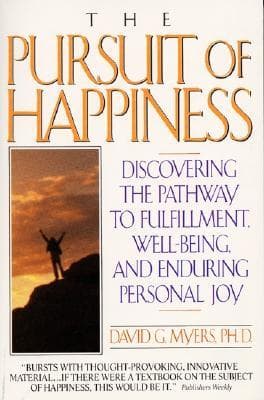
Pursuit of Happiness cover
Archivist's Choice

Pursuit of Happiness

David G. Myers (1992)

Genre

Psychology / Science / Philosophy

Reading Time

360 min

Key Themes

See below

Track Your Reading

Sign in to track this book

David G. Myers condenses global scientific research to show the real, often surprising, psychological components of lasting happiness. He challenges common ideas and gives readers practical ways to live a more joyful life.

Core Idea

David G. Myers argues that while genetics and outside events matter, much of our happiness is within our control and can be grown through deliberate actions. Using extensive psychological research, he corrects common errors, like the idea that wealth directly causes lasting happiness. Instead, he points to consistent predictors of well-being: strong social ties, engaging work or activities (flow), thankfulness, helping others, and a sense of purpose found in beliefs or personal values. Myers says happiness is not a fixed state but a skill built through steady effort in certain life areas. He stresses our ability to adjust to both good and bad situations, showing why it is important to actively pursue and keep positive habits.
Reading time
360 min
Difficulty
Medium
✓ Read this if...
You're interested in the scientific basis of happiness and practical, research-backed strategies to increase your well-being, moving beyond self-help platitudes.
✗ Skip this if...
You prefer a purely philosophical or spiritual exploration of happiness without a strong emphasis on psychological research and data.

Core idea

The central argument and framework that powers the entire book.

David G. Myers argues that while genetics and outside events matter, much of our happiness is within our control and can be grown through deliberate actions. Using extensive psychological research, he corrects common errors, like the idea that wealth directly causes lasting happiness. Instead, he points to consistent predictors of well-being: strong social ties, engaging work or activities (flow), thankfulness, helping others, and a sense of purpose found in beliefs or personal values. Myers says happiness is not a fixed state but a skill built through steady effort in certain life areas. He stresses our ability to adjust to both good and bad situations, showing why it is important to actively pursue and keep positive habits.

At a glance

Reading time

360 min

Difficulty

Medium

Read this if...

You're interested in the scientific basis of happiness and practical, research-backed strategies to increase your well-being, moving beyond self-help platitudes.

Skip this if...

You prefer a purely philosophical or spiritual exploration of happiness without a strong emphasis on psychological research and data.

Key Takeaways

1

The Happiness Baseline

Most people report being generally happy, defying common assumptions of widespread misery.

Quote

For most people, happiness is a chronic rather than an acute condition.

Most people report being at least moderately happy, Myers shows through much research, contrary to the common idea that unhappiness is normal. This does not mean life is without problems, but that our mental defenses and ability to adjust often bring us back to a positive starting point. This natural strength suggests that while we have ups and downs, a general feeling of contentment is the usual state for many, not a hard-to-reach goal. Understanding this baseline can change our focus from 'finding' happiness to 'growing' it, by seei...

Supporting evidence

Myers cites numerous international studies and polls showing that in most countries, a significant majority (often 70-80%) of people describe themselves as 'pretty happy' or 'very happy'.

Apply this

Acknowledge your inherent capacity for happiness. When faced with adversity, trust your psychological immune system to help you recover. Don't assume others are happier or unhappier; focus on your own internal state.


happiness-baselinepsychological-resiliencehedonic-adaptation
2

Wealth's Diminishing Returns

Money buys happiness only up to a point, after which more wealth provides little additional joy.

Quote

Once beyond poverty, more money provides diminishing returns on happiness.

Myers examines the common idea that more wealth always leads to more happiness. While getting out of poverty greatly improves well-being by providing basic needs and safety, the link between income and happiness mostly disappears once basic needs are met. The 'more is better' attitude often traps people in a never-ending cycle, always wanting the next thing only to find the joy is short-lived. This suggests that society's focus on ever-increasing wealth may be wrong, as it takes away from other, stronger reasons for lasting contentmen...

Supporting evidence

Myers references studies comparing happiness levels in wealthy nations to less affluent ones, and within nations, comparing the rich to the middle class. For instance, he points out that despite significant increases in real income over decades in Western countries, reported happiness levels have remained stagnant.

Apply this

Prioritize experiences, relationships, and personal growth over relentless pursuit of material wealth once your basic needs are comfortably met. Re-evaluate consumption habits and focus on contentment with 'enough'.

hedonic-treadmillmoney-and-happinessdiminishing-returns
3

The Power of Positive Traits

Happy people share common internal characteristics like high self-esteem, optimism, and a sense of control.

Quote

Happy people tend to have high self-esteem, a sense of personal control, optimism, and extroversion.

Myers finds a consistent set of inner traits that separate happier people. These are not surface qualities but deep mental ways of being. High self-worth creates a feeling of value and strength; optimism allows for a positive outlook and hope for the future; and a strong sense of personal control helps people believe they can affect their own lives instead of being helpless. These traits are not necessarily born with us but can be learned. Knowing these common points gives a plan for personal growth, suggesting that happiness is less ...

Supporting evidence

Myers synthesizes findings from personality psychology, showing strong correlations between happiness and traits like self-esteem (e.g., studies on self-perceived competence), optimism (e.g., explanatory style research), and internal locus of control (e.g., studies on perceived agency).

Apply this

Actively work on cultivating a more positive self-image, challenge negative thought patterns, and take ownership of your choices and responses. Practice gratitude and reframe challenges as opportunities.

self-esteemoptimismlocus-of-controlpositive-psychology
4

Extroversion's Advantage

Extroverts often report higher levels of happiness due to their social nature and positive affect.

Quote

Extroverts, more than introverts, tend to be happier.

Myers' research shows a consistent pattern: extroverts generally report higher levels of happiness, even though introversion and extroversion are different personality types. This is not a judgment against introverts, but an observation about what helps well-being. Extroverts do well with social interaction, which provides strong social support networks—a known help against stress and a source of joy. They also tend to feel more positive emotions and are more likely to do things that create positive feelings. This suggests that for ev...

Supporting evidence

Myers cites numerous personality studies that consistently show a positive correlation between extroversion scores on personality inventories (like the Big Five) and self-reported happiness or life satisfaction.

Apply this

If you lean introverted, make a conscious effort to schedule regular, meaningful social interactions. For extroverts, leverage your natural inclination by fostering strong community ties and engaging in group activities that bring you joy.

extroversionsocial-connectionpositive-affectpersonality-traits
5

The Faith Factor

Religious faith often correlates with higher levels of happiness and well-being.

Quote

Religious faith correlates with many of the other predictors of happiness: social support, meaning and purpose, and hope.

Myers looks at the often-missed connection between religious faith and happiness, finding a notable positive link. This is not necessarily about divine help, but about the mental and social benefits faith often gives. Religious groups offer strong social support networks, a sense of belonging, and chances to help others. Faith often gives life meaning and purpose, offering a way to understand suffering and hope for the future. While not telling people what to do, the evidence suggests that for many, a spiritual side greatly helps a st...

Supporting evidence

Myers references studies showing that religiously active people report higher life satisfaction, lower rates of depression, and greater resilience. He notes that these benefits are often mediated by factors like social support from a faith community, a sense of meaning, and a hopeful outlook.

Apply this

Consider exploring or deepening your spiritual practice, whether through organized religion or personal reflection, to cultivate a sense of meaning, purpose, and community.

religious-faithmeaning-and-purposesocial-supportspirituality
6

Flow and Engagement

Happiness is found not just in pleasure, but in deep engagement and 'flow' states.

Quote

The secret to happiness is to find something you love to do and then direct all your energy into it.

Beyond quick pleasures, Myers stresses the deep happiness from 'flow' states—times of complete focus in a challenging, meaningful activity. Mihaly Csikszentmihalyi named flow as when skill meets challenge, leading to losing self-awareness and a changed sense of time. This idea goes against passively seeking happiness through free time, instead supporting active involvement in work, hobbies, or creative efforts that need our full attention. Creating chances for flow changes daily life from tasks into a rich series of rewarding experien...

Supporting evidence

Myers integrates Csikszentmihalyi's research on 'flow' experiences, where individuals report peak enjoyment and satisfaction when fully immersed in activities that perfectly match their skills to a challenge, such as artists painting, athletes competing, or surgeons operating.

Apply this

Identify activities that challenge you without overwhelming you, where you lose track of time. Intentionally seek out and cultivate more of these 'flow' experiences in your work, hobbies, and daily life.

flow-stateengagementmeaningful-activitypositive-experience
7

The Power of Close Relationships

Strong, supportive relationships are among the most consistent predictors of happiness.

Quote

Humans are social animals, and those who have close relationships with friends, family, or partners tend to be happier.

Myers clearly states that strong social connections are most important for happiness. Loneliness is a strong sign of unhappiness, while strong ties with friends, family, and romantic partners consistently appear as top contributors to well-being. These relationships give emotional help, a sense of belonging, and chances for shared joy and mutual support. The quality of these connections, more than the number, is key. This shows a basic human need for connection and closeness, suggesting that putting time and effort into growing these ...

Supporting evidence

Myers references extensive longitudinal studies and meta-analyses showing that people with strong social ties (e.g., married individuals, those with close friends) consistently report higher levels of happiness and live longer, healthier lives.

Apply this

Actively nurture your closest relationships. Prioritize spending quality time with loved ones, practice active listening, and offer support. Seek out opportunities to build new, meaningful connections.

social-connectionrelationshipsbelongingintimacy
8

Gratitude and Altruism

Practicing gratitude and helping others are powerful pathways to personal well-being.

Quote

Those who express gratitude and help others are consistently happier individuals.

Myers stresses how much thankfulness and helping others affect personal happiness. Actively seeing and valuing the good things in life, instead of focusing on what is missing, changes our view and grows positive emotions. Likewise, doing kind acts and helping others creates a good cycle: helping others makes us feel good, strengthens our sense of purpose, and often builds social ties. These actions move us beyond self-focus, creating a sense of being connected to something bigger than ourselves. They are not just feel-good activities ...

Supporting evidence

Myers discusses research on 'counting blessings' and gratitude journals, showing increased well-being. He also cites studies on the 'helper's high' and the positive psychological effects of altruistic behavior, where giving leads to greater happiness than receiving.

Apply this

Start a daily gratitude practice (e.g., a gratitude journal). Regularly seek out opportunities to help others, whether through volunteering, small acts of kindness, or simply being supportive to friends and family.

gratitudealtruismprosocial-behaviorpositive-emotions
9

The Adaptation Principle

Humans quickly adapt to both good and bad circumstances, returning to a happiness 'set point'.

Quote

We adapt to our circumstances, good and bad, meaning that initial surges of joy or sorrow eventually fade.

The 'adaptation principle,' or hedonic adaptation, is a key idea in understanding happiness. Myers explains that people can greatly adjust to new situations, whether good or bad. The first excitement of a new car or a promotion, like the first pain of a setback, eventually fades, and we return to our individual happiness baseline. This explains why big life events often have less long-term effect on happiness than we expect. Understanding adaptation helps us avoid the 'hedonic treadmill'—the endless chase of outside events mistakenly ...

Supporting evidence

Myers refers to studies on lottery winners and paraplegics, showing that after an initial period of extreme joy or despair, both groups tend to return to their pre-event happiness levels within a relatively short time frame, illustrating hedonic adaptation.

Apply this

Don't rely solely on external achievements or acquisitions for lasting happiness. Instead, focus on cultivating internal resources and consistent positive practices that can gently shift your happiness set point over time. Appreciate the present moment.

hedonic-adaptationhappiness-set-pointresiliencechange-management
10

Happiness is a Skill, Not a Destination

Happiness is an ongoing practice, not a fixed state achieved through specific accomplishments.

Quote

Happiness is less a destination than a way of traveling.

Myers' summary of research leads to the strong idea that happiness is not a prize to be won or a permanent place reached after getting certain life goals. Instead, it is an ongoing practice, a set of skills and habits we build daily. This view frees us from the pressure of chasing a hard-to-reach, perfect state and lets us actively do things known to help well-being. It stresses the importance of the process over the result, showing that steady effort in building relationships, being thankful, finding flow, and keeping a positive outl...

Supporting evidence

This takeaway synthesizes the cumulative evidence throughout the book, drawing on the effectiveness of practices like gratitude, altruism, social connection, and finding meaning, all of which are ongoing and require consistent effort rather than one-time achievements.

Apply this

View happiness as a daily practice. Regularly engage in activities that foster well-being, such as mindful reflection, connecting with loved ones, or pursuing engaging hobbies, rather than waiting for external events to make you happy.

happiness-practiceintentional-livingwell-being-journeyprocess-over-outcome

Critical analysis

Notable Quotes

Happiness is not a destination to be reached but a manner of traveling.

Introduction to the concept of happiness as a process, not an end goal.

The scientific pursuit of happiness reveals that our well-being is less about what happens to us and more about how we perceive and respond to life.

Discussing research on subjective well-being and cognitive appraisal.

Material wealth increases happiness only up to a point; beyond that, it contributes little to our lasting satisfaction.

Analysis of studies on income and happiness, referencing the adaptation principle.

Close relationships are the single strongest predictor of human happiness.

Summarizing findings from longitudinal studies on social connections.

We often overestimate the impact of future events on our happiness, a phenomenon known as 'impact bias'.

Explaining cognitive biases in affective forecasting.

Gratitude turns what we have into enough.

Highlighting the role of gratitude practices in enhancing well-being.

The pursuit of meaning, though sometimes challenging, contributes more to enduring happiness than the pursuit of pleasure alone.

Contrasting hedonic and eudaimonic approaches to happiness.

Our brains are wired to notice threats more readily than blessings, an evolutionary legacy that can skew our perception of happiness.

Discussing negativity bias from an evolutionary psychology perspective.

Acts of kindness not only benefit recipients but also boost the giver's happiness, creating a virtuous cycle.

Describing research on altruism and prosocial behavior.

Happiness is contagious; it spreads through social networks like a positive emotional virus.

Referencing studies on emotional contagion and social networks.

The myth that suffering is necessary for great achievement is often overstated; positive emotions can fuel creativity and resilience.

Challenging common assumptions about struggle and success.

Mindfulness—paying attention to the present moment without judgment—can dissolve the anxieties that cloud happiness.

Exploring meditation and mindfulness practices in psychological research.

Comparing ourselves to others is a thief of joy; focusing on personal growth fosters greater contentment.

Addressing social comparison theory and its effects on well-being.

Quiz

Test Your Knowledge

Ready to see how well you understood this book? Take our interactive quiz with 10 questions.

10
Questions
~5
Minutes
?
Best Score

Key Questions (FAQ)

The book synthesizes thousands of scientific studies to explore the key factors that contribute to happiness, debunking common myths and offering evidence-based techniques for enhancing well-being. It covers topics like personality traits, social relationships, and practical strategies for finding joy.

About the author

David G. Myers is a social psychologist and author known for his accessible and engaging writing on topics such as happiness, faith, and psychology. His bestselling book, "The Pursuit of Happiness: Discovering the Keys to Lasting Fulfillment," has helped countless readers understand the science behind well-being. Myers's work often integrates research findings with personal reflection, making complex psychological concepts relatable and practical.