Meaning is Use
Words derive their meaning from their context and how they are used, not from a fixed, internal essence.
Quote
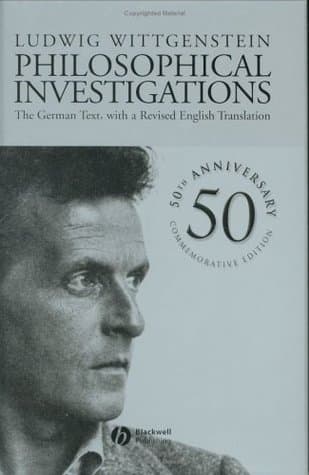
For a large class of cases—though not for all—in which we employ the word 'meaning' it can be explained thus: the meaning of a word is its use in the language.
Wittgenstein challenged the idea that words are labels for pre-existing objects or ideas. Instead, he argued that a word's meaning is determined by its 'use in the language.' To understand a word, one must observe how it functions within a specific linguistic context, how it is used in various 'language-games.' Searching for an intrinsic, universal meaning for a word often leads to confusion. Meaning is dynamic, context-dependent, and socially constructed through shared practices. This concept reframes many traditional philosophical p...
Supporting evidence
Wittgenstein's famous example of the word 'game.' He shows that there is no single, essential property shared by all activities we call 'games' (board games, card games, Olympic games, etc.). Instead, they form a 'family resemblance,' and the meaning of 'game' is derived from its diverse uses.
Apply this
When encountering philosophical or conceptual difficulties, stop searching for an essential definition. Instead, ask: 'How is this word (or concept) actually used in different contexts?' Examine its practical application rather than its abstract essence to resolve confusion.