“Before I was born, my father was a tree. And my mother was a bird.”
— The very first lines of the book, establishing the surreal and metaphorical nature of the narrative.

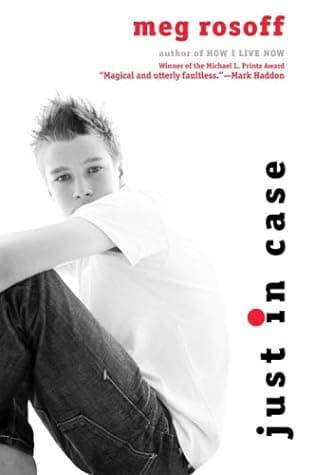
Meg Rosoff (2009)
Genre
Psychology / Fantasy / Young Adult / Romance
Reading Time
250 min
Key Themes
See below
Sign in to track this book
Haunted by a premonition of his own demise, a teenage boy reinvents himself as 'Justin Case' to outrun fate, only to discover destiny has a darkly romantic sense of humor.
Fifteen-year-old David Case has a profound realization when he sees his younger brother, Adam, dangerously balanced on their apartment balcony railing. The near-tragedy shatters David's sense of security and shows him the terrifying randomness of fate. Convinced that his own life is now under some cosmic threat, David decides he must escape his current identity and surroundings to outwit this perceived destiny. This moment sparks his urgent desire for change and sets him on a path to reinvent himself, believing it's the only way to survive the dangers he now senses everywhere.
After the balcony incident, David Case makes a radical decision to leave his old life. He changes his name to Justin Case, a play on words reflecting his new philosophy of preparedness. He dyes his hair blonde, buys new clothes, and moves to a different part of the city, cutting ties with his past. This change is not just superficial; Justin tries to adopt a new personality, shed his old fears, and embrace a more adventurous, yet careful, persona. He even invents an imaginary dog named Boy to accompany him, symbolizing his need for companionship and protection in this new, uncertain world.
In his new life as Justin Case, he meets Agnes Day, a striking and somewhat mysterious girl who immediately captivates him. Agnes is a free spirit, seemingly without the worries that now consume Justin. Their meeting marks a significant turn in Justin's journey, as he is drawn to her adventurous nature and her ability to live in the moment. Despite his newfound caution and his belief in impending doom, Justin is irresistibly attracted to Agnes, and their budding romance becomes a central part of his reinvented life, challenging his resolve to remain detached and safe.
Justin's imaginary dog, Boy, becomes a real presence in his new life. Boy is more than just a figment of his imagination; he is Justin's confidant, protector, and a sign of his inner anxieties and desires. Boy accompanies Justin everywhere, offering silent support and a sense of normalcy in a world Justin now sees as dangerous. The interactions with Boy allow Justin to process his thoughts and feelings, serving as a way to cope with his deep sense of isolation and his constant watch against fate. Boy is a key element in Justin's psychological makeup.
As Justin, he tries to build a new social circle, befriending people like the eccentric Stella and the more grounded Marcus. These new friendships are complicated by Justin's need to maintain his made-up identity and his constant fear of revealing his past. He struggles to connect genuinely, always on guard, fearing that any deep connection might expose him to the dangers he's trying to avoid. His interactions often have a sense of detachment, as he observes others through the lens of his 'just in case' philosophy, constantly assessing potential threats and weaknesses.
Justin's relationship with Agnes Day grows, bringing both joy and deep challenges to his new identity. Agnes represents everything Justin fears and desires: spontaneity, vulnerability, and a potential for deep connection that could expose him. He finds himself falling deeply in love, an emotion that goes against his need for detachment and safety. Their shared experiences, from exploring the city to intimate conversations, chip away at Justin's resolve to remain guarded. Agnes's influence forces him to confront the limits of his 'just in case' philosophy and the true cost of living a life without genuine human connection.
Despite his best efforts to erase David Case, parts of his past begin to enter Justin's carefully built new life. Subtle reminders, chance encounters, or even just his own memories start to reappear, creating internal conflict and external tension. He becomes increasingly paranoid, constantly looking for any sign that his old life might catch up to him. This return of the past shows how difficult it is, if not impossible, to truly escape one's identity and history, emphasizing the psychological strain of maintaining such an elaborate deception.
A moment arrives when Justin's carefully kept illusion of safety and his imaginary companion, Boy, are tested against reality. Without revealing specific plot points, this scene forces Justin to confront the limits of his coping methods and the true nature of his fears. It is a moment of reckoning where the line between his internal world and the external world blurs, pushing him to acknowledge how fragile his self-deception is. This confrontation is a painful but necessary step in his journey toward understanding the real sources of his anxiety.
Throughout his journey, Justin constantly struggles with the philosophical question of fate versus free will. He believes he is 'just in case' against an inevitable doom, yet his actions, particularly his pursuit of Agnes and new friendships, suggest a desire to actively shape his destiny. He reflects on whether his efforts to outsmart fate are pointless or if his choices genuinely have the power to change his path. This internal struggle is a main idea, driving much of his story and influencing his decisions as he tries to reconcile his belief in a predetermined future with his yearning for control over his life.
The story builds to a climax where Justin Case must make a choice that will define his future. This moment represents the end of his journey, bringing together his fears, his love for Agnes, and his struggle with identity. He must decide whether to continue living in fear and evasion, or to fully embrace life, with all its inherent risks and uncertainties. This final moment tests his courage and his ability to grow, determining whether he can truly move beyond his past and the idea of fate.
The Protagonist
David transforms into Justin, initially living in fear and denial, but eventually learns to embrace vulnerability and the unpredictable nature of life.
The Love Interest / Supporting
Agnes remains largely consistent, acting as a catalyst for Justin's growth by offering unconditional acceptance and challenging his worldview.
The Supporting / Symbolic
Boy's role diminishes as Justin grows more self-aware and connected to reality, symbolizing his decreasing need for imaginary coping mechanisms.
The Mentioned / Catalyst
Adam's role is primarily catalytic, his near-accident setting the protagonist's journey in motion without significant personal development.
The Supporting
Stella's arc is minor, primarily serving to illustrate Justin's attempts at building a new social life and the challenges he faces.
The Supporting
Marcus's arc is minor, primarily serving as a background character who helps define Justin's new social context.
This theme is central to the novel, introduced by Adam's near-fatal fall from the balcony. Justin becomes aware of life's precariousness and develops a fear of impending doom, believing fate is 'out to get him.' His transformation into 'Justin Case' is a direct response to this fear, an attempt to control the uncontrollable. The story explores whether one can truly escape or outwit destiny, or if such attempts only lead to isolation and anxiety. It shows in Justin's constant watchfulness, his 'just in case' preparations, and his thoughts about the random nature of tragedy, as when he plans escape routes or avoids certain streets.
“What if you were just in case, just in case everything went wrong? Just in case the world decided you were next?”
The novel explores identity through David's decision to shed his old self and become 'Justin Case.' He believes that by changing his name, appearance, and surroundings, he can escape his perceived fate. This theme questions whether identity is inherent or created, and if one can truly outrun their past or fundamental self. Justin's struggle to maintain his new persona, his invented dog Boy, and his reluctance to reveal his true history to Agnes all show the difficulties and psychological cost of living a fabricated life. His journey is about bringing together his past self with his desired new self.
“I was David Case. And now I wasn't. Now I was Justin. Justin Case.”
Despite his fear and need for control, Justin finds himself falling in love with Agnes Day. This theme examines how love forces vulnerability and challenges the main character's carefully built emotional defenses. For Justin, love is dangerous because it means opening himself up to potential loss and pain, which goes against his 'just in case' philosophy. Agnes's free-spirited nature and her ability to live in the moment contrast with Justin's caution, forcing him to confront the idea that true connection requires risk. Their relationship becomes a test for Justin's growth, pushing him to choose between safety and genuine human experience.
“To love her was to give fate another target, another chink in my armor.”
Justin's imaginary dog, Boy, is a strong sign of this theme. Boy represents Justin's way of coping, his need for companionship, and the blurring lines between his internal world and external reality. The novel looks at how imagination can be both a refuge and a prison. While Boy offers comfort and a way for Justin to process his fears, he also shows Justin's isolation and his reliance on self-deception. The theme questions how much we create our own realities and how these internal stories can shape our experiences and perceptions of danger.
“Boy was real. To me. And that was all that mattered.”
A figment of Justin's imagination that serves as his confidant and a symbol of his psychological state.
Boy, Justin's imaginary dog, functions as a crucial plot device by externalizing Justin's internal monologue and emotional state. He allows Justin to vocalize his fears and anxieties without directly interacting with others, showcasing Justin's isolation and his struggle to connect authentically. Boy also acts as a barometer for Justin's mental health; his presence and 'interactions' with Justin highlight the protagonist's detachment from reality. As Justin grows and confronts his fears, Boy's role subtly shifts or diminishes, symbolizing Justin's progress towards self-acceptance and genuine human connection.
A literal and symbolic transformation of identity, driving the central conflict.
The name change from David Case to Justin Case is not merely a plot point but a central plot device. It immediately establishes the protagonist's core motivation: to escape fate by being 'just in case.' This device creates immediate conflict, as Justin must constantly maintain his new identity and hide his past, leading to tension in his relationships and internal struggles. It also allows for exploration of themes like identity, reinvention, and the psychological burden of living a lie. The chosen name itself is a constant reminder of his fear and his coping strategy.
A near-tragedy that irrevocably alters the protagonist's perception of life and triggers his transformation.
Adam's near-fatal fall from the balcony serves as the inciting incident, a powerful plot device that sets the entire narrative in motion. This single event shatters David's worldview, introducing the profound fear of fragility and fate that drives his subsequent actions. It provides the initial motivation for his identity change and his 'just in case' philosophy. Without this traumatic catalyst, Justin's journey would not exist, making it the foundational event that underpins all subsequent character development and thematic exploration.
“Before I was born, my father was a tree. And my mother was a bird.”
— The very first lines of the book, establishing the surreal and metaphorical nature of the narrative.
“I was born on a Tuesday. I remember the day vividly. It was a Tuesday.”
— Bobby's unusual and matter-of-fact way of recounting his birth, highlighting his unique perspective.
“It was just in case. Just in case I needed to be someone else.”
— Bobby explaining why he felt compelled to change his name to Justin Case, central to the plot.
“The thing about being a chameleon is you never quite know who you are underneath.”
— A reflection on the challenges of constantly adapting and changing one's persona.
“Love is a dangerous thing. It makes you do stupid things. And brave things.”
— Bobby's contemplation on the nature and impact of love, particularly his feelings for the various girls.
“Sometimes you have to break things to make them better.”
— A philosophical musing on the necessity of destruction or change for progress, often in the context of his own life.
“The world is full of people trying to be someone they're not. I just happen to be good at it.”
— Justin's self-awareness regarding his ability to adopt different identities and roles.
“There's a fine line between destiny and just plain bad luck.”
— A moment of reflection on whether his circumstances are fated or merely a series of unfortunate events.
“You can run from who you are, but you can't run from what you are.”
— An internal thought about the inescapable aspects of one's fundamental nature, despite external changes.
“Every time I changed my name, I felt a little bit more like me.”
— Paradoxically, the act of changing his identity helps him solidify a sense of self.
“The truth is, I was just trying to find somewhere to belong.”
— A poignant admission of his underlying motivation behind his various escapades and identity shifts.
“Happiness is a slippery fish. You think you've got it, and then it's gone.”
— A melancholic observation on the fleeting nature of happiness and contentment.
“Sometimes the biggest adventures are the ones you don't plan.”
— A realization about the spontaneous and unpredictable nature of life's significant events.
“It's hard to be a hero when you're not sure which story you're in.”
— A reflection on the confusion of his multiple identities and roles, making it difficult to act decisively.
Ready to see how well you understood this book? Take our interactive quiz with 10 questions.

Biography coming soon.

Rhonda Byrne
4.3

Menno Henselmans
4.3
Sylvia Plath
4.3
Elliot Aronson
4.3
Joseph Campbell
4.3
Erich Fromm
4.3
Irvin D. Yalom
4.2
Lucy Strange
4.2