BookBrief
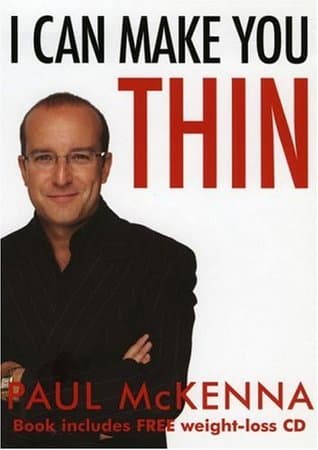
I Can Make You Thin cover
Archivist's Choice

I Can Make You Thin

Paul McKenna (2006)

Genre

Psychology / Reference / Health / Self-Help

Reading Time

90 min

Key Themes

See below

Track Your Reading

Sign in to track this book

Paul McKenna's 'I Can Make You Thin' offers a psychological approach to weight loss, helping people naturally desire healthier eating habits and build lasting body confidence without restrictive diets.

Core Idea

Paul McKenna's "I Can Make You Thin" states that traditional dieting is flawed and unsustainable because it ignores the body's natural hunger signals and creates a restrictive mindset. The book argues that lasting thinness comes from reprogramming the subconscious mind to adopt the eating habits of naturally thin people: eating only when physically hungry, stopping when comfortably full, and enjoying food without guilt. Using NLP techniques, self-hypnosis, and four 'golden rules,' McKenna aims to move readers from a diet mentality to intuitive eating, addressing emotional eating and building a positive self-image for sustainable weight management.
Reading time
90 min
Difficulty
Easy
✓ Read this if...
You're tired of traditional diets, believe your eating habits are driven by subconscious patterns, and are open to self-hypnosis and NLP techniques for weight management.
✗ Skip this if...
You prefer a strict diet plan with calorie counting, are skeptical of hypnosis, or are looking for a book focused purely on nutrition science or exercise routines.

Core idea

The central argument and framework that powers the entire book.

Paul McKenna's "I Can Make You Thin" states that traditional dieting is flawed and unsustainable because it ignores the body's natural hunger signals and creates a restrictive mindset. The book argues that lasting thinness comes from reprogramming the subconscious mind to adopt the eating habits of naturally thin people: eating only when physically hungry, stopping when comfortably full, and enjoying food without guilt. Using NLP techniques, self-hypnosis, and four 'golden rules,' McKenna aims to move readers from a diet mentality to intuitive eating, addressing emotional eating and building a positive self-image for sustainable weight management.

At a glance

Reading time

90 min

Difficulty

Easy

Read this if...

You're tired of traditional diets, believe your eating habits are driven by subconscious patterns, and are open to self-hypnosis and NLP techniques for weight management.

Skip this if...

You prefer a strict diet plan with calorie counting, are skeptical of hypnosis, or are looking for a book focused purely on nutrition science or exercise routines.

Key Takeaways

1

Eat When You're Hungry, Stop When You're Full

Reconnecting with your body's natural hunger and satiety signals is the cornerstone of sustainable weight loss.

Quote

The secret to effortless weight control is to eat when you are hungry, eat what your body wants, and stop when you are full.

McKenna says that most people gain weight not from a lack of willpower or a slow metabolism, but because they have lost touch with their body's natural wisdom about food. We eat from habit, emotion, social pressure, or by the clock, rather than from real physical hunger. The main idea involves training yourself to eat only when truly hungry and to stop the moment you feel comfortably full. This re-establishes a natural feedback loop, preventing overeating and building a healthier relationship with food. It is about moving from externa...

Supporting evidence

McKenna frequently references the natural eating habits of naturally thin people who inherently follow these rules without conscious effort or dieting.

Apply this

Before eating, ask yourself, 'Am I genuinely hungry?' and rate your hunger on a scale of 1-10. During the meal, pause frequently and ask, 'Am I full yet?' Stop eating when you reach a comfortable 7/10 fullness, leaving a little room.


intuitive-eatingsatiety-signalsmindful-eating
2

The Power of Hypnosis and NLP

Utilizing guided visualization and neuro-linguistic programming to reprogram your subconscious mind for healthy eating habits.

Quote

Your mind is like a powerful supercomputer. If you feed it the right programs, it will produce the right results.

McKenna's method relies on hypnosis and NLP to address the subconscious patterns that drive unhealthy eating. He believes our eating habits are deeply set programs in our minds, often formed in childhood or in response to emotional triggers. Through guided audio sessions, he aims to bypass the conscious mind and place new, positive suggestions directly into the subconscious. This includes visualizing a healthier self, re-framing food cravings, and building a stronger sense of self-control and confidence around food choices. The goal i...

Supporting evidence

The book itself includes a CD (or audio download) with guided hypnosis sessions designed to reinforce the four core rules and address common eating challenges.

Apply this

Commit to listening to the provided hypnosis audio daily for at least 30 days. Approach it with an open mind, visualizing the suggested scenarios and allowing the positive affirmations to sink in.

subconscious-reprogrammingguided-hypnosisneuro-linguistic-programming
3

Eat What You Want, Not What You Think You Should

Granting yourself permission to enjoy desired foods removes their forbidden allure and reduces bingeing.

Quote

When you allow yourself to eat anything you want, you take away the power the food has over you.

This idea challenges the traditional dieting mindset that labels certain foods as bad. McKenna argues that restricting 'forbidden' foods often backfires, creating intense cravings and leading to binges. By giving yourself unconditional permission to eat anything you truly want, the psychological pressure and 'rebellious' urge to overeat decrease. This permission must be paired with the 'eat when hungry, stop when full' rule. When you truly listen to your body, it often wants a balanced variety of foods, and the strong desire for unhea...

Supporting evidence

McKenna often points to the cyclical nature of diets: restriction leads to craving, craving leads to bingeing, bingeing leads to guilt, and guilt leads back to restriction.

Apply this

Identify a food you typically 'forbid' yourself. Consciously decide that you can have it whenever you truly want it. Observe how this changes your desire for it, especially when coupled with mindful eating.

food-freedomrestriction-cycleunconditional-permission
4

The Importance of Slow and Mindful Eating

Slowing down your eating pace enhances enjoyment, improves digestion, and allows satiety signals to register.

Quote

Eating slowly is not just about savouring your food; it's about giving your body time to register that it's full.

In our busy world, many people eat quickly, often while distracted. McKenna stresses that eating slowly is important for several reasons. First, it lets you truly taste and enjoy your food, making meals more satisfying. Second, it gives your body the 20 minutes needed for satiety hormones to travel from your gut to your brain. Eating too quickly means you often consume much more than you need before your brain registers fullness, leading to overeating and discomfort. Mindful eating, without distractions like TV or phones, helps you st...

Supporting evidence

Scientific understanding of satiety hormones like leptin and cholecystokinin (CCK) which take time to signal fullness to the brain.

Apply this

Put your fork down between bites. Chew your food thoroughly and consciously experience its taste, texture, and smell. Avoid distractions during meals, focusing solely on the eating experience.

mindful-eatingsatiety-hormonesdigestion
5

Address Emotional Eating Triggers

Uncover and resolve the underlying emotional reasons for overeating to break destructive patterns.

Quote

Often, we eat not because we are hungry, but because we are trying to fill an emotional void.

McKenna knows that food is often used to cope with emotions like stress, boredom, sadness, loneliness, or anxiety. Simply trying to 'diet' without addressing these underlying emotional triggers will not work. He encourages readers to identify their emotional eating patterns and develop other, healthier coping strategies. This might involve recognizing the feeling, accepting it, and then consciously choosing an action that truly addresses the emotion, instead of automatically reaching for food. The hypnosis sessions in the book help re...

Supporting evidence

Common scenarios of comfort eating after a bad day, or boredom snacking while watching TV.

Apply this

When you feel an urge to eat but aren't physically hungry, pause and identify the emotion you're feeling. Instead of eating, try a different activity: call a friend, take a walk, meditate, or engage in a hobby.

emotional-eatingcoping-mechanismsself-awareness
6

Visualize Your Ideal Self

Using powerful mental imagery to internalize your desired body image and motivate behavioral change.

Quote

Your mind cannot tell the difference between a real experience and an imagined one, so use this to your advantage.

A key part of McKenna's method is regular visualization. He tells readers to vividly imagine themselves at their ideal weight, feeling confident, healthy, and happy. This is not just wishful thinking; it is a tool from sports psychology and NLP. By repeatedly 'rehearsing' the desired outcome in your mind, you begin to program your subconscious to match your behaviors with that image. This creates a strong internal drive, making healthy choices feel more natural and less like a chore. The more detailed and emotionally engaging the visu...

Supporting evidence

McKenna's own success stories from clients who effectively used visualization to achieve their goals.

Apply this

Spend 5-10 minutes daily visualizing yourself at your ideal weight: what you look like, how you feel, what you wear, and what activities you engage in. Engage all your senses in this mental rehearsal.

visualizationself-imagemental-rehearsal
7

Exercise for Pleasure, Not Punishment

Shifting the perception of physical activity from a dreaded chore to an enjoyable part of a healthy lifestyle.

Quote

When exercise becomes a pleasure, it becomes a habit.

McKenna questions the common belief that exercise must be hard to be effective. He suggests finding physical activities you genuinely enjoy, rather than forcing yourself into intense workouts you dislike. When exercise is seen as punishment for eating, it becomes unsustainable. Instead, by focusing on activities that bring joy, improve mood, or offer social connection, movement becomes a natural and enjoyable part of life. This change in mindset is important for sticking to an active lifestyle, supporting both physical and mental heal...

Supporting evidence

Examples of naturally thin people who are often active in ways they enjoy, like walking, gardening, or dancing, rather than strictly structured gym routines.

Apply this

Experiment with various forms of physical activity until you find one or more that you truly enjoy. This could be dancing, walking in nature, cycling, swimming, or playing a sport. Focus on the feeling of enjoyment and energy.

joyful-movementsustainable-fitnessintrinsic-motivation
8

Forgive Yourself and Move On

Releasing guilt and self-criticism over past eating habits is essential for maintaining progress and avoiding relapse.

Quote

Don't beat yourself up if you occasionally overeat. Just learn from it and get back on track with the four rules.

Self-compassion is a critical, often overlooked, aspect of sustainable weight management. McKenna emphasizes that occasional slips or overeating are normal. The danger lies in letting these small setbacks turn into overwhelming guilt and self-blame, which often leads to giving up healthy habits. Instead, he advises acknowledging the slip, learning from it without judgment, and immediately returning to the core rules of eating when hungry and stopping when full. This approach prevents the 'all-or-nothing' mindset that ruins many diets ...

Supporting evidence

The common experience of dieters who 'fall off the wagon' after one perceived failure and then give up entirely.

Apply this

If you overeat, don't dwell on it or punish yourself. Simply acknowledge it, remind yourself of the four rules, and consciously make your next eating decision based on true hunger.

self-compassionrelapse-preventionresilience
9

The Four Golden Rules of Thin

A concise framework for intuitive eating that simplifies weight management into actionable principles.

Quote

The four golden rules are the foundation of everything you need to know to become permanently thin.

McKenna condenses his philosophy into four easy-to-remember 'Golden Rules' meant to be internalized and applied automatically. These are: 1. When you are hungry, eat. 2. Eat what you want, not what you think you should. 3. Eat consciously and enjoy every mouthful. 4. When you are full, stop. These rules are not a diet but a framework for intuitive eating, encouraging people to reconnect with their body's natural wisdom. By consistently applying these principles, individuals learn to trust their natural hunger and fullness cues, removi...

Supporting evidence

These four rules are repeated throughout the book and form the basis of the hypnosis exercises.

Apply this

Memorize the four golden rules. Before each meal, quickly review them in your mind. Practice them consistently until they become automatic habits.

intuitive-eatinggolden-ruleshabit-formation
10

Embrace a Positive Self-Image

Cultivating a deep sense of self-acceptance and confidence, regardless of current weight, is crucial for lasting change.

Quote

The most powerful thing you can do for your body is to love and accept it exactly as it is right now.

Beyond the practical eating rules, McKenna places importance on developing a positive self-image and self-acceptance. He argues that negative self-talk and dissatisfaction with one's body can continue unhealthy eating cycles and hinder progress. By actively practicing self-love and appreciating your body for what it can do, regardless of its current size, you create a more supportive internal environment for change. This positive self-regard reduces emotional eating driven by self-criticism and empowers you to make healthier choices f...

Supporting evidence

McKenna's hypnosis sessions often include affirmations and visualizations aimed at building self-esteem and body acceptance.

Apply this

Practice daily affirmations of self-love and gratitude for your body. Stand in front of a mirror and consciously appreciate aspects of your body. Challenge negative self-talk whenever it arises.

body-positivityself-esteemself-acceptance

Critical analysis

Notable Quotes

Every time you eat, you have a choice. You can either feed your body or feed your problem.

Introducing the concept of conscious eating choices.

Thin people do four things differently to fat people.

Laying out the core principles of the program.

Only eat when you are hungry.

The first of the 'thin people' rules.

Eat exactly what you want, not what you think you should eat.

The second of the 'thin people' rules, emphasizing freedom and intuition.

Eat consciously and enjoy every mouthful.

The third of the 'thin people' rules, promoting mindfulness.

When you think you've had enough, stop.

The fourth of the 'thin people' rules, focusing on satiety.

Your mind and body are designed to keep you at your ideal weight.

Explaining the natural ability of the body to regulate weight.

The secret to lasting weight loss is not about deprivation; it's about changing your relationship with food.

Highlighting the psychological rather than restrictive approach.

You are reprogramming your mind to think like a thin person.

Describing the core process of the psychological techniques.

The purpose of food is to fuel your body, not to feed your emotions.

Addressing emotional eating and reframing the purpose of food.

If you don't keep it off, what's the point of losing it?

Emphasizing the importance of sustainable, long-term results.

You can have any food you want, whenever you want it, as long as you follow the four golden rules.

Reassuring readers about freedom of choice within the framework.

Your ideal weight is where you feel healthy, energetic, and happy.

Defining the personal and holistic nature of an 'ideal weight'.

The power to change your body is already within you.

Empowering the reader with the belief in their own capabilities.

Quiz

Test Your Knowledge

Ready to see how well you understood this book? Take our interactive quiz with 10 questions.

10
Questions
~5
Minutes
?
Best Score

Key Questions (FAQ)

The core principle is to change your mindset and relationship with food through psychological techniques, rather than relying on restrictive diets. It focuses on listening to your body's natural hunger signals and eating more consciously.

About the author