BookBrief
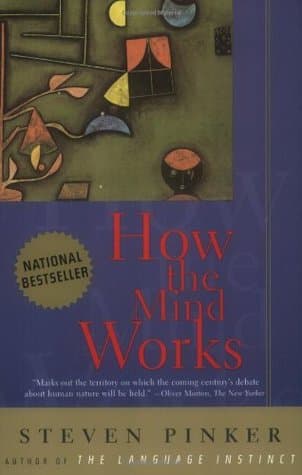
How the Mind Works cover
Archivist's Choice

How the Mind Works

Steven Pinker (1997)

Genre

Psychology / Science / Philosophy

Reading Time

15-20 hours

Key Themes

See below

Track Your Reading

Sign in to track this book

Steven Pinker examines the human mind, explaining its evolutionary roots as a computational organ and challenging common beliefs about emotion, parenting, and human nature with clear thinking and scientific evidence.

Core Idea

The human mind is a system of computational parts, shaped by natural selection to solve problems our ancestors faced. It is not a blank slate but a set of specialized tools, each with its own purpose, that process information and guide behavior. To understand the mind, we must look at its evolutionary history, how it is built, and how it creates things like perception, emotion, and consciousness, often going against our everyday assumptions.
Reading time
15-20 hours
Difficulty
Hard
✓ Read this if...
You're fascinated by the intersection of psychology, evolutionary biology, and cognitive science, and want a comprehensive, evidence-based theory of how the mind works, written by a master explainer.
✗ Skip this if...
You prefer a purely philosophical or introspective approach to the mind, are uncomfortable with evolutionary explanations for human behavior, or are seeking a quick, introductory overview rather than a deep dive into cognitive science.

Core idea

The central argument and framework that powers the entire book.

The human mind is a system of computational parts, shaped by natural selection to solve problems our ancestors faced. It is not a blank slate but a set of specialized tools, each with its own purpose, that process information and guide behavior. To understand the mind, we must look at its evolutionary history, how it is built, and how it creates things like perception, emotion, and consciousness, often going against our everyday assumptions.

At a glance

Reading time

15-20 hours

Difficulty

Hard

Read this if...

You're fascinated by the intersection of psychology, evolutionary biology, and cognitive science, and want a comprehensive, evidence-based theory of how the mind works, written by a master explainer.

Skip this if...

You prefer a purely philosophical or introspective approach to the mind, are uncomfortable with evolutionary explanations for human behavior, or are seeking a quick, introductory overview rather than a deep dive into cognitive science.

Key Takeaways

1

The Mind as a Computational Organ

Our brains are sophisticated computers, processing information to navigate the world.

Quote

The mind is a system of computational organs, designed by natural selection to solve the kinds of problems our ancestors faced in their foraging way of life.

Pinker argues that the mind is a computational system. This means the brain's main job is to process information, much like a computer. Our thoughts, perceptions, and actions come from complex steps that work on what we sense and what we know internally. This idea connects different mental things, from sight to language to thinking, under one framework of computation. It challenges romantic ideas of the mind as something untouchable, instead rooting it in a physical, working structure shaped by evolution. Seeing the mind as a computer...

Supporting evidence

Pinker points to the success of cognitive science in modeling specific mental tasks, such as object recognition or grammatical parsing, using computational principles. He references Marr's computational theory of vision, which breaks down visual processing into distinct computational levels, demonstrating how the brain computes depth, shape, and motion from retinal images.

Apply this

When facing a complex problem, break it down into smaller, discrete information-processing steps. Recognize that your brain is constantly running 'programs' for various tasks; optimizing these programs (e.g., through deliberate practice or learning new mental models) can enhance cognitive performance. Approach personal biases not as moral failings, but as 'bugs' in your internal algorithms that can be debugged.


computational-theory-of-mindcognitive-scienceinformation-processing
2

Evolutionary Psychology's Blueprint

Human nature is a product of natural selection, designed to solve ancestral problems.

Quote

Our minds are not blank slates, but rather equipped with innate predispositions and modules shaped by the demands of our evolutionary past.

Pinker supports evolutionary psychology, stating that the mind is a collection of mental tools, or modules, each developed to solve specific problems our ancestors faced. These modules guide much of what we see, think, and feel today. This idea directly counters the 'blank slate' theory, arguing instead for a rich, inborn human nature. Understanding this evolutionary past helps explain common human behaviors, preferences, and even illogical actions. Our liking for sweets, fear of snakes, and social hierarchies, for example, are not ra...

Supporting evidence

Pinker discusses the universal facial expressions for emotions (e.g., fear, joy, anger), which are recognized across diverse cultures, suggesting an innate, evolved basis. He also cites studies on human mate selection preferences (e.g., attraction to symmetry, indicators of health) that align with evolutionary predictions for reproductive success.

Apply this

Instead of viewing certain human behaviors (like jealousy or status-seeking) as purely cultural constructs, consider their potential evolutionary roots. This doesn't excuse negative behaviors but provides a deeper understanding of their origins. Design social systems and personal habits that acknowledge and work with, rather than against, these evolved predispositions. For example, understanding our innate need for social connection can inform how we combat loneliness.

evolutionary-psychologynatural-selectionblank-slateinnate-modules
3

The Modularity of Mind

The mind is not a general-purpose processor but a collection of specialized 'organs'.

Quote

The mind is not a single, undifferentiated blob, but rather a collection of specialized organs, each designed to perform a particular task.

A main point of Pinker's argument is that the mind is modular. He suggests that the mind has many distinct, specialized systems or 'modules,' each designed to solve a particular problem. These modules work somewhat on their own and are 'domain-specific,' meaning they are optimized for tasks like recognizing faces, learning language, spatial reasoning, or spotting cheaters in social groups. This structure is very different from the idea of a general intelligence that can apply the same logic to all problems. The modular view explains w...

Supporting evidence

Pinker uses examples from neuropsychology, such as prosopagnosia (the inability to recognize faces despite intact vision) or specific language impairments (e.g., aphasias), where damage to a particular brain region selectively impairs one cognitive function while leaving others untouched. This suggests distinct, localized processing units.

Apply this

When learning a new skill, recognize that it might engage a specific 'module' or set of modules. Tailor your learning strategy to the specific demands of that domain rather than applying a generic approach. Understand that individual differences in aptitude might stem from variations in the efficiency or development of specific mental modules. Avoid the trap of thinking intelligence is a single, monolithic entity; instead, appreciate its multi-faceted nature.

modularity-of-minddomain-specificitycognitive-architectureneuropsychology
4

Beyond the Blank Slate

Human nature is rich and innate, not solely sculpted by culture or parenting.

Quote

The mind is not a blank slate, but rather equipped with innate predispositions and modules shaped by the demands of our evolutionary past.

Pinker strongly disproves the 'blank slate' theory, the idea that humans are born without any mental content and are completely shaped by their environment and upbringing. He argues that this idea, while appealing for its fair implications, goes against scientific evidence. Instead, he proposes a complex and rich human nature, a set of common cognitive and emotional tendencies that are products of evolution. These inborn abilities allow us to learn language, form social bonds, feel emotions, and understand the physical world. While cu...

Supporting evidence

Pinker cites the rapid and spontaneous acquisition of language by children, even in impoverished linguistic environments, as compelling evidence for an innate language faculty. He also points to cross-cultural universals in social behaviors, moral intuitions, and emotional expressions that defy purely cultural explanations.

Apply this

When considering child development, recognize that parents are not solely responsible for shaping their children's personalities and intelligence; innate predispositions play a significant role. Approach social problems by considering inherent human tendencies rather than assuming people can be infinitely molded by external factors. Embrace the idea that certain aspects of human experience are universal and biologically grounded, fostering greater empathy and understanding across cultures.

blank-slateinnate-human-naturenature-vs-nurtureuniversal-human-behaviors
5

The Purpose of Emotions

Emotions are evolved programs designed to optimize decisions in recurring situations.

Quote

Emotions are not irrational intrusions on an otherwise logical mind, but rather sophisticated computational programs that set goals and priorities for our behavior.

Against the common belief that emotions are illogical forces that override our thinking, Pinker argues that they are very useful, evolved programs. Each emotion—whether fear, anger, joy, or disgust—is a specialized mental tool designed to solve specific, repeated problems our ancestors faced. Fear, for example, causes a quick fight-or-flight response to immediate dangers. Anger moves us to stop aggression or punish unfairness. Love builds bonds and cooperation. Emotions are not random but are finely tuned decision-making systems that ...

Supporting evidence

Pinker discusses the 'logic' of specific emotions, such as reciprocal altruism explaining why we feel gratitude or indignation, or the adaptive function of disgust in avoiding pathogens. He references experiments showing how emotions like fear can enhance memory for threatening stimuli, demonstrating their role in prioritizing information.

Apply this

Instead of suppressing or dismissing emotions, try to understand their underlying adaptive purpose. Ask yourself: 'What problem is this emotion trying to solve?' This can lead to more constructive responses. For example, recognizing anger as a signal of injustice can prompt you to address the root cause rather than simply reacting impulsively. Understand that emotional intelligence involves not just feeling, but interpreting and strategically responding to these evolved signals.

adaptive-emotionsevolutionary-psychologyrationality-of-emotiondecision-making
6

The Nature of Consciousness

Consciousness remains a profound mystery, but can be approached scientifically through its functions.

Quote

Consciousness remains the 'hard problem' of cognitive science, but we can make progress by dissecting its functional components.

Pinker admits that consciousness, especially the subjective 'what it's like' part (qualia), remains one of the biggest unsolved mysteries in science, the 'hard problem.' While he does not offer a final solution, he suggests a functional approach. We can understand what consciousness does even if we do not fully grasp how it feels. He breaks down consciousness into various parts: sentience (the ability to feel), access consciousness (the ability to report on internal states), and self-knowledge (the ability to think about oneself)....

Supporting evidence

Pinker discusses neurological cases where specific aspects of consciousness are impaired (e.g., blindsight, where patients can react to visual stimuli without conscious awareness), suggesting that consciousness is not a monolithic entity but composed of separable functions. He also touches on global workspace theories, which propose that consciousness arises from the widespread broadcasting of information within the brain.

Apply this

When contemplating consciousness, focus on observable functions and measurable effects rather than getting bogged down in philosophical debates about qualia. Appreciate that even if we can't fully 'feel' what it's like to be another person or animal, we can still understand their cognitive processes. Engage with the scientific literature on attention, memory, and self-awareness as components of the broader phenomenon of consciousness. Recognize the limits of current scientific explanation, but remain optimistic about future discoveries.

consciousnessqualiahard-problemglobal-workspace-theoryaccess-consciousness
7

The Aesthetics of Evolution

Our appreciation for beauty, art, and music is rooted in our evolutionary history.

Quote

Our sense of beauty is not an arbitrary cultural construct, but rather an aesthetic sense calibrated by evolution to appreciate fitness, health, and natural patterns.

Pinker looks at the seemingly non-useful parts of human experience, such as our liking for art, music, and humor, and argues that these also have evolutionary roots. While not always directly useful in the way fear is, they often use our evolved cognitive mechanisms. For example, our preference for certain landscapes (savannas with water and trees) reflects environments that historically had many resources. Music might use our natural abilities for pattern recognition and emotional communication. Humor, he suggests, often involves the...

Supporting evidence

Pinker discusses cross-cultural preferences for certain landscape types (e.g., open savannas with scattered trees and water), which resemble the ancestral environment where humans evolved. He also explores how music often mimics patterns found in speech and natural rhythms, tapping into existing auditory processing modules. Humor, he notes, frequently relies on the detection of incongruity, a fundamental cognitive operation.

Apply this

When engaging with art or music, consider not just the cultural context but also the fundamental cognitive processes it engages. Understand that your aesthetic preferences might be rooted in ancient, adaptive responses. Use art and humor as tools for social bonding and communication, recognizing their deep-seated evolutionary functions. Appreciate that even seemingly 'frivolous' aspects of human culture are products of our sophisticated minds.

evolution-of-aestheticsart-and-evolutionmusic-cognitionhumor-psychology
8

The Illusion of Common Sense

Our 'common sense' is a complex, evolved mental toolkit, not simple intuition.

Quote

What we call 'common sense' is a vast, unconscious body of knowledge and inference, the product of millions of years of evolution, rather than a simple, effortless intuition.

Pinker shows that what we see as 'common sense' – our easy understanding of the physical and social world – is actually the result of very complex and advanced calculations done by our brains. We take for granted our ability to recognize objects, understand intentions, or predict simple physics, but these are difficult problems that even advanced AI struggles with. Our minds have inborn 'intuitive physics' and 'intuitive psychology' modules that let us navigate the world without consciously calculating every variable. This 'common sen...

Supporting evidence

Pinker illustrates this by highlighting the difficulty engineers face in programming robots to perform tasks that humans find trivial, like picking up a cup or walking across uneven terrain. He also discusses the 'intuitive physics' of infants, who show surprise when objects violate basic physical laws (e.g., passing through solid objects), suggesting an innate understanding of the world.

Apply this

Don't underestimate the complexity of seemingly simple mental tasks. When struggling with a problem, recognize that your 'common sense' might be insufficient or even misleading in novel situations. Be wary of arguments that rely solely on 'common sense' without deeper analysis, as what feels intuitive might be a product of ancient, domain-specific heuristics. Appreciate the profound intelligence embedded in our everyday perceptions and interactions.

common-sense-reasoningintuitive-physicsintuitive-psychologycognitive-complexity
9

The Perils of Moralistic Fallacies

Confusing 'is' with 'ought' distorts our understanding of human nature.

Quote

The moralistic fallacy is the argument that because something would be bad if it were true, it must not be true.

Pinker warns against the 'moralistic fallacy' (and its opposite, the 'naturalistic fallacy'), which mixes up what is with what should be. The moralistic fallacy happens when people reject a scientific finding because they fear its moral or social effects – for example, denying inborn differences because they fear it justifies inequality. Conversely, the naturalistic fallacy wrongly assumes that if something is 'natural,' it is therefore 'good' or morally right. Pinker argues that understanding the scientific facts of human nature ...

Supporting evidence

Pinker discusses the resistance to findings in behavioral genetics regarding intelligence or personality, often driven by the fear that acknowledging genetic influence would lead to discrimination. He argues that understanding these influences is vital for addressing challenges like educational disparities, but it doesn't mean we should accept or promote inequality.

Apply this

When evaluating scientific claims, consciously separate your moral desires from the empirical evidence. Ask yourself: 'Am I rejecting this idea because it clashes with my values, or because the evidence is weak?' Avoid using scientific findings to justify moral positions (e.g., 'it's natural to be aggressive, therefore it's okay'). Instead, use scientific understanding of human nature to inform ethical frameworks and design better interventions to mitigate undesirable behaviors.

moralistic-fallacynaturalistic-fallacyis-ought-problemethical-reasoningscience-and-morality
10

The Joy of Understanding

Science offers profound beauty and meaning by revealing the mind's intricate workings.

Quote

To understand the mind is not to diminish its wonder, but to deepen it, revealing an intricate tapestry woven by evolution.

Pinker conveys a deep appreciation for the human mind, arguing that scientific understanding makes its wonder greater, rather than less. By breaking down the mind into its computational and evolutionary parts, he does not reduce it to just mechanics but reveals an amazingly complex and elegant system. Far from making things less mysterious, science shows the detailed beauty of how we see, think, feel, and connect. This journey of understanding gives a richer, more grounded appreciation for human experience, allowing us to marvel at th...

Supporting evidence

The entire book serves as evidence, meticulously breaking down complex mental phenomena (vision, reasoning, emotion, social interaction) into understandable, evolved mechanisms. Pinker's ability to explain these intricate processes with clarity and wit demonstrates how scientific inquiry can lead to a deeper and more satisfying understanding of ourselves than purely mystical or philosophical accounts.

Apply this

Cultivate intellectual curiosity about how things work, especially the human mind. Don't shy away from scientific explanations, even if they challenge cherished beliefs, as they often lead to a more profound and accurate understanding. Embrace the beauty found in complexity and the elegance of evolved solutions. Share this scientific wonder with others, fostering a culture of informed curiosity and critical thinking about human nature.

scientific-understandingcognitive-sciencewonder-of-the-mindintellectual-curiosity

Critical analysis

Notable Quotes

The mind is a system of organs of computation, designed by natural selection to solve the kinds of problems our ancestors faced in their foraging way of life—understanding and outsmarting objects, animals, plants, and other people.

Introducing the computational theory of mind and evolutionary psychology perspective.

The feeling of knowing is not a feeling that something is true, but a feeling that something is familiar.

Discussing the nature of memory and recognition.

We are not blank slates. We are endowed with a universal human nature.

Arguing against the blank slate theory and in favor of innate cognitive structures.

Common sense is not a single thing, but a multitude of adaptations for dealing with the world.

Explaining that 'common sense' is a complex set of evolved cognitive modules.

The brain is not a general-purpose computer. It is a collection of special-purpose computers, each designed to solve a particular problem.

Elaborating on the modularity of mind.

Beauty is in the adaptations of the beholder.

Discussing the evolutionary basis of aesthetic preferences.

Language is not just a string of words; it is a means of conveying propositions.

Explaining the fundamental nature of language beyond surface structure.

The mind is what the brain does.

A concise statement on the relationship between mind and brain.

Happiness is not a design problem. It's an engineering problem.

Suggesting that happiness can be understood and approached through scientific analysis.

Our moral sense is not a single faculty, but a collection of emotions and intuitions.

Analyzing the components of human morality from an evolutionary perspective.

The human mind has a voracious appetite for explanation.

Highlighting the inherent human drive to understand and make sense of the world.

The world is not presented to us on a silver platter; we have to reconstruct it.

Describing the active, constructive nature of perception.

Humor is a form of play that allows us to explore dangerous ideas in a safe way.

Offering an evolutionary and psychological explanation for the function of humor.

Consciousness is the brain's way of telling itself a story about itself.

A metaphorical explanation of consciousness as an emergent property of brain activity.

Quiz

Test Your Knowledge

Ready to see how well you understood this book? Take our interactive quiz with 10 questions.

10
Questions
~5
Minutes
?
Best Score

Key Questions (FAQ)

Steven Pinker argues that the mind is a system of computational organs, shaped by natural selection, designed to solve problems faced by our ancestors. He explores how this evolutionary perspective explains our abilities like sight, thought, emotion, and social interaction.

About the author