“The world moves on, and we must move with it.”
— Spoken by Harry Potter, emphasizing the need to adapt to change.

Genre
General
Reading Time
3-4 hours
Key Themes
See below
Sign in to track this book
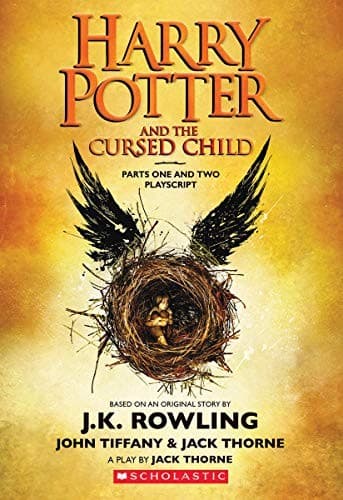
Decades after Voldemort's fall, Harry Potter's son, Albus, grapples with his father's legacy and a fractured timeline, risking everything to rewrite history and save those lost to time.
Nineteen years after the Battle of Hogwarts, Harry Potter is a harried Ministry of Magic official, and his youngest son, Albus Severus Potter, is preparing for his first year at Hogwarts. Unlike his famous father, Albus dreads the sorting ceremony and the weight of expectations. On the Hogwarts Express, he defies his family's legacy by befriending Scorpius Malfoy, son of Draco Malfoy, a bond that instantly sets them apart from other students and deepens Albus's sense of alienation. This friendship becomes the cornerstone of their shared journey through the wizarding world.
To Albus's dismay and his family's quiet shock, he is sorted into Slytherin House, further solidifying his feeling of not belonging. He struggles academically and socially, constantly overshadowed by his father's legend. Years later, Amos Diggory, still grieving the loss of his son Cedric, approaches Harry with a plea to use a newly discovered, illegal Time-Turner to save Cedric. Harry refuses, citing the dangers of altering time. However, Albus overhears this conversation and, fueled by a desire to prove himself and fix a past wrong, decides to take matters into his own hands.
Albus, Scorpius, and Delphi Diggory, Amos's 'niece,' conspire to steal the prototype Time-Turner from Hermione Granger's office at the Ministry of Magic. Delphi, a charismatic and manipulative figure, convinces the boys that saving Cedric is a noble cause. They successfully execute the heist and formulate a plan to go back to Cedric's fourth year at Hogwarts during the Triwizard Tournament. Their goal is to subtly humiliate Cedric during the first task, preventing him from winning and thus avoiding his tragic death.
The trio's first attempt to alter the past involves sabotaging Cedric during the first Triwizard task, making him look foolish. Upon returning to their present, they discover a significantly altered reality: Ron Weasley is married to Padma Patil, and Hermione Granger is a bitter, unmarried Potions teacher. This change stems from Ron's jealousy over Hermione's date to the Yule Ball, which now never happened in the original way. This immediate, drastic consequence highlights the unpredictable and dangerous nature of time travel.
Determined to fix their mistake, Albus and Scorpius travel back again, this time to the second Triwizard task, attempting to humiliate Cedric by making him lose his way in the lake. They return to an even grimmer present: Dolores Umbridge is the Headmistress of Hogwarts, and the school is a dark, oppressive place. Harry Potter is a cold, distant figure, and Albus finds himself in a world where he barely recognizes his family or friends. This timeline is a direct result of Cedric's extreme humiliation turning him into a Death Eater.
In this terrifying altered timeline, Scorpius discovers that Harry Potter was killed during the Battle of Hogwarts, which Voldemort won. Dolores Umbridge, now Headmistress, teaches a curriculum that glorifies pure-blood supremacy. Severus Snape, alive in this reality, leads a resistance movement with Ron and Hermione. Scorpius must convince them of the true timeline and seek their help to restore it, revealing the depths of loyalty and sacrifice among these alternate versions of beloved characters. This timeline underscores the catastrophic impact of their actions.
With the help of alternate Snape, Ron, and Hermione (who sacrifice themselves to help him), Scorpius manages to travel back one last time to prevent his past self from interfering in the Triwizard Tournament. He returns to the original present, with Albus by his side, relieved that their world is restored. However, their relief is short-lived as they realize Delphi has disappeared and her true intentions remain unknown. They discover a hidden prophecy that points to a sinister truth about Delphi's identity.
Albus and Scorpius uncover that Delphi is not Amos Diggory's niece but the secret daughter of Lord Voldemort and Bellatrix Lestrange, born in Malfoy Manor before the Battle of Hogwarts. Her goal is not to save Cedric, but to prevent Voldemort's death by ensuring his survival. They reveal this shocking truth to Harry, Ron, Hermione, and Ginny. Draco Malfoy, having observed his son's bond with Albus, finally understands the depth of their friendship and offers crucial assistance, revealing he possesses a more powerful, legal Time-Turner.
Using Draco's advanced Time-Turner, Harry and his allies travel back to October 30, 1981, the night before Voldemort's attack on the Potters, to stop Delphi from warning Voldemort. Harry disguises himself as Voldemort to lure Delphi, creating a tense and emotional confrontation. The group works together to overpower Delphi, ensuring that history remains on its original course. This final act of teamwork solidifies the bonds between the generations and former adversaries.
After Delphi is captured and sent to Azkaban, Harry and Albus return to their present. The traumatic events force Harry to confront his own past and the pressures he inadvertently placed on Albus. They share a poignant moment at Cedric Diggory's grave, acknowledging the complexities of loss and the burden of their shared history. Their relationship is mended, built on a newfound understanding and respect, as Albus finally feels accepted and valued by his father, and Harry embraces his son for who he is.
The Protagonist
Albus starts as a resentful, insecure teenager desperate to escape his father's shadow. He makes reckless decisions, driven by a desire to prove himself, which leads to catastrophic consequences. Through these trials, he learns the dangers of altering history and the value of his true friends. His arc culminates in a deeper understanding and reconciliation with Harry, accepting his identity and finding peace with his past.
The Deuteragonist / Best Friend
Scorpius begins as an isolated, rumor-plagued boy finding his only true friendship in Albus. He is initially dragged into Albus's schemes but quickly becomes the more responsible and strategic of the two. His journey involves facing the horrors of altered timelines, particularly the 'Voldemort Wins' reality, where he takes on a leadership role. He emerges stronger and more confident, solidifying his identity as a good person despite his lineage, and proving the power of his loyalty.
The Protagonist / Father Figure
Harry starts as a well-intentioned but flawed father, unable to connect with Albus, leading to conflict and resentment. He initially dismisses Albus's feelings and makes mistakes in communicating with him. Through the unfolding crisis and the revelation of Delphi's true nature, Harry is forced to confront his past and his parenting style. His arc culminates in a profound act of vulnerability and reconciliation with Albus, where he learns to accept his son for who he is.
The Antagonist
Delphi's arc is one of revelation and downfall. She begins as a seemingly benevolent figure, guiding Albus and Scorpius, but her true, sinister intentions are gradually exposed. Her ambition to resurrect Voldemort and her willingness to manipulate and harm others solidify her as a formidable villain. Her arc culminates in her defeat and capture, ensuring the original timeline's integrity, but leaving a chilling legacy as Voldemort's child.
The Supporting Character / Reformed Adversary
Draco begins as a somewhat isolated and resentful figure, still bearing the scars of his past. He is protective of Scorpius and initially suspicious of his friendship with Albus. However, witnessing the genuine bond between their sons and the catastrophic consequences of their actions forces him to re-evaluate his prejudices. His arc culminates in a moment of true alliance with Harry and the others, revealing his possession of a more powerful Time-Turner and showing genuine concern for the safety of both boys, signifying his full redemption.
This theme explores the immense pressure placed on the children of famous figures, particularly Albus Severus Potter, who struggles to live up to his father Harry's heroic reputation. It delves into the resentment and insecurity that can arise when one feels constantly compared to an idealized past, and how these pressures can lead to impulsive, dangerous actions. The story highlights the importance of forging one's own path and the challenge for parents to allow their children to be individuals.
“Albus: 'I don't need protection! I'm not a child! And I'm not you!'”
The deep bond between Albus Potter and Scorpius Malfoy is the emotional core of the play. Their friendship transcends family rivalries, house affiliations, and even the fabric of time itself. It is tested by manipulation, altered realities, and the very real dangers of their actions, yet it remains unwavering. The theme emphasizes that true friendship provides strength, loyalty, and acceptance, often being the most powerful force against loneliness and adversity, and a crucial element for survival.
“Scorpius: 'We're going to be okay, Albus. We're going to be okay.'”
A central cautionary theme, the play vividly demonstrates the catastrophic consequences of tampering with time. Even well-intentioned attempts to 'fix' history lead to drastically darker and more dangerous alternate realities. It underscores the idea that certain events, however tragic, are integral to the timeline and that interfering with them can unravel the very fabric of existence, leading to unforeseen horrors and highlighting the delicate balance of fate and consequence.
“Hermione: 'Time is a fickle thing. Any change, however small, can have a profound effect on the future.'”
The narrative explores the possibility of redemption, particularly through the character of Draco Malfoy. Having grown up under the shadow of his family's dark past, Draco now strives to be a good father and ultimately becomes an unexpected ally to Harry and his friends. It suggests that individuals can evolve beyond their past mistakes and prejudices, and that new generations can forge different paths, fostering understanding and cooperation even between former adversaries.
“Draco: 'Our sons are in danger. And a Malfoy and a Potter, whatever our differences, our sons are more important.'”
A dangerous relic of temporal manipulation.
The Time-Turner is the central plot device, initially a rare, Ministry-restricted magical artifact allowing travel to the past. The play features two versions: a limited prototype that allows for five minutes of travel, and a more powerful, illegal version. Its misuse by Albus and Scorpius drives the entire plot, leading to the creation of multiple, progressively darker alternate timelines. It serves as a powerful symbol of the allure and peril of rewriting history, demonstrating that even good intentions can have catastrophic consequences when meddling with the flow of time.
A cryptic foretelling of a dark lineage.
This newly revealed prophecy speaks of 'the Augurey,' a dark child born to a powerful dark wizard, destined to rise and restore their parent's power. It directly relates to Delphi's true identity as the daughter of Voldemort and Bellatrix. The prophecy acts as a crucial piece of exposition, revealing Delphi's sinister lineage and ultimate goal. It raises the stakes, transforming the mission from merely 'saving Cedric' to preventing the resurrection of Voldemort's reign, adding a layer of fated inevitability to Delphi's actions.
The 'What If?' scenarios of a broken past.
This device is a direct consequence of the Time-Turner's misuse. Each attempt by Albus and Scorpius to alter Cedric Diggory's fate creates a new, drastically different reality – from a world where Ron and Hermione never married, to one where Dolores Umbridge rules Hogwarts, and most dramatically, a 'Voldemort Wins' timeline where Harry Potter is dead. These alternate realities serve to highlight the butterfly effect of time travel, demonstrating the interconnectedness of events and the profound impact of even minor changes on the entire course of history, forcing the characters to confront the true horror of their actions.
“The world moves on, and we must move with it.”
— Spoken by Harry Potter, emphasizing the need to adapt to change.
“Sometimes, the things we lose have a way of coming back to us in the end.”
— Luna Lovegood's wisdom, though not directly in this play, the sentiment is echoed regarding lost time and relationships.
“Love blinds. We all know that.”
— Spoken by Delphi, manipulating others' emotions.
“Albus, I know you're not happy, but sometimes you just have to get on with things.”
— Ginny Weasley to her son Albus, urging him to face his responsibilities.
“It is a curious thing, Albus, but you are more like your father than you know.”
— Dumbledore's portrait to Albus, highlighting the similarities between father and son.
“We are all going to be okay. We are going to be fine.”
— Ron Weasley offering reassurance in a moment of crisis.
“The past is a stubborn thing.”
— Spoken by Scorpius Malfoy, acknowledging the difficulty of changing history.
“For the health of the world, we must find a way to live with the choices we have made.”
— Harry Potter, reflecting on the consequences of their actions and the need for acceptance.
“The greatest good for the greatest number.”
— A phrase used by a character, reflecting a utilitarian viewpoint.
“Being a father is a difficult thing.”
— Harry Potter, expressing the challenges of parenthood.
“Slytherin house will have a new kind of hero, you know.”
— Scorpius Malfoy, challenging stereotypes about Slytherin.
“It's time to let the past go.”
— Hermione Granger, advising on moving forward.
“Sometimes, the best way to help someone is just to be there.”
— A sentiment expressed by various characters, emphasizing the importance of presence and support.
Ready to see how well you understood this book? Take our interactive quiz with 10 questions.