BookBrief
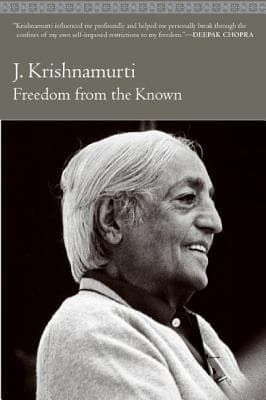
Freedom from the Known cover
Archivist's Choice

Freedom from the Known

Jiddu Krishnamurti (1959)

Genre

Psychology / Spirituality / Philosophy / Self-Help

Reading Time

120 min

Key Themes

See below

Track Your Reading

Sign in to track this book

Krishnamurti explores how freedom from ingrained thought leads to immediate self-liberation, changing society and personal connections.

Core Idea

Jiddu Krishnamurti states that true psychological freedom comes only when the mind breaks free from the 'known'—memory, experience, tradition, knowledge, and thought itself. This 'known' creates a rigid structure that stops direct perception, causes fear, and continues suffering. He suggests that real insight and an end to conflict happen not by adding to or changing the known, but by a sudden, complete end to its psychological control. This allows for an unconditioned state of being and observation without the past's distorting view.
Reading time
120 min
Difficulty
Hard
✓ Read this if...
You are seeking a radical, non-traditional approach to self-understanding and psychological liberation, questioning the very foundations of thought, memory, and societal conditioning.
✗ Skip this if...
You prefer practical, step-by-step self-help techniques or are looking for a gentle introduction to mindfulness or spiritual practices that involve building upon existing knowledge.

Core idea

The central argument and framework that powers the entire book.

Jiddu Krishnamurti states that true psychological freedom comes only when the mind breaks free from the 'known'—memory, experience, tradition, knowledge, and thought itself. This 'known' creates a rigid structure that stops direct perception, causes fear, and continues suffering. He suggests that real insight and an end to conflict happen not by adding to or changing the known, but by a sudden, complete end to its psychological control. This allows for an unconditioned state of being and observation without the past's distorting view.

At a glance

Reading time

120 min

Difficulty

Hard

Read this if...

You are seeking a radical, non-traditional approach to self-understanding and psychological liberation, questioning the very foundations of thought, memory, and societal conditioning.

Skip this if...

You prefer practical, step-by-step self-help techniques or are looking for a gentle introduction to mindfulness or spiritual practices that involve building upon existing knowledge.

Key Takeaways

1

The Tyranny of the Known

Our past experiences and accumulated knowledge hinder true understanding.

Quote

You must understand the whole structure and nature of the known, and only then is it possible for the mind to be free from the known.

Krishnamurti states that humans are trapped by the 'known' – all our experiences, memories, traditions, beliefs, and learned information. This known creates a psychological prison, stopping us from seeing reality freshly. Every new experience is filtered through the past, which prevents real understanding. The mind, shaped by centuries of thought, constantly seeks safety and familiarity within this known, even when it causes pain. To truly understand, one must be free from the past, observing without old conclusions or expectations. T...

Supporting evidence

Krishnamurti repeatedly refers to the mind as a 'bundle of memories,' 'conditioned by tradition,' and 'the result of the past,' emphasizing how this historical baggage prevents us from seeing 'what is' directly.

Apply this

When facing a new situation or conflict, consciously observe your immediate reactions and assumptions. Ask yourself if these reactions are truly based on the present moment or if they are echoes of past experiences and conditioning. Practice observing without judgment or interpretation based on prior knowledge.

conditioningmemorylistened-knowledge
2

Observation Without the Observer

True seeing occurs when the 'I' and its judgments are absent.

Quote

The observer is the observed. There is no division between the two.

This is a main point of Krishnamurti's philosophy: the insight that the 'observer' (the 'I,' the ego, the thinker) is not separate from the 'observed' (the thought, the feeling, the problem). We usually create a division, believing there's a 'me' watching 'my' anger, 'my' fear, or 'my' thoughts. This division causes conflict and stops solutions. When the observer identifies with what is observed, it creates a cycle of judgment, comparison, and resistance. True observation, then, is a state where the 'I' disappears, and there is only p...

Supporting evidence

He uses the example of fear: 'When you are afraid, you say, 'I am afraid.' Is that 'I' different from fear?' He argues that the 'I' is fear itself, not an entity experiencing it.

Apply this

When experiencing a strong emotion like anger or sadness, try to observe it without labeling it as 'my anger' or 'I am sad.' Instead, simply acknowledge the sensation or thought as it arises, without the 'I' stepping in to judge, suppress, or enhance it. Allow the emotion to be, without the subject-object split.

egoselfdualityawareness
3

The Illusion of Time as a Means

Psychological change cannot be achieved through gradual effort over time.

Quote

Time is a movement, and as long as you think in terms of time to achieve a psychological result, you are caught in the trap of becoming.

Krishnamurti strongly questions the idea that psychological change, like overcoming fear or reaching enlightenment, can be a slow process. He says that 'time' is a psychological invention that keeps suffering going. We believe we need time to change, to improve, to become 'better.' This belief in 'becoming' is a mistake, as it suggests a future state that is always out of reach and distracts us from the present moment. Real change, he argues, is an immediate end to the old, a direct perception in the present, not a slow progression. T...

Supporting evidence

He often criticizes the idea of 'evolution' in a psychological sense, stating, 'You cannot evolve into freedom. Freedom is not an end product of time.' He also speaks against practices that promise gradual self-improvement.

Apply this

Instead of setting a long-term goal to 'overcome anxiety,' try to directly observe anxiety *in the present moment* without projecting it into the future or thinking about how long it will take to dissipate. Focus on the immediate perception, not on a desired future state.

becomingpsychological-timetransformationinstantaneous-change
4

The Danger of Authority and Ideals

External authority and internal ideals prevent self-discovery.

Quote

To be free, you must be free of all authority, including that of the speaker.

Krishnamurti strongly rejects all forms of authority, whether religious, spiritual, political, or even a guru's authority. He states that truth cannot be found by following someone else's path or taking on another's ideas. Outside authority stops individual inquiry and creates dependence. Similarly, internal ideals – what we 'should be' or 'ought to do' – create a conflict with 'what is,' leading to hypocrisy and internal struggle. These ideals often come from conditioning and stop direct perception. Freedom means letting go of both o...

Supporting evidence

He consistently urged his listeners not to follow him or any other teacher, emphasizing that 'truth is a pathless land.' He also critiques the 'guru system' and organized religions for creating dependence.

Apply this

When seeking answers or guidance, critically examine the source of the information. Instead of blindly accepting, engage in your own direct observation and questioning. For personal ideals, instead of striving to 'be more patient,' observe your impatience directly without judgment or the pressure to conform to an ideal.

authorityidealsguruself-discovery
5

Thought as the Origin of Suffering

Our thought processes, not external events, are the root of psychological pain.

Quote

Thought is the origin of our problems, of our misery, of our chaos.

This is a deep and often challenging statement. Krishnamurti argues that thought, while useful for practical tasks, is the main cause of psychological suffering. Thought creates the 'me,' the ego, and then builds walls around it, causing fear, attachment, comparison, and the search for security. It invents the past and future, leading to regret and worry. Thought divides, judges, and idealizes, stopping us from experiencing life directly. The solution is not to stop thinking completely, but to understand thought's movement and limits,...

Supporting evidence

He often connects fear, loneliness, and sorrow directly to the activity of thought, stating that 'fear is the product of thought.' He also explains how thought creates the image of the 'self' that it then seeks to protect.

Apply this

When experiencing emotional pain, trace it back to the thoughts that are generating or sustaining it. Observe the narrative your mind is creating around the event. Can you distinguish the raw sensation from the interpretation and judgment of thought? This practice helps to disidentify from the suffering generated by the mind.

thought-processegosufferingpsychological-pain
6

Meditation is Not a Technique

True meditation is a state of choiceless awareness, not a practiced ritual.

Quote

Meditation is not a search, it is not a seeking, it is not a cultivation. It is a state of mind.

Krishnamurti distinguishes real meditation from common practices. He argues that most meditation techniques are still within the 'known' – they are efforts of the ego to reach a desired state, using methods and systems. This, he says, only makes the division between the meditator and the object of meditation stronger. Real meditation is not something you 'do' for a period; it is a state of being, an awareness that comes when the mind is free from thought, desire, and effort. It is a state of intense observation, where the mind is quie...

Supporting evidence

He criticizes specific techniques like mantra repetition or controlled breathing if they are used as a means to an end, emphasizing that 'truth is not a thing to be cultivated.'

Apply this

Instead of approaching meditation as a task, try to cultivate a state of choiceless awareness throughout your day. Observe sounds, sights, and thoughts as they arise without choosing to focus on one or push another away. Let your mind be receptive, without effort or struggle, even for brief moments.

choiceless-awarenessstillnessmindfulnessobservation
7

The Nature of Fear and How to End It

Fear is a product of thought about the past or future, not the present.

Quote

Fear is the product of thought. If there is no thought, there is no fear.

Krishnamurti states that fear is not a natural part of us but is created by thought. We are afraid of past events repeating, or of what might happen in the future. The 'present' moment, when seen directly, has no fear. Fear appears when thought projects itself into time, creating images of danger, loss, or pain. To end fear, one must observe it without thought getting in the way – without trying to escape it, justify it, or analyze it through the past. When fear is met with complete attention in the immediate present, its power fades ...

Supporting evidence

He challenges listeners to observe fear directly, asking, 'Can the mind look at fear without any word, without any image?' He emphasizes that the 'word' fear itself creates the continuity of fear.

Apply this

When you feel fear, pause and notice if your mind is projecting into the future or recalling a past event. Bring your attention fully to the physical sensations of fear in your body, without labeling them or creating a story around them. Observe the fear as a raw energy in the present moment, without resistance or identification.

fearthoughtpresent-momentpsychological-security
8

Love is Not Thought or Memory

True love is a state of being, free from attachment and image-making.

Quote

Love is not a memory. Love is not thought. Love is not desire.

Krishnamurti differentiates true love from what we often call love, which he argues is usually a mix of desire, attachment, memory, and projected images. When we say 'I love you,' we often mean 'I love the image I have of you,' or 'I love what you give me,' or 'I love the security you provide.' This is not love but a product of thought and self-interest. True love, for Krishnamurti, is a state of being that appears when the self, the ego, and its demands are absent. It is a state of deep attention, compassion, and sensitivity, without...

Supporting evidence

He often probes the nature of relationships, asking if 'love' is conditional or based on gratification, and if jealousy and possessiveness can coexist with real love. He states that 'love can only exist in freedom.'

Apply this

In your relationships, observe if your 'love' is based on expectations, demands, or images you've created of the other person. Try to interact without these projections, seeing the other person afresh, without the burden of past memories or future desires. Practice a non-demanding attention towards others.

attachmentdesirecompassionrelationship
9

The Ending is the Beginning

True creation and renewal arise from the complete cessation of the old.

Quote

It is only when there is an ending that there is a new beginning.

This idea shows the radical nature of Krishnamurti's teachings. For psychological change to happen, there must be a complete and immediate end to the known, the old patterns, the learned conditioning. This is not a change or a reform but a total stopping. Only when the mind is completely empty of the past, free from its burdens and distortions, can it truly see 'what is' and be open to the new, the unconditioned, the creative. This ending is not an act of will but a natural result of clear observation and understanding. It means a 'de...

Supporting evidence

He often speaks of the 'death to the past' as essential for living in the present, and how 'the freedom from the known is the death to the known.'

Apply this

When you recognize a habitual, unhelpful pattern of thought or behavior, instead of trying to modify it or gradually change it, try to see if you can allow that pattern to cease entirely in that moment. It's not about effort but about a complete, non-resistant observation that allows the old to fall away.

renewalcessationtransformationradical-change
10

Intelligence is Beyond Thought

True intelligence is a state of direct perception, not accumulated knowledge.

Quote

Intelligence is not knowledge. Intelligence is the capacity to see what is.

Krishnamurti distinguishes between mere intellect (which is the faculty of thought, memory, and learned knowledge) and true intelligence. Intellect, while useful for practical matters, is limited by the known and cannot bring psychological freedom. True intelligence is a much wider, deeper ability – it is the ability to see 'what is' directly, without distortion, interpretation, or the known getting in the way. It is a state of clarity, insight, and sharp sensitivity that comes when the mind is quiet, free from constant thought and th...

Supporting evidence

He often contrasts the 'cleverness of the mind' with 'intelligence,' highlighting how knowledge can make us clever but not necessarily intelligent in a deeper sense. He relates intelligence to 'seeing the truth instantaneously.'

Apply this

When faced with a complex problem, instead of immediately jumping to solutions based on past experiences or learned information, try to quiet your mind and observe the problem itself with fresh, open attention. Allow insight to emerge from this quiet observation, rather than forcing a solution through intellectual effort.

insightclaritydirect-perceptionwisdom

Critical analysis

Notable Quotes

You are accustomed to being told what to do, or to telling yourself what to do, and your mind is the result of all that. You have never been free to find out.

Krishnamurti challenges the reader's conditioned thinking.

The observer is the observed.

A central tenet, highlighting the non-duality of the one experiencing and what is experienced.

Truth is a pathless land.

Emphasizing that truth cannot be reached through any organized religion, dogma, or pre-set method.

Can the mind be free from the known?

The fundamental question posed throughout the book, exploring liberation from past knowledge and experience.

Security is a terrible thing.

Krishnamurti argues that the search for psychological security prevents true understanding and freedom.

To understand anything, you must live with it, you must observe it, you must know all its content, its nature, its structure, its movement.

Describing the process of deep, non-judgmental observation.

Comparison is a form of violence.

Highlighting how comparing oneself to others or an ideal creates conflict and suffering.

When you are free from all authority, from all tradition, from all dogma, from all gurus, then you are a light to yourself.

Advocating for self-reliance in spiritual and psychological exploration.

Sorrow is not separate from the observer.

Reiterating the 'observer is the observed' principle in the context of emotional suffering.

There is no end to sorrow if you are seeking comfort.

Suggesting that the avoidance of pain through comfort prolongs suffering.

Meditation is not a means to an end. It is both the means and the end.

Defining meditation not as a technique to achieve something, but as a state of being.

To look without the word is to be in a state of choiceless awareness.

Encouraging observation free from verbal labels, concepts, or judgments.

What is important is to be free of all psychological accumulation.

Emphasizing the liberation from the burden of past experiences, memories, and conditioning.

Can the mind be quiet, without any movement, without any image, without any thought?

Exploring the possibility of a truly silent and still mind, free from internal chatter.

Quiz

Test Your Knowledge

Ready to see how well you understood this book? Take our interactive quiz with 10 questions.

10
Questions
~5
Minutes
?
Best Score

Key Questions (FAQ)

'Freedom from the Known' emphasizes the urgent need for individuals to liberate themselves from all forms of psychological conditioning, including beliefs, traditions, and societal expectations. Krishnamurti argues that true freedom and understanding emerge only when the mind is unburdened by the past and the known.

About the author