BookBrief
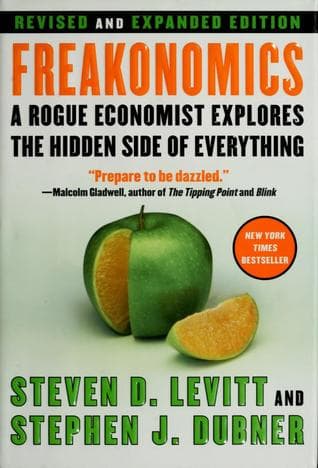
Freakonomics: A Rogue Economist Explores the Hidden Side of Everything cover
Archivist's Choice

Freakonomics: A Rogue Economist Explores the Hidden Side of Everything

Steven D. Levitt (2005)

Genre

Business / Politics / Economics / Finance / Science

Reading Time

12 Minutes

Key Themes

See below

Track Your Reading

Sign in to track this book

This book uses economic principles to reveal the surprising incentives behind everything from drug dealing and real estate to cheating teachers and the decline of crime.

Core Idea

Freakonomics proposes that economics is, at its heart, the study of incentives—how people get what they want or need, especially when resources are scarce. The book applies economic principles and rigorous data analysis to a wide range of unconventional and often surprising topics, from the economics of drug dealing to the impact of abortion on crime rates. It challenges conventional wisdom by demonstrating that the world is often more complex and counter-intuitive than it appears, revealing hidden connections and causes behind everyday phenomena.
Difficulty
Easy

Core idea

The central argument and framework that powers the entire book.

Freakonomics proposes that economics is, at its heart, the study of incentives—how people get what they want or need, especially when resources are scarce. The book applies economic principles and rigorous data analysis to a wide range of unconventional and often surprising topics, from the economics of drug dealing to the impact of abortion on crime rates. It challenges conventional wisdom by demonstrating that the world is often more complex and counter-intuitive than it appears, revealing hidden connections and causes behind everyday phenomena.

At a glance

Difficulty

Easy

Key Takeaways

1

The Power of Incentives

Understanding human behavior requires dissecting the incentives at play, not just stated intentions.

Quote

Economics is, at root, the study of incentives — how people get what they want, or need, especially when other people want or need the same thing.

This book's main idea, and its best contribution, is that incentives explain most human behavior, from teachers cheating to drug dealers' choices. People respond predictably to rewards and punishments, even if those incentives are subtle or accidental. The key is finding these hidden incentives, which often go against common beliefs. For example, a teacher might cheat to improve test scores if their job or bonus depends on it, rather than out of a desire for student learning. This framework helps us understand why people act as they d...

Supporting evidence

The analysis of sumo wrestlers and school teachers cheating due to performance-based incentives (rankings, bonuses, job security) directly illustrates how powerful incentives can distort behavior.

Apply this

When trying to understand or change behavior, look beyond superficial explanations and identify the explicit and implicit incentives driving the actions. Design systems that align desired outcomes with appropriate incentives.


2

Conventional Wisdom is Often Wrong

Many widely accepted beliefs lack empirical support and can obscure the true causes of phenomena.

Quote

The conventional wisdom is often wrong. It's not just an innocent mistake; it's often a self-serving lie.

Levitt shows repeatedly how 'conventional wisdom'—ideas widely accepted without strong proof—can be misleading or even harmful. These beliefs often support existing power structures or simplify complex situations, preventing a deeper understanding. For example, the widespread fear of 'superpredators' in the 1990s, which predicted a rise in violent youth crime, was a common belief that turned out to be wrong. By questioning these assumptions and using data, Levitt uncovers surprising truths. This takeaway encourages skepticism toward p...

Supporting evidence

The book's entire premise challenges conventional wisdom, such as the initial belief that parental actions are the dominant factor in a child's success, or the exaggerated dangers of certain activities (e.g., stranger abduction vs. swimming pools).

Apply this

Before accepting a common belief, ask for the evidence. Be prepared to challenge long-held assumptions, especially when they are presented without data or serve a particular agenda.

3

Correlation vs. Causation

Just because two things happen together doesn't mean one causes the other; establishing causality is crucial.

Quote

Correlation does not imply causation.

A repeated idea, though not always stated directly, is the difference between correlation and causation. Levitt is good at finding situations where two things seem linked, but the real cause is indirect, coincidental, or due to a third, unseen factor. The chapter on parenting and child development is a good example: many parental actions are linked to good child outcomes, but the book argues that many of these are just correlations with good parenting, not causes themselves. The child's genes or home environment might be the real caus...

Supporting evidence

The discussion on parenting, where many parental actions (reading to children, visiting museums) correlate with higher test scores but don't necessarily cause them, instead reflecting the type of parents who engage in such activities.

Apply this

When encountering statistical relationships, always ask: 'Is A causing B, or is B causing A, or is there a C causing both A and B?' Avoid drawing causal conclusions without robust evidence or controlled experiments.

4

The Hidden Side of Everything

Beneath the surface of seemingly simple phenomena lie complex, often counterintuitive, realities.

Quote

The modern world, despite a surfeit of obfuscation, complication, and downright deceit, is not impenetrable, is not unknowable, and — if the right questions are asked — is even more intriguing than we think.

Levitt's main method is to strip away assumptions and common beliefs to find the 'hidden side.' He does this by looking at drug dealing, where the idea of kingpins earning huge amounts is disproven by data showing most street dealers make minimum wage and live with their mothers. Similarly, real estate agents often prioritize their own commission over their client's best selling price, a hidden conflict of interest. This idea stresses the importance of looking past appearances and official stories to find the real workings of things. ...

Supporting evidence

The chapter on drug dealers, revealing that foot soldiers earn very little, despite the perception of drug dealing as highly lucrative, and the hierarchical structure mirroring a corporation.

Apply this

Cultivate a curious mindset, always asking 'why?' and 'what's really going on here?' when faced with social or economic phenomena. Don't accept surface-level explanations at face value.

5

Small Causes, Big Effects

Seemingly minor or obscure factors can have profound and widespread impacts.

Quote

A small adjustment in incentives can lead to a huge change in behavior.

One of Levitt's most debated and significant arguments is that legalizing abortion through Roe v. Wade in 1973 had a big, though delayed, effect on the sharp drop in violent crime rates two decades later. His analysis suggests that by reducing the number of unwanted children born into poverty and disadvantage, the number of potential future criminals was significantly lowered. This argument shows how a single policy decision, seemingly unrelated to crime, could have a huge societal effect. It questions common explanations for crime re...

Supporting evidence

The extensive analysis linking the legalization of abortion (Roe v. Wade) to the subsequent decline in crime rates in the 1990s, arguing it reduced the pool of future criminals.

Apply this

When analyzing social problems, consider a wider range of potential causal factors, including those that seem historically or contextually distant. Policies often have ripple effects that are not immediately obvious.

6

Information Asymmetry and Exploitation

When one party has more information, they can exploit the less informed party.

Quote

If a person is paid for his expertise, his incentive is to protect his turf.

The book clearly shows how unequal information creates chances for exploitation. Real estate agents, for example, know much more about the housing market and properties than their clients. Levitt shows that agents tend to sell their own homes for much more money and keep them on the market longer than their clients' homes, suggesting they prioritize their higher commission on their own sale. Similarly, car mechanics, doctors, or lawyers often have specialized knowledge that clients lack, letting them recommend services that might not ...

Supporting evidence

The analysis of real estate agents, showing they sell their own homes for more money and keep them on the market longer than their clients' homes, due to the incentive structure.

Apply this

Always be wary when a professional's incentives might not perfectly align with your own. Seek multiple opinions, educate yourself, and question recommendations, especially when significant financial decisions are involved.

7

The Economics of Crime

Criminal behavior, like other economic activities, is often a rational response to incentives.

Quote

Criminals are rational actors who respond to incentives, just like everyone else.

Levitt challenges the romantic or purely sociological views of crime, instead seeing it as an economic activity driven by rational (though perhaps morally wrong) choices. The decision to commit a crime is often a cost-benefit analysis: the possible reward versus the risk of getting caught and the punishment's severity. The chapter on drug gang economics shows this well, presenting its structure as a typical business hierarchy, with most 'employees' (street dealers) earning very little. This view shifts the focus from inherent 'evil' t...

Supporting evidence

The detailed breakdown of a crack gang's finances, showing the low wages of street dealers and the business-like structure, and the analysis of crime rates responding to policing changes (e.g., more police leading to less crime).

Apply this

When addressing crime or other 'undesirable' behaviors, analyze the economic incentives (rewards, risks, alternatives) facing individuals. Policy interventions should focus on altering these incentives rather than solely on moral condemnation.

8

Fear as a Manipulative Tool

Fear is often exaggerated and used to manipulate public perception and behavior.

Quote

The things that scare us are not always the things that are most dangerous.

This idea is well shown by comparing the perceived danger of guns versus swimming pools. Despite widespread fear of gun violence, Levitt points out that children are statistically much more likely to drown in a swimming pool than to die from a gun accident. This difference happens because media, politicians, and interest groups often exaggerate rare, dramatic risks (like stranger abduction or school shootings) while downplaying more common dangers. Fear can be a strong tool for manipulation, guiding public policy, consumer choices, an...

Supporting evidence

The comparison of risks, such as a child being more likely to drown in a swimming pool than to die from a gun accident, and the exaggerated fear of stranger abduction versus known risks.

Apply this

When confronted with alarming statistics or news, critically evaluate the actual probability and context of the risk. Question who benefits from exaggerating certain dangers and downplaying others.

9

The Value of Data and Asking the Right Questions

Uncovering truths requires both access to data and the intellectual courage to ask unconventional questions.

Quote

All it takes is a new way of looking. Steven Levitt, through devilishly clever and clear-eyed thinking, shows how to see through all the clutter.

Levitt's whole approach depends on two key things: having large amounts of data and being willing to ask questions that others think are too small, too controversial, or too obvious to investigate. He often starts with a simple, unasked question and then looks at data (e.g., test scores, crime statistics, KKK membership records) to find answers, even if they challenge established norms. This shows that insights do not always come from having 'better' theories, but from carefully analyzing real-world data, without being limited by acad...

Supporting evidence

Levitt's use of diverse data sets, from school test scores to crime statistics to membership rolls of the Ku Klux Klan, to answer seemingly disparate questions.

Apply this

Approach problems with intellectual curiosity and a willingness to question assumptions. Prioritize data collection and analysis over intuition or anecdotal evidence, especially when seeking to understand complex social phenomena.

10

Economics as a Lens for Life

Economic principles can illuminate a vast range of human activities beyond traditional finance.

Quote

If morality represents how we would like the world to work, then economics represents how it actually does work.

This last idea covers the book's broader goal: to show that economics, as the study of incentives and scarcity, is not just about markets and money. It is a powerful way to understand almost any human behavior, from cheating in schools to how a criminal enterprise works, from parenting decisions to historical changes in crime rates. By applying economic reasoning to unusual topics, Levitt expands the perceived usefulness of the field, making it accessible and relevant to everyday life. This perspective encourages readers to adopt an '...

Supporting evidence

The diverse range of topics covered in the book—from sumo wrestling to drug dealing to parenting—all analyzed through an economic lens, demonstrating its broad applicability.

Apply this

Apply an 'economic way of thinking' to everyday situations. Identify the incentives, costs, and benefits in various decisions and interactions, even those not traditionally considered 'economic.'

Critical analysis

Notable Quotes

Quiz

Test Your Knowledge

Ready to see how well you understood this book? Take our interactive quiz with 10 questions.

10
Questions
~5
Minutes
?
Best Score

Key Questions (FAQ)

Freakonomics is about applying economic principles, particularly the study of incentives, to understand unconventional topics like crime, cheating, and parenting. It explores the hidden side of everyday life by asking questions that challenge conventional wisdom.

About the author