BookBrief
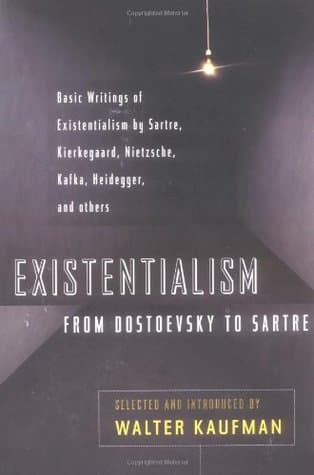
Existentialism from Dostoevsky to Sartre cover
Archivist's Choice

Existentialism from Dostoevsky to Sartre

Walter Kaufmann (1965)

Genre

Psychology / Reference / History / Philosophy

Reading Time

10-15 hours (for careful reading and reflection)

Key Themes

See below

Track Your Reading

Sign in to track this book

Kaufmann explores the anxieties and freedoms of existential thought through the writings of Dostoevsky, Nietzsche, and Sartre.

Core Idea

Walter Kaufmann's 'Existentialism from Dostoevsky to Sartre' collects primary texts and commentary. It argues that existentialism is not a single system but a widespread idea emphasizing individual freedom, responsibility, and facing a meaningless universe. The book shows how figures like Dostoevsky, Kierkegaard, Nietzsche, Heidegger, and Sartre dealt with anguish, loneliness, despair, and the need to create meaning through action. Kaufmann believes existentialism, in its many forms, consistently pushes individuals to accept their freedom and the task of self-creation.
Reading time
10-15 hours (for careful reading and reflection)
Difficulty
Hard
✓ Read this if...
You want a comprehensive, primary-source-driven introduction to the core tenets and historical development of existentialist thought, from its literary origins to its philosophical zenith, curated and contextualized by a leading scholar.
✗ Skip this if...
You are looking for a light, simplified overview of existentialism or prefer a single author's analytical interpretation without engaging directly with original philosophical and literary texts.

Core idea

The central argument and framework that powers the entire book.

Walter Kaufmann's 'Existentialism from Dostoevsky to Sartre' collects primary texts and commentary. It argues that existentialism is not a single system but a widespread idea emphasizing individual freedom, responsibility, and facing a meaningless universe. The book shows how figures like Dostoevsky, Kierkegaard, Nietzsche, Heidegger, and Sartre dealt with anguish, loneliness, despair, and the need to create meaning through action. Kaufmann believes existentialism, in its many forms, consistently pushes individuals to accept their freedom and the task of self-creation.

At a glance

Reading time

10-15 hours (for careful reading and reflection)

Difficulty

Hard

Read this if...

You want a comprehensive, primary-source-driven introduction to the core tenets and historical development of existentialist thought, from its literary origins to its philosophical zenith, curated and contextualized by a leading scholar.

Skip this if...

You are looking for a light, simplified overview of existentialism or prefer a single author's analytical interpretation without engaging directly with original philosophical and literary texts.

Key Takeaways

1

The Burden of Freedom

Existence precedes essence, placing the full weight of self-definition on the individual.

Quote

Man is condemned to be free; because once thrown into the world, he is responsible for everything he does.

Existentialism states that human existence comes before any set purpose. Unlike an object made with a purpose, humans are simply 'thrown into the world' and must create their own meaning and identity through choices and actions. This freedom is a heavy burden, meaning we are fully responsible for who we become. There is no divine plan or inherent human nature; every decision shapes our being and defines what it means to be human for ourselves and others. This absolute freedom requires absolute responsibility, which can cause anguish.

Supporting evidence

Sartre's lecture 'Existentialism is a Humanism' directly argues this core tenet, emphasizing that there is no universal human nature and each individual must create their own values and meaning through their choices.

Apply this

Embrace the responsibility of your choices. Recognize that procrastination or indecision is also a choice that shapes your being. Act with intention, knowing that your actions define you and contribute to the definition of humanity.


existence-precedes-essenceradical-freedomresponsibilityanguish
2

The Absurdity of Existence

Confronting the inherent meaninglessness of a universe devoid of intrinsic purpose.

Quote

There is but one truly serious philosophical problem, and that is suicide. Judging whether life is or is not worth living amounts to answering the fundamental question of philosophy.

The 'absurd' comes from the conflict between humanity's wish for meaning and clarity, and the cold indifference of a universe that offers none. Life itself has no inherent purpose. This realization can lead to despair, but for existentialists like Camus, it is a starting point for action. Instead of giving in to nihilism or seeking false comfort, one must accept the absurdity, acknowledge the lack of ultimate meaning, and choose to live passionately, creating meaning within this framework. It is a defiant embrace of life despite its l...

Supporting evidence

Camus' 'The Myth of Sisyphus' vividly illustrates this through the metaphor of Sisyphus, who is condemned to eternally push a boulder up a hill, only for it to roll back down. Camus concludes that 'one must imagine Sisyphus happy' in his conscious rebellion against his fate.

Apply this

Instead of searching for a pre-ordained purpose, actively create your own meaning through engagement with life, relationships, art, or personal projects. Find joy and defiance in the struggle, knowing that your choices imbue your existence with significance.

the-absurdmeaninglessnessrebellionnihilism
3

Anguish, Forlornness, Despair

The emotional manifestations of confronting radical freedom and responsibility.

Quote

When we speak of forlornness, we mean also that man is alone, with no excuses. If, indeed, existence precedes essence, man is responsible for what he is.

Sartre points to three main emotional states that come from the existential condition. Anguish is the deep feeling that comes from realizing the weight of one's absolute freedom and responsibility, for oneself and for all humanity through one's choices. Forlornness (or 'abandonment') comes from realizing there is no God, no given values, and no external authority to guide or justify our choices; we are alone in creating our morality. Despair is the understanding that we can only rely on our own actions and the world's probabilit...

Supporting evidence

Sartre's 'Existentialism is a Humanism' elaborates on these concepts, using examples like the military leader whose decision affects countless lives, demonstrating the anguish of responsibility.

Apply this

Acknowledge these feelings when they arise. Instead of letting them paralyze you, use them as a catalyst for conscious decision-making. Understand that these emotions are signs of your engagement with the fundamental truths of existence, prompting authentic action.

anguishforlornnessdespairresponsibility
4

Authenticity vs. Bad Faith

Living genuinely by embracing freedom and responsibility, or denying it through self-deception.

Quote

Man is a useless passion.

Authenticity is the conscious choice to accept one's freedom and responsibility, acknowledging that there is no external reason for one's actions. It means living according to one's subjective experience, making choices that truly reflect one's self-created values, and owning those choices. 'Bad faith' (mauvaise foi) is self-deception where individuals deny their freedom and responsibility, often by pretending to be an object controlled by external forces (e.g., 'I couldn't help it,' 'I'm just following orders,' 'that's just how I am'...

Supporting evidence

Sartre's famous example of the waiter who performs his role with excessive, mechanical precision, attempting to fully 'be' a waiter rather than a free consciousness who chooses to wait tables, illustrates bad faith.

Apply this

Regularly question your motivations. Are you acting out of genuine choice, or are you trying to escape responsibility by claiming external forces or predefined roles dictate your behavior? Strive to align your actions with your conscious self-definition, even when it's uncomfortable.

authenticitybad-faithself-deceptionfreedom
5

The Leap of Faith (Kierkegaard)

Embracing the irrational and subjective truth over objective certainty in the face of despair.

Quote

The absurd is not a category which can be recognized, but a category which must be experienced.

For Søren Kierkegaard, an early existentialist, realizing life's inherent meaninglessness and reason's inability to provide ultimate answers leads to a deep crisis. This crisis can only be solved through a 'leap of faith'—a strong, personal commitment to something (often God) that goes against rational explanation and objective proof. This is not blind belief but a personal choice to accept the absurd and find meaning through an act of will, accepting the inherent paradoxes and uncertainties. It is a move from aesthetic and ethical st...

Supporting evidence

Kierkegaard's 'Fear and Trembling' examines Abraham's sacrifice of Isaac as the ultimate 'teleological suspension of the ethical,' where a divine command (a subjective, absurd truth) overrides universal moral law, requiring a leap of faith beyond reason.

Apply this

When faced with profound uncertainty or a lack of objective answers, consider what you are willing to commit to passionately, even if it lacks rational justification. This doesn't necessarily mean religious faith, but a deep, personal commitment to a project, relationship, or value that brings subjective meaning.

leap-of-faithsubjective-truthirrationalitykierkegaard
6

The Will to Power (Nietzsche)

Overcoming nihilism by affirming life and creating one's own values through self-mastery.

Quote

That which does not kill us makes us stronger.

Nietzsche, another early figure, faced the 'death of God' and the nihilism that followed. Instead of despair, he proposed the 'will to power'—not as control over others, but as an inner drive for self-improvement, growth, and creating one's own values. In a world without inherent meaning or objective morality, individuals must become 'overmen' (Übermensch) who go beyond conventional morality and create their own, life-affirming values. This means accepting suffering and challenge as chances for growth, saying 'yes' to life in all its ...

Supporting evidence

Nietzsche's concept of the 'eternal recurrence,' where one must live each moment as if they would relive it infinitely, forces individuals to affirm life and choose their actions with ultimate responsibility, driving the will to power.

Apply this

Identify areas where you are constrained by external values or self-imposed limitations. Challenge yourself to overcome them, not for external validation, but for personal growth and the creation of your own meaningful life. Embrace difficulties as opportunities to strengthen your will.

will-to-powernihilismubermenschvalue-creationnietzsche
7

Dostoevsky's Underground Man

The rebellion against rationalism and the embrace of irrational, destructive freedom.

Quote

I say that if God did not exist, everything would be permitted. That is the starting point of existentialism.

Dostoevsky's 'Notes from Underground' features a character who rejects the Enlightenment's belief in reason, progress, and usefulness. The Underground Man deliberately chooses irrationality, spite, and self-destruction over any system that tries to explain or predict human behavior. He champions the human capacity for arbitrary will, even if it is self-defeating, as the ultimate proof of freedom. This character explores early existential themes: rebellion against imposed meaning, preferring suffering and freedom over a 'crystal palace...

Supporting evidence

The Underground Man's refusal to be 'reduced to a set of calculations' and his deliberate choice to act against his own perceived best interest simply to assert his freedom demonstrates this concept.

Apply this

Recognize the human tendency to resist being categorized or fully understood. While not advocating for self-destruction, understand that true freedom sometimes involves choices that defy conventional logic or societal expectations, and respect that in yourself and others.

underground-manirrationalityrebelliondostoevskyfreedom
8

The Look of the Other

How the gaze of others shapes our self-perception and can objectify or validate our being.

Quote

I exist for myself as a for-itself, but I exist for the other as a in-itself.

Sartre's idea of 'the Look' (le Regard) explores how other people's consciousness affects our own. When another person looks at us, we become an object in their world, defined by their perception. This can cause shame and alienation, as their gaze tries to fix our fluid, subjective 'for-itself' into a static 'in-itself.' We lose our absolute freedom for a moment, becoming aware of ourselves as seen by another. This is central to how people interact and shows the constant tension between our subjective freedom and our objective existen...

Supporting evidence

Sartre's example of hearing footsteps in a corridor and realizing someone is looking at him through a keyhole, instantly transforming him from a free subject to an object of observation, illustrates the power of 'the Look.'

Apply this

Be aware of how you present yourself and how you perceive others. Recognize that while others' perceptions can influence you, you retain the ultimate freedom to define yourself through your actions, rather than being confined by their gaze. Practice empathy, understanding the other's subjective world.

the-lookintersubjectivityobjectificationshamesartre
9

Engagement and Action

Meaning is not found, but created through committed action in the world.

Quote

There is no reality except in action.

Existentialism is not a philosophy of passive thought or despair, but one that requires active 'engagement.' Since existence comes before purpose, and there is no inherent meaning, individuals must actively create their values and define themselves through their choices and actions. This means taking responsibility for one's situation, committing to projects, and participating in the human condition. It is a call to move beyond abstract thought into concrete action, recognizing that our being is made up of what we do. True freedom is ...

Supporting evidence

Sartre's political activism and his emphasis on the writer's responsibility to engage with social and political issues exemplify this call to action, arguing that even inaction is a form of action.

Apply this

Don't wait for inspiration or perfect conditions. Identify a value or goal that resonates with you and take concrete steps towards it, however small. Understand that your identity is built through these actions, not just through your thoughts or intentions.

engagementactionmeaning-creationresponsibility
10

The Embrace of the Finite

Acknowledging death and limitation as essential aspects of human existence that give life urgency.

Quote

Death is the possibility of the absolute impossibility of Dasein.

While not always called 'death positivity,' many existential thinkers stress the important role of finitude and death in human experience. Heidegger argues that our awareness of death (being-towards-death) is not morbid but fundamental to authentic existence. It forces us to face the limited nature of our time and possibilities, giving urgency to our choices. If life were endless, our decisions might hold less weight. Similarly, accepting limits—whether personal, societal, or cosmic—is essential for authentic living. Trying to escape ...

Supporting evidence

Heidegger's concept of 'Dasein' (being-there) and its inherent 'being-towards-death' in 'Being and Time' underscores how the awareness of our own mortality structures our experience and possibilities.

Apply this

Reflect on your mortality not with fear, but as a motivator to live meaningfully. Prioritize what truly matters, make the most of your time, and accept the limitations that are inherent to the human condition, using them as a framework for purposeful living.

finitudedeathauthenticityheideggerurgency

Critical analysis

Notable Quotes

Man is condemned to be free; because once thrown into the world, he is responsible for everything he does.

Sartre's lecture 'Existentialism is a Humanism,' discussing the core of existential freedom and responsibility.

If God does not exist, everything is permitted.

Dostoevsky's 'The Brothers Karamazov,' often cited by existentialists to highlight the implications of atheism for morality.

Existence precedes essence.

Sartre's foundational statement of existentialism, meaning humans first exist and then define themselves through their actions.

We must imagine Sisyphus happy.

Camus's 'The Myth of Sisyphus,' concluding that despite the absurdity of life, one can find joy in the struggle.

The only way to deal with an unfree world is to become so absolutely free that your very existence is an act of rebellion.

Attributed to Camus, reflecting a spirit of defiance against oppressive realities.

Hell is other people.

Sartre's play 'No Exit,' referring to the inescapable judgment and objectification by others.

Man is a useless passion.

Sartre's 'Being and Nothingness,' expressing the idea that human desire to be a 'being-in-itself-for-itself' is ultimately futile.

The absurd is born of this confrontation between the human need and the unreasonable silence of the world.

Camus's 'The Myth of Sisyphus,' defining the concept of the absurd.

One does not become enlightened by imagining figures of light, but by making the darkness conscious.

Jung, whose ideas often intersect with existential themes of self-discovery and confronting one's shadow.

To be is to be perceived.

Berkeley's idealism, though not strictly existentialist, touches on themes of reality and perception explored within existential thought.

The meaning of life is that it stops.

Kafka, whose works often explore themes of alienation and the brevity of existence, resonating with existential dread.

Anxiety is the dizziness of freedom.

Kierkegaard's 'The Concept of Anxiety,' describing the inherent dread that comes with the infinite possibilities of human freedom.

Truth is subjectivity.

Kierkegaard's radical claim that genuine truth is not objective but found in passionate, personal commitment.

Man is nothing else but what he makes of himself.

Sartre's 'Existentialism is a Humanism,' emphasizing self-creation and the absence of a predetermined human nature.

Quiz

Test Your Knowledge

Ready to see how well you understood this book? Take our interactive quiz with 10 questions.

10
Questions
~5
Minutes
?
Best Score

Key Questions (FAQ)

Existentialism is a philosophical movement emphasizing individual existence, freedom, and responsibility. It posits that humans define their own meaning in life, often in the face of an absurd or meaningless world, through their choices and actions.

About the author