BookBrief
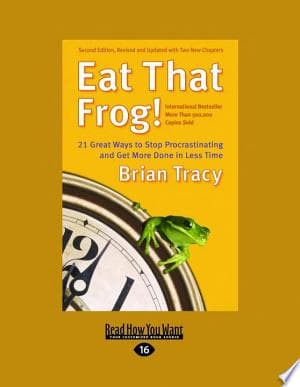
Eat That Frog! cover
Archivist's Choice

Eat That Frog!

Brian Tracy (2008)

Genre

Productivity / Self-Help

Reading Time

90 min

Key Themes

See below

Track Your Reading

Sign in to track this book

Tackle your hardest task first to boost productivity and achieve more.

Core Idea

The main idea of "Eat That Frog!" is that to stop putting things off and be productive, you should find your most important and often hardest task of the day (your 'frog') and do it first thing in the morning. Finishing this big task before anything else builds momentum, lowers stress, and ensures important work gets done. The book suggests that lasting success comes from consistently using this rule, along with good planning and disciplined work.
Reading time
90 min
Difficulty
Easy
✓ Read this if...
You struggle with procrastination, feel overwhelmed by your to-do list, or want a straightforward, actionable system to improve your daily productivity and focus on high-impact tasks.
✗ Skip this if...
You are looking for deep psychological insights into procrastination or complex productivity frameworks; this book offers practical, direct tactics rather than extensive theoretical exploration.

Core idea

The central argument and framework that powers the entire book.

The main idea of "Eat That Frog!" is that to stop putting things off and be productive, you should find your most important and often hardest task of the day (your 'frog') and do it first thing in the morning. Finishing this big task before anything else builds momentum, lowers stress, and ensures important work gets done. The book suggests that lasting success comes from consistently using this rule, along with good planning and disciplined work.

At a glance

Reading time

90 min

Difficulty

Easy

Read this if...

You struggle with procrastination, feel overwhelmed by your to-do list, or want a straightforward, actionable system to improve your daily productivity and focus on high-impact tasks.

Skip this if...

You are looking for deep psychological insights into procrastination or complex productivity frameworks; this book offers practical, direct tactics rather than extensive theoretical exploration.

Key Takeaways

1

Eat the Biggest Frog First

Tackle your most important, most challenging task at the start of your day.

Quote

If it's your job to eat a frog, it's best to do it first thing in the morning. And if it's your job to eat two frogs, it's best to eat the biggest one first.

The main idea of 'Eat That Frog!' is that your 'frog' is your biggest, most important task. This is the task you are most likely to put off, but it will have the greatest positive effect on your life or work. By tackling and finishing this task first thing in the morning, you build momentum, reduce stress, and ensure important work gets done. This is not just about clearing your plate; it is about choosing high-value activities over low-value ones. The good feeling from finishing a big task early in the day sets a positive tone and fr...

Supporting evidence

Tracy doesn't cite specific studies but relies on the common human tendency to procrastinate on difficult tasks. He argues that the feeling of accomplishment after tackling the 'frog' provides a self-reinforcing positive feedback loop.

Apply this

Identify your single most important task for tomorrow before you go to bed tonight. The next morning, before checking emails, social media, or engaging in any other activity, dedicate yourself entirely to completing that task. Do not move on until it is finished.


priority-management
2

Plan Your Day the Night Before

Invest a few minutes to organize your next day's tasks for clarity and focus.

Quote

Every minute you spend in planning saves ten minutes in execution.

Good daily planning is essential for productivity. Tracy highlights the benefit of writing down your to-do list for the next day at the end of the current workday. This simple habit lets your subconscious mind work on your tasks overnight, often leading to clearer solutions and a more focused approach when you start your day. It removes the wasted time and mental energy spent trying to decide what to do next. A well-organized list means you can immediately start productive work, instead of getting sidetracked by small decisions or dis...

Supporting evidence

Tracy refers to this as the '6 P's Formula': Proper Prior Planning Prevents Poor Performance. He asserts that the act of writing solidifies intentions and improves execution.

Apply this

Each evening, take 10-15 minutes to create a detailed to-do list for the next day. List all tasks, then prioritize them using the A-B-C-D-E method (explained in a later takeaway). This clears your mind and prepares you for immediate action upon waking.

time-managementtask-prioritization
3

Apply the 80/20 Rule Relentlessly

Focus on the vital few tasks that yield the majority of your results.

Quote

Always resist the temptation to clear up small things first. Remember the 80/20 Rule: 20 percent of your activities will account for 80 percent of your results.

The Pareto Principle, or the 80/20 Rule, is a helpful way to look at your productivity. Tracy says that a small part of your tasks will lead to most of your valuable results. The key insight here is that not all tasks are equally important. Many people get busy with low-value activities, feeling productive without actually making progress on their most important goals. By consciously finding and focusing your energy on the 20% of tasks that produce 80% of your results, you can greatly increase what you achieve. This rule encourages st...

Supporting evidence

Tracy applies the Pareto Principle (80/20 Rule) to nearly every aspect of work and life, from sales (20% of customers provide 80% of revenue) to tasks (20% of tasks produce 80% of results).

Apply this

Before starting any task, ask yourself: 'Is this part of the 20% of activities that will give me 80% of my desired results?' If not, question its importance or delegate it. Prioritize your 'A' tasks (most important) using this filter.

pareto-principlestrategic-focus
4

Use the A-B-C-D-E Method

Categorize your tasks by importance and urgency for clear action.

Quote

The ABCDE Method is a powerful priority-setting technique that you can use every single day.

Once you have a list of tasks, the next step is to prioritize them well. The A-B-C-D-E method gives a simple yet strong way to do this. 'A' tasks are your 'frogs'—the most important, high-value tasks you must do. 'B' tasks are important but less critical than 'A's, with minor consequences if not done. 'C' tasks are nice to do but have no real consequences. 'D' tasks are ones you can delegate, freeing up your time for 'A' tasks. 'E' tasks are those you can remove completely, as they offer little value. This system makes you think caref...

Supporting evidence

Tracy frames this as a practical, actionable method to immediately apply to any to-do list, ensuring that time is always spent on the most impactful activities.

Apply this

After creating your daily task list, go through each item and assign it a letter: A (must do), B (should do), C (nice to do), D (delegate), E (eliminate). Crucially, never do a 'B' task until all 'A' tasks are complete, and so on.

task-managementprioritization-framework
5

Focus on Key Result Areas

Identify and excel in the specific outcomes you are responsible for.

Quote

Your key result areas are the results you absolutely, positively have to get to fulfill your responsibilities.

To be truly productive, you must understand what 'results' mean in your role. Key Result Areas (KRAs) are the specific outcomes you are responsible for, and by which your performance is measured. If you are unsure about your KRAs, it is easy to get lost in busywork that does not help your main goals. Tracy urges people to identify 5-7 KRAs and then rate themselves on a scale of 1-10 for each. This self-assessment shows weak areas that, if improved, would greatly boost overall performance and value. Mastering your KRAs means consistent...

Supporting evidence

Tracy suggests asking your boss for clarification on your KRAs if they aren't clear, emphasizing that clarity is paramount for effective work.

Apply this

List 5-7 key result areas for your job or personal goals. For each KRA, rate your current performance from 1-10. Then, identify one 'frog' task that, if completed, would significantly improve your score in your lowest-rated KRA.

performance-metricsgoal-setting
6

Practice Single Handling

Concentrate all your energy on one task until it is 100% complete.

Quote

Once you begin an important task, discipline yourself to stick with it until it is 100 percent complete.

In a time of constant distractions and multitasking, 'single handling' is a strong solution. This rule means starting one important task and giving it your full, undivided attention until it is completely finished. The negative effects of switching tasks—lost time, more errors, and lower quality—are often underestimated. By committing to single handling, you build momentum, reach flow states, and produce better work in less time. It takes discipline to avoid checking emails, answering texts, or switching to another task, but the rewar...

Supporting evidence

Tracy notes that the average person is interrupted every 8 minutes and takes 17 minutes to return to the original task, highlighting the time-wasting nature of constant interruptions.

Apply this

When you start your 'frog' task, eliminate all distractions (turn off notifications, close unnecessary tabs, inform colleagues). Work on that single task without interruption until it is fully completed. Break it down if necessary, but don't switch tasks.

deep-workfocus-techniques
7

Motivate Yourself with Vision

Maintain a clear mental picture of your goals and the benefits of achieving them.

Quote

The clearer you are about what you want and the benefits of achieving it, the more motivated and determined you will be.

Productivity is not just about techniques; it is also about staying motivated. Tracy stresses the importance of having a clear, strong vision for your future and understanding the benefits that will come from reaching your goals. When you face a difficult 'frog,' reminding yourself of the bigger purpose and the positive outcomes gives you the drive to push through. This is not just wishful thinking; it is a smart way to link daily tasks to long-term goals, making the effort feel worthwhile. A strong vision acts as a powerful internal ...

Supporting evidence

Tracy frequently refers to the idea that successful people have clear goals and visions, and they review them regularly to maintain motivation.

Apply this

Take time each morning to visualize your most important long-term goal as if it has already been achieved. Feel the emotions of success. Connect your 'frog' task for the day directly to how it contributes to this larger vision, reinforcing its importance.

goal-visualizationself-motivation
8

Develop a Sense of Urgency

Cultivate a bias for action and a reputation for getting things done quickly.

Quote

Develop a sense of urgency. The faster you move, the more energy you have.

A 'sense of urgency' in Tracy's view does not mean frantic rushing, but rather a proactive, results-focused mindset. It means developing an inner drive to start and finish important tasks without needless delay. People with a strong sense of urgency are known for their speed and reliability; they do not wait for perfect conditions or outside pressure. This mindset creates positive momentum, reduces the chance of procrastination, and often leads to higher output. It also shows competence and efficiency, opening up more opportunities. B...

Supporting evidence

Tracy observes that top performers in any field tend to move faster and complete tasks more quickly than average performers, often developing a 'get-it-done' reputation.

Apply this

When a new task or idea comes up, ask yourself, 'Can I start this now?' or 'How quickly can I move on this?' Avoid 'later' or 'tomorrow.' Push yourself to begin immediately, even if it's just a small step, to build momentum.

proactivityaction-bias
9

Upgrade Your Skills Constantly

Continuously learn and improve in your key result areas to stay effective.

Quote

Your ability to learn and grow is unlimited. Your potential to be more and do more is infinite.

To stay highly productive and valuable, you cannot remain still. The world changes constantly, and what worked yesterday might not be enough tomorrow. Tracy emphasizes the importance of continuous learning and self-improvement, especially in your Key Result Areas. By spending time reading, taking courses, listening to audio programs, or getting mentorship, you improve your abilities, find more efficient methods, and become more valuable. This commitment to lifelong learning is not a luxury but a must for sustained high performance. It...

Supporting evidence

Tracy consistently advocates for dedicating specific time each day to learning, such as 30-60 minutes of reading in one's field, as a habit of highly successful people.

Apply this

Identify one skill or knowledge area that, if improved, would significantly boost your performance in your most important KRA. Dedicate 30 minutes each day (e.g., during commute, lunch break) to learning or practicing that skill through books, podcasts, or online courses.

lifelong-learningskill-development
10

Pressure Yourself to Perform

Set deadlines and create internal urgency to optimize your work output.

Quote

You can use this method to accelerate yourself and virtually guarantee that you complete your most important tasks on schedule.

While outside pressures exist, Tracy argues for the power of self-imposed pressure. By setting clear, firm deadlines for yourself—especially for your 'frog' tasks—you create a sense of urgency that encourages action and prevents procrastination. This is not about stress; it is about using the psychological tendency to work more efficiently under a set time limit. When you commit to a deadline, your mind and body tend to meet the challenge, finding ways to finish the task within the given time. This method also involves holding yoursel...

Supporting evidence

Tracy suggests treating every task as if it has a deadline, and even creating artificial deadlines for tasks that lack them, to harness the power of time pressure.

Apply this

For your next major 'frog' task, set a specific, challenging, but achievable deadline. Write it down and commit to it. If possible, share this deadline with a trusted colleague or mentor to add an element of external accountability.

self-disciplineaccountability

Critical analysis

Notable Quotes

The first rule of frog eating is this: If you have to eat two frogs, eat the ugliest one first.

Introducing the core metaphor of tackling the most difficult task first.

If you eat a live frog first thing every morning, you'll have the satisfaction of knowing that's probably the worst thing that's going to happen to you all day long.

Emphasizing the psychological benefit of starting with the hardest task.

The key to success is action.

A general statement about the importance of taking action.

Your ability to select your most important task, and then to start on it and get it done, faster and better, is the key to your success.

Connecting task selection and execution to overall success.

Resist the temptation to clear up small things first.

Advising against getting sidetracked by minor tasks before the important ones.

One of the very best ways to stop procrastinating and get more done is to practice the 'power of one.'

Introducing a technique for focusing on one task at a time.

Always work from a list.

Highlighting the importance of planning and organization.

The more clearly you can see your goals, the more effective you will be in achieving them.

Emphasizing the importance of clear goal setting.

Think on paper.

Encouraging the use of writing for planning and problem-solving.

The ability to concentrate single-mindedly on one thing, until it is complete, is the true key to high achievement.

Stressing the importance of sustained focus for major accomplishments.

There is never enough time to do everything, but there is always enough time to do the most important thing.

A powerful reminder about time scarcity and prioritizing.

Your greatest asset is your earning ability.

Connecting personal productivity to financial success.

Never interrupt yourself.

Advising against self-distraction during focused work.

Practice the 'ABCDE Method' continually.

Referring to a specific prioritization technique taught in the book.

Quiz

Test Your Knowledge

Ready to see how well you understood this book? Take our interactive quiz with 10 questions.

10
Questions
~5
Minutes
?
Best Score

Key Questions (FAQ)

The core concept of 'Eat That Frog!' is to tackle your most important and challenging task first thing in the morning. By completing your 'frog' early, you gain momentum and ensure that crucial work gets done, even if other distractions arise later in the day.

About the author

Brian Tracy

Brian Tracy is a renowned motivational speaker and author specializing in personal development and business success. He is best known for his bestselling book "Eat That Frog!: 21 Great Ways to Stop Procrastinating and Get More Done in Less Time," which has been translated into numerous languages. Tracy has authored over 70 books and has trained millions of people worldwide in sales, management, and personal effectiveness.