BookBrief
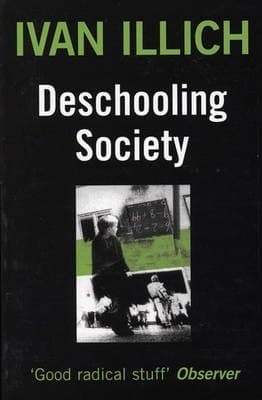
Deschooling Society cover
Archivist's Choice

Deschooling Society

Ivan Illich (1970)

Genre

Politics / Relationships / Philosophy

Reading Time

180 min

Key Themes

See below

Track Your Reading

Sign in to track this book

Ivan Illich's "Deschooling Society" calls for dismantling institutionalized education to reclaim authentic learning through self-directed exploration and informal social connections.

Core Idea

Ivan Illich argues that institutionalized schooling is an oppressive and counterproductive force, indoctrinating individuals into a consumerist, hierarchical society. He believes the school system limits knowledge, creates artificial learning scarcity, and enforces a hidden curriculum of submission to authority and passive consumption. This stifles genuine learning, creativity, and independent growth. Illich says universal schooling leads to a global caste system based on certified knowledge, perpetuating inequality and disempowering individuals from managing their own education and societal participation. Illich proposes 'deschooling society' as an alternative. He advocates for dismantling compulsory, curriculum-driven institutions and replacing them with informal, open-access learning networks and skill exchanges. He imagines a society where learning is personal and self-directed, helped by available resources and peer connections, rather than dictated by educators and state curricula. This deschooling would empower individuals to learn what they need and want, creating a more equal and participatory society free from the credentialism and dependence schools create.
Reading time
180 min
Difficulty
Medium
✓ Read this if...
You are a critical thinker interested in radical critiques of education, societal structures, and the role of institutions in shaping human development. You question the fundamental assumptions behind modern schooling and are open to revolutionary alternatives.
✗ Skip this if...
You believe strongly in the current public education system as the primary means for societal progress and individual advancement, or you are looking for practical, incremental reforms within existing educational frameworks.

Core idea

The central argument and framework that powers the entire book.

Ivan Illich argues that institutionalized schooling is an oppressive and counterproductive force, indoctrinating individuals into a consumerist, hierarchical society. He believes the school system limits knowledge, creates artificial learning scarcity, and enforces a hidden curriculum of submission to authority and passive consumption. This stifles genuine learning, creativity, and independent growth. Illich says universal schooling leads to a global caste system based on certified knowledge, perpetuating inequality and disempowering individuals from managing their own education and societal participation. Illich proposes 'deschooling society' as an alternative. He advocates for dismantling compulsory, curriculum-driven institutions and replacing them with informal, open-access learning networks and skill exchanges. He imagines a society where learning is personal and self-directed, helped by available resources and peer connections, rather than dictated by educators and state curricula. This deschooling would empower individuals to learn what they need and want, creating a more equal and participatory society free from the credentialism and dependence schools create.

At a glance

Reading time

180 min

Difficulty

Medium

Read this if...

You are a critical thinker interested in radical critiques of education, societal structures, and the role of institutions in shaping human development. You question the fundamental assumptions behind modern schooling and are open to revolutionary alternatives.

Skip this if...

You believe strongly in the current public education system as the primary means for societal progress and individual advancement, or you are looking for practical, incremental reforms within existing educational frameworks.

Key Takeaways

1

The Myth of Universal Schooling

Schooling is a modern invention, not an inherent human need, and has become a global religion.

Quote

The pupil is thereby 'schooled' to confuse teaching with learning, grade advancement with education, a diploma with competence, and fluency with the ability to say something new.

Illich argues that universal, compulsory schooling is a relatively recent development, not a timeless human institution. He believes schooling has become like a global religion, with its own rituals, leaders (teachers), and symbols (diplomas). This 'religion' teaches people that learning can only happen in institutions and with certified professionals. This belief makes it hard for societies to imagine other ways to gain knowledge and develop personally. The school system, instead of helping real learning, often reinforces social hier...

Supporting evidence

Illich traces the historical rise of compulsory schooling, contrasting it with earlier, more informal learning structures. He highlights how the school system became the primary path for social mobility and economic integration in industrialized nations, effectively monopolizing the definition of 'education.'

Apply this

Question the necessity and efficacy of formal educational credentials for all forms of learning and professional advancement. Explore informal learning networks and skill-sharing initiatives as legitimate alternatives to traditional schooling.


institutional-monopolycredentialismhidden-curriculum
2

The Hidden Curriculum of Schooling

Schools teach conformity, passive consumption, and a reliance on institutional authority, rather than critical thought.

Quote

School prepares people for the institution of life by teaching them that life is an institution.

Beyond subjects like math and history, schools teach a powerful 'hidden curriculum.' This curriculum teaches students to value institutional authority over personal initiative, to accept standard paths, and to become passive consumers of pre-packaged knowledge. Students learn patience, conformity, and delayed gratification. These skills are useful for navigating bureaucracies but harmful to independent thought and self-directed learning. Illich argues that this hidden curriculum stifles creativity and critical thinking, preparing indi...

Supporting evidence

Illich points to the structure of classrooms, the grading system, the bell schedules, and the hierarchical relationship between teachers and students as evidence of this hidden curriculum at work. He also notes how schools implicitly teach that 'valuable' knowledge is that which is officially sanctioned and delivered by an institution.

Apply this

Actively challenge the notion that all learning must be validated by an institution. Cultivate self-directed learning habits, question authority, and seek out diverse perspectives outside of established educational frameworks.

social-engineeringinstitutional-dependencypedagogical-alienation
3

The Industrialization of Education

Schools operate like factories, processing students through standardized stages and producing uniform 'products.'

Quote

The school system is a factory that produces people with standardized minds.

Illich criticizes the industrial model of modern schooling. He compares schools to factories, where students are raw materials processed through assembly-line stages (grades) to add specific 'value' (knowledge unit). Teachers are line workers delivering standard content, and diplomas are quality control labels for the finished 'products.' This industrial approach prioritizes efficiency, standardization, and measurable outcomes over individual differences, creative exploration, and organic learning. It assumes all students can be taugh...

Supporting evidence

The existence of standardized curricula, age-segregated classrooms, bell schedules, and hierarchical administrative structures all point to an industrial, factory-like organization. The focus on 'output' (test scores, graduation rates) reinforces this analogy.

Apply this

Advocate for personalized learning paths, project-based learning, and interdisciplinary approaches that break free from rigid, factory-like scheduling and curriculum delivery. Support educational models that value individual agency and diverse learning styles.

standardized-curriculummass-educationfactory-model
4

The Deschooling Proposal

Replace compulsory schooling with informal, self-directed learning networks and skill exchanges.

Quote

We need to deschool society to create the conditions for a new learning society.

Illich's radical proposal is not to reform schools, but to 'deschool society.' He imagines a world where compulsory schooling is gone, replaced by flexible, self-directed learning opportunities. This 'learning web' would have four main parts: reference services for educational materials (libraries, labs), skill exchanges (peer teaching), peer-matching networks (connecting those with similar interests), and educators-at-large (mentors, guides). The goal is to empower individuals to control their own learning, pursue their passions, and...

Supporting evidence

Illich outlines specific, practical alternatives: 'learning webs' that leverage technology (though nascent in his time) and community resources to connect learners. He describes how individuals could offer skills, seek mentors, and access resources without needing institutional mediation.

Apply this

Actively participate in or create informal learning communities, skill-share groups, and mentorship programs. Utilize open educational resources and online platforms for self-directed learning. Advocate for public policies that support diverse learning pathways outside of traditional schools.

learning-websself-directed-learninginformal-educationdemocratization-of-knowledge
5

The Problem of 'Curriculum'

A fixed curriculum dictates what should be learned, stifling curiosity and individual learning paths.

Quote

The curriculum is a package of goods that must be consumed in a predetermined sequence.

Illich views the idea of a 'curriculum' as problematic. He argues that a pre-defined set of subjects and learning objectives, imposed on all students, stifles natural curiosity and individual learning paths. Instead of letting learners pursue their own interests and discover knowledge naturally, a curriculum forces them through a standard sequence, often unrelated to their real-world needs or personal motivations. This rigid structure makes learning a chore, focusing on memorization and compliance rather than genuine understanding and...

Supporting evidence

The existence of national or state-mandated curricula, standardized textbooks, and the division of knowledge into distinct, often siloed, subjects within schools illustrates this point. Illich highlights how this structure disempowers the learner by removing their agency in what and how they learn.

Apply this

Prioritize interest-driven learning over curriculum-driven learning. Encourage exploration, interdisciplinary studies, and problem-solving approaches that allow learners to define their own questions and seek diverse resources.

prescribed-learningrote-learningknowledge-monopoly
6

Certification as a Barrier

Diplomas and certifications are gatekeepers, limiting access to opportunities based on institutional approval.

Quote

The diploma has become a license to practice, not a proof of competence.

Illich believes that diplomas and certifications, rather than being objective measures of competence, primarily act as gatekeepers. They give institutions power to control access to professions, social status, and economic opportunities, regardless of an individual's actual skills or knowledge. This system forces individuals to spend significant time and money on schooling, not necessarily to learn, but to get the required credentials. It creates an artificial scarcity of opportunities for those without diplomas, even if they have sup...

Supporting evidence

The increasing requirement for degrees in professions that historically did not demand them (e.g., certain trades or entrepreneurial roles) demonstrates how diplomas become a prerequisite for entry, often overshadowing actual skill. The rising cost of higher education is also a direct consequence.

Apply this

Challenge employers and institutions to prioritize demonstrable skills and experience over formal credentials. Invest in portfolio development and alternative credentialing methods that showcase actual abilities rather than just institutional attendance.

credential-inflationmeritocracy-mythinstitutional-gatekeeping
7

The Impossibility of Equal Educational Opportunity

True equality in schooling is an illusion; the system inherently reinforces existing social inequalities.

Quote

The myth of unending consumption of services, services of increasing quality, is the basis of the school system.

Illich argues that the promise of 'equal educational opportunity' through schooling is an illusion. While well-intentioned, attempts to equalize school access or resources will always fall short because the structure of institutionalized schooling inherently reinforces existing social and economic inequalities. Wealthier individuals and communities can always afford 'more' or 'better' schooling, creating a constant competition for educational advantage. Even if resources were perfectly equalized, the hidden curriculum and the credenti...

Supporting evidence

Despite decades of reforms aimed at achieving educational equity, disparities in educational outcomes based on socioeconomic status persist globally. Illich points to the inherent competitive nature of schooling, where even with equal inputs, unequal outcomes are inevitable due to external factors and the system's design.

Apply this

Recognize that educational reform alone cannot solve deep-seated social inequalities. Advocate for broader societal changes that address economic disparities, access to resources, and power imbalances, rather than solely focusing on school-based interventions.

social-reproductioneducational-inequitysystemic-bias
8

Learning as a Personal Activity

Genuine learning is an autonomous, often serendipitous, process that cannot be 'produced' or 'delivered' by an institution.

Quote

Learning is the human activity which least needs manipulation by others.

For Illich, learning is personal, internal, and often unpredictable. It is not something an institution can efficiently 'produce' or 'deliver' like a car or a package. True learning happens when individuals are motivated, engaged with their environment, and actively trying to understand the world. It often occurs through hands-on experience, exploration, conversation, and unexpected discovery, rather than through passively receiving information. Institutions, by trying to package and standardize learning, often stifle this natural pro...

Supporting evidence

Illich contrasts the formal, structured environment of schools with how people naturally learn outside of them – through play, work, hobbies, and social interaction. He emphasizes the role of curiosity and personal relevance in genuine learning experiences.

Apply this

Cultivate environments that foster intrinsic motivation, curiosity, and autonomy in learning. Encourage experiential learning, mentorship, and peer-to-peer exchanges where individuals are empowered to guide their own educational journeys.

intrinsic-motivationexperiential-learningautodidacticism
9

The Deschooling of Imagination

Schooling limits our ability to imagine alternative futures and fosters dependence on institutional solutions.

Quote

The imagination of most people has been schooled into submitting to an endless procession of institutional services.

Illich argues that beyond its practical failings, schooling affects our collective imagination. By making individuals rely on institutions for their needs (from learning to healthcare to social welfare), it limits our ability to imagine and create alternative, self-organized solutions. We become 'schooled' into believing that complex problems require complex, institutional interventions, rather than empowering individuals and communities to find their own solutions. This intellectual dependence stifles innovation, reduces civic engage...

Supporting evidence

The societal impulse to create new programs or institutions to 'fix' problems, rather than fostering community self-sufficiency or individual agency, demonstrates this trained dependence. The difficulty in imagining life without schools, hospitals, or formal welfare systems is a testament to this 'schooled imagination.'

Apply this

Actively challenge institutional solutions to societal problems and explore community-based, decentralized alternatives. Engage in critical discussions about the role of institutions in our lives and foster creative thinking about non-institutional pathways to well-being.

institutional-thinkingcivic-disempowermentutopian-thinking
10

The School as a 'Sacred Cow'

The school system is protected by deeply ingrained societal beliefs, making it resistant to genuine reform.

Quote

Schooling is a ritual that has become the world's most widespread religion.

Illich states that the school system has become a 'sacred cow' in modern society. It is so deeply embedded in our cultural, economic, and political structures that questioning its basic ideas often meets resistance, even outrage. People have been taught to believe that schools are good, necessary, and the only legitimate path to knowledge and societal progress. This reverence makes genuine, radical reform nearly impossible, as attempts to change the system are often superficial, merely reinforcing its core beliefs. The belief in schoo...

Supporting evidence

The widespread public outcry against proposals to significantly alter or defund public schools, even in the face of poor performance, demonstrates the deep-seated societal belief in the institution. The emotional attachment to the idea of 'sending children to school' often transcends rational debate about educational outcomes.

Apply this

Engage in open and critical dialogue about the fundamental assumptions underlying our educational system. Be prepared to challenge deeply held beliefs about schooling and advocate for alternative paradigms, even when they are unpopular.

cultural-hegemonydogmatic-beliefparadigm-shift

Critical analysis

Notable Quotes

Universal education through schooling is not feasible. It would be too expensive, it would take too long, and it would be too destructive to the natural learning process.

Illich's fundamental critique of the school system's practical limitations.

School is the advertising agency which makes you believe that you need the society as it is.

Highlighting school's role in perpetuating the status quo and consumerism.

The pupil is thereby 'schooled' to confusion of process and substance. Once he accepts the idea that an institutional process can create value, the way is open for him to accept all kinds of substitutes for value.

Describing how schooling trains individuals to value institutional processes over genuine learning.

We have been taught to need what the institutions are structured to provide.

Critiquing how institutions shape our desires and perceived necessities.

Most learning happens incidentally, without the need for formal instruction.

Underpinning the argument for informal learning and deschooling.

The institutionalization of values leads to the degradation of value.

A core philosophical point about how formal institutions can corrupt intrinsic worth.

A good educational system should have three purposes: it should provide all who want to learn with access to available resources at any time in their lives; empower all who want to share what they know to find those who want to learn it from them; and, finally, furnish all who want to present an issue to the public with the opportunity to make their challenge known.

Illich's vision for an alternative, learner-centric educational network.

Schooling is an age-specific, teacher-related, and curriculum-bound institution that has been developed in response to a felt need for universal education.

Defining the specific, limited nature of schooling that Illich challenges.

The inverse of school is not 'free' education, but education that is free.

Distinguishing between cost-free schooling and true liberation of learning.

The hidden curriculum of schooling is the instruction in the necessity of schooling itself.

Exposing the self-perpetuating nature of the school system.

Only a society that has lost its balance will try to make of education a commodity.

Critiquing the commodification of knowledge and learning.

I believe that a desirable future depends on our deliberately choosing a life of more contact and less management; more inherent experience and less engineered commodity; more participation and less consumption; more primary engagement and less secondary treatment.

A broader philosophical statement about societal priorities beyond education.

We must disestablish the school and thereby disentangle the idea of education from the idea of schooling.

The central thesis and call to action of the book.

The student is thereby 'schooled' to confusion of process and substance. Once he accepts the idea that an institutional process can create value, the way is open for him to accept all kinds of substitutes for value.

A powerful statement on how schooling teaches individuals to mistake institutional processes for genuine value.

Quiz

Test Your Knowledge

Ready to see how well you understood this book? Take our interactive quiz with 10 questions.

10
Questions
~5
Minutes
?
Best Score

Key Questions (FAQ)

'Deschooling Society' argues that institutionalized education, particularly compulsory schooling, is an inherently flawed and counterproductive system that stifles genuine learning and perpetuates social inequality. Illich proposes that true education should be self-directed and occur through informal, voluntary networks.

About the author