BookBrief
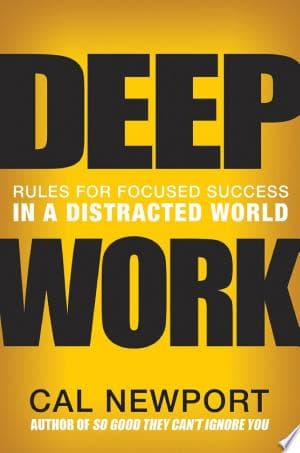
Deep Work cover
Archivist's Choice

Deep Work

Cal Newport (2016)

Genre

Productivity / Self-Help

Reading Time

240 min

Key Themes

See below

Track Your Reading

Sign in to track this book

Achieve great things in a distracting world by focusing intensely and reducing unimportant tasks.

Core Idea

In a world full of distractions, the ability to do 'deep work'—focused, uninterrupted work that stretches your mind—is becoming both rare and valuable. This book argues that developing a deep work habit is key to achieving expertise, producing good work quickly, and finding professional satisfaction. It suggests a strict training plan, including specific methods and lifestyle changes, to minimize easy tasks and maximize periods of intense focus. This helps people succeed in today's economy.
Reading time
240 min
Difficulty
Medium
✓ Read this if...
You feel overwhelmed by distractions, struggle to concentrate on complex tasks, or believe your productivity is hampered by constant interruptions and shallow work.
✗ Skip this if...
You already have a highly structured work environment with minimal distractions and consistently produce high-quality, focused output, or you are looking for a quick fix rather than a demanding lifestyle change.

Core idea

The central argument and framework that powers the entire book.

In a world full of distractions, the ability to do 'deep work'—focused, uninterrupted work that stretches your mind—is becoming both rare and valuable. This book argues that developing a deep work habit is key to achieving expertise, producing good work quickly, and finding professional satisfaction. It suggests a strict training plan, including specific methods and lifestyle changes, to minimize easy tasks and maximize periods of intense focus. This helps people succeed in today's economy.

At a glance

Reading time

240 min

Difficulty

Medium

Read this if...

You feel overwhelmed by distractions, struggle to concentrate on complex tasks, or believe your productivity is hampered by constant interruptions and shallow work.

Skip this if...

You already have a highly structured work environment with minimal distractions and consistently produce high-quality, focused output, or you are looking for a quick fix rather than a demanding lifestyle change.

Key Takeaways

1

The Deep Work Hypothesis

Achieving elite performance requires undistracted, focused effort on cognitively demanding tasks.

Quote

The ability to perform deep work is becoming increasingly rare at the same time it is becoming increasingly valuable in our economy. As a consequence, the few who cultivate this skill, and then make it a core part of their working life, will reap tremendous rewards.

Newport says deep work—professional tasks done with no distractions that push your mental limits—is the key to producing high-quality work quickly and mastering complex information. In an economy increasingly driven by complex systems and fast technological change, the ability for deep work helps people stand out. It is not just about working harder; it is about working smarter and more effectively through intense focus. This is very different from shallow work, which involves easy, logistical tasks often done while distracted, adding...

Supporting evidence

Newport cites a 2012 McKinsey study that found 'knowledge workers' spend up to 60% of their time on communication and administrative tasks, often in a state of semi-distraction, rather than deep, focused work.

Apply this

Identify the core, high-value tasks in your role that require significant cognitive effort. Schedule dedicated, uninterrupted blocks of time for these tasks, treating them as non-negotiable appointments.


deep-work-hypothesisshallow-workcognitive-load
2

Choose Your Deep Work Philosophy

Adopt a structured approach to integrate deep work into your life that aligns with your personality and profession.

Quote

To systematically and successfully integrate deep work into your professional life, you need a philosophy for how you’ll do it.

Newport describes four ways to schedule and do deep work: Monastic (total isolation for long periods, like Carl Jung), Bimodal (alternating between long deep work periods and more social, easy periods), Rhythmic (scheduling regular, daily deep work sessions at the same time), and Journalistic (fitting deep work whenever possible, often spontaneously, like a journalist on deadline). The point is not to try deep work randomly, but to choose a strategy that makes it sustainable and effective for your specific situation and job demands. T...

Supporting evidence

Carl Jung's remote retreat at Bollingen Tower exemplifies the Monastic approach, where he isolated himself to write and think deeply. Bill Gates's 'Think Weeks' represent a Bimodal strategy.

Apply this

Experiment with one of the four philosophies. If you have a predictable schedule, try the Rhythmic method by blocking out 90 minutes each morning. If your work allows for longer breaks, consider a Bimodal approach for a week or two.

monastic-deep-workbimodal-deep-workrhythmic-deep-workjournalistic-deep-work
3

Embrace Productive Meditation

Leverage periods of physical activity to intentionally focus on and solve professional problems.

Quote

The goal of productive meditation is to take a period in which you’re physically occupied but not mentally occupied—walking, jogging, driving, showering—and focus your attention on a single well-defined professional problem.

Newport suggests 'productive meditation,' a method where you intentionally focus on a professional problem when your body is busy but your mind is free. This is not passive daydreaming; it is an active, structured process of breaking down a problem, finding variables, and exploring solutions. By using these often-overlooked times (like commutes, walks, or chores), you can extend your deep work capacity beyond your desk. This allows for creative breakthroughs and problem-solving without needing extra dedicated time. It is a powerful wa...

Supporting evidence

Newport describes how he uses walks to structure and refine arguments for his books and articles, moving from identifying the core problem to exploring potential angles and counterarguments.

Apply this

Before your next walk or commute, choose a specific, complex problem you're trying to solve at work. During the activity, actively and systematically think through the problem, breaking it down and exploring solutions.

productive-meditationfocused-thinkingproblem-solving-techniques
4

Quit Social Media (or Drastically Reduce It)

Recognize the detrimental impact of social media on your ability to concentrate and intentionally reduce its use.

Quote

To remain relevant in the new economy, you must be able to quickly master hard things. This in turn requires deep work. If you don’t regularly practice deep work, however, then your brain will struggle to achieve the state of intense concentration necessary for this mastery.

Newport argues that social media, designed for constant new notifications, systematically reduces your brain's ability for deep focus. The constant switching of attention, the desire for new notifications, and fragmented engagement train your mind to be easily distracted. He suggests a 'craftsman approach to tool selection,' meaning you should only use tools (including social media) that offer a clear, significant benefit to your professional and personal life. For most, social media's benefits are less than its negative impact on foc...

Supporting evidence

Newport suggests a 30-day 'social media detox' to empirically evaluate its actual value in your life, noting that many people find little actual loss after the experiment.

Apply this

Conduct a 30-day experiment: remove all social media apps from your phone and avoid visiting sites directly. Observe changes in your focus, anxiety levels, and overall productivity. If you choose to return, set strict rules for usage.

attention-residuedigital-minimalismintermittent-reinforcement
5

Drain the Shallows Systematically

Minimize time spent on low-value, shallow tasks to free up more capacity for deep work.

Quote

The more you can reduce the amount of shallow work in your schedule, the more time and mental energy you can dedicate to deep work.

Shallow work—tasks that do not require much mental effort and are often done while distracted (e.g., routine emails, administrative tasks, endless meetings)—can take up too much of your day. Newport stresses that while shallow work cannot be fully removed, it must be aggressively minimized and scheduled. By counting your shallow work, grouping similar tasks, and setting clear limits (like checking email only at specific times), you stop these tasks from breaking up your attention and invading your deep work blocks. The goal is to crea...

Supporting evidence

Newport suggests measuring the percentage of your time spent on shallow work. He also proposes setting a specific 'email response time' to manage expectations and reduce constant inbox checking.

Apply this

At the start of each day, estimate the percentage of your time spent on shallow work. Then, schedule specific blocks for these tasks (e.g., 30 minutes for email at 11 AM and 4 PM). Decline non-essential meetings or suggest asynchronous communication.

shallow-work-minimizationtime-blockingemail-management
6

Schedule Every Minute of Your Day

Proactively plan your day hour-by-hour to ensure deep work takes priority and distractions are minimized.

Quote

To succeed with deep work, you must fight back against the forces of distraction and fragmentation that plague our current working world. The best way to do this is by aggressively scheduling your deep work.

Instead of reacting to demands, Newport suggests a proactive, detailed daily schedule where every minute is assigned a task or activity. This 'time-blocking' method forces you to face your time limits, making sure that deep work blocks are specifically protected. It also makes you aware of how much time you actually have for easy tasks and helps you find wasted time. When distractions come up, you can quickly see if they fit your schedule or if they are important enough to ruin your planned day. This is about intentionality and contin...

Supporting evidence

Newport shares his own practice of planning his day in 30-minute increments, including blocks for deep work, shallow work, and breaks, and constantly refining it as the day progresses.

Apply this

At the beginning of each workday, create a detailed schedule for the entire day, assigning specific tasks to specific time blocks. Include deep work, shallow work, breaks, and even 'flex' time. Adjust as needed throughout the day.

time-blockingdaily-planningstructured-productivity
7

Make Grand Gestures for Deep Work

Invest significant resources and effort into creating a dedicated environment for deep focus.

Quote

To maximize your chances of success, you should support your deep work habit with grand gestures, which means investing significant time, energy, and money into creating an environment conducive to deep work.

A 'grand gesture' is a big change to your normal environment or routine designed to make deep work easier and more likely. This could be booking a hotel room for a day to work on a key project, taking a long solitary retreat, or building a dedicated deep work space at home. The psychological effect of these gestures is strong: they tell your brain and others that this work is very important, justifying the effort and expense. By removing yourself from your usual surroundings, you also remove the usual triggers for distraction, making ...

Supporting evidence

J.K. Rowling famously finished *Harry Potter and the Deathly Hallows* in the solitude of the Balmoral Hotel, a 'grand gesture' that removed her from her usual distractions.

Apply this

For your next critical project, consider a grand gesture: book a quiet co-working space for a day, reserve a library carrel, or even spend a few hours at a distraction-free cafe with noise-canceling headphones.

grand-gesturesenvironmental-designfocus-sanctuaries
8

Be Lazy Productively

Schedule downtime and rest as intentionally as you schedule deep work to replenish cognitive resources.

Quote

If you want to do deep work, you need to build in regular periods of downtime. You need to schedule your laziness.

Newport questions the idea that constant work maximizes output. Instead, he argues that regular, planned downtime is essential for maintaining high-quality deep work. This is not just about avoiding burnout; it is about optimizing mental function. Downtime lets your brain rest, process information, and engage in diffuse thinking, which can lead to creative breakthroughs. It also provides a clear end to your workday, preventing the 'always-on' mindset that leads to exhaustion and less effective work. By scheduling your 'laziness,' you ...

Supporting evidence

Research on attention fatigue and decision fatigue supports the idea that continuous intense focus depletes cognitive resources, making subsequent deep work less effective.

Apply this

Establish a clear end-of-day shutdown ritual. Before leaving work, review your schedule for tomorrow, make a to-do list, and then consciously disconnect from work-related thoughts. Plan specific, non-work activities for your evenings and weekends.

productive-lazinesscognitive-restdowntime-scheduling
9

Quantify Your Deep Work

Track your deep work efforts to measure progress, identify patterns, and stay motivated.

Quote

What gets measured gets managed. If you want to increase your deep work, you need to start tracking it.

Like any other important metric, deep work benefits from being measured. Newport suggests tracking the hours you spend in deep concentration, perhaps with a simple scorecard. This measurement gives objective feedback on your efforts, letting you see if you are meeting your deep work goals and identifying where your focus might be slipping. It also acts as a strong motivator, as seeing your deep work hours grow can be very satisfying and strengthen the habit. This data-driven approach turns deep work from an abstract idea into a tangib...

Supporting evidence

Newport describes using a simple deep work 'scorecard' where he manually tracks his deep work hours each week, allowing him to set goals and monitor his progress.

Apply this

Create a simple spreadsheet or use a habit tracking app to log your deep work hours each day. Set a weekly goal for deep work (e.g., 10-15 hours) and review your progress at the end of each week.

deep-work-metricshabit-trackingquantified-self
10

Practice Productive Prioritization

Identify the 'wildly important goals' that truly drive impact and devote deep work to them.

Quote

The 4 Disciplines of Execution (4DX) framework is a useful tool to help you identify and focus on a small number of 'wildly important goals' (WIGs) that will produce the most impact.

Deep work is not just about focusing; it is about focusing on the right things. Newport introduces the '4 Disciplines of Execution' (4DX) framework to help identify and prioritize 'wildly important goals' (WIGs). This means focusing on a few critical goals that, if achieved, will make a big difference, rather than spreading your efforts thin across many initiatives. Once WIGs are identified, you then dedicate your deep work efforts to tasks that directly move these goals forward. This ensures that your valuable deep work time is spe...

Supporting evidence

Newport explains how the 4DX framework emphasizes 'lead measures' (predictive, influenceable activities) over 'lag measures' (results), ensuring deep work focuses on controllable actions that drive desired outcomes.

Apply this

Identify 1-2 'wildly important goals' for your current quarter that will significantly impact your work. For each deep work session, explicitly link the task you're performing to one of these WIGs, ensuring your focus is on high-leverage activities.

wildly-important-goals4dx-frameworklead-measuresprioritization

Critical analysis

Notable Quotes

Deep work is the ability to focus without distraction on a cognitively demanding task. It's a skill that allows you to quickly master complicated information and produce better results in less time.

Defining the core concept of the book early on.

To remain valuable in our economy, therefore, you must master the art of quickly learning complicated things. This in turn requires deep work.

Explaining the economic necessity of deep work in the modern age.

The Deep Work Hypothesis: The ability to perform deep work is becoming increasingly rare at the same time it is becoming increasingly valuable in our economy. As a consequence, the few who cultivate this skill—and make it a core part of their working life—will thrive.

Presenting the central thesis of the book.

To produce at your peak level, you need to work for extended periods with full concentration on a single task free from distraction.

Outlining the ideal conditions for peak performance.

Shallow work is noncognitively demanding, logistical-style tasks, often performed while distracted. These efforts tend not to create much new value in the world and are easy to replicate.

Defining and contrasting shallow work with deep work.

A commitment to deep work is not a moral stance or a lifestyle choice; it's a strategic necessity.

Emphasizing the practical, rather than ideological, importance of deep work.

The Principle of Least Resistance: In a business setting, without clear feedback on the impact of various behaviors, we will tend toward behaviors that are easiest in the moment.

Explaining why people often default to shallow work.

Quit social media. Not because you're a bad person for using it, but because you're a professional who understands the opportunity cost of your time and attention.

Challenging the conventional wisdom around social media use for professionals.

To succeed with deep work, you must routinize it. The more you can make deep work an automatic part of your schedule, the less energy you'll expend in deciding whether to do it.

Advocating for the importance of routines in cultivating deep work habits.

The idea is to give your brain a new way to understand its time away from deep work—as a period of purposeful rest that helps you recharge for the next session—rather than as a free-for-all that can be filled with any distraction that comes along.

Highlighting the importance of structured downtime and rest.

Schedule every minute of your day. It's not about being a robot, but about being intentional with your time.

Proposing a strict scheduling method to prioritize deep work and other activities.

The most successful people don’t have more time than the rest of us; they simply make better use of the time they have.

Underscoring that effective time management, not more time, is key.

Deep work is not a fad; it's a foundational skill for anyone serious about creating significant value in the new economy.

Reiterating the enduring importance and fundamental nature of deep work.

Quiz

Test Your Knowledge

Ready to see how well you understood this book? Take our interactive quiz with 10 questions.

10
Questions
~5
Minutes
?
Best Score

Key Questions (FAQ)

Deep work is the ability to focus without distraction on a cognitively demanding task. It's a skill that allows individuals to quickly master complicated information and produce better results in less time, offering a significant advantage in today's competitive economy.

About the author

Cal Newport

Cal Newport is a computer science professor and author known for his books on productivity and the impact of technology. His most influential work, "Deep Work: Rules for Focused Success in a Distracted World," argues for the importance of intense, uninterrupted concentration in achieving professional excellence. Newport's writing often explores strategies for cultivating focus and meaningful work in the digital age.