BookBrief
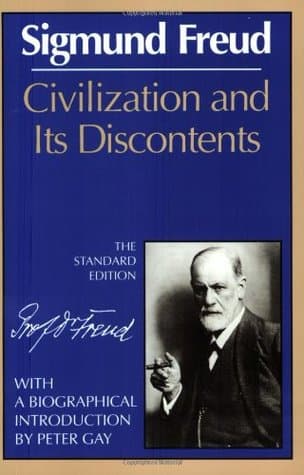
Civilization and Its Discontents cover
Archivist's Choice

Civilization and Its Discontents

Sigmund Freud (1961)

Genre

Psychology / History / Science / Philosophy

Reading Time

120 min

Key Themes

See below

Track Your Reading

Sign in to track this book

Freud explores the inherent tragedy of human existence, showing how civilization's demands for conformity perpetually clash with our primal aggressive and erotic urges, leaving us burdened with an inescapable, pervasive guilt.

Core Idea

Freud argues that civilization, though needed for people to live together, requires giving up instinctual drives, especially aggression and the pursuit of pleasure. This ongoing conflict between individual instinctual desires (driven by the pleasure principle) and society's demands (enforced by the reality principle and the superego) leads to a widespread and unavoidable sense of unhappiness, guilt, and neurotic suffering. Humanity pays a high psychological cost for the safety and structure of civilized life. A truly happy or harmonious existence within civilization may be impossible, as the very things that bind us also cause our deepest unhappiness.
Reading time
120 min
Difficulty
Hard
✓ Read this if...
You are interested in the foundational psychological conflicts between individual instinct and societal demands, the origins of guilt and neurosis, or a critical philosophical perspective on the inherent trade-offs of human civilization.
✗ Skip this if...
You prefer practical self-help, are looking for optimistic solutions to societal problems, or find dense, speculative psychological theory without empirical data unconvincing.

Core idea

The central argument and framework that powers the entire book.

Freud argues that civilization, though needed for people to live together, requires giving up instinctual drives, especially aggression and the pursuit of pleasure. This ongoing conflict between individual instinctual desires (driven by the pleasure principle) and society's demands (enforced by the reality principle and the superego) leads to a widespread and unavoidable sense of unhappiness, guilt, and neurotic suffering. Humanity pays a high psychological cost for the safety and structure of civilized life. A truly happy or harmonious existence within civilization may be impossible, as the very things that bind us also cause our deepest unhappiness.

At a glance

Reading time

120 min

Difficulty

Hard

Read this if...

You are interested in the foundational psychological conflicts between individual instinct and societal demands, the origins of guilt and neurosis, or a critical philosophical perspective on the inherent trade-offs of human civilization.

Skip this if...

You prefer practical self-help, are looking for optimistic solutions to societal problems, or find dense, speculative psychological theory without empirical data unconvincing.

Key Takeaways

1

The Unhappy Bargain of Civilization

Society's demands for conformity inherently clash with individual instinctual freedom, leading to pervasive discontent.

Quote

The price of progress in civilization is paid by forfeiting happiness through the heightening of the sense of guilt.

Freud argues that civilization, while necessary for group survival and progress, requires individuals to make a basic sacrifice. Humans are driven by strong instinctual urges, mainly Eros (life instincts, including sexuality and self-preservation) and Thanatos (the death drive, appearing as aggression and destructiveness). Society requires people to control and redirect these drives to maintain order and cooperation. This constant tension between acting on instincts and social rules creates a lasting state of 'discontent' or unhappine...

Supporting evidence

Freud's structural theory of the mind (id, ego, superego) underpins this, where the superego, internalized societal norms, constantly censors the id's impulses, mediated by the ego.

Apply this

Recognize that feelings of frustration or dissatisfaction with societal norms are not necessarily personal failings, but rather an inherent part of the human condition within civilization. Seek outlets for sublimation that are socially acceptable yet personally fulfilling.

sublimationinstinctual-drivessuperegoid
2

Aggression: The Unstoppable Force

Human aggression is an innate, primary instinct, not merely a reaction, posing a constant threat to social cohesion.

Quote

Man is a wolf to man. Who has the courage to dispute it after all the evidence of life and history?

Freud states that aggression is not just a defense mechanism or a learned behavior, but a basic, inherent human drive – how the death drive (Thanatos) shows itself outwardly. This 'primary aggressiveness' poses a significant challenge to civilization, which tries to bring people together into larger groups. Society's existence depends on its ability to control and direct this destructive force. Laws, morality, and social norms are largely designed to lessen the effects of this common human tendency to dominate, exploit, and harm other...

Supporting evidence

Freud points to historical atrocities, wars, and everyday human cruelty as evidence of this inherent aggressive instinct, refuting idealistic views of human nature.

Apply this

Acknowledge the potential for aggression within oneself and others. Instead of denying it, develop strategies for managing and sublimating aggressive impulses into productive or competitive (but non-harmful) activities. Understand that societal rules are often a necessary bulwark against this instinct.

thanatosdeath-driveaggressionhuman-nature
3

The Burden of Guilt

Civilization cultivates an internal 'sense of guilt' as its primary tool for controlling aggression, leading to widespread neurosis.

Quote

The sense of guilt is the most important problem in the development of civilization and the one by which the struggle between humanity and instinct is decided.

For Freud, 'guilt' is the most important psychological outcome of civilization. It comes from internalizing aggression, where external authority (parents, society) is replaced by an internal force, the superego. When people are forced to repress their aggressive impulses, this aggression does not disappear; instead, it turns inward, appearing as guilt, anxiety, and self-punishment. This unconscious guilt is a strong, yet often weakening, way to maintain social order. While it prevents total societal collapse, it also adds greatly to i...

Supporting evidence

The development of the superego, which acts as an internal moral censor, leading to self-reproach and a 'bad conscience' even for unexpressed desires or thoughts.

Apply this

Reflect on sources of unconscious guilt or self-criticism. Understand that some of these feelings might stem from deeply ingrained societal prohibitions rather than actual wrongdoings. Seek to differentiate between healthy remorse and debilitating, irrational guilt that hinders well-being.

guiltsuperegoneurosisrepression
4

Love's Limited Power

While Eros aims to bind individuals, its power is insufficient to overcome the pervasive force of aggression.

Quote

Love alone is not strong enough to master the aggressive instincts of men.

Freud acknowledges the civilizing power of Eros, the life instincts, which appear as love, attachment, and the desire for connection. These forces push individuals to form families, communities, and ultimately, civilization itself. Love, in its various forms (sexual, familial, altruistic), tries to bind people together, working against the inherent human tendency towards aggression and isolation. However, Freud is doubtful about love's ultimate ability to overcome everything. He argues that the aggressive drive is too fundamental and ...

Supporting evidence

Freud's observation that even within families or close-knit groups, conflict and hostility persist, and that love for one group often comes with aggression towards another (e.g., nationalism).

Apply this

Cultivate love and connection in your life, recognizing their importance for well-being and social cohesion. However, maintain a realistic perspective on human nature, understanding that love has limits and that aggression will always be a factor to manage, even in the most loving relationships or societies.

erosloveaggressionsocial-cohesion
5

The Discontents of Happiness

True happiness, defined as instinctual gratification, is fundamentally incompatible with the demands of civilized life.

Quote

What we call happiness in the strictest sense of the word comes from the (preferably sudden) satisfaction of needs which have been dammed up to a high degree.

Freud defines happiness mainly as the strong, often sudden, satisfaction of instinctual needs and desires. However, civilization requires the constant delay, redirection, and repression of these very impulses. The pursuit of immediate pleasure and unrestrained instinctual expression disrupts social order. Therefore, civilization forces individuals to trade intense, brief moments of happiness for a more stable, but less exciting, state of security and communal living. The 'discontent' comes from this ongoing compromise: humans are made...

Supporting evidence

The societal prohibition of unrestricted sexual activity, aggression, and selfish pursuits, all of which would lead to individual gratification but societal breakdown.

Apply this

Adjust expectations about 'happiness.' Understand that continuous, intense happiness is an unrealistic goal within civilization. Instead, focus on finding contentment, meaning, and occasional, healthy gratifications within the bounds of social responsibility, and recognize the value of stability over fleeting euphoria.

happinesspleasure-principleinstinctual-gratificationdiscontent
6

The Superego's Tyranny

The internalized voice of society, the superego, becomes an overly harsh master, punishing even unfulfilled desires.

Quote

The Super-ego torments the sinful ego with the same feeling of anxiety and watches for opportunities of punishing it.

Freud expands on the idea of the superego, which forms from internalizing parental and societal authority. At first, our behavior is controlled by external threats of punishment. But as we grow, these external controls are absorbed into our mind, forming a conscience that judges our thoughts, feelings, and actions. The superego, however, is often overly harsh and unreasonable. It demands impossible standards of moral purity and punishes not only actual wrongdoings but even forbidden desires or aggressive impulses that are never acted ...

Supporting evidence

The development of a 'bad conscience' where individuals feel guilty even for thoughts they deem immoral, despite no external action being taken, or the phenomenon of neurotic self-punishment.

Apply this

Become aware of your inner critic (superego). Question its judgments and standards. Work to moderate its harshness by developing a more compassionate and realistic self-assessment. Understand that some self-criticism is not based on objective reality but on internalized, often outdated, prohibitions.

superegoegoconscienceinternalizationguilt
7

The Illusion of Progress

Despite technological advancements, the fundamental psychological conflict between individual and society remains unresolved.

Quote

Men have gained control over the forces of nature to such an extent that with their help they would have no difficulty in exterminating one another to the last man.

Freud challenges the optimistic Enlightenment idea that scientific and technological progress automatically leads to human happiness or moral improvement. He notes that while civilization has achieved great things in controlling nature and improving material comfort, it has failed to resolve the inherent psychological 'discontents' within humanity. In fact, technological progress, by providing more powerful tools for destruction, only worsens the danger posed by innate human aggression (the death drive). The basic conflict between ins...

Supporting evidence

The development of increasingly destructive weapons and the recurring horrors of war throughout history, despite advancements in science and philosophy.

Apply this

Be critical of narratives that equate technological progress directly with human flourishing or moral evolution. Understand that inner psychological work and societal structures for managing human nature are as crucial as, if not more important than, external advancements. Prioritize internal peace over external accumulation.

progresshuman-naturetechnological-advancementdisillusionment
8

The Futility of Universal Love

The command to 'love thy neighbor as thyself' is an impossible and psychologically damaging ideal, undermining self-preservation.

Quote

Why should we do it? What good will it do us?

Freud directly criticizes the Christian commandment to 'love thy neighbor as thyself,' arguing it is an unrealistic and ultimately harmful ideal for human psychological well-being. He contends that humans are not naturally inclined to extend universal love, especially given their innate aggressive tendencies. To demand such broad love not only ignores human nature but also asks individuals to undervalue their own self-interest and self-preservation. Such an ideal, if truly believed, would lead to immense psychological strain and guilt...

Supporting evidence

The historical and ongoing reality of human hostility, even between groups professing universal love, and the psychological burden placed on individuals trying to live up to an impossible moral standard.

Apply this

Focus on cultivating genuine, reciprocal relationships and extending empathy where possible, rather than striving for an abstract, universal love that goes against human psychological realities. Prioritize healthy self-love and set realistic boundaries in your interactions, understanding that not everyone is 'your neighbor' in an intimate sense.

universal-lovealtruismaggressionself-preservationmorality
9

The Neurotic's Escape

Neurosis represents a pathological attempt to resolve the inherent conflict between individual instincts and societal demands.

Quote

The neurotic's escape into illness is an attempt to resolve the conflict between his instinctual demands and the demands of civilization.

Freud sees neurosis as a direct result of the unsolvable conflict between an individual's instinctual drives (mainly sexual and aggressive) and civilization's repressive demands. When individuals cannot find healthy ways to redirect or integrate these drives, the repressed energies appear as symptoms: anxieties, phobias, obsessions, and other psychological disorders. Neurosis is a pathological, often unconscious, attempt to escape or resolve this tension. It is a retreat from the harsh realities of civilized life, offering a distorted...

Supporting evidence

Freud's clinical observations of patients whose neurotic symptoms could be traced back to unresolved childhood conflicts and repressed desires, often related to societal prohibitions.

Apply this

If experiencing persistent psychological distress, seek professional help. Understand that neurosis is not a moral failing but a complex psychological response to internal and external pressures. Explore healthy coping mechanisms and avenues for sublimation to manage instinctual drives within societal constraints.

neurosisrepressionsublimationpsychological-conflictmental-health
10

The Enduring Predicament

The tension between individual freedom and societal control is an unresolvable and permanent feature of human existence.

Quote

The question of the purpose of human life has been raised countless times; it has never yet received a satisfactory answer.

Freud's final conclusion is that the 'discontent' inherent in civilization is not a temporary phase or a problem that can be 'solved.' It is a fundamental and permanent part of the human condition. There is no ideal state where individual instinctual freedom and societal demands can perfectly coexist without conflict. Civilization requires sacrifices, and these sacrifices inevitably lead to psychological suffering. While humans seek happiness and freedom, the very mechanisms that allow for collective living — the repression of aggress...

Supporting evidence

The cyclical nature of human history, marked by repeated conflicts and the consistent presence of individual and collective suffering despite varying forms of societal organization.

Apply this

Embrace a realistic view of human nature and societal limitations. Accept that life will always involve inherent tensions and compromises. Focus on building resilience and finding meaning within these constraints, rather than striving for an unattainable utopian ideal. Understand that the 'struggle' is part of the human journey.

human-conditionsocial-contractexistentialismpessimismfreedom-vs-security

Critical analysis

Notable Quotes

The price of civilization is a certain sacrifice of instinctual gratification.

Freud's central thesis on the tension between individual desires and societal demands.

The aim of all life is death.

Discussing the death drive (Thanatos) as a fundamental human instinct.

The element of truth contained in this, which people are so ready to deny, is that man is not a gentle animal, who wants to be loved, who at the most can defend himself when he is attacked.

Challenging Rousseau's view of human nature and introducing the concept of human aggression.

Happiness is not a cultural value.

Exploring the difficulty of achieving happiness within the constraints of civilization.

Civilization is built upon a renunciation of instinct.

Reinforcing the idea that societal progress requires individuals to suppress their primal urges.

The sense of guilt is the most important problem in the development of civilization.

Highlighting guilt as a key mechanism through which civilization controls aggression and maintains order.

What decides the purpose of life is simply the programme of the pleasure principle.

Describing the fundamental human drive to seek pleasure and avoid pain.

The development of civilization is a struggle between Eros and Death, between the instinct of life and the instinct of destruction, as it works itself out in the human species.

Framing the entire history of civilization as a conflict between the life and death drives.

Every individual is virtually an enemy of civilization.

Emphasizing the inherent conflict between individual instinctual desires and the demands of society.

One feels inclined to say that the intention that man should be 'happy' is not included in the plan of 'Creation'.

A somewhat pessimistic view on the inherent human capacity for happiness given external and internal struggles.

The liberty of the individual is no gift of civilization.

Arguing that individual freedom is often curtailed by civilization for the sake of collective safety and order.

The replacement of the power of the individual by the power of a community constitutes the decisive step of civilization.

Describing the fundamental shift from individual might to collective authority as a cornerstone of civilized society.

The neurotic is a species of artist.

An intriguing comparison suggesting a creative, albeit pathological, aspect to neurotic behavior.

The community, too, develops a super-ego under the influence of civilization.

Extending the concept of the individual super-ego to the collective, forming societal norms and morality.

Quiz

Test Your Knowledge

Ready to see how well you understood this book? Take our interactive quiz with 10 questions.

10
Questions
~5
Minutes
?
Best Score

Key Questions (FAQ)

Freud argues that civilization, while necessary for human coexistence, inherently conflicts with individual instinctual desires, leading to pervasive guilt and unhappiness. This tension arises from society's demand for conformity versus the individual's quest for freedom and self-satisfaction.

About the author