BookBrief
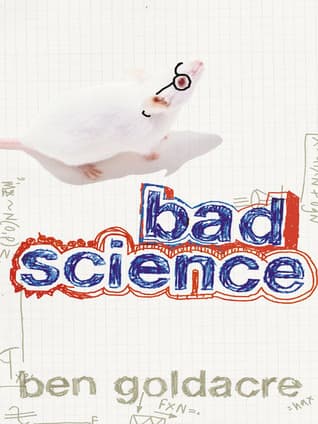
Bad Science cover
Archivist's Choice

Bad Science

Ben Goldacre (2008)

Genre

Psychology / Health / Science

Reading Time

360 min

Key Themes

See below

Track Your Reading

Sign in to track this book

With a healthy dose of skepticism and a Barbie doll, Ben Goldacre hilariously dissects the poor science peddled by the media and advertisers, empowering readers to spot the 'brown sludge' in everyday claims.

Core Idea

Ben Goldacre's "Bad Science" takes apart the widespread misuse of scientific data in daily life, from news headlines and drug marketing to alternative medicine and government policy. The book argues that a basic lack of scientific understanding, along with self-serving interests and confirmation bias, leads many to accept pseudoscience and ineffective treatments. Goldacre advocates for critical thinking, statistical knowledge, and evidence-based reasoning as key tools for navigating a world full of misleading claims, helping readers identify and challenge bad science everywhere.
Reading time
360 min
Difficulty
Medium
✓ Read this if...
You want to sharpen your critical thinking skills and learn how to identify misleading scientific claims in health, media, and marketing.
✗ Skip this if...
You are firmly committed to alternative medicine without an interest in scientific scrutiny or evidence-based perspectives.

Core idea

The central argument and framework that powers the entire book.

Ben Goldacre's "Bad Science" takes apart the widespread misuse of scientific data in daily life, from news headlines and drug marketing to alternative medicine and government policy. The book argues that a basic lack of scientific understanding, along with self-serving interests and confirmation bias, leads many to accept pseudoscience and ineffective treatments. Goldacre advocates for critical thinking, statistical knowledge, and evidence-based reasoning as key tools for navigating a world full of misleading claims, helping readers identify and challenge bad science everywhere.

At a glance

Reading time

360 min

Difficulty

Medium

Read this if...

You want to sharpen your critical thinking skills and learn how to identify misleading scientific claims in health, media, and marketing.

Skip this if...

You are firmly committed to alternative medicine without an interest in scientific scrutiny or evidence-based perspectives.

Key Takeaways

1

The Placebo Effect is Real and Powerful

Understanding the mind's ability to heal itself, and how it's exploited.

Quote

The placebo effect is so powerful that it can mimic the effects of active drugs, even surgery, and understanding it is crucial to evaluating any treatment.

Goldacre carefully examines the placebo effect, showing its significant influence on perceived and actual health outcomes. He explains it is not just 'in your head' but a complex biological process where the expectation of healing triggers real physical responses. This understanding is important because it shows why many alternative therapies 'work' for people, not because of their inherent properties, but because they effectively use the placebo effect. Conversely, it also shows why strict, double-blind, placebo-controlled trials are...

Supporting evidence

Goldacre cites numerous studies on the placebo effect, including those where patients reported pain relief or improvement in conditions like Parkinson's disease after receiving an inert substance, sometimes even when they knew they were receiving a placebo.

Apply this

When evaluating any new treatment or health claim, consider the potential role of the placebo effect. Be skeptical of therapies that lack evidence from rigorous, placebo-controlled trials. Focus on treatments with proven efficacy rather than relying solely on anecdotal evidence or testimonials.


placebo-effectclinical-trialsanecdotal-evidence
2

Misinterpreting Statistics: The Foundation of Bad Science

How cherry-picking data and misunderstanding probability distorts reality.

Quote

The media, advertisers, and even some scientists routinely misunderstand or misrepresent statistics, leading to wildly inaccurate conclusions.

A main idea in 'Bad Science' is the common misuse of statistics. Goldacre shows how seemingly small errors, like confusing relative risk with absolute risk, or picking only data points that support a pre-existing conclusion, can lead to alarming headlines, misleading product claims, and poor health advice. He stresses the importance of understanding basic statistical ideas, such as sample size, control groups, and statistical significance, to tell real findings from random data. Without this knowledge, the public remains open to manip...

Supporting evidence

Goldacre dissects examples like misleading '90% of dentists recommend' claims, or the misrepresentation of vaccine safety data, demonstrating how small absolute risks are inflated into terrifying percentages, or how studies with insufficient sample sizes are presented as definitive.

Apply this

Always question statistical claims. Look for absolute numbers, not just percentages. Understand the sample size, who funded the study, and whether a control group was used. Be wary of correlations presented as causation.

statistical-biasrelative-riskabsolute-riskcorrelation-causation
3

The Pseudoscience of Detox

Unmasking the lucrative myth of 'toxins' and their removal.

Quote

The idea of 'detox' is a scam. There are no 'toxins' in the sense that detox products claim to remove, and your body already has highly efficient organs for dealing with actual waste products.

Goldacre clearly debunks the entire 'detox' industry, from footbaths to diets, showing it as a prime example of bad science preying on public worry. He points out the complete lack of scientific basis for the idea of 'toxins' as marketed, noting that no detox product maker can name the specific toxins they claim to remove, nor provide proof of their products' effectiveness. He explains that the human body has organs like the liver and kidneys that efficiently process and remove actual waste products. The appeal of detox comes from its...

Supporting evidence

Goldacre's famous 'Detox Barbie' experiment, where an Aqua Detox footbath turned water brown with or without human feet, demonstrating the chemical reaction of the device itself rather than the removal of 'toxins'.

Apply this

Be highly skeptical of any product or diet claiming to 'detox' your body. Understand that your liver and kidneys are incredibly effective at their jobs. Prioritize a balanced diet and healthy lifestyle over expensive, unproven detox regimes.

detox-scamalternative-medicinescientific-literacy
4

The Media's Role in Spreading Misinformation

Sensationalism and a lack of scientific understanding fuel bad health reporting.

Quote

Journalists often lack the basic scientific literacy to critically evaluate health claims, leading to a constant stream of misleading and sometimes dangerous news stories.

Goldacre criticizes the media for its consistent failure to report on science accurately, which greatly adds to public confusion and the spread of bad science. He identifies several key problems: the desire for sensational headlines over detailed truth, the 'balance' fallacy where fringe views are given equal weight to established science, and a general lack of scientific training among journalists. This results in stories that exaggerate risks, misinterpret study findings, or promote unproven cures, often without critically questioni...

Supporting evidence

Goldacre dissects numerous newspaper articles and TV segments, showing how journalists misinterpret scientific papers, fail to consult appropriate experts, or create false controversies where none exist, such as with MMR vaccine scares.

Apply this

Develop a critical eye for health news. Ask: Is this a single study or a body of evidence? Who funded it? What are the absolute risks/benefits? Is the source reputable and peer-reviewed? Don't rely solely on headlines.

media-biassensationalismscience-journalismfalse-balance
5

Pharmaceutical Companies and Publication Bias

The selective reporting of drug trial results distorts medical knowledge.

Quote

When drug companies withhold or delay the publication of negative trial results, it distorts the entire body of evidence available to doctors and patients.

Goldacre exposes the hidden problem of publication bias within the drug industry, where companies often suppress or delay publishing clinical trials that show their drugs are ineffective or have significant side effects. This selective reporting creates a skewed picture of a drug's effectiveness and safety, as only positive results tend to be published. Doctors, relying on published literature, may then prescribe drugs based on incomplete or biased evidence, potentially leading to worse patient outcomes. This practice undermines the v...

Supporting evidence

Goldacre discusses the case of Tamiflu, where the full trial data was withheld for years, making it impossible for independent researchers to assess its true efficacy, despite governments stockpiling it based on limited information.

Apply this

Be aware that not all research is published, especially negative findings. Support initiatives for mandatory clinical trial registration and full data transparency. Advocate for independent research and meta-analyses that include all available data.

publication-biasclinical-trialspharmaceutical-industryevidence-based-medicine
6

The Appeal to Nature Fallacy

'Natural' does not equate to 'good' or 'safe'.

Quote

The idea that something is automatically good for you because it's 'natural' is a dangerous logical fallacy that underpins much of the alternative health industry.

Goldacre systematically breaks down the 'appeal to nature' fallacy, a core idea of many alternative health claims. He argues that the word 'natural' has been taken over as a marketing term to imply safety and effectiveness, despite many examples of naturally occurring substances that are highly toxic (e.g., arsenic, hemlock) and synthetic ones that save lives (e.g., antibiotics). This fallacy leads people to distrust conventional medicine while embracing unproven 'natural' remedies, often at great financial and health cost. It is a cr...

Supporting evidence

Goldacre highlights the dangers of 'natural' herbal remedies that lack standardized dosages, interact negatively with prescription drugs, or are contaminated, contrasting them with rigorously tested synthetic drugs.

Apply this

Don't assume something is safe or effective just because it's labeled 'natural.' Always ask for scientific evidence of efficacy and safety, regardless of origin. Be wary of products that market themselves solely on their 'naturalness' without data.

appeal-to-naturelogical-fallacyalternative-medicineherbal-remedies
7

The Importance of Peer Review and Replication

Why scientific consensus relies on scrutiny, not isolated findings.

Quote

Science is a process of constant scrutiny and self-correction, not a collection of individual, unchallengeable truths. Peer review and the ability to replicate findings are central to this.

Goldacre explains that true science is a collaborative, ongoing process, not a series of isolated 'eureka!' moments. He explains that peer review, where experts examine research before publication, is an important (though imperfect) filter for quality and validity. Equally important is the ability for other scientists to repeat experimental findings; a single, groundbreaking study is often not enough to establish a new truth until its results can be independently reproduced. Bad science often skips these crucial steps, relying on pers...

Supporting evidence

Goldacre points to the controversy surrounding Andrew Wakefield's MMR study, which was not only based on flawed methodology but also failed to be replicated by any other research group, ultimately leading to its retraction.

Apply this

When encountering a scientific claim, consider if it has been peer-reviewed and if its findings have been replicated by independent researchers. Be skeptical of 'breakthroughs' that haven't undergone this rigorous process.

peer-reviewscientific-replicationscientific-methodreproducibility-crisis
8

The Danger of Anecdote Over Evidence

Personal stories, however compelling, are not scientific proof.

Quote

One of the most powerful and misleading forces in the world of bad science is the compelling personal anecdote, which often trumps rigorous evidence in the public's mind.

Goldacre consistently warns against the appealing power of personal stories. He explains that while personal stories of recovery or improvement are emotionally strong and can feel very convincing, they are scientifically unreliable. Personal stories lack control groups, are subject to many biases (like the placebo effect, regression to the mean, and confirmation bias), and cannot distinguish between a treatment's true effect and other confusing factors. The human brain is wired to connect cause and effect, even when none exists, makin...

Supporting evidence

Goldacre recounts stories of people claiming miraculous cures from various alternative therapies, contrasting these with the lack of evidence from controlled trials. He also discusses the 'post hoc ergo propter hoc' fallacy.

Apply this

Recognize that personal testimonials, while potentially inspiring, are not a substitute for scientific evidence. Always ask for data from controlled studies, not just stories. Understand the limitations of your own personal experiences when evaluating treatments.

anecdotal-evidenceconfirmation-biasregression-to-the-meanpost-hoc-fallacy
9

Understanding Risk: Relative vs. Absolute

How percentages can deceive, and why context matters.

Quote

Many health scares and misleading claims rely on confusing relative risk with absolute risk, making tiny changes sound terrifyingly large.

Goldacre focuses on the often-misunderstood difference between relative and absolute risk, a common tactic used to sensationalize health news or exaggerate product benefits. He shows how a seemingly dramatic '50% increased risk' can mean a tiny absolute increase in risk when the baseline risk is very low. This manipulation of numbers can cause unnecessary alarm about daily activities or, conversely, make an ineffective treatment sound incredibly powerful. To truly understand the impact of a risk factor or intervention, one must always...

Supporting evidence

Goldacre uses examples like the 'bacon causes cancer' headlines, where a small relative increase in risk for a rare cancer is presented without the context of the tiny absolute risk, leading to public panic.

Apply this

Always ask for absolute risk when presented with percentages. If a headline says 'risk increased by X%', ask 'from what to what?' Understand the baseline risk before evaluating the significance of any change.

relative-riskabsolute-riskrisk-assessmentstatistical-literacy
10

The Power of Critical Thinking and Skepticism

Your best defense against the onslaught of bad science.

Quote

The greatest tool you have against bad science is your own critical faculties. Learn to ask questions, demand evidence, and be skeptical.

Ultimately, Goldacre's 'Bad Science' is a strong call for critical thinking and healthy skepticism. He empowers readers by giving them the intellectual tools needed to navigate the tricky world of health claims, media sensationalism, and advertising hype. The book is not just about identifying bad science; it is about helping people become informed, able to demand better from journalists, advertisers, and even scientists. By understanding common mistakes and logical fallacies, individuals can protect themselves from exploitation, make...

Supporting evidence

The entire book serves as evidence, with each chapter providing examples and methods for applying critical thinking to different facets of bad science.

Apply this

Actively question claims, especially those that seem too good to be true or rely on 'secret' knowledge. Seek out primary sources and peer-reviewed research. Understand basic scientific principles and statistical literacy. Cultivate a mindset of informed skepticism.

critical-thinkingskepticismscientific-literacyevidence-based-decision-making

Critical analysis

Notable Quotes

I think it is a reasonable thing to say that if you're selling a product, and you say it does X, you should be able to demonstrate that it does X.

Goldacre's fundamental principle regarding product claims, especially in health.

The plural of anecdote is not data.

A classic line used to dismiss the reliance on personal stories over systematic evidence.

If you want to know how well a drug works, you need to compare it against a placebo, and against the best available alternative treatment.

Explaining the necessity of robust control groups in clinical trials.

We are drowning in a sea of information, but we are starving for knowledge.

Highlighting the challenge of discerning reliable information in the modern age.

The media's job is not to represent reality, but to create news.

Critiquing the way media often distorts scientific findings for sensationalism.

There are some people who are so intent on proving their point that they will ignore any evidence to the contrary.

Describing the resistance to evidence-based arguments, often seen in proponents of alternative therapies.

The more implausible the claim, the more rigorous the evidence required.

Setting a standard for evaluating extraordinary claims.

Science is a process, not a body of facts.

Emphasizing the dynamic and evolving nature of scientific inquiry.

If you don't know what a 'p-value' is, you probably shouldn't be reporting on medical research.

A pointed critique directed at journalists who misinterpret statistical data.

The greatest trick the placebo effect ever pulled was convincing the world it didn't exist.

Underscoring the powerful, yet often misunderstood, influence of the placebo.

It's very easy to be a scientist in a white coat, looking important. It's much harder to be a good scientist.

Distinguishing genuine scientific rigor from mere appearances or authority.

Bad science isn't just a waste of money; it can also be a waste of life.

Highlighting the serious real-world consequences of poorly conducted or misrepresented science.

We need to teach people how to think, not what to think.

Advocating for critical thinking skills over rote memorization of facts.

The most important tool for understanding the world is not a microscope or a telescope, but a good pair of critical spectacles.

Metaphorically emphasizing the importance of skepticism and critical analysis.

Quiz

Test Your Knowledge

Ready to see how well you understood this book? Take our interactive quiz with 10 questions.

10
Questions
~5
Minutes
?
Best Score

Key Questions (FAQ)

'Bad Science' by Ben Goldacre is an exposé of misleading scientific claims found in media, advertising, and popular culture. It humorously dissects how poor scientific understanding and deliberate misrepresentation lead to widespread misinformation, from health fads to biased research reporting.

About the author

Ben Goldacre

Ben Goldacre is a British physician, academic, and science writer. He is known for his critical approach to scientific research and statistics, particularly in his books 'Bad Science' and 'Bad Pharma'. Goldacre is a leading voice in the movement for evidence-based medicine and transparent research transparency.