“The universe is a cruel, uncaring void. The key to being happy isn't to search for meaning, it's to just keep yourself busy with unimportant stuff and eventually you'll be dead.”
— Ozzie's pessimistic outlook on life and the universe.

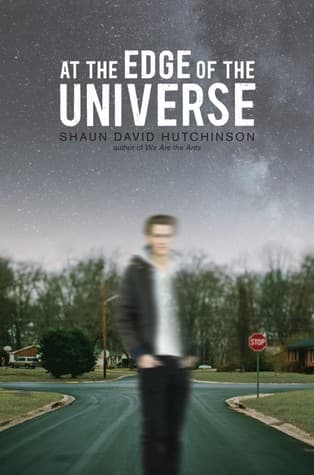
Shaun David Hutchinson (2017)
Genre
Psychology / Science Fiction / Young Adult / Romance
Reading Time
6-7 hours
Key Themes
See below
Sign in to track this book
Ozzie's boyfriend vanishes from existence, and no one remembers him but Ozzie. As the universe shrinks, Ozzie races to find him, even as a new connection sparks an unexpected, forbidden love.
Ozzie Pounce, a high school student, wakes up one morning to a reality where his best friend and boyfriend, Tommy Burke, has completely vanished. Not only is Tommy gone, but no one else remembers him—not his parents, not his friends, not even Tommy's own family. Ozzie is the only person who remembers Tommy. This absence leaves Ozzie grieving and confused, struggling to reconcile his vivid memories with everyone else's blank slate. His parents suggest therapy, believing Ozzie is having a breakdown, but Ozzie remains convinced Tommy was real and that something has fundamentally shifted in their world.
As Ozzie grapples with Tommy's disappearance, he notices strange changes in his environment: inanimate objects like lampposts and buildings are vanishing, and the stars in the night sky appear fewer and dimmer. He interprets these phenomena as signs that the universe is shrinking. At the same time, a new student named Calvin transfers to their school. Ozzie is paired with Calvin for a physics project, a subject Ozzie usually excels at but struggles with due to his preoccupation with Tommy. Calvin is quiet and observant, and their initial interactions are marked by Ozzie's distant demeanor.
Ozzie begins to have vivid, unsettling dreams. In these dreams, he is in a dark, confined space, sometimes feeling strange pressure, and occasionally seeing glimpses of Tommy. He also starts drawing a recurring image of a bubble, which he instinctively feels is connected to Tommy's vanishing. During their physics project, Ozzie hesitantly tells Calvin about Tommy, explaining that he believes Tommy was real and has somehow been erased. To Ozzie's surprise, Calvin doesn't dismiss him; instead, he listens intently, though he offers no immediate solutions or explanations. This openness creates a fragile bond between them.
As Ozzie and Calvin spend more time together, working on their project and talking, a new kind of intimacy develops. Calvin's calm demeanor and intellectual curiosity provide a grounding presence for Ozzie, who is otherwise adrift in his grief and confusion. They share personal stories and vulnerabilities, and Ozzie finds himself increasingly drawn to Calvin, experiencing feelings he thought were reserved only for Tommy. This attraction creates significant internal conflict for Ozzie, as he feels deep loyalty to Tommy and believes pursuing a relationship with Calvin would betray his lost love and his mission to find him.
Driven by Ozzie's belief that the universe is shrinking, he and Calvin begin to research advanced theoretical physics, specifically concepts related to alternate dimensions, string theory, and the nature of reality. Calvin, who possesses a surprising depth of scientific knowledge, helps Ozzie articulate his observations in scientific terms. They explore the idea that reality might not be fixed, and that Tommy's disappearance could be a symptom of a larger cosmic anomaly. Their research leads them to consider the possibility of a 'bubble' or a 'fold' in spacetime, which aligns with Ozzie's recurring dream imagery and drawings, strengthening his belief that there's a scientific explanation for Tommy's absence.
After much shared research and growing emotional intimacy, Calvin reveals a shocking truth: he is not entirely human. He explains that he is an entity from another dimension, sent to observe and, if possible, correct the anomaly causing their universe to shrink. Calvin confesses that he knows about Tommy's existence and disappearance, and that he has been indirectly guiding Ozzie towards understanding the situation. This revelation both validates Ozzie's sanity and introduces new complexity and danger to their quest. Calvin explains that Tommy is not gone, but trapped in a collapsing pocket of reality, and that the universe is indeed shrinking as a consequence of this cosmic imbalance.
Calvin elaborates on the nature of Tommy's entrapment, explaining that Tommy is stuck in a dimension slowly being reabsorbed into the void, causing their universe to shrink. There is a 'gate'—a fragile point of connection between realities—that allows for potential interaction. Calvin reveals that for Tommy to return, a sacrifice must be made. Ozzie must choose to either open the gate and bring Tommy back, which would likely erase all of Ozzie's memories of his time with Calvin and potentially endanger Calvin's existence, or close the gate, cementing Tommy's absence but preserving Ozzie's current reality and his relationship with Calvin. The choice is agonizing for Ozzie.
Ozzie, torn between his love for Tommy and his feelings for Calvin, ultimately chooses to open the gate. He understands that this means losing his memories of Calvin and the new life he's built. In a poignant, bittersweet moment, Ozzie and Calvin share a final, heartfelt goodbye, acknowledging their impact on each other. As the gate opens, Ozzie feels a rush of energy and a sense of displacement. He wakes up to find Tommy back in his life, everyone remembering him as if he'd never left. The universe is no longer shrinking. However, all memories of Calvin and the alternative reality are gone from Ozzie's mind.
Tommy is back, vibrant and real, and their relationship resumes as if the intervening time never happened. Their friends and family are relieved and happy, completely oblivious to the cosmic anomaly that almost erased Tommy from existence. Ozzie, however, feels a persistent, inexplicable sense of loss and a vague emptiness. He cannot pinpoint the source of this feeling, but a part of him senses that something significant is missing from his life, a profound experience or connection that has been erased. He finds himself drawing bubbles unconsciously, a lingering echo of his forgotten journey and the person he can no longer recall.
Despite having Tommy back and life seemingly returning to normal, Ozzie is haunted by an unidentifiable longing. He sometimes catches glimpses of a boy with dark hair and intense eyes in crowds, a face that feels familiar yet utterly unknown. These fleeting encounters stir a deep, melancholic ache within him. He continues to draw the bubble motif, an instinctive urge he doesn't understand. The novel concludes with Ozzie living his life with Tommy, but with a palpable sense that a crucial part of his personal history, and a significant connection, has been sacrificed and now exists only as a phantom limb in his memory, a subtle reminder of the choice he made at the edge of the universe.
The Protagonist
Ozzie transforms from a grief-stricken, isolated individual into someone capable of immense sacrifice for love, even if it means forgetting a profound connection.
The Lost Love/Catalyst
Tommy's arc is external to the narrative; he is a constant presence in Ozzie's mind, a goal to be reached, and his return signifies Ozzie's ultimate sacrifice.
The Supporting/Love Interest/Guide
Calvin serves as a catalyst for Ozzie's understanding of the universe and his own emotional growth, ultimately making a sacrifice for Ozzie's happiness.
The Supporting
Her arc is static; she remains a constant, loving parental figure, accepting Tommy's return without question.
The Supporting
His arc is static, remaining a supportive but uncomprehending parent until Tommy's return.
The Supporting
Her arc is static; she embodies the 'normal' world's perspective on Ozzie's grief.
The novel deeply explores grief, not just for a lost person, but for a lost reality. Ozzie's struggle to maintain his memories of Tommy against a world that denies them highlights memory's impact on identity. His isolation in grief is central, as no one can validate his sorrow. The theme complicates with the idea that his memories of Calvin are also sacrificed, showing that grief can be erased, but a sense of loss might linger, as seen in Ozzie's unconscious drawing of bubbles and vague longing even after Tommy's return.
“What if you were the only one who remembered someone you loved? What if everyone else forgot? Would that person still be real?”
The story constantly questions what reality is. Is it collective memory, or an individual's perception? The shrinking universe and Tommy's erasure suggest that reality is fluid and fragile, not a fixed constant. Calvin's existence as an interdimensional being further blurs the lines, proposing that multiple realities and dimensions exist. The novel posits that our understanding of reality is limited and that what we perceive as 'real' can be altered or undone, making Ozzie's experience terrifying and profoundly existential. The physics discussions between Ozzie and Calvin ground these abstract ideas.
“Maybe the universe isn't shrinking. Maybe it's just forgetting.”
The central dilemma of the novel revolves around love's sacrificial nature. Ozzie's love for Tommy drives his quest, but his developing love for Calvin forces him to confront an impossible choice. He ultimately chooses to sacrifice his memories of Calvin and their shared journey to bring Tommy back, demonstrating that true love can involve immense personal cost. This sacrifice highlights the idea that sometimes, love means letting go of one version of happiness for the sake of another, even if the memory of that sacrifice is erased, leaving only a lingering feeling.
“Sometimes, love means choosing to forget, even if it's the hardest thing you'll ever do.”
Ozzie's identity is tied to his relationships and memories. When Tommy vanishes, Ozzie loses a significant part of himself, struggling with who he is without his boyfriend and best friend. His journey to find Tommy is also a journey to reclaim his own sense of self. The development of his relationship with Calvin offers him a new identity, one that is ultimately sacrificed. The lingering sense of loss after Tommy's return, despite not remembering Calvin, suggests that even erased experiences can profoundly shape who we become, leaving an indelible, if unconscious, mark on our identity.
“If everyone forgets you, are you still you? And if you're the only one who remembers, are you still sane?”
Tommy's inexplicable disappearance from everyone's memory except Ozzie's.
This is the primary inciting incident, creating the central mystery and Ozzie's profound isolation. It serves as a powerful metaphor for grief and loss, making the absence of a loved one literal and absolute. It also establishes the fantastical element of the story and sets up the stakes for Ozzie's quest, as he fights not just for Tommy's return, but for his very existence in the collective consciousness. The erasure forces Ozzie to question his own sanity and the nature of reality itself.
The literal shrinking of physical objects and the night sky.
This serves as a tangible, visual representation of the cosmic anomaly and the escalating stakes. It provides a scientific framework for Ozzie's quest, allowing him and Calvin to explore theoretical physics. Symbolically, it represents Ozzie's diminishing world and his growing sense of isolation, reflecting his internal state outwardly. It also creates a sense of urgency, implying that time is running out to save Tommy and restore reality.
Ozzie's recurring dreams and drawings of a bubble.
This acts as a powerful symbol and a subtle foreshadowing device. It represents Tommy's isolated dimension, a pocket of reality where he is trapped. It also symbolizes Ozzie's own isolated memories and, later, the fragile, temporary nature of his connection with Calvin. The bubble imagery provides a visual anchor for the abstract concepts of alternate dimensions and collapsing realities, making the complex physics more accessible and emotionally resonant for Ozzie and the reader.
Calvin's true identity as an entity from another dimension.
Calvin's true nature is a major plot twist that validates Ozzie's experiences and provides a credible source of information about the anomaly. He functions as a mentor and guide, offering the scientific and metaphysical explanations Ozzie needs. His existence introduces the concept of higher powers or cosmic forces at play, expanding the scope of the narrative beyond a purely personal story. Furthermore, his identity creates the central emotional conflict and the ultimate choice Ozzie must make.
“The universe is a cruel, uncaring void. The key to being happy isn't to search for meaning, it's to just keep yourself busy with unimportant stuff and eventually you'll be dead.”
— Ozzie's pessimistic outlook on life and the universe.
“Maybe the universe isn't trying to tell us something. Maybe it's just doing its thing, and we're just along for the ride.”
— Natalie contemplating the indifference of the cosmos.
“Love isn't about finding someone who completes you. It's about finding someone who accepts you completely.”
— Ozzie's developing understanding of love.
“The problem with believing in a flat Earth isn't that you're wrong. It's that you're so sure you're right, you stop looking.”
— A metaphor for close-mindedness.
“Sometimes the most scientific explanation is also the most magical.”
— Ozzie reflecting on the wonders of the universe and science.
“We're all just trying to make sense of a world that doesn't always make sense.”
— A general observation about the human condition.
“You can't fix someone else's broken heart, but you can sit with them in the wreckage.”
— Natalie's empathy towards Ozzie's struggles.
“Maybe the universe is just a really big, complicated puzzle, and we're all just tiny pieces trying to find where we fit.”
— Ozzie musing on his place in the cosmos.
“Fear is a powerful motivator, but it's also a terrible guide.”
— A comment on the nature of fear.
“The stars don't care about your problems, but they're still beautiful.”
— Ozzie's dual perspective on the universe's indifference and beauty.
“Being brave isn't about not being scared. It's about being scared and doing it anyway.”
— A classic definition of bravery.
“We create our own meaning in a meaningless universe.”
— Ozzie's eventual shift towards finding personal meaning.
“Sometimes the most important discoveries are the ones you make about yourself.”
— Ozzie's journey of self-discovery.
Ready to see how well you understood this book? Take our interactive quiz with 10 questions.

Rhonda Byrne
4.3

Menno Henselmans
4.3
Sylvia Plath
4.3
Elliot Aronson
4.3
Joseph Campbell
4.3
Erich Fromm
4.3
Irvin D. Yalom
4.2
Lucy Strange
4.2