BookBrief
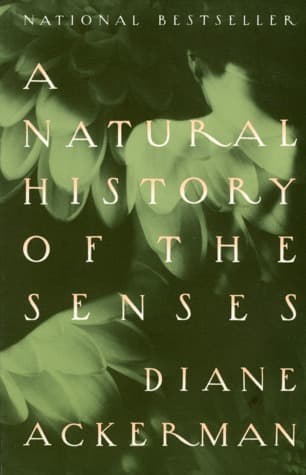
A Natural History of the Senses cover
Archivist's Choice

A Natural History of the Senses

Diane Ackerman (1990)

Genre

Psychology / History / Science / Philosophy

Reading Time

12 hours

Key Themes

See below

Track Your Reading

Sign in to track this book

Diane Ackerman blends science and poetry to explore our senses, from an Antarctic iceberg's breath to a perfumer's artistry, revealing how we perceive the world.

Core Idea

Diane Ackerman's "A Natural History of the Senses" explores the human sensory experience. It argues that our understanding of the world comes from our senses. By engaging with sight, sound, smell, taste, and touch, we can better appreciate life, our biology, and the culture shaped by perception. The book promotes a sensualist's view, urging readers to rediscover how our bodies connect us to the universe.
Reading time
12 hours
Difficulty
Medium
✓ Read this if...
You are fascinated by the human body, the intricacies of perception, and how our senses connect us to the world, history, and culture. You appreciate poetic language and a multidisciplinary approach to scientific and philosophical topics.
✗ Skip this if...
You prefer highly structured, data-driven scientific texts or prescriptive self-help books. If you dislike digressions, metaphors, and a more subjective, essayistic style, this might not be for you.

Core idea

The central argument and framework that powers the entire book.

Diane Ackerman's "A Natural History of the Senses" explores the human sensory experience. It argues that our understanding of the world comes from our senses. By engaging with sight, sound, smell, taste, and touch, we can better appreciate life, our biology, and the culture shaped by perception. The book promotes a sensualist's view, urging readers to rediscover how our bodies connect us to the universe.

At a glance

Reading time

12 hours

Difficulty

Medium

Read this if...

You are fascinated by the human body, the intricacies of perception, and how our senses connect us to the world, history, and culture. You appreciate poetic language and a multidisciplinary approach to scientific and philosophical topics.

Skip this if...

You prefer highly structured, data-driven scientific texts or prescriptive self-help books. If you dislike digressions, metaphors, and a more subjective, essayistic style, this might not be for you.

Key Takeaways

1

The Sensualist's Manifesto

Embracing the full spectrum of sensory experience is essential for a rich life.

Quote

The great secret is not having some special talent or wisdom, but in being an ordinary human being who is willing to experience the whole of life.

Ackerman argues that we often live in sensory deprivation, dulling ourselves to the world. She advocates for re-engaging with our senses, not just as passive receivers, but as active creators of our reality. By paying attention to the details of sight, sound, smell, taste, and touch, we gain a deeper appreciation for life, turning ordinary moments into meaningful experiences. This is about heightened awareness and a more complete understanding of what it means to be alive. To truly live is to feel everything, from a cold wind's sting ...

Supporting evidence

Ackerman's own immersive experiences, such as her conversations with an iceberg in Antarctica, demonstrate her commitment to fully engaging with the world through all available senses.

Apply this

Dedicate specific time each day to a 'sensory walk' or 'sensory meal' where you deliberately focus on one sense at a time, noticing details you usually overlook. Describe your observations aloud or in a journal to deepen the experience.


sensory-awarenessembodied-cognitionmindfulness-practice
2

Olfaction's Ancient Power

Smell, our most primal sense, holds profound sway over memory and emotion.

Quote

There is no more powerful sense than the sense of smell. It is our oldest sense, and it connects us directly to the animal world, to our ancestors, and to our deepest emotions.

Ackerman explores the power of smell, noting its direct path to the limbic system, the brain's emotional and memory center. Unlike other senses, smell signals bypass the thalamus, which explains why a scent can instantly transport us back decades and evoke strong emotions. She examines the language of scent, from pheromones that influence attraction to nostalgic aromas that trigger childhood memories. This connection shows smell's role not just in perception, but in shaping our sense of self and our relationship with the world, often ...

Supporting evidence

The phenomenon of Proust's madeleine, where the taste and smell of a small cake triggered a flood of involuntary memories, serves as a classic illustration of olfaction's power.

Apply this

Create a 'scent journal' to record smells you encounter throughout the day, noting the emotions, memories, and associations they trigger. Experiment with essential oils or specific perfumes to consciously evoke desired moods.

limbic-systemolfactory-memorypheromonessensory-priming
3

The Tactile Tapestry

Touch is fundamental to connection, understanding, and even self-definition.

Quote

Touch is the most intimate of the senses. It is how we know the world, how we know each other, and how we know ourselves.

Ackerman states that touch is about the core of our being, not just physical contact. From early life, touch sets boundaries, provides comfort, and lets us perceive texture, temperature, and pressure. She explores different forms of touch, from a gentle caress to a firm grip, and its impact on human development, social bonding, and healing. Our skin, the largest organ, acts as a sensory map, constantly gathering information that shapes our understanding of reality. Ignoring touch means neglecting a basic part of human experience, lead...

Supporting evidence

Studies on infant development, showing the critical role of touch for emotional and physical well-being (e.g., Harlow's monkey experiments, though not explicitly cited, align with the concept). Ackerman discusses the importance of touch in various cultures and rituals.

Apply this

Consciously engage with different textures throughout your day – the smoothness of a stone, the roughness of bark, the softness of a blanket. Practice mindful touch, paying attention to the sensations when you hold an object or embrace a loved one.

haptic-perceptionsomatosensationskin-receptorssocial-bonding
4

Taste's Cultural Kaleidoscope

Flavor is a complex interplay of biology, memory, and cultural narrative.

Quote

Taste is a kaleidoscope of sensations, a dance of chemistry and culture, memory and expectation.

Beyond the five basic tastes, Ackerman shows how flavor perception is a mix of smell, texture, temperature, and even sound. She highlights taste's cultural roots, showing how preferences are shaped by history, geography, and social rituals. Food is more than sustenance; it is a way to tell stories, express identity, and build community. From shocking cuisine to comforting home flavors, taste helps us understand ourselves and others. Our relationship with food is a rich, multi-sensory experience that reflects our deepest values and tra...

Supporting evidence

Ackerman discusses the nuances of wine tasting, the cultural significance of spices, and even the concept of 'sadistic cuisine' as examples of how taste extends beyond simple chemical detection.

Apply this

When eating, pause to identify the different components contributing to the flavor – not just sweet/sour, but also the aroma, texture, and how it evokes memories or cultural associations. Try a food from a culture unfamiliar to you with an open, analytical mind.

gastronomyumamiflavor-perceptionsensory-integration
5

Sight's Subjective Canvas

Seeing is an active, interpretive process, not a passive reception of light.

Quote

We do not just see with our eyes; we see with our brains, our memories, our emotions, and our imaginations.

Ackerman challenges the idea that sight is a purely objective view of the world. She argues that visual perception is a subjective act, influenced by our experiences, culture, and emotions. The brain actively builds what we see, filling in gaps, interpreting information, and filtering out what it deems irrelevant. She explores visual experience, from light and shadow to color's symbolic power, showing how artists, mystics, and ordinary people use sight to create meaning. To truly 'see' is to constantly create.

Supporting evidence

Discussions of optical illusions, the cultural symbolism of colors (e.g., red meaning danger vs. passion), and how individual experiences shape what we perceive in art.

Apply this

Practice 'active seeing' by choosing a familiar object or scene and trying to notice details you've never observed before – the subtle shifts in color, the play of light, the forgotten textures. Sketch or describe what you see without judgment.

visual-perceptioncognitive-biascolor-theorysubjectivity
6

The Symphony of Sound

Sound shapes our environment, our emotions, and our understanding of time.

Quote

Sound is the architecture of our world, a constant companion that shapes our emotions, our memories, and our sense of place.

Ackerman explores sound not just as vibrations, but as a force that shapes our reality. From the silent infrasound and ultrasound perceived by animals, to music's harmonies and urban noise, sound constantly defines our spatial and temporal awareness. She examines the emotional impact of sounds, how they can soothe, alarm, or inspire, and their role in communication beyond words. The world is a constant symphony, and by listening to its details, we appreciate its rhythms and hidden messages. Ignoring the soundscape means missing a laye...

Supporting evidence

Ackerman mentions the 'music played by the planet Earth' and discusses the impact of different musical forms on human emotion and culture.

Apply this

Practice 'soundwalking' – choose a route and focus solely on the sounds around you, identifying their sources, qualities, and how they make you feel. Try to distinguish between natural and artificial sounds, near and far sounds.

acousticsauditory-perceptionsoundscapebioacoustics
7

Synesthesia: The Blended Senses

For some, senses intertwine, offering a glimpse into heightened perception.

Quote

For the synesthete, the world is a carnival of blended sensations, where numbers have colors and music has taste.

Ackerman introduces synesthesia, where one sense automatically triggers another. This blending of senses – seeing sounds as colors, tasting words, or feeling shapes – shows the arbitrary boundaries we place on our sensory experiences. While rare, synesthesia reveals the interconnectedness of our sensory systems and suggests that 'normal' perception is just one possibility. It encourages us to imagine other sensory dimensions and how a richer, more integrated sensory world could be perceived.

Supporting evidence

Ackerman describes various forms of synesthesia (e.g., grapheme-color synesthesia, chromesthesia) and the unique experiences of individuals who possess these abilities.

Apply this

Engage in cross-sensory exercises: try to 'taste' a piece of music, 'see' the texture of a sound, or 'feel' the color of an object. While you may not be a true synesthete, this can open your mind to new ways of perceiving.

cross-modal-perceptionsensory-integrationneurodiversityperceptual-flexibility
8

Sensory Deprivation's Toll

A lack of sensory input can be as detrimental as overstimulation.

Quote

To be deprived of sensory input is to be deprived of the world itself, to lose the very anchor of our reality.

Ackerman clearly shows the negative impact of sensory deprivation. She argues that our senses are not just tools for experiencing the world, but are essential for our sanity, identity, and connection to reality. Through examples of people in solitary confinement or with sensory loss, she shows how a lack of varied input can lead to hallucinations, disorientation, and a breakdown of self. This highlights the importance of a rich sensory environment for psychological well-being and cognitive function. Our senses ground us, providing dat...

Supporting evidence

Discussions about the psychological effects of solitary confinement, the experiences of individuals with severe sensory impairments, and experiments in sensory deprivation chambers.

Apply this

Reflect on your daily sensory diet. If you find yourself in a monotonous or under-stimulating environment, actively seek out opportunities for novel sensory input – listen to new music, try a different route to work, or visit a new place.

sensory-processingcognitive-loadpsychological-wellbeingenvironmental-enrichment
9

The Evolution of Perception

Our senses are finely tuned products of evolutionary adaptation.

Quote

Our senses are ancient tools, honed over millennia by the relentless pressures of survival and adaptation.

Ackerman emphasizes that our senses are a marvel of evolutionary engineering, shaped by survival and reproduction. Each sense, with its strengths and limits, reflects the challenges and opportunities our ancestors faced. She explores how different species have evolved extraordinary sensory capabilities (e.g., bats' echolocation, dogs' smell) that surpass human abilities, reminding us that our perception is a limited slice of the whole. Understanding the evolutionary context of our senses explains why we perceive the world as we do, an...

Supporting evidence

Comparisons of human sensory capabilities with those of various animals, such as the superior hearing of bats or the incredible sense of smell in dogs, illustrate evolutionary adaptations.

Apply this

Observe animals in their natural habitats (even pets) and try to imagine how their world might be perceived through their senses. Consider how your own senses help you navigate and survive in your environment.

sensory-evolutionadaptationinterspecies-communicationecological-niche
10

Art as Sensory Alchemy

Art transmutes raw sensory data into profound human experience.

Quote

Art is the human attempt to replicate, to heighten, and to make sense of the vast, overwhelming data stream that is our sensory world.

Ackerman positions art as a way to enhance sensory experience. Artists, she argues, transform raw sensory input into structured, meaningful, and emotional forms. Through painting's colors, a symphony's rhythms, sculpture's tactile pleasure, or poetry's language, art lets us see the world differently, feel more deeply, and connect with human experiences. Art does not just reflect reality; it redefines and enriches our sensory engagement with it, inviting us to a heightened state of awareness and appreciation.

Supporting evidence

Discussions of different art forms (painting, music, literature) and how they manipulate sensory elements to evoke specific emotions and ideas.

Apply this

When experiencing art (music, visual art, literature), consciously analyze how the artist is manipulating your senses – what colors, sounds, textures, or implied tastes are being used, and what emotional or intellectual response they provoke.

aestheticssensory-aestheticsart-therapycreative-expression

Critical analysis

Notable Quotes

The only way to make sense out of change is to plunge into it, move with it, and join the dance.

General reflection on embracing life's flux.

Smell is the primitive sense, a kind of primeval memory.

Discussing the fundamental nature and power of olfaction.

Poets have been trying for centuries to describe the scent of roses. They fail. It's too complex.

Illustrating the ineffability and complexity of certain smells.

Touch is the most fundamental sense. It is the first sense to develop in the womb, and the last to leave us.

Emphasizing the primacy and enduring nature of touch.

Taste is the most intimate of the senses, a direct portal to pleasure and memory.

Exploring the personal and evocative power of taste.

We are not just rational beings; we are feeling beings, sensing beings.

Arguing against an overemphasis on pure rationality.

Color is a language the eye speaks to the mind.

Describing the communicative and interpretive nature of sight.

The ear is a funnel for the world's music, a delicate instrument for processing vibrations.

Metaphorically portraying the ear's function and sensitivity.

Everything that has a beginning has an end. Make your peace with that and all will be well.

A philosophical reflection on transience and acceptance.

To live is to be a breath. To be alive is to breathe.

A simple yet profound statement about the essence of life.

Our senses are our portals to the world, our way of understanding and interacting with reality.

Summarizing the vital role of the senses in human experience.

The skin remembers what the mind forgets.

Highlighting the body's capacity for memory, especially through touch.

To be human is to be sensuous, to be alive to the myriad textures and aromas and flavors of the world.

Defining humanity through its capacity for sensory experience.

The world is an orchestra, and our senses are the conductors, allowing us to interpret its symphony.

Using an extended metaphor to describe sensory perception.

Quiz

Test Your Knowledge

Ready to see how well you understood this book? Take our interactive quiz with 10 questions.

10
Questions
~5
Minutes
?
Best Score

Key Questions (FAQ)

Diane Ackerman's 'A Natural History of the Senses' is an immersive exploration of the five senses and beyond, blending science, history, philosophy, and personal experiences. It delves into how we perceive the world through touch, taste, smell, sight, and hearing, examining their cultural, psychological, and biological significance.

About the author

Diane Ackerman

Diane Ackerman is a celebrated poet, essayist, and naturalist known for her lyrical prose that explores the intersection of nature and human experience. Her seminal work, "A Natural History of the Senses," earned widespread acclaim and cemented her reputation as a gifted nature writer. Ackerman masterfully blends scientific observation with poetic sensibility, inviting readers to engage deeply with the world around them.