“And the ship went for'ard, and she went for'ard, and she went for'ard, till we thought she would never stop.”
— Describing the ship's relentless progress despite damage.


Sign in to track this book
A young Marlow takes his first sea voyage to the East, facing the sea's power and his ship's fiery end, all while experiencing adventure and the realities of life.
The story begins with five friends, all experienced sailors now living comfortable lives, gathered around a table. Charles Marlow is among them, and he starts to tell a story from his youth, his first voyage to the East. The others, who have had similar sea experiences, listen closely, sometimes adding their own memories. Marlow sets the scene, talking about how time has passed and the difference between his youthful hopes and his current age. He introduces the ship, the 'Judea,' and the dangerous journey ahead, setting up a sense of adventure and challenge.
Marlow, at twenty, gets a job as second mate on the 'Judea,' a three-masted barque. He remembers his great excitement and energy, eager for his first trip to the mysterious East. The 'Judea' is an old, broken-down ship, past its best years. Young Marlow notices this, but it only adds to the adventure's romance. He describes the ship's age and poor state, calling it 'ancient' and 'decrepit,' but his youthful hope overlooks any practical worries about its condition. His first impression of the ship and crew is of a grand, if somewhat messy, undertaking.
Soon after leaving London, the 'Judea' is hit by a strong storm in the North Sea. The ship takes a severe beating, almost sinking, and has to go into port for repairs. Marlow describes the terrifying experience, the ship groaning in the waves, and the constant threat of being overcome. This first sea trial is a harsh lesson for the young, inexperienced crew, including Marlow. Despite the danger and serious damage to the ship, Marlow's spirit remains strong. He sees the storm as an exciting challenge, a sign of nature's power, and a thrilling start to a sailor's life, not a reason to quit.
After the storm, the 'Judea' spends a long time in Falmouth for repairs. The delays are frustrating, and the ship's poor state means the repairs are long and slow. Marlow, however, sees even this long stop as part of the grand adventure. He describes the waiting, but also the friendship that grows among the crew during this time. The ship's ongoing problems, including coal cargo that shifts and causes issues, hint at its deeper flaws. Despite the setbacks, Marlow's youthful excitement remains high, though he notices some older crew members growing tired.
After many delays and repairs, the 'Judea' finally sails for Bangkok, loaded with coal. As they head south, the coal in the hold starts to shift dangerously, threatening the ship's stability. This new danger requires the crew to work hard, shoveling and moving the coal to prevent the ship from tipping over. Marlow details the difficult, dirty, and dangerous work, showing the constant threat of being buried or the ship overturning. He describes the intense heat in the hold and how it wears down the men. Still, even in this hard labor, Marlow finds purpose and adventure, driven by the goal of reaching the East.
The worst fear comes true: the coal cargo, because of spontaneous combustion, catches fire. Smoke starts to leak from the holds, and the air smells strongly of burning coal. The crew's efforts to put out the fire are desperate and mostly useless. Marlow vividly tells of finding the fire and the frantic attempts to douse it, including pouring water into the holds, which only seems to make it worse. The ship, now a 'burning coal,' becomes a dangerous place, and the crew's spirits start to drop. The reality of their situation, trapped on a burning ship in the middle of the ocean, becomes clear.
As the fire burns out of control, consuming the 'Judea' from within, Captain Beard decides to abandon ship. The crew, including Marlow, rushes into the ship's longboat, taking what little supplies and water they can save. Marlow describes the chaotic scene of their departure, the burning ship lighting up the night sky, a striking and unforgettable image. The longboat, crowded with the entire crew, begins its dangerous journey across the open sea, heading for the nearest land. Despite the great danger and uncertainty, Marlow feels a strange excitement, seeing this as the ultimate test of his youthful spirit and strength.
After days adrift in the longboat, enduring thirst, hunger, and the hot sun, a passing steamer finally spots and rescues the crew. Marlow recounts their great relief at being rescued and their first sight of land. As they are towed to their destination, he describes the lively, foreign sights and sounds of the East, a sharp contrast to the grim struggle at sea. He is fascinated by the busy harbor, the foreign faces, and the rich smells, fulfilling his dream of reaching this legendary land. Though the 'Judea' is lost, Marlow's personal discovery ends with this experience of the Orient, a moment of triumph for his youthful spirit.
As the rescued crew is towed to port, they pass the smoldering remains of the 'Judea.' Marlow describes the sad sight of their old ship, now a blackened, ruined hulk, still burning but slowly sinking into the sea. He thinks about the ship's brave struggle and final end, recognizing its part in his early experiences. The 'Judea' is more than just a vessel; it stands for the difficulties of his youth and the dreams it carried. The last look at the ship's end is a bittersweet moment, marking the close of one chapter and the start of another, leaving a lasting mark on Marlow's memory.
Marlow finishes his story, bringing it back to the present gathering of friends. He thinks about the impact of that first voyage, acknowledging the wild energy of his youth. He emphasizes how, looking back, the hardships and dangers were simply part of the great adventure, seen through the eyes of youthful invincibility. He compares this with the tiredness and wisdom of old age, seeing that such intense experiences are unique to youth. The story ends with Marlow's thought about the 'glamour' of youth, its ability for endless hope and strength, even when facing great hardship, a feeling shared by his aging fellow sailors.
The Protagonist/Narrator
Marlow's arc is less about transformation and more about the vivid experience of his youth shaping the man he becomes, culminating in a profound appreciation for that period of his life.
The Supporting
Captain Beard endures immense hardship and the loss of his ship with dignity, representing the stoicism of an old seaman.
The Supporting
The First Mate remains largely unchanged, serving as a steady, if uninspired, presence throughout the voyage.
The Mentioned
They remain static, serving as the appreciative audience for Marlow's story.
The main theme explores the great hope, resilience, and perceived strength of youth. Marlow often says how, when he was young, he saw every difficulty—storms, shifting cargo, fire—not as a disaster but as an exciting adventure or a test. The 'Judea's' many misfortunes, which would break an older man, only fuel his youthful energy. This theme shows when Marlow describes his almost joyful reaction to the burning ship, seeing it as 'a magnificent blaze' and a 'splendid and terrifying sight,' rather than a tragedy.
“''Oh, the glamour of youth! Oh, the fire of it, more dazzling than the flames of the burning ship, throwing a magic light on the wide water, for the sea was dark still, only relieved by the crimson glitter of the burning wreck.'”
The East is an ideal, almost mythical place for young Marlow, symbolizing adventure, mystery, and a dream come true. Despite endless problems and dangers, the idea of reaching the East drives his persistence. The journey itself, with all its trials, becomes a trip towards this foreign and life-changing land. When he finally sees the shores of the East from the longboat, it is a moment of great triumph and discovery, a reward for all the suffering and the peak of his youthful dreams, even though his ship is lost.
“'And then I saw the East! I had a glimpse of it as I went by—that's all. But I've seen it. I've seen it, and it is good.'”
The fight against nature's power—storms, the sea, and spontaneous combustion—is a repeated idea. The 'Judea' and its crew are often tested by the elements, showing how vulnerable humans are to the natural world. From the fierce North Sea gale to the coal catching fire, the ship's journey is a constant fight for survival. Yet, for young Marlow, these conflicts are not just destructive but also shape him, helping him understand the world and his own abilities, showing the strength of the human spirit even against huge odds.
“'There are not many things in a man's life that he can look back to with unalloyed satisfaction. But my first sight of the East is one of them.'”
The story's frame, with an older Marlow telling his youthful adventure to his aging friends, highlights the theme of time passing and how memory is personal. The story is a nostalgic reflection, where past hardships are softened by time, turning them into cherished memories of a lively youth. Marlow's thoughts show how experiences, especially those from youth, shape who someone is and continue to matter years later. The difference between his young self and his present self emphasizes life's journey and the lasting power of early experiences.
“'For twenty years already I had been looking at the sea, and I had never seen a ship like that... She was a bark, of three hundred tons, and she was called the Judea.'”
An older Marlow recounts his past adventure to a group of friends.
The story begins and ends with an older Charles Marlow sharing his tale with a circle of fellow ex-seamen. This device allows for a dual perspective: the raw, immediate experience of young Marlow and the reflective, often nostalgic, commentary of the older narrator. It emphasizes the theme of memory and the passage of time, allowing the audience to appreciate the story through the lens of wisdom and experience, highlighting how past events are reinterpreted and cherished over the years, giving depth to the 'youthful' narrative.
The ship represents the journey of youth itself.
The 'Judea', an old, decrepit ship persistently plagued by misfortune, symbolizes youth's inherent fragility, its trials, and its eventual, inevitable end. Despite its flaws, it carries the hopes and dreams of young Marlow. Its repeated breakdowns, the shifting cargo, and the final fiery destruction mirror the challenges and transformative experiences of youth. The ship's valiant, yet ultimately doomed, struggle reflects the idea that youth, though full of vigor, is a temporary state destined to give way to maturity or be consumed by life's hardships.
The story is told entirely from Marlow's subjective point of view.
Marlow's first-person narration is crucial, as it allows the reader to directly access his thoughts, feelings, and unique perspective on events. His enthusiasm, resilience, and later, his reflective wisdom, are all conveyed intimately. This subjective viewpoint is particularly effective in highlighting the theme of youth, as the reader experiences the world through the unbridled optimism of young Marlow, even when facing dire circumstances. It also allows for the poignant contrast between the past and present self, enriching the story with layers of personal insight and emotional depth.
“And the ship went for'ard, and she went for'ard, and she went for'ard, till we thought she would never stop.”
— Describing the ship's relentless progress despite damage.
“She was an old ship, but she was a good ship.”
— A simple yet profound statement about the Judea.
“I remember my youth and the feeling that will never come back any more—the feeling that I could last for ever, outlast the sea, outlast the earth.”
— The narrator reflecting on the boundless energy and optimism of youth.
“Passage after passage was like a long struggle of a man fighting for his life with a wild beast.”
— Comparing the arduous journey to a primal struggle.
“We were cut off from the rest of the world.”
— Highlighting the isolation experienced at sea.
“Oh, the glamour of the East, oh, the glamour of the sea!”
— Expressing the romantic allure of distant lands and maritime life.
“The East looked at you with such an inscrutable face that you could never tell what might be behind it.”
— Describing the mysterious and unpredictable nature of the Orient.
“There are not many things in a man's life that he can look back to with unalloyed satisfaction.”
— A general reflection on life's disappointments, contrasting with the cherished memory of the voyage.
“And there was the Judea, a miracle of human ingenuity and courage, floating on the waves, a mere shell, a mere wreck, but still afloat!”
— Admiration for the damaged ship's resilience.
“I was twenty, and an East Indiaman for my first command.”
— The narrator's youthful ambition and the significant opportunity.
“We were in a world of our own, and we were content.”
— Describing the self-contained and satisfying experience of the crew.
“The ultimate truth of a thing is in its mystery, not in its manifestations.”
— A philosophical musing on the nature of truth, often applied to the sea or the East.
“I loved the great world of waters, the mercilessness of the winds, the fierceness of the sun.”
— Embracing the harsh realities of nature with a sense of passion.
“It was a great fire, and it was my fire, a fire that was to light me to my first command.”
— The burning cargo, a disaster, becomes a symbolic beacon for his future.
Ready to see how well you understood this book? Take our interactive quiz with 10 questions.
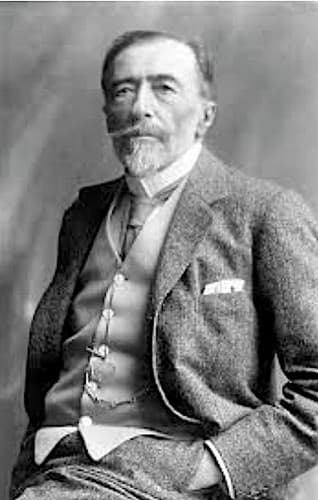
Joseph Conrad was a Polish-British novelist and short story writer. He is regarded as one of the greatest writers in the English language; though he did not speak English fluently until his twenties, he came to be regarded a master prose stylist who brought a non-English sensibility into English literature. He wrote novels and stories, many in nautical settings, that depict crises of human individuality in the midst of what he saw as an indifferent, inscrutable and amoral world.

Ashley Antoinette
4.6

Mark McDonald
4.4
Luo Guanzhong
4.4

Mia McKenzie
4.3

Dorothy Parker
4.3

Joaquim Maria Machado de Assis
4.3

James Thurber
4.2

Terry Kay
4.2