“It is better to have loved and lost than to have to do forty pounds of laundry a week.”
— From 'The Secret Life of Walter Mitty,' a humorous take on domesticity.

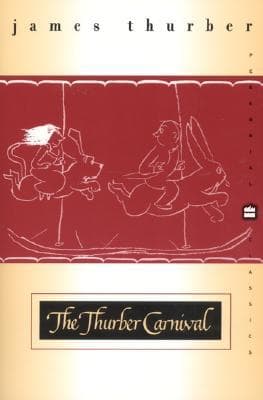
James Thurber (1940)
Genre
Fiction
Reading Time
500 min
Key Themes
See below
Sign in to track this book
James Thurber's classic collection humorously explores the absurdities of everyday life, turning ordinary situations into comical reflections on human nature.
Walter Mitty, a mild-mannered husband, drives his wife, Mrs. Mitty, to their weekly errands. During the day, Walter escapes into elaborate, heroic daydreams. He imagines himself a daring Navy pilot in a storm, a brilliant surgeon, a crack shot in a courtroom, and a fearless Royal Air Force pilot on a suicide mission. Each fantasy breaks apart when he faces a mundane reality: his wife's complaints, a parking attendant's order, or a siren. By the end of the day, waiting for Mrs. Mitty, he envisions himself facing a firing squad, stoic and defiant, showing the courage he lacks in real life.
Mr. Martin, the head of the filing department at F & S, a New York firm, is a man of habit and order. His organized world is disrupted by Mrs. Ulgine Barrows, a loud, jargon-filled 'special advisor' hired to reorganize departments. She often threatens to 'rub out' departments and people, including Mr. Martin. Annoyed by her disruptive presence and her habit of calling him 'itty bitty' and 'ding-dong,' Mr. Martin calmly decides to 'rub out' Mrs. Barrows. He carefully plans to frame her for drug use and threatening the company president, Mr. Fitweiler, by visiting her apartment and acting strangely, knowing she will report him but be disbelieved.
Thurber describes a memorable night when his bed, loosely balanced on casters, finally collapsed. The loud crash woke the entire household. His mother, convinced the collapsing bed meant his father had fallen out of his bed in the attic, screamed for help. His father, meanwhile, was asleep in the attic. His grandfather, known for his strong reactions to perceived threats, thought burglars were in the house and shot his pistol into the ceiling. The family dog, a large Airedale named Muggs, added to the noise by barking. The chaos grew with his Aunt Sarah believing she had been poisoned, leading to a frantic, comical family gathering in the hallway, all based on misunderstandings and the family's general nervousness.
Thurber describes his family's patience and odd affection for their Airedale terrier, Muggs, who had a habit of biting almost everyone, including family members, deliverymen, and visitors. Despite the many bites and the medical care needed for his victims, the family always excused Muggs’s behavior, blaming the victims or outside circumstances. His mother, especially, was very protective, even making special meals for him and defending his actions to those he bit. Muggs eventually died of old age, and his urn was placed in an unusual spot, reflecting his eccentric life.
A man wakes up one morning and sees a unicorn in his garden eating roses. He tells his wife, who is in bed. She dismisses his claim, calling him a 'booby' and saying that 'the unicorn is a mythical beast.' She threatens to have him sent to an asylum. The man goes back to the garden, feeds the unicorn a lily, and then returns to his wife, who is calling the police and a psychiatrist. When the authorities arrive, the wife eagerly tells them her husband claimed to see a unicorn. The police and psychiatrist, seeing her frantic manner and absurd story, decide she is the one who needs to be institutionalized, and they take her away, leaving the husband free.
A young moth, unlike his peers who are drawn to nearby streetlights, aims for a distant, unreachable star. His family and friends mock him, telling him to chase more 'practical' lights. He spends his life trying to reach the star, never succeeding, but also never getting burned out like the other moths who chase the closer, brighter, but ultimately destructive, artificial lights. The fable ends with the moral: 'All men should strive to learn before they die what they are running from, and to, and why.' This shows the pointlessness of ambition without true purpose and the dangers of chasing superficial desires.
Thurber describes a frustrating experience with a friend who refuses to admit the existence of Thurber's new dog, a large, loud Irish setter named Rex. Despite Rex's visible presence, his barking, and even his physical interaction with the friend, the friend maintains a peculiar, almost philosophical, denial, insisting he 'doesn't see a dog.' Thurber's attempts to provide clear proof, from showing photos to having Rex present, are met with the friend's firm skepticism and intellectual reasoning, turning the simple fact of a dog's existence into a baffling debate about perception and reality.
Thurber recounts his difficulties in an English literature course, especially with Shakespeare's Macbeth. His professor, Professor Canby, insists students understand the play's deeper meanings and literary details. Thurber, however, is more concerned with the practicalities and absurdities of the plot, such as who cleaned up the blood after Duncan's murder. His literal approach conflicts with the academic interpretation, leading to his comical inability to grasp the play's 'true' meaning. He even considers a 'fourth murderer' in the banquet scene, much to his professor's frustration, showing the gap between academic analysis and a more practical, if misguided, view.
The narrator's wife, a woman with an odd love for animals, begins bringing home seals and keeping them in their bathroom. Initially, it is one seal, but eventually, there are many, all enjoying the bathtub. The husband, annoyed by the constant splashing, the smell of fish, and the general disruption to his home life, tries to reason with her. She, however, remains unaware of his distress, treating the seals as beloved pets. The story humorously increases the absurdity of the situation, showing the wife's obliviousness and the husband's resigned confusion in the face of her peculiar obsession, making his home increasingly unlivable.
Thurber fondly remembers his family's extraordinary bull terrier, Rex, who had almost human intelligence and strong loyalty. Rex could do complex things, such as opening doors, understanding commands, and even telling family members' voices apart. He was a protector, a companion, and a source of constant amusement. Thurber describes Rex's unique personality, his quirks, and the deep bond he shared with the family, especially Thurber himself. The story is a heartfelt tribute to a beloved pet, celebrating the lasting impact animals can have on human lives and the unique, often unexplainable, qualities that make them unforgettable.
The narrator, a middle-aged man, thinks about the various worries, frustrations, and existential questions that bother him. He feels caught in constant unease, balancing the demands of work, family, and personal desires, like a performer on a flying trapeze. He observes the absurdity of daily life, people's peculiar habits, and his own internal struggles. The piece is a stream-of-consciousness reflection on the burdens of responsibility, the loss of youthful dreams, and the often-comical attempts to find meaning and contentment in a world that seems increasingly complex. He feels constantly out of sync with the world and his own expectations.
The narrator attends a social gathering, intending to make an impression and join the conversation. However, despite his best efforts and internal practice, he cannot say anything meaningful or clear. Every attempt to speak results in mumbled clichés, awkward pauses, or irrelevant remarks. He becomes more self-conscious and frustrated by his own verbal inability, while others easily engage in witty conversation. The story humorously shows the social anxiety and internal thoughts of someone wanting to be clever but consistently failing, highlighting the gap between thought and expression.
Thurber describes a historical incident in Columbus, Ohio, when a false rumor spread that the dam upstream had broken, causing widespread panic and chaos. People fled their homes, running through the streets in their pajamas, climbing trees, and seeking higher ground. The city fell into pandemonium, with traffic jams, shouting, and general hysteria, all based on an unfounded report. Thurber describes the various reactions of individuals, from the truly terrified to the absurdly calm, showing the power of collective delusion and the fragility of social order when faced with a perceived disaster. The humor lies in the sheer scale of the overreaction to nothing.
The Protagonist
Walter Mitty's character arc is internal; while his external circumstances remain unchanged, his internal world of fantasy provides a consistent escape and a defiant, if imagined, sense of self.
The Supporting/Antagonist
Mrs. Mitty remains a static character, consistently acting as a foil to Walter's imaginative nature.
The Protagonist
Mr. Martin transforms from a passive observer of chaos into an active, albeit subtle, agent of order, employing cunning to restore his world.
The Antagonist
Mrs. Barrows remains a static character whose disruptive nature directly causes the plot against her.
The Protagonist/Narrator
Thurber's persona remains largely consistent, serving as a lens through which the reader experiences the world's peculiarities, occasionally achieving moments of understanding or resignation.
The Supporting
Her character remains consistent as a source of domestic chaos and peculiar logic.
The Supporting
His character is static, serving as a catalyst for chaotic events due to his anachronistic worldview.
The Supporting
Muggs remains consistently aggressive and unpredictable throughout his life, his nature unchanging.
Thurber often points out the inherent irrationality and peculiar logic in everyday life. From Walter Mitty's escapes into fantasy to the Thurber family's chaotic household and Mrs. Barrows' corporate jargon, the stories show how illogical human behavior and societal structures often are. This theme appears in 'The Unicorn in the Garden,' where the logical person is institutionalized, and in 'The Day the Dam Broke,' where widespread panic is based on a false rumor, illustrating how easily reality can be twisted by collective delusion and individual eccentricity.
“It is better to have tried and failed than to have won and been ruined.”
Many of Thurber's characters, especially Walter Mitty, use fantasy to cope with the pressures and disappointments of reality. These internal worlds offer freedom, heroism, and control that are missing from their ordinary lives. This theme explores the human need for imagination and how people create alternative realities to navigate a world that often feels limiting or overwhelming. The contrast between a rich inner life and a dull external reality is a repeated idea, suggesting that sometimes, the most vibrant life is lived within one's own mind, even if it is an escape.
“Walter Mitty was driving Mrs. Mitty to Waterbury to the hairdresser's.”
Thurber often explores the comical conflicts and misunderstandings between men and women. His female characters are often shown as domineering, practical, or eccentric, while his male characters are typically mild-mannered, confused, or prone to fantasy. This dynamic is central to 'The Secret Life of Walter Mitty,' where Mrs. Mitty's nagging drives Walter into his daydreams, and 'The Unicorn in the Garden,' where a wife's dismissal of her husband's vision leads to her own downfall. The humor comes from the exaggerated gender roles and the characters' inability to truly understand each other's views, leading to domestic disagreements and odd power struggles.
“You're not a young man any longer, you know.”
Thurber often shows how language can cause confusion, misinterpretation, and even manipulation. From the corporate jargon used by Mrs. Ulgine Barrows to Thurber's own literal understanding of Macbeth, the stories demonstrate the complexities and problems of communication. 'The Case of the Dog Who Was Not There' is a prime example of deliberate denial through language, while 'Something to Say' illustrates the struggle to express one's thoughts. This theme highlights how language, meant for connection, can often create barriers, lead to absurd misunderstandings, and reveal character flaws.
“Are you poking fun at me?”
Using humor, irony, and exaggeration to criticize human folly and societal norms.
Thurber employs satire to lampoon various aspects of human behavior and society. In 'The Catbird Seat,' he satirizes corporate jargon and the disruptive nature of modern business practices. 'The Unicorn in the Garden' parodies traditional fables and challenges conventional wisdom, while 'The Secret Life of Walter Mitty' satirizes the mundane existence of the average man and his escapist fantasies. Thurber's satire often uses gentle humor rather than harsh criticism, making his observations on human folly both incisive and entertaining.
Narrative technique that mimics the flow of a character's thoughts.
While not always a pure stream of consciousness, many of Thurber's stories, particularly 'The Secret Life of Walter Mitty' and 'The Middle-Aged Man on the Flying Trapeze,' utilize elements of this technique. The narrative frequently shifts between external reality and a character's internal thoughts, memories, and fantasies without clear transitions. This allows readers direct access to the character's subjective experience, highlighting their inner turmoil, anxieties, and imaginative escapes, often creating a disjointed yet psychologically revealing portrait.
Overstating situations or characteristics for humorous or dramatic effect.
Thurber frequently exaggerates situations and character traits to amplify the humor and absurdity of his narratives. The sheer number of people Muggs bites, the extreme reactions of Thurber's family in 'The Night the Bed Fell,' or the wife's collection of seals in the bathroom are all examples of hyperbole. This device serves to underscore the irrationality of human behavior and the comedic potential in everyday life, turning minor inconveniences into grand farces and ordinary people into unforgettable eccentrics.
Short stories with animals or inanimate objects as characters, conveying a moral lesson.
Thurber includes several modern fables in his collection, most notably 'The Unicorn in the Garden' and 'The Moth and the Star.' These stories, while often featuring animal characters or fantastical elements, serve to deliver a satirical or philosophical moral about human nature and societal values. Unlike traditional fables, Thurber's morals are often ironic, cynical, or subtly subversive, challenging conventional wisdom and encouraging readers to look beyond superficial appearances to find deeper, often unsettling, truths.
“It is better to have loved and lost than to have to do forty pounds of laundry a week.”
— From 'The Secret Life of Walter Mitty,' a humorous take on domesticity.
“Well, I'm certainly glad I don't have to go through life with a name like that.”
— A character's reaction to an unusual name, typical Thurber wit.
“The dog has seldom been an inspiration to the poets, but he has been a friend to man.”
— From 'My Life and Hard Times,' reflecting on the role of dogs.
“I'm not a lady, I'm a Thurber woman.”
— A phrase often used to describe the strong, often exasperated female characters in his cartoons and stories.
“Let us not look back in anger, nor forward in fear, but around in awareness.”
— A philosophical observation, less common than his humor but present.
“He was a man who had been loved by many women, and he knew it. He wore it like a rare and precious jewel.”
— Describing a confident, perhaps arrogant, male character.
“It was a dark and stormy night; the rain fell in torrents—except at occasional intervals, when it was checked by a sudden gust of wind that swept up the street (for it is in London that our scene lies), rattling along the housetops, and fiercely agitating the scanty flame of the lamps that struggled against the darkness.”
— A famous opening line, parodied by Thurber, though often attributed to Edward Bulwer-Lytton.
“The most dangerous food is wedding cake.”
— A humorous observation on marriage and its risks.
“Accuracy is to a newspaper what virtue is to a woman.”
— A satirical comment on the perceived standards of journalism, from 'The Case for the Daydreamer.'
“Don't get it right, just get it written.”
— A practical, if slightly cynical, piece of advice on writing.
“The world is full of people who are trying to hold onto things that are going away.”
— A reflective observation on change and attachment.
“I have seen the future, and it works.”
— A hopeful, albeit possibly ironic, statement about progress.
“The two most engaging powers of an author are to make new things familiar, and familiar things new.”
— A critical insight into the art of storytelling.
“Man has gone to the moon, but he has not yet learned to be kind to his neighbor.”
— A comment on technological advancement versus human morality.
Ready to see how well you understood this book? Take our interactive quiz with 10 questions.
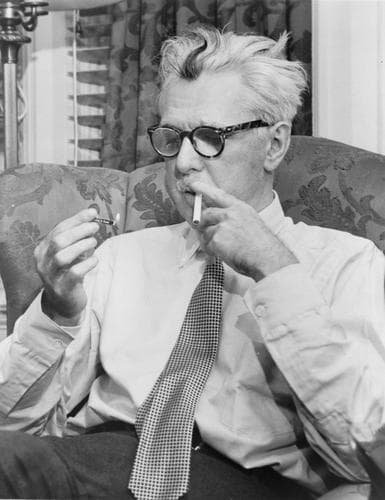
James Grover Thurber was an American cartoonist, writer, humorist, journalist and playwright. He was best known for his cartoons and short stories, published mainly in The New Yorker and collected in his numerous books.

Ashley Antoinette
4.6

Mark McDonald
4.4
Luo Guanzhong
4.4

Dorothy Parker
4.3

Mia McKenzie
4.3
Joaquim Maria Machado de Assis
4.3

Terry Kay
4.2
Mario Vargas Llosa
4.2