“I wisht I had of stayed home and went to work in the automobile factory and got some money ahead.”
— Al is expressing regret over his baseball career and its financial struggles.

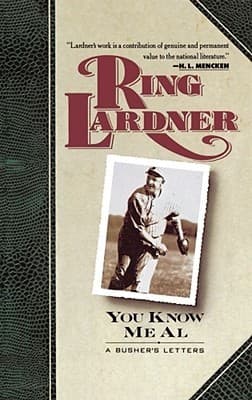
Ring Lardner (1916)
Genre
Fiction
Reading Time
240 min
Key Themes
See below
Sign in to track this book
Through the self-important letters of a talented but unperceptive baseball pitcher, Ring Lardner writes a lasting and sharp satire on ego, ambition, and the human inability to learn from mistakes.
The story begins with Jack Keefe, a young, confident pitcher, writing letters to his friend Al from a minor league baseball team in Terre Haute. Jack often boasts about his pitching skill and expresses frustration with his manager and teammates, whom he believes do not appreciate his talent. He details his wins and losses, often blaming others for his failures and taking full credit for his successes. He frequently mentions his desire to play in the big leagues, specifically for the Chicago White Sox, believing he is already good enough. His letters contain misspellings, grammar errors, and a general lack of self-awareness, setting the tone for his character. He also starts to mention his romantic interest in a local girl, Florence.
Jack's wish comes true when he is called up to the Chicago White Sox. His letters to Al then detail his experiences in the major leagues, including his interactions with famous players like Ty Cobb and Walter Johnson. He continues to brag about his performances, often exaggerating his contributions and downplaying any difficulties. Despite his initial excitement, Jack quickly gets into small arguments with his new teammates and manager, always feeling disrespected or misunderstood. He struggles with the higher level of competition and the demanding travel schedule, but his letters always show a confident, though mistaken, front. He also continues to pursue Florence, often writing about her in his letters.
Jack marries Florence, a decision he often brags about, believing he has found a prize. However, his letters soon show the problems and difficulties of married life, often caused by his own immaturity and poor judgment. He frequently complains about Florence's spending, even though he is often the one making expensive purchases or losing money gambling. Their arguments become a regular theme, with Jack always presenting himself as the wronged party. He struggles to understand Florence's view and often asks Al for advice, though he rarely takes it. His money troubles and domestic disputes start to affect his performance on the field.
Florence's sister, Hazel, moves in with Jack and Florence, supposedly to help. However, Hazel's presence only adds to Jack's domestic frustrations. He frequently complains about Hazel's influence on Florence, her perceived laziness, and her general presence in his home. His letters to Al are full of complaints about the two sisters teaming up on him, making him feel unwelcome in his own house. This new dynamic further distracts Jack from his baseball career and highlights his inability to handle personal relationships maturely. He sees Hazel as an intruder and a constant annoyance, often wishing she would leave.
Beyond his baseball salary, Jack tries several business ventures, each ending badly. He invests in a restaurant, a pool hall, and other plans, always convinced he has found a way to get rich quickly. His letters detail his initial optimism, followed by his inevitable losses and the blame he places on others for these failures. He shows a lack of business sense, failing to understand basic investment or management. These financial errors worsen his domestic problems with Florence, who often criticizes his carelessness. Al frequently advises caution, but Jack rarely listens, always believing his own judgment is better.
Florence becomes pregnant, a development that initially excites Jack, though he quickly returns to his self-centered ways. His letters mention the baby's arrival, but often in terms of how it will affect him, his sleep, or his finances. He struggles to grasp the full meaning of fatherhood and continues to prioritize his own desires. The pregnancy adds another layer of stress to his already troubled relationship with Florence, as he often fails to provide the support and understanding she needs. He frequently complains about Florence's mood swings and the costs associated with the baby's arrival.
Jack and Florence welcome a baby, but fatherhood does little to make Jack more mature. His letters continue to focus on his own complaints, whether it is the baby crying, Florence's attention shifting to the child, or the added financial burden. He often seems disconnected from the responsibilities of being a parent, seeing the baby as another source of inconvenience rather than joy. His self-pity and blame remain constant, even with this major life event. He struggles to adapt to the demands of family life, often seeking escape through baseball or his failed business ventures, further straining his marriage.
As the seasons pass, Jack's pitching performance becomes inconsistent. He experiences slumps, gets benched, and sometimes gets sent down to the minors. True to form, he blames everyone but himself: the manager, the umpire, his teammates' fielding errors, or even bad luck. He never acknowledges his own faults or the impact of his personal life on his game. His letters are full of detailed accounts of perceived injustices and how he was unfairly treated. This inability to take responsibility for his actions ultimately hinders his growth as a player and contributes to his career instability, despite his underlying talent.
A major crisis happens when Jack's flirtatious, and at times improper, behavior with Hazel leads to a big fight with Florence. Jack, always unaware, sees nothing wrong with his actions and is genuinely surprised by Florence's anger and jealousy. His letters show a complete lack of understanding regarding boundaries and loyalty. This incident pushes his marriage to the brink, with Florence threatening to leave him. Jack, still unable to grasp how serious his actions are, tries to explain his behavior and blame Florence for overreacting, further highlighting his immaturity and self-centeredness.
After the crisis with Hazel, Jack and Florence try to reconcile, often driven by Jack's desperate pleas and promises he rarely keeps. His letters detail these periods of truce, but also quickly return to his old complaints and grievances. The basic issues of his immaturity, financial carelessness, and inability to empathize with Florence are never truly addressed or solved. Their relationship remains a cycle of arguments, brief truces, and renewed tensions. Jack continues to see himself as the victim of circumstances, rather than acknowledging his role in their marital problems, leaving their future uncertain.
As the baseball season ends, Jack Keefe's character remains consistent. Despite his time in the major leagues, his marriage, fatherhood, and many personal and professional problems, he shows little personal growth. His letters continue to be full of boasts, complaints, misspellings, and a complete lack of self-awareness. He still blames others for his problems and takes too much credit for any success. The novel ends with Jack looking forward to the next season, still confident in his abilities and unaware of his own flaws, suggesting a continuing cycle of his experiences without true learning or maturity.
The Protagonist
Jack's arc is largely flat; despite numerous life experiences and setbacks, he remains fundamentally unchanged, consistently failing to learn or grow from his mistakes.
The Supporting
Al's character is static, serving as a constant, non-judgmental ear for Jack's evolving life.
The Supporting
Florence endures significant personal trials, particularly with Jack's behavior, but she remains largely consistent in her efforts to manage their household and her frustration with Jack's immaturity.
The Supporting
Hazel's role is static; she acts as a catalyst for conflict and a sounding board for Jack's complaints.
The Mentioned
Comiskey's character is static, serving as an external authority figure and a frequent target of Jack's grievances.
The Mentioned
Cobb's character is static, serving as a benchmark for Jack's perceived greatness and a historical reference point.
The Mentioned
Johnson's character is static, functioning as a historical figure and a measure of Jack's self-perception.
The Supporting
The managers are static, representing the consistent external authority that Jack chafes against.
The novel's main theme is Jack Keefe's deep self-delusion and inability to see himself accurately. He constantly brags about his intelligence, talent, and good judgment, even when his actions and words clearly show otherwise. He blames everyone else for his failures—umpires, managers, teammates, Florence—never taking personal responsibility. This theme is clear in every letter, from his exaggerated pitching statistics to his explanations for his financial errors and marital problems. For instance, after a poor game, he will write that he 'had good stuff' but the 'umpire was blind' or his 'fielders let him down.' His belief in his own superiority, despite strong evidence to the contrary, creates much of the humor and sadness.
“You know me Al I am to smart to be fooled by a woman.”
Jack Keefe's character is defined by his lack of development and his complete inability to learn from experience. Despite facing many problems in his baseball career, his marriage, and his financial ventures, he never gains insight or changes his behavior. He repeats the same mistakes—gambling money, making bad investments, alienating his wife and teammates—without ever connecting his actions to their negative results. This theme is shown by the repeated nature of his complaints and his constant rejection of any advice, including Al's implied wisdom. His journey is one of experience without growth, showing how raw talent can be wasted by a lack of personal maturity, as seen in his repeated financial errors or his inability to understand Florence's feelings.
“Well Al I guest I will give that guy a peace of my mind tomorrow and tell him where to head in at.”
The novel contrasts Jack's perceived success with the reality of his struggles, both professionally and personally. While Jack achieves his dream of playing in the major leagues, his letters reveal constant complaints, money problems, and domestic conflicts. He presents a confident and controlled image, but the details he accidentally reveals show a man constantly fighting with himself and the world around him. His 'big league' life is full of small arguments, poor decisions, and a lack of true happiness. This theme explores the gap between outward appearances and inner trouble, as Jack's 'glorious' baseball career is overshadowed by his personal failures and unhappiness, like his repeated complaints about money despite his major league salary.
“You know me Al I am not afraid of nobody and I can pitch a shutout any time I want to.”
The entire novel is told through Jack's letters, making it a strong exploration of unreliable narration. The reader gets direct access to Jack's biased, self-serving perspective, forcing them to 'read between the lines' to understand the real events and character motivations. Jack's misspellings, grammar errors, and simple worldview shape the story, revealing more about his character through what he does not understand or acknowledge than what he directly states. This narrative choice allows Lardner to create both humor and sharp insight into human nature, showing how individuals create their own realities and present themselves to the world, as seen in his consistent self-justifications for every negative event.
“Well Al I guest I am to good for this league and they are just trying to keep me down.”
Jack Keefe embodies parts of the early 20th-century American Dream, especially the pursuit of fame and money through sports. However, his materialistic desires often lead to his downfall. He constantly focuses on his salary, contract disputes, and get-rich-quick schemes, rather than on personal growth or real relationships. His attempts at business ventures are all motivated by greed and a superficial understanding of wealth, leading to repeated financial losses. This theme questions the idea that material success alone means happiness or fulfillment, showing how Jack's relentless pursuit of money and status without wisdom leads to a life full of dissatisfaction and conflict, such as his obsession with buying expensive clothes while complaining about Florence's spending.
“You know me Al I am going to make a million dollars before I am 30 years old.”
The entire novel is told through a series of letters written by Jack Keefe to his friend Al.
This device is central to the novel's structure and impact. By presenting the story solely through Jack's highly subjective and often grammatically incorrect letters, Lardner effectively creates an unreliable narrator. The reader gains direct access to Jack's unfiltered thoughts, biases, and self-deceptions, forcing them to infer the true events and characters' motivations by reading between the lines. This format enhances the humor, pathos, and character development, as Jack inadvertently reveals more about himself through his own words than any third-person narration could. It also provides an intimate, immediate perspective on his experiences and thought processes.
Jack Keefe's perspective is consistently biased, self-serving, and often contradictory.
Jack Keefe serves as a classic unreliable narrator. His letters are filled with boasts, rationalizations, and blame-shifting, always portraying himself in the best possible light and others in the worst. He frequently contradicts himself, misinterprets situations, and demonstrates a profound lack of self-awareness. This device is crucial for the novel's comedic effect and its exploration of human nature. The reader quickly learns to distrust Jack's interpretations and reconstruct the 'real' story from the details he inadvertently provides, highlighting the theme of self-deception and the often humorous gap between how Jack sees himself and how he truly is.
The reader understands more about Jack's character and situations than Jack himself does.
Dramatic irony is a pervasive element in the novel. Because the reader sees through Jack's self-serving narrative and recognizes his flaws and misinterpretations, they possess a greater understanding of the true situation than Jack himself. For example, Jack might boast about his 'great' pitching, only for the subsequent details to reveal he gave up several runs or lost the game. This gap in understanding between Jack and the reader creates much of the novel's humor and also elicits a degree of pity for Jack's obliviousness. The irony highlights his immaturity and inability to learn, making his struggles more poignant despite his arrogance.
The use of Jack Keefe's distinctive, uneducated voice and misspellings.
Lardner meticulously crafts Jack's voice through his unique vernacular, including consistent misspellings, grammatical errors, and colloquialisms. This device is essential for establishing Jack's character as uneducated yet self-important. The distinctive language not only provides humor but also reinforces Jack's lack of sophistication and his inability to articulate complex thoughts or emotions. It grounds the character in a specific social and educational context of early 20th-century America, making him feel authentic and relatable despite his flaws. The language itself becomes a character, speaking volumes about Jack's inner world and his perception of himself.
“I wisht I had of stayed home and went to work in the automobile factory and got some money ahead.”
— Al is expressing regret over his baseball career and its financial struggles.
“I got a letter from my girl Florrie and she says she is going to quit me if I don't send her some money to buy a new dress.”
— Al's financial woes are impacting his relationship with his fiancée.
“You know me Al, I am not a guy that will stand for much fooling.”
— A recurring phrase Al uses to assert his seriousness or no-nonsense attitude.
“I wisht I was back in the factory and had some money in the bank instead of being a ball player and broke all the time.”
— Al often reflects on the perceived stability of his old factory job versus the financial instability of baseball.
“He is a swell guy only he is always trying to borrow money off of me.”
— Al describes a teammate, highlighting a common complaint about others' financial dependency.
“I guess I will have to get married and settle down and quit this foolishness.”
— Al contemplates marriage as a way to bring stability to his life, often after a setback.
“I told him that I was not a sucker and that I knew what was what.”
— Al's assertion of his intelligence and refusal to be taken advantage of.
“I guess I am too good for this league.”
— Al's frequent belief in his own superior talent, despite evidence to the contrary.
“The manager said I was a swell pitcher only I got to learn to control my curve ball.”
— A common critique Al receives, often presented with a slight misinterpretation of the manager's intent.
“I guess I will have to get a divorce and start all over again.”
— Al's dramatic, often fleeting, thoughts on his tumultuous marriage.
“I guess I am just too good-hearted for my own good.”
— Al's self-pitying reflection after being taken advantage of or experiencing a setback.
“They don't know nothing about baseball out here.”
— Al's dismissive attitude towards fans or local critics in various towns.
“I wish I had of never left home.”
— A recurring lament from Al, expressing homesickness and regret for his life choices.
“I got a letter from Florrie and she says she is going to have a baby.”
— A significant life event for Al, often met with a mix of surprise and financial anxiety.
Ready to see how well you understood this book? Take our interactive quiz with 10 questions.

Biography coming soon.

Ashley Antoinette
4.6

Mark McDonald
4.4
Luo Guanzhong
4.4

Mia McKenzie
4.3

Dorothy Parker
4.3

Joaquim Maria Machado de Assis
4.3
James Thurber
4.2

Terry Kay
4.2