“The future was not a place we were going to. It was a place we were making, and we were making it badly.”
— Reflecting on the decline of modern society and the loss of essential skills.

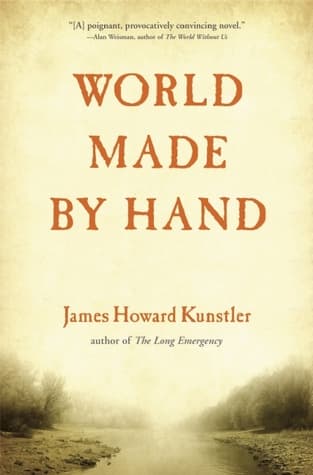
James Howard Kunstler (2008)
Genre
Science Fiction
Reading Time
420 min
Key Themes
See below
Sign in to track this book
In a post-collapse America where gasoline is a myth and the outside world a rumor, the residents of Union Grove grapple with horse-drawn plows, local feuds, and the haunting echo of a forgotten civilization as they forge a new, intensely local existence.
The story begins in Union Grove, New York, a small town struggling in post-collapse America, seen through Robert Earle's eyes. Robert, a former software engineer, now lives an agrarian life, using horses for plowing and dealing with limited resources. His wife, Lucy, died years ago, and he lives with his quiet, withdrawn son, Daniel. A group of armed newcomers, led by Brother Jethro, arrive and settle near Union Grove. These 'New Faith' people claim to seek a place to live, but their self-sufficiency and armed guards immediately create tension among the townsfolk, who are wary of outsiders in a world where safety is important.
The peace in Union Grove breaks when a group of New Faith men try to claim the mill pond, a vital resource for the town's water and power. A confrontation follows, involving Robert Earle, his neighbor Owen, and other townspeople. The New Faith men, acting under Brother Jethro's command, are aggressive and well-armed. During the fight, a young New Faith man dies. This accident deeply troubles Robert, but the New Faith sees it as murder. This incident marks a turning point, making peaceful coexistence impossible. The townspeople, while defending their resources, now face the consequences of this violent encounter.
After his follower's death, Brother Jethro gives an ultimatum to Union Grove's elders. He demands that the person responsible for the death be handed over for justice, or his community will retaliate. This demand puts pressure on Robert Earle and other leaders, especially Owen, the town's mayor, who understands the severe implications of both choices. The townspeople are divided; some want to resist, while others fear the New Faith's superior numbers and organization. Robert feels responsible, knowing his involvement in the incident. The threat hangs over Union Grove, forcing them to consider their options against a strong, vengeful enemy.
Adding to Union Grove's problems, a group of vagabonds, led by Wayne, arrives at the town's borders, seeking food and shelter. These people are displaced by societal collapse, living hand-to-mouth. Their presence presents a new challenge. While the town is wary of outsiders due to past experiences and limited resources, they also feel a sense of humanity. Robert Earle sees their desperate state, noting their hunger and lack of hope. The vagabonds remind him of the widespread suffering outside Union Grove's relatively stable, though precarious, existence. Their arrival further complicates the town's security, as they could drain resources and attract unwanted attention from groups like the New Faith.
Feeling responsible for the mill pond incident and fearing for Daniel's safety, Robert Earle decides to leave Union Grove, hoping to draw the New Faith's attention away from the town. He takes Daniel with him, and they travel through the desolate landscape. During their journey, they encounter a ruthless gang known as the Freemen, led by Caleb. These Freemen are lawless scavengers, preying on the weak. Robert and Daniel are captured, and Robert sees the Freemen's cruelty. This encounter shows the extreme dangers outside established communities and tests Robert's resolve to protect his son, pushing him to desperate measures to escape and survive.
News of Robert and Daniel's capture by the Freemen reaches Union Grove. Despite the threat from the New Faith, Owen, showing his leadership and loyalty, organizes a rescue party. Armed with their meager weapons, Owen and a few other townspeople track Robert and Daniel to the Freemen's camp. A tense and violent confrontation follows. The Union Grove residents, though outnumbered, fight with determination. They free Robert and Daniel, but not without casualties. The rescue confirms the strong bonds within Union Grove and their willingness to protect their own, even against great odds. Robert, grateful, returns to the town, more committed than ever to its survival.
Recognizing the threat from Brother Jethro's New Faith, Owen, Robert, and other Union Grove leaders realize they need more people to stand a chance. They approach Wayne, the vagabond leader, proposing an alliance. Wayne and his people, desperate for security and a place to belong, agree to join Union Grove. This alliance is born out of necessity and is initially uneasy, as the vagabonds are not used to structured community life. However, the shared enemy creates a common purpose. The vagabonds bring additional manpower, though they are poorly armed and trained. Their integration into Union Grove's defense becomes a critical, though challenging, factor in the coming conflict with the New Faith.
The inevitable conflict arrives as Brother Jethro and his New Faith followers attack Union Grove. The townspeople, helped by the vagabonds, prepare defenses, barricading roads and setting up watchpoints. The battle is fierce and brutal, fought with firearms, bows, and improvised weapons. The New Faith, with their organization and discipline, initially gain ground. Robert Earle, Owen, and Wayne lead different parts of the defense, showing courage and strategic thinking. Casualties increase on both sides. The siege tests Union Grove's resilience and the strength of their hastily formed alliance, pushing everyone to their limits in a fight for their existence.
During the siege, a turning point occurs. Robert Earle, using his knowledge of the terrain and surprise, outmaneuvers a key New Faith detachment. At the same time, Owen and Wayne rally their forces for a desperate counterattack. In a dramatic confrontation, Brother Jethro dies, either in combat or due to a strategic error. His death shatters the morale and command structure of the New Faith forces, leading to disarray. Without their leader, the remaining New Faith members lose cohesion and retreat, breaking the siege and giving Union Grove a hard-won victory. The town is battered but triumphant.
After the battle, Union Grove assesses its losses and begins the difficult process of healing and rebuilding. Many homes are damaged, and lives are lost, but the town has survived. Robert Earle and Owen, now even more solidified as leaders, face the challenge of integrating the remaining New Faith followers, many of whom are disillusioned and leaderless, as well as the vagabonds, into the community. This process brings tension and distrust, but the shared experience of the siege has formed new bonds. The novel ends with Union Grove looking towards an uncertain but hopeful future, having proven its resilience and ability to adapt in a world that demands constant struggle for survival. They begin to establish new rules and a new social order.
The Protagonist
Robert transforms from a somewhat passive observer to a decisive leader, actively fighting to protect his town and family, ultimately finding a new purpose in rebuilding society.
The Supporting
Owen maintains his steady leadership throughout the trials, proving his unwavering commitment to Union Grove's survival and unity.
The Supporting
Daniel remains a quiet but resilient presence, his survival representing the hope for a future generation.
The Antagonist
Brother Jethro rises as a powerful, menacing figure, only to be ultimately defeated, symbolizing the failure of oppressive leadership.
The Supporting
Wayne transitions from a nomadic survivor to an integrated member of the Union Grove community, finding a sense of belonging and purpose.
The Antagonist
Caleb's brief but impactful appearance solidifies his role as a pure antagonist, representing the unbridled savagery of the post-collapse world.
The Mentioned
Her memory serves as a static but powerful motivator for Robert, representing the past and a lost future.
The Supporting
Initially united and aggressive, they become disoriented and fractured after their leader's death, some eventually integrating into Union Grove.
This theme explores how communities, even after societal collapse, show resilience and adaptability. Union Grove, despite limited resources and constant threats, maintains a functioning society, grows food, and defends its people. The townspeople work together, sharing burdens and showing loyalty, especially in their defense against the New Faith and their rescue of Robert and Daniel. The theme also highlights the challenges of integrating outsiders, like the vagabonds and the remnants of the New Faith, into an established social fabric. True resilience is not just about defense but also about the capacity for absorption and rebuilding.
“What had been the great American dream was now a landscape of ruins, and the task of the living was to make something out of the fragments.”
The novel examines different forms of leadership in a world without central government. Owen represents a democratic, community-focused leadership based on trust and shared responsibility. Brother Jethro, in contrast, embodies an authoritarian, religiously motivated leadership, demanding obedience and using force to expand his influence. Robert Earle, initially reluctant, becomes a leader through his practical actions and moral courage. The story shows how, without established institutions, leadership emerges from necessity, and its nature shapes a community's survival and values. The conflict between Union Grove and the New Faith is a clash of these leadership philosophies.
“In a world made by hand, the only law was what you could enforce, and the only justice was what you could take.”
The theme explores the impact of a world without modern technology and the slow, often painful, process of relearning basic skills. Robert Earle, a former software engineer, is an example, forced to farm and do manual labor. The narrative highlights the challenges of farming with horses, communicating without electronics, and defending oneself without advanced weapons. It also suggests the potential for reclaiming or adapting older technologies, like the mill pond's water wheel. The collapse forces humanity to reconnect with fundamental skills and resources, emphasizing self-sufficiency and a deeper relationship with the natural world, even as it mourns lost convenience and progress.
“The memory of electricity was like a ghost, haunting the empty outlets and dead screens.”
In a world where basic survival is a daily struggle, characters find meaning beyond mere existence. Robert Earle, grieving his wife and living a changed life, seeks purpose in protecting his son and helping Union Grove. Brother Jethro's New Faith gives a clear, though rigid, purpose to his followers. The vagabonds, initially without purpose, find it through their alliance with Union Grove. The novel suggests that even in desperate circumstances, humans try to build something, believe in something, and find a reason to continue. Rebuilding and defending Union Grove becomes a collective search for a meaningful future.
“Maybe the purpose of life wasn't to get somewhere, but just to keep going.”
The novel shows how quickly civilization can unravel and how fragile its foundations are. Abandoned highways, empty houses, and the absence of national government constantly remind us of the collapse. The threat from marauding gangs like the Freemen and ideological groups like the New Faith shows how easily society can fall into anarchy and violence. Union Grove, while stable, is always on the brink, showing that law, order, and social norms are fragile and need constant vigilance and effort to maintain. The story is a cautionary tale about the delicate balance of societal structures.
“The past was a dream, the future was a guess, and the present was all they had.”
A world where modern society has collapsed, forcing humanity to revert to simpler ways of life.
The novel is set in a post-apocalyptic world where an unspecified global catastrophe has brought down modern civilization, including technology, transportation, and centralized government. This setting immediately establishes high stakes and a pervasive sense of vulnerability. It forces characters to confront fundamental questions of survival, community, and morality. The collapsed infrastructure, abandoned cities, and reliance on manual labor are not just background elements but active forces shaping characters' decisions and the plot's trajectory, emphasizing the themes of resilience and the fragility of civilization.
External groups who pose a significant danger to the established community's survival.
This device manifests primarily through the arrival of the New Faith and the Freemen. The presence of these organized, often violent, groups from outside Union Grove creates immediate conflict and drives much of the plot. They represent the chaos and danger of the wider world, constantly challenging the town's security and forcing its inhabitants to unite and defend themselves. The specific ideologies and methods of these groups (religious fanaticism vs. pure banditry) highlight different facets of post-collapse danger, making the external threat a dynamic and multifaceted plot driver.
The limited availability of essential goods and services, driving conflict and daily struggles.
Resource scarcity is a fundamental plot device, shaping every aspect of life in Union Grove. Food, fuel, safe water, and building materials are all precious and difficult to acquire. This scarcity directly leads to conflicts, such as the dispute over the mill pond, and influences character motivations, like the vagabonds' search for a safe haven. It constantly reminds the reader of the harsh realities of the post-collapse world, making every decision about resource allocation critical and every gain a hard-won victory. It grounds the narrative in a tangible, believable struggle for survival.
A character who speaks little, serving as a symbol of innocence and vulnerability.
Daniel, Robert Earle's son, is largely silent throughout the novel. This silence makes him a potent symbol within the narrative. He represents the innocent generation growing up in this harsh new world, vulnerable yet resilient. His lack of dialogue allows readers to project onto him the hopes and fears for the future. For Robert, Daniel's safety and well-being are a constant, powerful motivator, driving many of his actions and decisions. The silent child device emphasizes the emotional stakes of the story and the profound impact of the collapsed world on the youngest members of society.
“The future was not a place we were going to. It was a place we were making, and we were making it badly.”
— Reflecting on the decline of modern society and the loss of essential skills.
“The greatest freedom, after all, is to be free of the need for so much stuff.”
— A realization about the simpler, less materialistic life in the post-collapse world.
“We had traded away the things that truly mattered for the things that only seemed to.”
— Looking back at the pre-collapse world and its misplaced priorities.
“The only real security is self-sufficiency, and that's a lesson we learned the hard way.”
— Understanding the importance of local production and skills after global systems fail.
“A town is not just buildings; it's the sum of the people who live in it, and the stories they tell.”
— Considering the essence of community and its resilience.
“Ignorance, when it becomes widespread enough, is a form of collective suicide.”
— Critiquing the lack of foresight and understanding that led to the societal collapse.
“There's a dignity in honest labor that we'd forgotten how to appreciate.”
— Observing the renewed value placed on physical work and craftsmanship.
“Hope isn't a strategy, but it's a necessary ingredient for getting through the day.”
— Acknowledging the difficult realities while emphasizing the need for perseverance.
“The things we thought were permanent were just temporary arrangements.”
— A reflection on the fragility of modern infrastructure and social structures.
“You can't eat money, and you can't drive a stock certificate.”
— A blunt assessment of what truly matters for survival in a post-economic world.
“The earth itself, for all our abuses, still had the power to heal, if we let it.”
— Observing nature's resilience and the potential for ecological recovery.
“History doesn't repeat itself, but it rhymes.”
— Understanding the cyclical nature of human folly and societal patterns.
“Fear can be a useful thing, if it teaches you to be careful, but it's a terrible master.”
— Mulling over the role of fear in a dangerous world and the importance of not succumbing to it.
“The quiet was a new kind of wealth, a silence that allowed for thought and observation.”
— Appreciating the absence of constant noise and distraction in the changed world.
Ready to see how well you understood this book? Take our interactive quiz with 10 questions.

Biography coming soon.