The Fox's First Prey
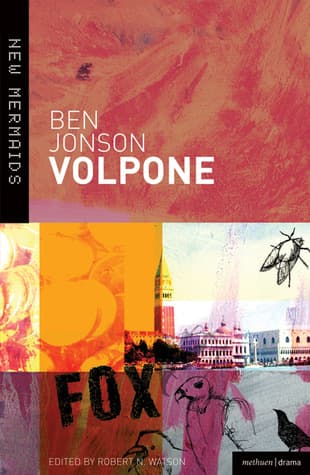
Volpone, a rich Venetian nobleman, pretends to be dying in bed. His servant, Mosca, helps him plan a trick to convince three prominent citizens—Voltore, Corbaccio, and Corvino—that they are his only heirs. Each man brings increasingly valuable gifts, hoping to secure their inheritance. Voltore, a lawyer, offers a gold plate. Corbaccio, an old moneylender, promises a strong medicine. Corvino, a merchant, brings a pearl and a diamond. Volpone enjoys their greed, mocking them privately with Mosca, while keeping up his act of extreme weakness.
A Father's Disinheritance and a Wife's Sacrifice
The tricks grow more complex. Corbaccio, sure he will inherit Volpone's money, disinherits his son, Bonario, in favor of Volpone. Mosca suggests this to Corbaccio, saying it will earn more favor with Volpone. Meanwhile, Corvino, desperate to outdo his rivals, offers his beautiful wife, Celia, to Volpone, believing a night with her will guarantee his inheritance. Volpone, lustful and confident, looks forward to this new conquest, showing how far the suitors' greed will drive them.
Lady Would-be's Persistent Visit
Lady Would-be, a talkative English lady, visits Volpone, hoping to be in his will. She arrives with her servant, Nano, and a dwarf, Castrone. Her constant talk about poetry, fashion, and her own supposed achievements quickly annoys Volpone. He tries various ways to get rid of her, pretending to get sicker or even to fall asleep, but she ignores his discomfort and continues her monologue. Her presence highlights society's self-absorption and superficiality.
The Attempted Seduction and Bonario's Intervention
Corvino brings Celia to Volpone's bedroom, leaving her alone with the 'dying' man. Volpone, suddenly energetic, reveals he is healthy and tries to seduce Celia, promising her wealth if she gives in. When she resists, he threatens her. At this moment, Bonario, Corbaccio's disinherited son, who Mosca had hidden to witness his father's disinheritance, bursts out. He rescues Celia, preventing the assault and exposing Volpone's deception, though others initially misunderstand his actions.
The Court Case and Mosca's Manipulation
The scene moves to a Venetian courtroom, where Volpone, Mosca, and the three dupes—Voltore, Corbaccio, and Corvino—conspire to discredit Bonario and Celia. Voltore, their lawyer, twists the facts, portraying Bonario as a rebellious son trying to murder his father and Celia as an unchaste woman trying to extort Volpone. Mosca, with his quick wit, supports these lies, even involving Lady Would-be in the fabricated story. The judges, influenced by the powerful speeches and the accusers' perceived reputations, begin to believe the false story, putting Bonario and Celia in danger.
The English Travelers and the Imposture
Throughout the play, a subplot involves the English travelers, Sir Politic Would-be and his wife, Lady Would-be. Sir Politic is a foolish, self-important knight obsessed with impractical schemes and political conspiracies. He believes he has found a plot to poison the Venetian Senate and plans to escape in a tortoise shell. His interactions with Peregrine, a more sensible English gentleman, provide comic relief and comment on foreign travelers and their often-absurd ideas. Sir Politic's foolishness contrasts with Volpone and Mosca's more sinister deceptions, showing different kinds of human folly.
Mosca's Rising Ambition
As the court proceedings continue, Mosca's ambition grows. He realizes his power over Volpone and the dupes. He subtly begins to assert himself, even acting important. He sees that he is the true designer of the schemes and that Volpone depends on him. This change in power hints at the eventual conflict between master and servant, as Mosca, no longer content as a mere parasite, begins to imagine a future where he controls Volpone's wealth and position, setting up his betrayal.
Volpone's Second Feigned Death
To further torment his victims and enjoy their reactions, Volpone stages a second 'death.' He arranges for a will to be read publicly, naming Mosca as his sole heir. He then disguises himself as a commendatore (a law officer) to watch Voltore, Corbaccio, and Corvino's reactions. Their rage and despair at being disinherited are immense, giving Volpone great satisfaction. This act of cruelty shows Volpone's deep sadism and his desire to control and humiliate others.
Mosca's Betrayal and Volpone's Panic
Mosca, now officially the heir, fully accepts his new role. When Volpone, still disguised, tries to reveal himself and reclaim his estate, Mosca denies knowing him. He publicly claims Volpone's identity and property, leaving Volpone in shock and panic. Volpone, stripped of his disguise and identity, realizes the extent of Mosca's betrayal. He is trapped by his own deception, unable to expose Mosca without exposing himself and admitting to years of fraud. The situation has reversed, and the hunter is now the hunted.
The Final Exposure and Justice
Cornered and facing the loss of everything, Volpone desperately decides to reveal his true identity and expose the entire scheme in court. He confesses his deceptions, hoping to reclaim his wealth by discrediting Mosca. This confession, however, also implicates Voltore, Corbaccio, and Corvino in their complicity and greed. The judges, finally seeing through the lies, deliver severe punishments. Volpone is sent to prison and his wealth taken. Mosca is condemned to the galleys. The dupes also receive fitting penalties, bringing a form of justice to the play's conclusion.