“Mathematics is not a spectator sport.”
— A phrase Petros often uses to describe the active nature of mathematical pursuit.

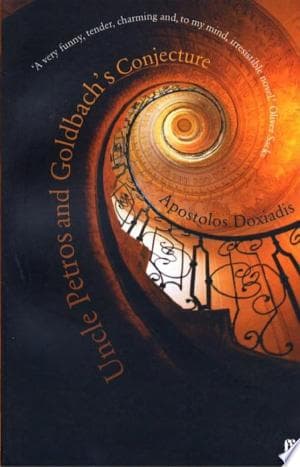
Apostolos Doxiadis (2012)
Genre
Fiction
Reading Time
180 min
Key Themes
See below
Sign in to track this book
A mathematician's life unravels in his obsessive pursuit of Goldbach's Conjecture, only to find its beauty reflected through his nephew's eyes.
The narrator, a young boy in Athens, is curious about his Uncle Petros Papachristos, whom his family considers a failure. Petros lives a quiet, solitary life, gardening and playing chess, but the narrator senses a deeper story. His parents call Petros's past a 'shame' and a 'catastrophe,' hinting at a brilliant but failed academic career in mathematics. The narrator's father, a successful businessman, dismisses Petros's pursuits as impractical, while his mother feels pity. Despite his family's judgment, the narrator is drawn to Petros's quiet intensity and the mystery of his past, sensing a hidden greatness beneath his reclusive life.
As the narrator grows older and develops an interest in mathematics, he begins to ask his uncle about his past. Petros, at first evasive, gradually reveals he was once a prodigy, a celebrated mathematician who studied at Cambridge University. He recounts his early brilliance, his mentors, and his meetings with other mathematical figures of the early 20th century. The narrator learns Petros dedicated his life to one monumental task: proving Goldbach's Conjecture, a seemingly simple statement about prime numbers that had remained unproven for centuries. This changes the narrator's view of his uncle from a family eccentric to a tragic, heroic figure.
Petros talks about his time at Cambridge, where his exceptional talent quickly became clear. He describes the lively academic environment, the friendships with other mathematicians, and the excitement of discovery. He details his early work in number theory, which brought him recognition. During this period, he first became fascinated by Goldbach's Conjecture, seeing it as the ultimate intellectual challenge. His early successes and his professors' encouragement made him believe he was destined to solve this old problem, leading him to dedicate his entire intellectual life to it.
Petros explains Goldbach's Conjecture, stating that every even integer greater than 2 is the sum of two prime numbers. He describes its deceptive simplicity and the immense difficulty in proving it, despite its truth for all tested numbers. He conveys the strong intellectual pull it had on him, comparing it to a siren song promising ultimate glory. The narrator, now an aspiring mathematician, starts to understand his uncle's deep obsession. Petros describes the various failed attempts by other great mathematicians throughout history, further showing the size of the challenge he had set for himself.
Petros shares stories about his interactions with other famous mathematicians. He describes his awe and respect for Srinivasa Ramanujan's intuitive genius; Ramanujan's unconventional methods both fascinated and frustrated the more formally trained Petros. He also speaks of meeting a young Alan Turing, noting Turing's groundbreaking work in computability and his impact on mathematics and logic. These stories show the intellectual excitement of the era and place Petros among brilliant minds, while also hinting at the limits of his own singular, human approach to a difficult problem.
As years pass, Petros's early optimism turns into a relentless, consuming obsession. He spends every waking moment on Goldbach's Conjecture, isolating himself and sacrificing personal relationships and other academic chances. The initial excitement of the chase slowly becomes a grueling, solitary struggle. He describes periods of intense frustration, near breakthroughs that disappear, and the heavy weight of repeated failure. His life narrows to his mathematical quest, his mind a battleground where he fights an unyielding problem, pushing himself to the edge of mental exhaustion.
Petros reveals a key turning point in his research: the 'Petrosian Fallacy.' He explains how, after years of intense work, he began to subconsciously trick himself. Whenever he met a difficulty in his proof, his mind would automatically 'resolve' it by assuming the very thing he was trying to prove, creating circular logic that made his proof seem valid to him, only for him to later find the basic flaw. This self-deception, born from immense pressure and desire for success, became a recurring pattern, draining his energy and pushing him further into despair, making him question his own sanity and ability.
The combined weight of repeated failures and the realization of the 'Petrosian Fallacy' eventually breaks Petros. He experiences a deep mental and emotional collapse, abandoning his mathematical career and leaving the academic world. He returns to Athens, finding comfort in a simple, anonymous life, gardening and playing chess. This period marks his change into the reclusive figure the narrator first knew. He sees his life's work as a catastrophic failure, haunted by the unsolved conjecture and the great personal cost of his pursuit.
Inspired and warned by his uncle's story, the narrator follows his own path in mathematics, becoming a successful professor of computational mathematics. He understands the beauty and challenges of the field but also the dangers of obsessive pursuits. He grapples with his uncle's legacy, trying to reconcile the brilliance with the breakdown. His own career, focused on applied mathematics and computational solutions, contrasts with Petros's pure, theoretical quest, offering a different view on the purpose and practice of mathematics.
Years later, after achieving his own academic success, the narrator visits his elderly uncle. He brings a new mathematical paper, a groundbreaking proof by a young female mathematician, which offers a new approach to a problem related to Goldbach's Conjecture. The narrator, knowing his uncle's deep connection to the problem, carefully presents it. Petros, at first resistant and resigned, slowly becomes re-engaged. The paper, while not a direct proof of Goldbach's Conjecture, is a significant step forward in number theory, rekindling a spark of intellectual curiosity and hope in Petros, suggesting his life's work was not entirely in vain.
In a moving moment, after being re-energized by the new mathematical discovery, Petros reveals to his nephew a long-hidden secret: a complete, handwritten 'proof' of Goldbach's Conjecture that he had worked on for years. He presents it with a mix of pride and fear, knowing its fatal flaw. As the narrator carefully examines it, he finds the exact point where the 'Petrosian Fallacy' takes hold, confirming his uncle's self-deception. This act is a cathartic confession for Petros, a final acknowledgment of his lifelong struggle and the ultimate, tragic flaw in his grand ambition.
The revelation of his flawed proof, combined with the new mathematical insights, brings Petros a strange sense of peace. He accepts the limits of his quest and the reality of his failure, but also recognizes the beauty and profound intellectual journey he took. The narrator's understanding and compassion offer Petros a form of redemption, validating his passion even in defeat. Petros, no longer burdened by the silent weight of his ambition, finds a quiet dignity in his past, realizing that the pursuit itself, with all its triumphs and heartbreaks, held its own value, independent of the final outcome.
The Protagonist
Petros begins as a confident prodigy, descends into obsessive failure and reclusion, and ultimately finds a measure of peace and acceptance through his nephew's understanding and a renewed connection to mathematics.
The Supporting/Protagonist
The narrator evolves from a curious boy to a successful mathematician who understands and eventually helps his uncle find peace, grappling with the legacy of his uncle's genius and tragedy.
The Supporting
Remains largely static, representing a contrasting worldview to Petros's intellectual pursuit.
The Mentioned
N/A (Historical figure, serves as an inspiration and point of comparison).
The Mentioned
N/A (Historical figure, serves as an inspiration and point of comparison).
The Mentioned
N/A (Symbolic character, represents progress and new hope).
The novel explores mathematical truth and the difficult process of proving it. Goldbach's Conjecture, empirically true but unproven, is a main example. Petros's struggle shows the difference between intuition and rigorous proof, and the 'Petrosian Fallacy' illustrates how even brilliant minds can deceive themselves. The narrator's introduction of new computational methods contrasts with Petros's classical approach, suggesting truth can be found in different ways, but proof requires absolute, unwavering logic. The book emphasizes that mathematical truth is not just about finding an answer, but about showing its undeniable validity.
“Mathematical truth is not just about knowing something is true, but about knowing why it is true, and being able to convince anyone else of its truth beyond any shadow of a doubt.”
Petros's life is a warning about the destructive power of single-minded obsession. His dedication to Goldbach's Conjecture consumes his entire existence, leading to isolation, the sacrifice of relationships, and a mental breakdown. The novel shows how a noble intellectual pursuit can become a relentless, self-destructive force when it overshadows all other parts of life. His reclusive later years are a direct result of this obsession, showing the high personal cost of chasing an 'impossible' goal. The narrator's more balanced approach to mathematics offers a contrast, highlighting the importance of perspective.
“I had become a prisoner of my own ambition, trapped in a labyrinth of numbers.”
The novel deals with the concept of failure, especially in intellectual endeavors. Petros sees his life as a catastrophic failure because he did not prove the conjecture. However, the narrative, particularly through the narrator's view, suggests that the journey itself, the passion, the struggle, and the deep engagement with the problem, has inherent value. Petros's eventual, though partial, redemption comes not from solving the conjecture, but from accepting his limitations and finding peace in the beauty of the pursuit. His story implies that true success might lie not in achieving a definitive outcome, but in the courage to strive for the impossible and the wisdom gained along the way.
“Perhaps the greatest lesson of all is that not every problem is meant to be solved, but every problem is meant to be wrestled with.”
Beyond abstract numbers, the novel humanizes pure mathematics, revealing the passions, rivalries, ego, and deep personal sacrifices involved. Petros's meetings with Ramanujan and Turing show the diverse personalities and approaches in the field. His 'Petrosian Fallacy' highlights the fallibility of even the most brilliant minds, showing that human psychology, with its desires and self-deceptions, plays a significant role in scientific effort. The book shows that mathematics, while seemingly objective, is deeply tied to human experience, ambition, and vulnerability.
“Mathematics is not just about cold logic; it is about passion, intuition, and sometimes, even self-deception.”
The story is told through the eyes of Petros's nephew.
The use of a first-person narrator, Petros's nephew, allows for a gradual unveiling of Petros's past. The narrator's initial curiosity and evolving understanding of mathematics mirror the reader's own journey into Petros's complex world. This perspective provides both objective distance and subjective intimacy, allowing the reader to witness Petros's story through the eyes of someone who deeply cares for him, while also offering an analytical, mathematical counterpoint to Petros's more emotional account. It creates a sense of discovery and personal connection to the intellectual drama.
Petros's life story is revealed through his recollections to his nephew.
The novel primarily employs a retrospective narrative, with Petros recounting his past to his nephew. This allows for a structured reveal of Petros's academic career, his triumphs, and his descent into obsession. The present-day interactions between uncle and nephew serve as a frame, grounding the historical accounts in a contemporary emotional context. This device builds suspense, as the narrator (and reader) slowly piece together the reasons behind Petros's reclusive state, culminating in the understanding of his 'failure' and eventual peace.
The unsolved mathematical problem drives the plot and symbolizes life's intractable challenges.
Goldbach's Conjecture functions as more than just a mathematical problem; it is the central symbol around which Petros's life revolves. It acts as a MacGuffin, driving Petros's ambition and ultimately leading to his downfall, but the true 'story' is about his internal struggle, not the conjecture's solution. It symbolizes the allure of the impossible, the limits of human intellect, and the profound personal cost of relentless pursuit. The conjecture represents any monumental, perhaps unwinnable, challenge that consumes an individual's life, making Petros's story relatable beyond the realm of mathematics.
A self-deceptive logical flaw that plagues Petros's attempts at proof.
The 'Petrosian Fallacy' is a crucial plot device that explains Petros's inability to solve Goldbach's Conjecture despite his brilliance. It's a psychological and logical trap where, under immense pressure, he would subconsciously assume the truth of what he was trying to prove, creating a circular argument. This device not only provides a concrete reason for his failure but also delves into the psychology of obsession and self-deception in intellectual pursuits. It highlights the rigorous demands of mathematical proof and the human vulnerability to cognitive bias when faced with an overwhelming desire for success.
“Mathematics is not a spectator sport.”
— A phrase Petros often uses to describe the active nature of mathematical pursuit.
“The feeling of being on the verge of discovery, the thrill, the anxiety, the hope...”
— Petros reflecting on the emotional rollercoaster of mathematical research.
“Some problems are like mountains: you climb them, and you find another peak behind.”
— Petros discussing the endless challenge of certain mathematical problems, particularly Goldbach's Conjecture.
“Genius, like madness, has an element of singularity.”
— The narrator's observation about the nature of exceptional intellect and its isolation.
“Goldbach's Conjecture, to him, was not merely a mathematical problem but a personal challenge, a test of his very being.”
— Describing Petros's deep, almost existential connection to the conjecture.
“The true mathematician lives in a world of his own, a world of pure thought, untouched by the mundane.”
— A romanticized view of the mathematician's existence.
“There are problems that are not meant to be solved by humans, or at least not by humans in their current form.”
— Petros's eventual, somewhat melancholic, conclusion about the limits of human intellect.
“The greatest discoveries often come not from trying to solve a problem directly, but from exploring the landscape around it.”
— A piece of advice Petros gives about the indirect paths to mathematical breakthroughs.
“To be a mathematician is to live in a constant state of yearning, a longing for truth and beauty that few others can comprehend.”
— The narrator's attempt to articulate the profound drive of a mathematician.
“The world of numbers is a harsh mistress; she demands everything and gives little in return, save for the fleeting glimpse of her beauty.”
— A poetic description of the demanding nature of pure mathematics.
“Sometimes the greatest challenge is not to find the answer, but to accept that there might be no answer.”
— A profound realization about the nature of unsolvable problems.
“He lived in the shadow of a conjecture, a ghost that haunted his every waking moment.”
— Describing Petros's all-consuming preoccupation with Goldbach's Conjecture.
“The beauty of a mathematical proof lies not just in its correctness, but in its elegance, its simplicity, its inevitability.”
— Petros's appreciation for the aesthetic qualities of mathematics.
“Every mathematician is an explorer, charting unknown territories of thought.”
— A metaphor for the pioneering spirit of mathematical research.
Ready to see how well you understood this book? Take our interactive quiz with 10 questions.

Apostolos K. Doxiadis is a Greek writer. He is best known for his international bestsellers Uncle Petros and Goldbach's Conjecture (2000) and Logicomix (2009).

Ashley Antoinette
4.6

Mark McDonald
4.4
Luo Guanzhong
4.4

Mia McKenzie
4.3

Dorothy Parker
4.3

Joaquim Maria Machado de Assis
4.3

James Thurber
4.2

Terry Kay
4.2