“Merdre!”
— Ubu's first word, a neologism for 'shit,' setting the tone for the play.

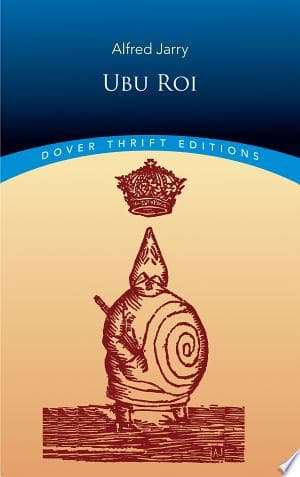
Sign in to track this book
King Ubu, a ridiculous and crude character, takes power. His rule quickly turns into a farcical display of gluttony and greed, exposing how easily authority can be debased. Audiences often find it both shocking and funny.
The play begins in Père Ubu's house. Mère Ubu constantly criticizes her husband for his cowardice and poor life, urging him to overthrow King Wenceslas of Poland. Père Ubu is at first hesitant and afraid, but Mère Ubu's arguments and the promise of wealth and sausages convince him. Captain Bordure, an officer, joins their plan, promising military support and further fueling Ubu's ambition. Despite his initial doubts, Ubu gives in to the idea of power, stating his intention to murder Wenceslas and take the crown. This marks the start of his tyrannical rise.
Père Ubu, Mère Ubu, and their co-conspirators attack King Wenceslas during a military parade. In a comically brutal scene, Ubu attacks and kills Wenceslas. Queen Rosamund and her three sons, Boleslas, Ladislas, and Buggerlas, are present. Ubu, wanting complete power, orders the execution of the two older princes, Boleslas and Ladislas, to remove immediate rivals. Young Buggerlas, however, escapes and vows revenge. With the king and his direct heirs gone, Père Ubu is quickly crowned King of Poland, beginning his rule of absurd terror.
As king, Père Ubu immediately shows his incompetence and cruelty. He announces he will change everything in Poland, starting with revising the calendar and abolishing taxes, only to bring them back with arbitrary increases. He takes land and property, seizes all money, and removes the nobility and judges using his 'debraining machine' or by throwing them into the dungeon. His rule is a chaotic mix of greed, ignorance, and a disregard for justice or human life, much to the dismay of the Polish people.
Captain Bordure, who helped Ubu gain the throne, soon disagrees with the new king's random rule. Ubu refuses to reward Bordure properly, even trying to throw him into the dungeon. Bordure, realizing Ubu's betrayal and constant greed, escapes. He flees Poland and goes to Russia, seeking an alliance with Tsar Alexis. He hopes to convince the Tsar to invade Poland and remove Père Ubu, thereby getting revenge and restoring order to the kingdom.
Père Ubu's extravagant spending and chaotic financial policies quickly bankrupt the kingdom. He has wasted the national treasury on lavish feasts and luxuries, leaving the country in ruins. Faced with an empty treasury, Ubu tries increasingly desperate and absurd ways to raise money. He attempts to sell government positions, places new, high taxes on an already poor population, and even tries to make new currency from old clothing, further showing his lack of skill and the complete breakdown of government under his rule.
Tsar Alexis, convinced by Captain Bordure's plea and stories of Ubu's tyranny, mobilizes his army and invades Poland. Père Ubu, completely surprised, must stop feasting and prepare for war. Despite his cowardly nature, Ubu puts on his armor and leads his poorly equipped, disorganized army to face the Russians. Mère Ubu, always looking for an opportunity, stays behind to loot the palace, seeing the war as a chance to get richer. The stage is set for a comical battle for Poland's future.
The battle between Ubu's Polish army and Tsar Alexis's Russian forces is chaotic and comical. Ubu, despite his boasting, is an incompetent and cowardly commander. He hides behind his troops, gives illogical orders, and cares more about his own safety than his soldiers. When his forces start to lose, Ubu panics and flees the battlefield in terror, abandoning his men. Captain Bordure, fighting bravely for the Russians, dies during the fight.
After the battle, Prince Buggerlas, who had escaped earlier, pursues the fleeing Père Ubu. Buggerlas, wanting to avenge his murdered father and brothers, confronts Ubu in a cave. A brief struggle happens, showing Ubu's fear and desperation. Despite Buggerlas's anger, Ubu escapes. Sadly, Buggerlas, weakened and alone, dies from his wounds or exhaustion soon after, without getting his full revenge. Ubu's fate remains unsettled.
While Père Ubu is away fighting (or fleeing) the Russians, Mère Ubu ransacks the royal palace, filling her pockets with gold and valuables. She tries to escape with her stolen goods, but her greed leads to her capture. Loyal Polish citizens, disgusted by her actions and Ubu's tyranny, catch her looting. She is arrested and stripped of her stolen treasures, left to face the results of her involvement in Ubu's destructive rule, losing all the wealth she wanted.
After their separate problems, Père Ubu and Mère Ubu surprisingly meet again. Both are messy, defeated, and without power or wealth. Despite their past arguments and betrayals, they decide to combine their remaining resources and flee Poland. They board a ship, planning to sail to France, leaving the damaged kingdom behind. Ubu expresses a wish to return to his former life, perhaps as a 'Master of Finances' in France, completely unrepentant for the chaos he caused.
As Père Ubu and Mère Ubu sail toward France, their ship faces a violent storm. The dangerous journey shows their vulnerability and the unpredictability of fate, a sharp contrast to their former inflated sense of power. Despite the danger, Ubu remains mostly unaware of the real threat, continuing to spout nonsense and complain about his lost sausages. Even with nature's fury, his petty concerns and delusions of grandeur continue, showing his unchanging, self-absorbed character until the end.
The Protagonist/Antagonist
Ubu begins as a disgruntled, ambitious bourgeois and rises to tyrannical power, only to be stripped of it due to his incompetence and cowardice, ultimately fleeing, unrepentant.
The Supporting
She instigates Ubu's rise to power, enjoys the spoils, and attempts to flee with stolen wealth, only to be caught and ultimately escape with Ubu.
The Supporting
He begins as Ubu's co-conspirator, becomes his betrayed enemy, and dies fighting for vengeance.
The Mentioned
He is introduced as the reigning king and is swiftly murdered, serving as the catalyst for the entire plot.
The Supporting
He escapes Ubu's initial massacre, seeks vengeance for his family, confronts Ubu, but dies before fully achieving his goal.
The Supporting
He is introduced as a powerful foreign ruler and successfully leads an invasion to depose Ubu, restoring some semblance of order.
The Mentioned
They are introduced as the ruling class and are systematically eliminated by Ubu.
The play constantly makes fun of power, showing it not as a noble goal but as a corrupting force that turns people into grotesque tyrants. Père Ubu's rule is a series of illogical decrees, random executions, and self-serving policies. This highlights the inherent irrationality that can happen when power is given to the incompetent and immoral. His 'debraining machine' and constant changes to laws (like taxes) show how authority can be used without reason or justice, leading to complete chaos, as seen when he bankrupts the country and his army is easily defeated.
“Père Ubu: 'By my green candle, I shall be King of Poland, and my wife will be Queen!'”
Père Ubu's main drives are his constant desires for food, wealth, and power. He always thinks about sausages, gold, and his 'Phynance' (his term for finance), which he uses to get rich at the kingdom's expense. Mère Ubu shares this greed, always pushing her husband to take more. This theme is clear in Ubu's immediate seizure of all wealth when he becomes king, his attempts to make money from old clothes, and Mère Ubu's frantic looting of the palace during the war. Their greed directly causes the kingdom's ruin and their eventual flight.
“Mère Ubu: 'You were a great king, my lord, but now you are a poor wretch, and soon you will have nothing to eat.'”
Ubu shows a mix of extreme cowardice and shocking brutality. He is a loud bully when in power, ordering executions and tortures happily. Yet, he panics and flees at the first sign of real danger, such as during the battle with the Russians or his confrontation with Buggerlas. This contrast shows the hypocrisy often found in tyrants who are brave only when their victims are defenseless. His casual violence, like the 'debraining' of nobles, is often presented with grotesque humor, making the brutality even more disturbing.
“Père Ubu: 'What a fine thing to be king! I can eat all the sausages I want, and throw people in the dungeon!'”
The idea of revenge mainly comes from Prince Buggerlas, who wants to avenge his murdered family. His pursuit of Ubu suggests a traditional story of justice. However, the play twists this by having Buggerlas die before fully achieving his goal. Ubu, despite losing his throne, escapes unpunished, sailing to France with dreams of new ventures. This lack of definitive justice for Ubu highlights the play's nihilistic and absurd view, suggesting that evil often goes unpunished and moral order is not always restored.
“Buggerlas: 'I will avenge my father and my brothers! I will kill this monster, Père Ubu!'”
The use of exaggerated, often vulgar and violent, comedy to satirize serious subjects.
Jarry employs grotesque humor to make the horrific actions of Ubu simultaneously repellent and laughable. This device is central to the play's shock value and its critique of power. Examples include Ubu's scatological language ('merdre!'), the 'debraining machine' which is both absurd and terrifying, and the farcical nature of the battles and political maneuvers. This humor prevents the audience from fully empathizing with any character, instead forcing them to confront the inherent absurdity and brutality of human nature and political ambition.
Exaggerated portrayal of characters, especially for satirical purposes.
All characters, particularly Père Ubu, are caricatures rather than realistic individuals. Ubu is an extreme embodiment of greed, gluttony, and cowardice, with no redeeming qualities. Mère Ubu is similarly an exaggerated figure of manipulative ambition. This device serves to strip away any pretense of realism, allowing Jarry to focus on the abstract concepts these characters represent (e.g., the corrupt bourgeois, the tyrannical ruler). The lack of psychological depth emphasizes the play's allegorical nature and its critique of universal human flaws rather than specific individuals.
A fantastical, symbolic torture device used by Ubu to eliminate his enemies.
This device, though never explicitly described in detail, is Ubu's chosen method of executing the Polish nobility and magistrates. It's a symbol of his arbitrary, nonsensical, and brutal exercise of power. Its absurd name and implied function (removing brains) highlight Ubu's contempt for intellect and order, suggesting that he prefers mindless obedience. It functions as a chillingly comical representation of totalitarian purges, where logic and humanity are discarded in favor of brute force and irrational cruelty, making the horror of his reign palatable through its sheer absurdity.
The use of vulgar, toilet-humor language for shock and satire.
The most famous example is Ubu's opening word, 'Merdre!' (a deliberate misspelling of the French word for 'shit'). This device was revolutionary and highly controversial at the time of its premiere. It immediately establishes the play's anti-establishment, anti-bourgeois tone and signals a departure from traditional, polite theatre. It is used to strip away any sense of decorum or nobility from the characters and their actions, reinforcing the grotesque and primitive nature of Ubu's world and serving as a direct affront to audience sensibilities.
“Merdre!”
— Ubu's first word, a neologism for 'shit,' setting the tone for the play.
“What a fine country, it's full of potatoes!”
— Ubu's initial observation upon arriving in Poland, highlighting his gluttony and simplistic view.
“I will make a great fortune in this country.”
— Ubu's declaration of intent, revealing his avarice and ambition.
“Long live Pére Ubu! Long live Poland!”
— The people's chant, demonstrating their fickle loyalty and susceptibility to Ubu's influence.
“It's all one to me, so long as I can eat well and sleep well.”
— Ubu's philosophy, simplifying life to basic animalistic needs.
“I perceive that I am going to become very rich, and I will be able to eat a lot of sausages.”
— Ubu's primary motivation for seizing power, linking wealth directly to food.
“Gentlemen, you have been chosen by me to collect the taxes.”
— Ubu's arbitrary appointment of tax collectors, leading to widespread corruption.
“We will have to kill everyone.”
— Ubu's simplistic solution to any perceived problem or opposition.
“I will exterminate the nobility and the gentry.”
— Ubu's radical plan for social restructuring, reflecting revolutionary fervor gone awry.
“Ha! I'm going to have my fill of money!”
— Ubu's exultation after confiscating wealth, emphasizing his insatiable avarice.
“This is going badly, it's going very badly.”
— Ubu's repeated lament when faced with difficulties, showcasing his cowardly nature.
“No more justice, no more anything! It's an outrage!”
— Ubu's reaction to being challenged or having his authority questioned, highlighting his arbitrary rule.
“I will hang them all, and then we will be quiet.”
— Ubu's brutal and simplistic approach to maintaining order, a characteristic of his reign.
“My dear friends, we have made a fine campaign.”
— Ubu's self-congratulatory remark after a chaotic and often disastrous military campaign.
Ready to see how well you understood this book? Take our interactive quiz with 10 questions.
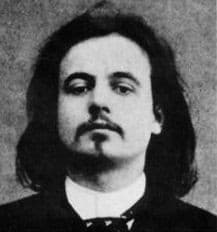
Alfred Jarry was a French symbolist writer who is best known for his play Ubu Roi (1896). He also coined the term and philosophical concept of 'pataphysics.

Ashley Antoinette
4.6

Mark McDonald
4.4
Luo Guanzhong
4.4
Mia McKenzie
4.3
Dorothy Parker
4.3
Joaquim Maria Machado de Assis
4.3
James Thurber
4.2

Terry Kay
4.2