“I can do anything with words. I can make them dance. I can make them sing.”
— Austin bragging to Lee about his writing ability.

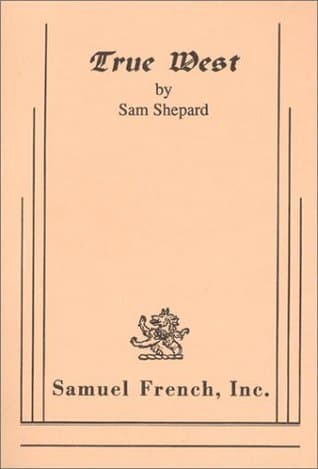
Sign in to track this book
In sun-baked Southern California, two estranged brothers—one a screenwriter, the other a drifter—clash over a film deal, blurring who they are and the stories they try to sell.
The play opens in the kitchen of the absent mother's Southern California house. Austin, a screenwriter, works on his script, a love story, for producer Sal Kimmer. He is house-sitting while his mother vacations. Suddenly, his older brother, Lee, a scruffy drifter and petty thief, appears unannounced. Lee immediately disrupts Austin's concentration, making demands, questioning his work, and asserting his dominance through intimidation. Austin tries to stay calm and focused, but Lee's presence is a constant, unsettling distraction, showing the vast differences in their lives.
Lee's disruptive behavior continues. He insists on staying at the house and demands the car keys. He talks about stealing televisions and dogs in the desert, a sharp contrast to Austin's ordered, professional life. Austin tries to be polite and accommodating, but he is clearly uncomfortable with Lee's presence and unpredictable nature. He tries to set boundaries, reminding Lee that their mother returns soon and he needs to work. However, Lee mostly ignores these pleas, focusing on his own desires and subtly undermining Austin's authority in their childhood home.
Sal Kimmer, the Hollywood producer, arrives to discuss Austin's screenplay. Austin wants to impress Kimmer and finalize their deal. However, Lee, despite Austin's efforts to keep him away, interrupts their meeting. Lee, with his rough charm and outlandish stories, begins to pitch his own impromptu movie idea: a Western about two men chasing each other across the desert. To Austin's shock, Kimmer becomes captivated by Lee's raw story, finding it more authentic and marketable than Austin's carefully written love story. Austin watches helplessly as his professional opportunity is taken by his brother.
After Lee's pitch, Sal Kimmer tells Austin he is no longer interested in Austin's original screenplay. Instead, Kimmer wants Austin to write Lee's Western story. This news shatters Austin's professional hopes and self-worth. He feels betrayed by Kimmer and humiliated by Lee. This professional setback triggers a deep personal crisis for Austin, who questions his identity and his structured life. The power dynamic between the brothers shifts, with Lee now holding the advantage, both professionally and in their sibling relationship.
With his own project dropped, Austin reluctantly agrees to help Lee write the Western script, though without enthusiasm. As Austin descends into despair and alcoholism, he begins to adopt some of Lee's destructive habits, drinking heavily and committing petty acts of vandalism, like stealing toasters from neighbors. Conversely, Lee, now tasked with creative work, struggles with the discipline needed for screenwriting. He cannot put his vision on paper, showing his own limits despite his initial confidence. The brothers slowly begin to trade places, their personalities blurring into one another.
As the night goes on, the brothers' descent into chaos speeds up. Austin, fueled by alcohol and resentment, becomes erratic. He smashes a typewriter, symbolizing his rejection of his former identity and career. Lee, frustrated by his inability to write and by Austin's taunts, also contributes to the rising destruction. They engage in a bizarre spree, destroying household items, scattering toast, and creating utter disarray in their mother's kitchen. This destructive outburst shows their inner turmoil and the breakdown of their civility.
The mother returns home from her Alaskan vacation to find her house devastated. The kitchen is a wreck, filled with scattered toast, broken appliances, and chaos. Her sons, Austin and Lee, are in a violent struggle, their rivalry reaching a brutal physical climax. She is horrified and bewildered, unable to understand her sons' transformation or the extent of the destruction. Her attempts to restore order or understand are useless, as the brothers are too deep in their primal conflict.
In a final struggle, Austin wraps a telephone cord around Lee's neck and strangles him. The mother, seeing this, flees the house in terror. Austin thinks he has killed Lee, and a chilling silence falls. However, as Austin stands over his brother's body, Lee slowly stirs. He twitches, then moves, and the play ends with the two brothers in a silent, predatory standoff, circling each other. The final scene leaves their fate ambiguous, suggesting an endless, cyclical struggle between their contrasting yet intertwined identities.
The Protagonist
Austin transforms from a refined, ambitious screenwriter into a destructive, primal figure, mirroring his brother's wildness.
The Antagonist/Catalyst
Lee initially dominates Austin, then briefly struggles with the demands of 'civilized' work, ultimately reverting to his primal state.
The Supporting
Kimmer's role is primarily static; he serves as the external force that sets the brothers' internal conflict into motion.
The Mentioned/Supporting
Mom's arc is brief; she returns to witness the devastating consequences of her sons' conflict and flees in terror.
This theme is key to 'True West,' shown through Austin's and Lee's contrasting personalities. Austin represents the educated, professional man bound by social rules, while Lee embodies the raw, untamed 'wilderness' of the American West. The play explores what happens when these two forces meet in a suburban home. The destruction of the kitchen and Austin's fall into Lee-like behavior (stealing toasters, heavy drinking) show the breakdown of order and the appeal of primal freedom. The play asks if the 'civilized' self can truly suppress its wilder instincts.
“There's nothin' to write about out here. Nothin' happens. It's too quiet.”
The play deeply explores how identity changes, especially as shaped by environment, goals, and sibling dynamics. Austin's identity as a screenwriter is challenged and shattered when his project is rejected and he starts to act like Lee. Conversely, Lee, initially confident in his wildness, struggles when forced into Austin's role as writer. The brothers' literal exchange of clothes and mannerisms shows a blurring of their individual selves, suggesting that identity is not fixed but can be altered or absorbed by another, especially within intense family bonds. The play asks if one can truly escape their inherent nature or family influence.
“I'm livin' out here. This is my place.”
'True West' takes apart the romanticized myth of the American West, showing a more brutal and ambiguous reality. Lee's 'true Western' story, though initially captivating to Sal Kimmer, is ultimately simplistic and violent, lacking the nuanced heroism often in the genre. The play suggests that the 'West' is not just a place but a state of mind—a place of raw survival, moral ambiguity, and primal conflict that still exists within the modern American psyche. The desert, often mentioned, becomes a metaphor for this untamed, dangerous aspect of the American spirit, contrasting with the suburban setting.
“I'm talkin' about a movie! A true-to-life Western!”
The play's core is the intense, destructive sibling rivalry between Austin and Lee, fueled by unresolved issues and different paths. Their competition is not just for their mother's approval or professional success, but for dominance and identity itself. The absent, alcoholic father and distant mother contribute to a dysfunctional family dynamic where resentment festers. The brothers' inability to coexist peacefully leads to physical violence and the destruction of their shared childhood home, showing how deep family conflicts can become primal, almost animalistic, struggles for survival and self-assertion.
“You think I'm gonna stand around here and watch you make a fool outta yourself?”
The mother's suburban home represents order, civilization, and the fragile domestic sphere.
The mother's house, particularly the kitchen, serves as a central symbol. Initially, it represents Austin's attempts at order and professionalism. As the play progresses, it becomes a battleground where the forces of civilization and wilderness clash. Its gradual destruction mirrors the psychological unravelling of the brothers and the breakdown of their societal facades. By the end, the ruined house reflects the complete chaos and the loss of any semblance of domestic peace, suggesting that the 'wild' has fully invaded and consumed the 'civilized' space.
The gradual swapping of personalities and behaviors between Austin and Lee.
The most prominent plot device, role reversal, drives much of the play's action and thematic exploration. Austin, the sophisticated writer, devolves into a drunken, destructive figure, stealing toasters and engaging in violence. Lee, the wild drifter, attempts to write a screenplay, struggling with the discipline and structure required. This exchange of roles highlights the fluid nature of identity and suggests that the brothers, despite their apparent differences, share a deeper, primal connection or perhaps represent two sides of the same coin. It questions whether environment or inherent nature truly dictates one's path.
The desert represents freedom, lawlessness, and a primal, untamed existence.
The desert, though mostly offstage, is a powerful metaphorical presence. It is Lee's natural habitat, symbolizing freedom from societal constraints, a place of survival and raw instinct. For Austin, it represents an escape from his stifling 'civilized' life, a yearning for authenticity and danger. Lee's 'true Western' story, set in the desert, embodies the myth of the American frontier. The desert functions as a constant pull, drawing the brothers away from their suburban reality and towards a more primal, unfettered existence, ultimately influencing their destructive actions within the confines of the home.
A symbol of Austin's professional identity and its destruction.
The typewriter is a concrete symbol of Austin's professional life and his intellectual identity. It is the tool of his trade, representing order, creativity, and his connection to the 'civilized' world of screenwriting. When Austin smashes the typewriter in a fit of rage, it signifies his complete rejection of his former self, his career aspirations, and the societal expectations that defined him. Its destruction is a pivotal moment in his transformation, marking his surrender to the more primal, destructive impulses embodied by Lee.
“I can do anything with words. I can make them dance. I can make them sing.”
— Austin bragging to Lee about his writing ability.
“You always got to be testing yourself, see how far you can go.”
— Lee explaining his philosophy of life to Austin.
“There's no such thing as a true story. There's only a story.”
— Austin's cynical view on narrative and truth.
“We're talkin' about a real movie here. A movie that can make some real money.”
— Lee trying to convince Austin to write his western screenplay.
“I hate the smell of toast. It reminds me of failure.”
— Lee expressing a strange aversion and linking it to personal shortcomings.
“You think I'm gonna let you get away with this? You think I'm just gonna sit here and watch you destroy everything?”
— Austin confronting Lee as their conflict escalates.
“There's nothin' real in this house. Not a thing. It's all fake.”
— Lee's assessment of his mother's suburban home.
“I'm not a thief. I just borrow things. And I always give 'em back. Sometimes.”
— Lee's casual justification for his petty crimes.
“You gotta have a dream, see. Even if it's just a little one.”
— Lee reflecting on the importance of aspiration.
“I just wanna write something true. Something that matters.”
— Austin's desire for meaningful artistic creation.
“It's a desert out there. And there's nothin' to drink.”
— Lee's bleak metaphor for the world outside their immediate conflict.
“You got a good heart, Austin. You just don't know how to use it.”
— Lee's assessment of his brother's character.
“I'm in charge now. I'm the one with the power.”
— Austin asserting dominance over Lee after a shift in their dynamic.
“Nobody understands the West. Nobody. It's a mystery. A complete mystery.”
— Lee's romanticized and enigmatic view of the American West.
Ready to see how well you understood this book? Take our interactive quiz with 10 questions.

Biography coming soon.

Ashley Antoinette
4.6

Mark McDonald
4.4
Luo Guanzhong
4.4
Mia McKenzie
4.3
Dorothy Parker
4.3

Joaquim Maria Machado de Assis
4.3
James Thurber
4.2
Terry Kay
4.2