“Between grief and nothing I will take grief.”
— Harry Wilbourne reflects on his predicament with Charlotte.


William Faulkner (1990)
Genre
Fiction
Reading Time
360 min
Key Themes
See below
Sign in to track this book
Two tales, one of illicit love's flight into the wilderness and another of a convict's selfless rescue through a flooded landscape, combine to show deliverance and spiritual damnation in the American South.
The novel opens in New Orleans, introducing Harry Wilbourne, a young, inexperienced doctor, and Charlotte Rittenmeyer, a sophisticated married woman with children. They are drawn to each other with an intense passion. Charlotte, feeling suffocated by her conventional life and her husband, Frank Rittenmeyer, plans their escape. They leave their lives, Harry's medical career and Charlotte's family, to start a flight fueled by their illicit love. Their first destination is a small cottage on a lake. This symbolizes their attempt to create a private world free from societal judgment and the results of their actions. This act sets the stage for their struggles with poverty, isolation, and the destructive nature of their all-consuming passion.
Interspersed with Harry and Charlotte's story is the narrative of a nameless convict from the Mississippi State Penitentiary. He is serving a sentence for attempting to rob a train. During a catastrophic flood of the Mississippi River, the convict is made by authorities to help rescue stranded individuals. Armed with a rifle and navigating a small skiff, he is ordered to rescue a pregnant woman from a collapsing cabin. Despite his desire to escape, the convict, a man of simple principles, feels compelled to fulfill his duty. This sets him on a perilous journey across the turbulent, debris-filled waters. This mission immediately challenges his personal freedom and sense of self-preservation against the force of nature and his moral code.
After their initial escape, Harry and Charlotte move to Chicago, where their financial situation quickly gets worse. Harry, having left his medical career, struggles to find work, taking on low-paying jobs. Charlotte, despite her sophisticated background, also finds herself in bad circumstances. Their love, which at first seemed to overcome all obstacles, begins to break under the pressure of poverty and social ostracism. They cannot establish any stable life, constantly moving and struggling to get by. This period shows their inability to function outside the societal structures they rejected. It reveals the practical limits of their passionate but impractical commitment.
The convict successfully retrieves the pregnant woman, identified only as the 'tall woman,' from the collapsing cabin. As they try to navigate back through the treacherous floodwaters, the woman goes into labor. Despite his complete lack of medical experience and the dangerous conditions, the convict delivers her baby in the skiff. This harrowing experience complicates his mission, as he now has a newborn and its mother to care for. His simple desire to return to prison and serve out his sentence is constantly stopped by the needs of the rescue. This pushes him into an unexpected role of responsibility and care.
Harry and Charlotte, still struggling financially, move to a mining camp in Utah. Charlotte finds out she is pregnant. Fearing that a child would further involve them in the societal responsibilities they fled, and unable to afford a proper birth, they decide on an abortion. Harry, despite his limited medical knowledge and moral concerns, tries to perform the procedure himself. The abortion is botched, leading to severe complications for Charlotte. This desperate act marks a turning point. It symbolizes the destructive results of their choices and how their love has led them to self-destruction. The procedure leaves Charlotte gravely ill and Harry consumed by guilt.
Having delivered the baby and navigated the floodwaters, the convict tries to return the woman and child to the authorities. However, due to the widespread chaos and his disheveled appearance, he is repeatedly mistaken for an escaped prisoner. Despite his attempts to explain his mission and return to his sentence, he is met with suspicion and hostility. He even meets a group of men who believe he is a looter. This frustrating cycle shows the bureaucratic indifference and injustice of his situation. It forces him to continue his journey against his will, further delaying his return to the structured existence of prison.
Following the botched abortion, Charlotte's health quickly gets worse. Harry, desperate and guilt-ridden, takes her to a remote cabin in Mississippi, hoping to nurse her back to health. Despite his efforts, Charlotte's condition worsens, and she dies. Her death is the result of their reckless choices and the physical toll their illicit relationship took. Harry is left alone, dealing with grief and the devastating realization of the consequences of their all-consuming passion. Her death forces him to confront the reality of their dream, which led to her demise.
After a long journey through the flood-ravaged landscape, during which he even meets a wealthy family who mistakes him for a rescuer, the convict is finally caught. He is cornered by a group of deputies who assume he is an escapee. Despite his continued attempts to explain his mission, he is taken back into custody. There is a sense of relief for the convict, as he is finally returned to the familiar confines of the prison. He has fulfilled his duty and now simply wishes to serve his time, having been thrust into a world of freedom and responsibility that he never sought.
After Charlotte's death, Harry is discovered and arrested, charged with murder. He is placed in a jail cell, where he reflects on his relationship with Charlotte, their choices, and the tragic outcome. He is offered a chance to escape, planned by Charlotte's husband, Frank Rittenmeyer, who still feels a strange loyalty to Charlotte and a desire to protect her memory. Harry, however, refuses the escape, choosing instead to face the consequences of his actions. He realizes that even in prison, he has a sense of agency and a connection to Charlotte's memory, a connection that he values more than physical freedom. He chooses the 'wild palms' of his memory over the 'wilderness' of escape.
The convict is returned to the penitentiary, where he is questioned about his journey. The authorities, still skeptical, eventually accept his story. He is given additional time on his sentence for 'attempting to escape' and 'stealing a skiff,' despite his protests. He returns to his work detail, having experienced a brief, involuntary taste of freedom and responsibility. His ordeal in the flood has changed him; he carries the memory of the woman and child, and the power of nature, back into his monotonous existence. He has faced a far greater challenge than his initial crime, and has emerged with a quiet, if unacknowledged, sense of accomplishment.
The Protagonist
From a cautious, inexperienced doctor, Harry transforms into a man haunted by his choices, ultimately finding a perverse form of freedom in accepting imprisonment and the memory of his destructive love.
The Protagonist
Charlotte embarks on a quest for absolute freedom and love, only to find it leading to her physical and spiritual destruction, yet she remains unyielding in her pursuit until her death.
The Protagonist
From a simple prisoner seeking only to serve his time, the Convict is unwillingly thrust into an epic struggle for survival and responsibility, only to find relief in returning to his confinement.
The Supporting
From abandoned husband, Frank evolves into a strangely detached and almost benevolent figure, offering Harry an unexpected chance at freedom.
The Supporting
From a passive victim of the flood, she becomes a symbol of life's endurance through the birth of her child in extreme circumstances.
The Mentioned
Born into chaos, the baby represents pure life and the future, inadvertently influencing the Convict's journey.
The Supporting
She provides a temporary haven for Harry and Charlotte, showcasing simple human kindness amidst their turmoil.
The Mentioned
Her memory serves as a constant, subtle reminder of Harry's abandoned past and moral obligations.
The Supporting
They offer a brief, ordinary encounter for the Convict, grounding his extraordinary journey in the reality of rural life.
This central theme is shown through the two narratives. Harry and Charlotte's 'wild palms' story illustrates how an all-consuming, illicit passion, pursued without regard for societal norms or practical consequences, can lead to ruin, isolation, and death. Their love, at first liberating, becomes a cage and a destructive force. In contrast, the Convict's story shows the endurance of duty, even when imposed against one's will. His reluctant heroism and commitment to his task, despite chances to escape, suggest a different kind of strength and survival. Faulkner questions whether absolute freedom in passion is truly liberating or self-destructive, especially when compared to the quiet dignity found in fulfilling an unwanted responsibility.
“Between grief and nothing I will take grief.”
The novel examines the meanings of freedom and confinement. Harry and Charlotte seek freedom from societal constraints, marriage, and financial stability. They find themselves confined by poverty, their own choices, and Harry's imprisonment and Charlotte's death. Their 'freedom' leads to a deeper form of entrapment. Conversely, the Convict, physically confined in prison, is put in a situation that offers him literal freedom from his cell, yet he consistently seeks to return to his confinement. His journey reveals that true freedom might lie not in the absence of walls, but in the acceptance of responsibility and the fulfillment of duty, however burdensome. His prison, in a strange way, offers a structure and purpose that the lovers' 'freedom' lacks.
“He knew that he was not free, that he was merely at liberty, that he was still a Convict.”
The Mississippi flood in the Convict's narrative is a large, indifferent force of nature that both threatens and compels. It removes human artifice, revealing primal instincts for survival and duty. The flood is a character itself, dictating the Convict's actions and pushing him beyond his limits. It contrasts sharply with the human-made crises of Harry and Charlotte. This shows the difference between a natural disaster that forces external action and internal, self-inflicted 'disasters' born of human passion. The flood shows nature's power to both destroy and, ironically, to facilitate life (through the baby's birth).
“The river, which had been a river, was now a flood, a primal, inchoate force.”
Faulkner presents love not as a simple romantic ideal, but as a complex, often paradoxical force capable of both immense uplift and destruction. Harry and Charlotte's love is fervent and all-consuming, at first seen as their salvation and their ultimate freedom. However, it quickly becomes a source of suffering, poverty, desperation, and death. It isolates them from the world and from themselves, demanding absolute sacrifice. The novel questions whether such an intense, exclusive love is sustainable or tragic, suggesting that its intensity makes it unsustainable outside societal structure. It shows the fine line between passionate devotion and self-annihilation.
“We're going to be together, always, whether we like it or not.”
The novel explores themes of class and social dislocation, particularly through Harry and Charlotte's narrative. Their abandonment of respectable lives puts them into poverty, forcing them into menial jobs and transient existences. They struggle to adapt to a life without the comforts and privileges they once knew. This highlights their inability to function outside their accustomed social strata. Their attempts to live authentically outside conventional society reveal the deep influence of class on identity and survival. The Convict's story, conversely, presents a man already outside 'respectable' society. His struggle for survival is more elemental, less tied to a fall from grace.
“They were outcasts, not because they had sinned, but because they had sinned and failed.”
Two seemingly unrelated stories presented in alternating chapters.
Faulkner employs a dual narrative structure, alternating between the story of Harry Wilbourne and Charlotte Rittenmeyer's illicit affair ('The Wild Palms') and the story of the Tall Convict during the Mississippi flood ('Old Man'). These two narratives, initially appearing disparate, are strategically interwoven. They never explicitly intersect in terms of plot, but they serve as thematic counterpoints and ironic parallels, illuminating each other's explorations of freedom, confinement, passion, and duty. The alternating chapters create a rhythmic tension and allow Faulkner to explore similar themes through vastly different human experiences and settings.
The side-by-side placement of contrasting elements for thematic emphasis.
Juxtaposition is a key device, most prominently seen in the alternating narratives themselves. The 'wild palms' of destructive human passion are juxtaposed with the 'old man' (the river) of indifferent natural force. The Convict's forced responsibility is juxtaposed with Harry and Charlotte's chosen freedom. This technique highlights the ironic similarities and profound differences between the characters' struggles. For example, Harry's botched abortion stands in stark contrast to the Convict's reluctant midwifery, underscoring different responses to life and death, choice and circumstance.
The Mississippi River as a symbol of primal force, fate, and cleansing.
The Mississippi River, particularly in its flooded state, functions as a powerful symbol. It represents an overwhelming, indifferent, and primal force of nature that dictates human destiny and strips away societal artifice. It is both destructive and life-giving (the birth of the baby). For the Convict, the river is a physical and metaphorical barrier, a test of endurance, and a force that ironically pushes him towards a form of heroism and self-discovery he never sought. It can also symbolize a kind of cleansing or a return to a more elemental state of being, contrasting with the complex, self-inflicted turmoil of the lovers.
The use of situations where the outcome is contrary to what is expected.
Irony pervades both narratives. In 'The Wild Palms,' Harry and Charlotte seek freedom and an escape from societal constraints through their passionate love, only to find themselves increasingly confined by poverty, guilt, and eventually, imprisonment and death. Their 'freedom' leads to their ultimate entrapment. In 'Old Man,' the Convict, a prisoner, is given literal freedom from his cell, yet he desperately tries to return to his confinement, finding a strange kind of peace and purpose within the prison walls that he lacks when 'at liberty.' This pervasive irony highlights the complex, often contradictory nature of human desires and outcomes.
Narration reflecting the character's unfiltered thoughts and feelings.
Faulkner frequently employs interior monologue and stream of consciousness, particularly in Harry's narrative, to delve deeply into the characters' psychological states. This device allows the reader to experience Harry's guilt, despair, and obsessive thoughts about Charlotte directly. It blurs the line between narration and thought, creating a sense of immediacy and intimacy with the characters' internal struggles. This technique is less prevalent in the Convict's story, emphasizing his more stoic and action-oriented nature, thus highlighting the contrast between the two protagonists' modes of experiencing the world.
“Between grief and nothing I will take grief.”
— Harry Wilbourne reflects on his predicament with Charlotte.
“It's not what you are that counts, but what you can be.”
— A philosophical observation within the 'Old Man' section.
“Man, a two-legged animal without feathers.”
— A simple, almost cynical definition of humanity.
“Love is not a fact. It is a state of mind or perhaps a disease.”
— A character's jaded view on the nature of love.
“Living is a process of getting ready for something, and then getting ready for something else.”
— A reflection on the continuous nature of life's transitions.
“The past is never dead. It's not even past.”
— While not unique to this book, the sentiment is strong in Faulkner's narrative style here.
“There are some things that even love cannot change.”
— A somber realization about the limits of love's power.
“The human heart is a lonely hunter.”
— A theme of isolation and yearning that resonates through the novel.
“We are all born for love. It is the principle of existence, and its only end.”
— A more romantic and idealistic perspective on human purpose.
“Maybe what you don't know won't hurt you, but it sure as hell won't help you either.”
— A pragmatic observation on ignorance.
“It takes a man to suffer, and a woman to make him suffer.”
— A cynical, gendered observation on suffering and relationships.
“The trouble with truth is, it's so hard to find out.”
— A character's lament about the elusiveness of truth.
“Drowning is not a bad way to die, if you don't mind the water.”
— A dark, almost flippant remark about death.
“We must be free not because we claim freedom, but because we practice it.”
— A statement on the active nature of freedom.
Ready to see how well you understood this book? Take our interactive quiz with 10 questions.
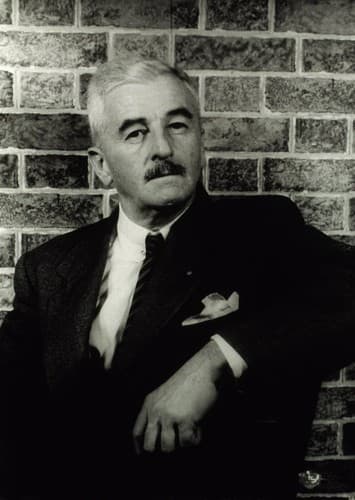
William Cuthbert Faulkner was an American writer known for his novels and short stories set in the fictional Yoknapatawpha County, based on Lafayette County, Mississippi, where Faulkner spent most of his life. A Nobel laureate, Faulkner is one of the most celebrated writers of American literature and often is considered the greatest writer of Southern literature.

Ashley Antoinette
4.6

Mark McDonald
4.4
Luo Guanzhong
4.4
Mia McKenzie
4.3
Dorothy Parker
4.3

Joaquim Maria Machado de Assis
4.3
James Thurber
4.2
Terry Kay
4.2