“When a man meets his master, he's like a dragon meeting the clouds.”
— Said in reference to heroes finding their place or rightful leader.

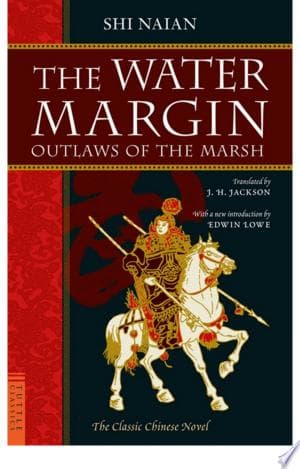
Shi Naian, Shi Nai'an (2010)
Genre
Fiction
Reading Time
17-20 hours
Key Themes
See below
Sign in to track this book
In Song Dynasty China, 108 outlaws, united by their opposition to corrupt officials and imperial rule, form a brotherhood to seek justice and restore their honor.
The story starts with Marshal Hong. Emperor Renzong sends him to Dragon Tiger Mountain to get the Celestial Master to cure a plague in Kaifeng. Hong ignores warnings and opens a sealed hall, thinking a true Celestial Master is inside. Instead, he unseals a stone tablet showing the names of 108 Demon Stars. These stars fly out as light. These 108 spirits are to be reborn as human heroes who will gather at Liangshan Marsh. This event sets up the gathering of the bandit heroes who will form the Water Margin's story, connecting their future rebellion to a supernatural beginning.
Gao Qiu, a former idler known for his football skills, gains favor with Emperor Huizong and quickly becomes a powerful military leader, Grand Marshal. His past dislike for Wang Jin, a martial arts instructor, returns. Gao Qiu, now in charge, seeks revenge. Wang Jin, fearing for his life and his mother's, leaves the capital. This event shows Gao Qiu as a main villain and shows the corruption and misuse of power in the Song Dynasty government, which will push many heroes to become outlaws. Wang Jin's escape also introduces the idea of injustice forcing good men into exile.
Lu Da, an army officer, helps a father and daughter who have been cheated and abused by the local butcher, Zheng Tu. In anger, Lu Da beats Zheng Tu to death. Forced to run, he becomes a monk at Wutai Mountain, taking the name Lu Zhishen. His loud and unusual behavior, including drinking and breaking monastic rules, leads to his expulsion. He then finds safety at Xiangguo Temple in Kaifeng but eventually must become an outlaw at Mount Twin Dragons, showing how injustice and personal honor can make people into bandits.
Lin Chong, an Imperial Guard instructor, is targeted by Gao Qiu's adopted son, Gao Yanei, who wants Lin Chong's wife. Gao Qiu plans against Lin Chong, falsely accusing him of carrying a knife into a forbidden area and sending him to Cangzhou. Even in exile, attempts are made on his life. After finding a plot to kill him and seeing his family destroyed by Gao Qiu's men, Lin Chong, in anger, kills his attackers and eventually flees to Liangshan Marsh, becoming a leader among the outlaws. His story is a strong condemnation of official corruption and injustice.
Chao Gai, the headman of Dongxi Village, with six friends including Wu Yong and the Ruan brothers, plans and carries out the robbery of birthday gifts meant for the corrupt Grand Tutor Cai Jing. These gifts, valuable gold and jewels, are being moved by a group led by Yang Zhi, a former officer. Using a trick with drugged wine, Chao Gai and his men successfully take the treasure. When their involvement is found, they must flee to Liangshan Marsh, where they remove Wang Lun, the original leader, and Chao Gai becomes the new chief, making the bandit stronghold much stronger.
Song Jiang, a county clerk known as 'Timely Rain' for his generosity, accidentally kills his mistress, Yan Poxi, after she blackmails him about a letter showing his connections to the Liangshan outlaws. He is exiled and later falsely accused by officials who fear his influence. During his exile, he meets many future Liangshan heroes and often shows his compassion and leadership. Finally, after being forced to kill a corrupt official and facing execution, he is saved by the Liangshan heroes and reluctantly joins them, becoming an important figure because of his charisma and strategic thinking.
After Song Jiang arrives, more heroes, driven by injustice, poverty, or friendship, gather at Liangshan Marsh. These include warriors like Lu Junyi and Guan Sheng, strategists like Zhu Wu, and others from all walks of life — fishermen, blacksmiths, scholars, and even former imperial officers. Each hero has a story explaining why they became an outlaw, often involving corrupt officials, local tyrants, or personal revenge. The marsh becomes a strong fortress, a safe place for those wronged by the Song government, with a large army and a growing reputation.
Under Chao Gai and later Song Jiang, the Liangshan heroes repel many imperial campaigns sent to stop them. They use clever plans, knowledge of the land, and their warriors' skills to defeat larger government armies. Victories include defeating Gao Qiu's forces and capturing cities. These wins not only strengthen Liangshan's position as a fortress but also show the imperial military's weakness and the outlaws' courage, adding to their legendary status among the common people.
After Chao Gai's death, Song Jiang takes full leadership of Liangshan. Despite their military successes, Song Jiang's main goal is not to overthrow the Song Dynasty but to be pardoned by the emperor and serve the state. He believes the heroes' talents should be used to defend the country. This goal causes disagreement among some of the more rebellious heroes, especially Li Kui. Song Jiang often tries to start talks with the imperial court, often through captured generals, hoping to prove the loyalty and worth of the Liangshan forces to the emperor.
Through constant efforts and help from sympathetic officials, Emperor Huizong finally pardons the Liangshan heroes. They are forgiven for their crimes and join the imperial army. Song Jiang and his brothers are then assigned to stop other rebellions, especially the forces of Fang La in the south. These campaigns are harsh and costly, leading to the deaths of many of the 108 heroes. This shows the tragic results of their return to a corrupt system and the realities of war. The heroes, despite their loyalty, are often treated with suspicion by court officials.
After stopping Fang La's rebellion, only a few of the 108 heroes remain. When they return, corrupt officials, especially Gao Qiu and Cai Jing, see the remaining Liangshan heroes as a threat and plan to remove them. Song Jiang is poisoned by imperial order, a cruel betrayal after his loyalty. Wu Yong and Hua Rong kill themselves at his grave. Li Kui drinks poisoned wine to die with Song Jiang. Other surviving heroes either die of illness, are executed, or leave official life. The story ends with most of the heroes' tragic deaths, showing the corruption of the Song court and the pointlessness of seeking justice within such a system.
The Protagonist
Transforms from a respected local official into the paramount leader of a vast bandit army, ultimately achieving amnesty only to face tragic betrayal and death.
The Supporting
Remains a fiercely loyal, albeit impulsive, follower of Song Jiang, ultimately choosing to die with his sworn brother.
The Supporting
Transforms from a military officer to a rebellious monk, then a formidable outlaw, always driven by a fierce sense of justice.
The Supporting
From a loyal imperial instructor, he is tragically stripped of everything and becomes a fierce, respected leader at Liangshan, a victim of systemic corruption.
The Supporting
Evolves from a village scholar to the strategic mastermind of a vast outlaw army, remaining a devoted advisor until his tragic end.
The Antagonist
Rises from obscurity to immense power, using his position to persecute the righteous, and ultimately orchestrates the tragic downfall of the Liangshan heroes.
The Supporting
Transforms from a village headman to a celebrated outlaw leader, establishing Liangshan as a haven before his untimely death.
The Supporting
Forced from a life of wealth and respectability into outlawry, he becomes a formidable warrior and Song Jiang's second-in-command, ultimately suffering a tragic end.
The Supporting
Remains fiercely loyal to his master, demonstrating exceptional skill and wisdom, and is one of the few who foresees and escapes the tragic end of the heroes.
This theme is central to 'The Water Margin,' as almost all 108 heroes become outlaws because of injustice from corrupt officials, greedy landlords, or local tyrants. Characters like Lin Chong are persecuted by Gao Qiu, while Lu Zhishen must flee after killing a predatory butcher. Liangshan Marsh becomes a safe place where a rough justice is given, often through violent revenge, a contrast to the corrupt imperial court. The heroes' fight for justice, even outside the law, forms the moral center of their rebellion.
“''In the world, there are many upright men, but few high officials.''”
Loyalty is a main value among the Liangshan heroes, forming the base of their community. The idea of 'brotherhood' (yìqì) connects them, despite social status and past conflicts. Song Jiang's ability to inspire loyalty, especially from figures like Li Kui, is key to his leadership. The heroes often risk their lives to save imprisoned friends, showing strong commitment. However, this loyalty is often compared with the betrayal in the imperial court, showing the moral strength of the outlaws' code.
“''Though we are not born on the same day, we wish to die on the same day.''”
The widespread corruption in the Song Dynasty government is the main reason for the entire story. Figures like Grand Marshal Gao Qiu and Grand Tutor Cai Jing show official wrongdoing, using their positions for personal gain, revenge, and oppressing the innocent. This corruption goes from the top levels of government down to local judges and jailers. The novel consistently shows the imperial court as wasteful, unfit, and unaware of the common people's suffering, justifying the heroes' rebellion and their fight against a broken system.
“''The court is filled with treacherous ministers and sycophants, while loyal and good men are suppressed.''”
The Water Margin explores what heroism means. The Liangshan heroes are not perfect; many are violent, impulsive, and do things that could be seen as criminal. However, their heroism is defined by their willingness to stand against injustice, protect the weak, and follow a code of honor and brotherhood when the official system fails. Characters like Lu Zhishen and Lin Chong show that true heroism can come from unexpected places and often means breaking usual rules. The novel asks the reader to consider who truly represents 'good' and 'evil' in a morally unclear world.
“''When the road is uneven, someone must step forward to make it smooth.''”
The novel begins with the release of the 108 Demon Stars, directly linking the heroes' existence and their gathering at Liangshan to a set celestial plan. This supernatural part suggests their rebellion is not just a human uprising but a cosmic event. Many characters have prophetic dreams or meet mystical figures who predict their future. This theme of fate often shows the inevitability of their actions and their tragic end, despite their individual choices, suggesting a large, overall plan beyond human control.
“''The 108 stars, having descended to earth, are destined to gather at Liangshan.''”
A supernatural origin for the heroes, linking them to celestial destiny
This is a foundational mythical element where Marshal Hong accidentally releases 108 powerful spirits (36 Heavenly Spirits and 72 Earthly Fiends) from a sealed hall on Dragon Tiger Mountain. These spirits are destined to be reborn as the heroes of Liangshan Marsh. This device imbues the heroes' gathering and their rebellion with a sense of cosmic inevitability and divine sanction, suggesting their actions are part of a larger, predetermined plan. It elevates the narrative beyond a simple bandit story, giving it an epic, mythological scope and providing a supernatural justification for their extraordinary abilities and eventual unity.
A prophetic artifact revealing the heroes' celestial names and ranks
After Song Jiang becomes the leader of Liangshan, a stone tablet is unearthed, revealing the celestial names of all 108 heroes and their precise ranks within the brotherhood. This device serves several crucial functions: it solidifies the concept of destiny, legitimizes Song Jiang's leadership by indicating a divine order, and provides a clear hierarchy for the vast number of characters. It marks a turning point, symbolizing the official formation of the Liangshan brotherhood and their recognition as a collective force, not just disparate individuals. It also foreshadows their collective fate, as their names are now inscribed for posterity.
A recurring epithet symbolizing Song Jiang's generosity and leadership
This epithet, meaning 'Timely Rain,' is applied to Song Jiang and functions as a powerful symbol of his character and influence. In agrarian China, timely rain is essential for life and prosperity. By associating Song Jiang with this, the novel highlights his benevolence, his willingness to help those in need, and his ability to bring relief and hope to the suffering. It underscores his moral authority and charisma, which attract many heroes to his cause. The epithet is not just a nickname but a narrative device that reinforces his reputation as a benevolent leader, contrasting him with the oppressive imperial government.
A recurring plot point driving the narrative towards reintegration into the state
The pursuit and eventual granting of amnesty by the imperial court is a central and recurring motif, particularly for Song Jiang. It represents the heroes' desire to legitimize themselves and serve the state rather than remain outlaws. This motif creates significant internal conflict within Liangshan, as some heroes prefer continued rebellion. It also serves as a tragic irony, as the amnesty ultimately leads to the demise of many heroes in imperial campaigns and through betrayal, highlighting the pervasive corruption of the court and the futility of their aspirations for honorable service within a flawed system.
“When a man meets his master, he's like a dragon meeting the clouds.”
— Said in reference to heroes finding their place or rightful leader.
“To rob the rich and help the poor is the way of a true hero.”
— A common sentiment among the outlaws justifying their actions.
“Where there are people, there are factions.”
— Reflecting on the internal politics and rivalries even within the bandit stronghold.
“A man's worth is not in his clothes, but in his heart.”
— Emphasizing inner virtue over outward appearance.
“Better to die standing than live kneeling.”
— A declaration of defiance against oppression.
“The tiger's strength is in its roar, but the snake's power is in its venom.”
— Highlighting different types of power and danger.
“Heaven has its way, and earth has its will. Man's will is but a flicker between the two.”
— A philosophical reflection on the limitations of human agency.
“One loyal heart can move mountains.”
— Praising the power of loyalty and dedication.
“Even the mightiest tree can be felled by a single axe blow.”
— A warning about vulnerability, even for the powerful.
“When the wine is good, friends gather; when the cause is just, heroes unite.”
— Explaining the camaraderie and motivation for joining the Liangshan band.
“A true hero does not fear death, but fears living without honor.”
— Defining the core values of the outlaws.
“The world is a chessboard, and we are but pieces upon it.”
— A fatalistic view of life and destiny.
“Though a dragon may fall into a shallow pond, it will still rise to the clouds.”
— Expressing the idea that true heroes will eventually overcome setbacks.
Ready to see how well you understood this book? Take our interactive quiz with 10 questions.

Shi Nai'an was a Chinese writer from the Yuan and early Ming periods. Shuihu zhuan, one of the Four Great Classical Novels of Chinese literature, is traditionally attributed to him. There are few reliable sources for his biography, much less his literary activity.

Biography coming soon.

Ashley Antoinette
4.6

Mark McDonald
4.4
Luo Guanzhong
4.4

Mia McKenzie
4.3

Dorothy Parker
4.3

Joaquim Maria Machado de Assis
4.3

James Thurber
4.2

Terry Kay
4.2