“It was not a question of being able to do it, it was a question of doing it.”
— Tristram's internal struggle with his duty to impregnate a woman.

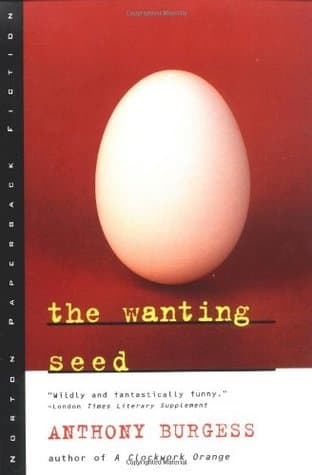
Anthony Burgess (1962)
Genre
Science Fiction
Reading Time
6-8 hours
Key Themes
See below
Sign in to track this book
In a future where mandated homosexuality gives way to rampant heterosexuality, the Foxe family navigates a society spiraling from sterile order into a comically grim chaos of fertility cults and polite cannibalism.
The novel begins in a future, overpopulated England where the government enforces strict population control. Tristram Foxe, a history teacher, and his wife, Beatrice-Joanna, live in a small apartment with their son, Ferdinand. The official belief, 'Pelagianism,' promotes homosexuality to control population, quietly discouraging heterosexual relationships. Heterosexual acts are often viewed with suspicion, and children are seen as a burden. Beatrice-Joanna secretly wants another child, a dangerous desire in this society. Tristram, while outwardly conforming, struggles with the hypocrisy and emotional emptiness of their world, often feeling alienated and wanting a more natural existence.
Beatrice-Joanna gets pregnant, despite societal pressure. This act directly defies Pelagian policy. As a result, Tristram loses his teaching position, and their son, Ferdinand, is sent to a state-run 'Infant Institute,' a term for an orphanage where children are often neglected. The couple's finances worsen, and they face growing social exclusion. Tristram, despite his initial anger at Beatrice-Joanna's impulsiveness, feels a strong need to protect his family and a growing anger at the oppressive system that punishes them for a natural human desire.
The Foxe family learns that Ferdinand has died at the Infant Institute. This devastating news fuels Beatrice-Joanna's grief and a desperate desire to escape their situation. They decide to flee north, aiming for Scotland, where they believe population controls might be less strict, or where they can find peace. Their journey is dangerous and shows widespread societal decay. They encounter various groups, from desperate migrants to armed youth gangs, all struggling in the crowded and increasingly chaotic world. This shows the breakdown of social order.
As Tristram and Beatrice-Joanna travel, they notice a subtle but growing rebellion against Pelagianism. This new belief, called 'Adamism,' advocates for procreation and natural heterosexual relations, often defying the state. Adamist groups start to appear, holding secret meetings and performing fertility rituals. This shift in belief shows a societal pendulum swing, a subconscious rebellion against the forced sterility and emotional repression of the Pelagian era. The rise of Adamism offers a glimmer of hope for Tristram and Beatrice-Joanna, suggesting their personal desires might match a broader societal change.
During their difficult journey, Tristram and Beatrice-Joanna see more disturbing signs of societal collapse. Food scarcity has become so severe that cannibalism, called 'dining clubs,' is a common, though hidden, practice. These clubs operate with a chilling normalcy, showing the extreme lengths people go to survive in a world with depleted resources. The discovery of these practices deeply disturbs Tristram, forcing him to face the dark side of human nature when pushed to its limits. This highlights the moral decay that comes with extreme societal pressures and the breakdown of order.
The Pelagian government, seeing the growing threat of Adamism, increases its crackdown on pro-fertility activities. Propaganda against 'breeders' becomes more intense, and state forces become more aggressive in enforcing population control. This escalation leads to more conflict between Pelagian loyalists and Adamist rebels. Tristram and Beatrice-Joanna find themselves caught in the middle of this ideological war, their personal struggle for survival now connected to a larger societal conflict. The government's desperate measures only fuel the rebellion, creating a cycle of violence and oppression.
Despite the dangers, Beatrice-Joanna gets pregnant a second time. This pregnancy, a symbol of defiance and hope, quickly makes her a leader for the Adamist movement. Her fertile state is celebrated and protected by Adamist followers, who see her as a living example of their pro-fertility ideals. Tristram, at first cautious of the attention, finds himself drawn into the movement's activities, becoming a reluctant participant in the growing rebellion. The personal act of procreation becomes a political statement, giving their journey a new, larger purpose within the unfolding societal transformation.
The ideological struggle between Pelagianism and Adamism results in open warfare. However, these battles are often absurd and ritualistic rather than truly destructive. Soldiers on both sides, wanting 'war without anger,' engage in theatrical combat, often using non-lethal methods. This unusual form of warfare shows Burgess's satirical comment on human conflict and the contradictions of ideological fervor. Tristram, watching these strange battles, struggles with the meaninglessness and the underlying violence, even when presented in a stylized, almost comical way. This highlights the human capacity for both absurdity and brutality.
During the chaos of the war, Tristram makes a shocking discovery: Ferdinand is alive. He learns that his son was not killed at the Infant Institute but was taken and raised by a group of homosexuals who strictly follow Pelagian ideology. This revelation adds another layer of complexity to Tristram's personal journey, forcing him to confront the state's manipulation and deception. The reunion with Ferdinand is bittersweet, as his son has been taught a worldview very different from his parents', showing the deep impact of societal engineering on individual identity and family bonds.
As Adamism wins and becomes the main belief, the societal pendulum swings dramatically. Procreation is now praised, and homosexuality, once state-sanctioned, becomes stigmatized and demonized. The new regime, in its fervor, begins to persecute homosexuals, mirroring the previous Pelagian persecution of heterosexuals. This rapid reversal of values shows the cyclical nature of human extremism and the dangers of any absolute belief. Tristram observes this shift with a cynical eye, recognizing that the new order, while different in its ideas, shares the same oppressive and intolerant characteristics as the old one, continuing the cycle of societal control.
With Adamism firmly established, Tristram, tired by the constant ideological shifts and societal upheavals, withdraws from public life. He and Beatrice-Joanna find a quiet life, adopting the new pro-fertility norms without fully giving in to the extremism. Tristram, having seen the rise and fall of two contrasting beliefs, develops a deep sense of resignation and a detached understanding of human nature's cyclical patterns. He finds a certain peace in a more agrarian, 'natural' existence, away from urban centers and political schemes. The novel ends with Tristram reflecting on the human desire for control and the futility of imposing artificial orders on fundamental biological drives.
The Protagonist
Tristram evolves from a cynical conformist to a disillusioned observer of societal extremism, ultimately seeking a quiet, natural life.
The Protagonist
Beatrice-Joanna transforms from a defiant individual into a symbolic figure for a societal revolution, ultimately finding fulfillment in motherhood.
The Supporting
Ferdinand's arc is defined by his indoctrination into Pelagianism and his eventual, complicated reunion with his parents.
The Supporting
Enderby remains a static character, representing the unchanging face of state control, regardless of the prevailing ideology.
The Supporting
The General's role is primarily to illustrate the nature of the 'war without anger,' rather than undergoing significant personal change.
The Mentioned
This character serves as a static symbol of societal decay.
The Supporting
These characters lead the ideological shift from Pelagianism to Adamism.
The novel shows a dystopian future where extreme overpopulation leads to harsh government policies. The Pelagian state's efforts to control fertility, from discouraging heterosexuality to the forced separation of families and the institutionalization of children, show the dehumanizing effects of such control. The scarcity of resources, leading to practices like cannibalism (the 'dining clubs'), highlights the extreme consequences. The societal decay and the constant struggle for survival underscore Burgess's warning about unchecked population growth and the resulting loss of individual freedom and dignity, as seen in Tristram's demotion and Ferdinand's fate.
“The greatest crime of all, the most deadly sin, was to bring forth another mouth to feed.”
Burgess shows how one extreme belief (Pelagianism, promoting homosexuality and anti-fertility) is replaced by another equally extreme one (Adamism, promoting procreation and persecuting homosexuals). The 'war without anger' and the rapid societal pendulum swing from one set of values to its opposite reveal the human tendency towards dogmatism and the dangers of absolute belief systems. Tristram's cynical observation of this cycle, from the initial oppression to the new wave of persecution, shows the novel's message that humanity often replaces one form of tyranny with another, rather than finding a balanced path.
“The human race, it seemed, was condemned to swing between two poles of absurdity.”
A main theme is the conflict between natural human instincts, especially the drive to procreate, and artificial societal rules. Beatrice-Joanna's strong desire for children, despite severe state penalties, shows nature's triumph. The eventual rise of Adamism, a pro-fertility movement, further illustrates that basic biological needs cannot be suppressed forever. Even the 'war without anger' shows a distorted, yet persistent, human drive for conflict. The novel suggests that attempts to engineer human nature or suppress innate drives will eventually fail, leading to chaotic and often violent reactions, as seen in the societal upheaval.
“You cannot argue with the sperm and the egg, for they are the voice of God.”
Burgess adds satire and dark humor to his critique of modern society. The 'war without anger,' the term 'dining clubs' for cannibalism, and the bureaucratic doublespeak of the Pelagian state all show the absurdity of human attempts to control and rationalize complex issues. Tristram's detached, often cynical observations of these strange events underscore the gap between official rhetoric and grim reality. The novel uses these absurdities to expose the dehumanizing and illogical consequences of extreme social engineering and the pervasive hypocrisy that underlies it.
“It was a war of the imagination, a war of symbols, a war without anger. And yet, people still died.”
A futuristic, overpopulated England serving as a cautionary tale.
The novel's setting is a quintessential dystopian future, characterized by extreme social engineering, resource scarcity, and a pervasive sense of state control. This setting allows Burgess to explore the potential negative consequences of unchecked population growth and governmental overreach. The cramped living conditions, the omnipresent propaganda, and the fear of procreation all contribute to a suffocating atmosphere, effectively illustrating the loss of individual freedom and dignity in such a society. It serves as a stark warning, amplifying the novel's thematic concerns.
The use of irony and exaggeration to critique societal flaws.
Burgess employs biting satire and dark humor to underscore the absurdities and hypocrisies of his dystopian world. Examples include the 'war without anger,' the euphemistic 'dining clubs' for cannibalism, and the state's glorification of homosexuality as a means of population control. This comedic approach, despite the grim subject matter, prevents the novel from becoming overly didactic and instead highlights the ridiculousness of human behavior when driven by extreme ideologies. It allows Burgess to deliver serious social commentary with a unique and engaging tone.
The cyclical shift between two opposing, equally extreme societal ideologies.
This device refers to the rapid and complete reversal of dominant societal ideologies, from Pelagianism (anti-fertility, pro-homosexuality) to Adamism (pro-fertility, anti-homosexuality). This pendulum swing illustrates the human tendency to replace one form of extremism with another, rather than finding a balanced approach. It highlights the inherent dangers of absolute belief systems and the cyclical nature of oppression, showing how yesterday's persecuted can become tomorrow's persecutors. This device is crucial for conveying the novel's message about the futility of human attempts to control fundamental drives.
The use of mild or indirect words to disguise unpleasant realities.
Throughout the novel, euphemisms are used to mask the grim realities of the dystopian society. 'Infant Institutes' are effectively orphanages where children are neglected or worse, and 'dining clubs' are establishments for cannibalism. This linguistic device highlights the state's manipulation of language to control public perception and sanitize atrocities. It also underscores the characters' complicity in accepting these veiled truths, demonstrating how a society can normalize horrific practices through the power of words. It contributes to the novel's dark humor and satirical tone.
“It was not a question of being able to do it, it was a question of doing it.”
— Tristram's internal struggle with his duty to impregnate a woman.
“The earth, in its wisdom, knew only how to be fruitful. It had no wisdom for barrenness.”
— Reflecting on the societal pressure for procreation and the natural world's drive.
“What was the point of art if it didn't make you want to go out and do something, even something stupid?”
— Tristram contemplating the purpose and effect of art in a sterile society.
“Every man a father, every woman a mother. That was the law, unspoken but absolute.”
— Describing the pervasive social mandate for procreation in the futuristic world.
“The greatest sin was not to be fruitful. It was to deny life.”
— A philosophical statement on the core tenet of their society's values.
“Love was a luxury, a diversion. Procreation was a necessity, a duty.”
— Comparing love and duty in the context of their highly regulated reproductive system.
“We are all merely instruments of the great biological imperative.”
— Tristram's cynical view of humanity's role in the grand scheme of reproduction.
“The future was a vast, fertile field, waiting for the seed.”
— A metaphorical description of the societal obsession with future generations.
“Ignorance was bliss, but knowledge was power, and power was sometimes a terrible burden.”
— Tristram grappling with the implications of understanding his society's true nature.
“To want, to desire, that was the human condition, even when the object of desire was forbidden.”
— Exploring the inherent human nature of desire against societal restrictions.
“The machine hummed, ready to receive, ready to create.”
— Referring to the artificial insemination technology, highlighting its impersonal nature.
“Sanity was a matter of conforming to the prevailing madness.”
— A commentary on the distorted norms of a society obsessed with reproduction.
“There was no escape from the wanting seed, no ultimate denial of the biological imperative.”
— The overarching theme of the novel, summarizing the inescapable drive for procreation.
“The individual was nothing; the species was all.”
— A stark statement on the collectivist and species-focused ideology of their world.
Ready to see how well you understood this book? Take our interactive quiz with 10 questions.

John Anthony Burgess Wilson, who published under the name Anthony Burgess, was an English writer and composer.