“I mock at the world's desire.”
— From 'Sailing to Byzantium', expressing a rejection of mortal passions.

Sign in to track this book
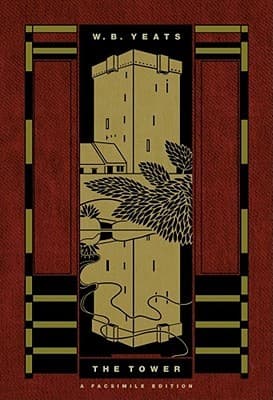
Yeats's 1928 collection, "The Tower," now in a new edition, explores the poet's mature work, from the spiritual quest of 'Sailing to Byzantium' to the power of 'Leda and the Swan,' as he considers age, history, and artistic lastingness.
The speaker, an old man, regrets the passing of youth and the physical world, where 'sensual music' is dominant. He feels out of place among the young and lively, calling himself a 'tattered coat upon a stick.' He decides to leave the 'country of the young' and go to Byzantium, a city known for its art and spiritual wisdom. He asks 'sages standing in God's holy fire' to be his guides, to take his heart and teach him to sing. He wants to become an artificial, lasting form, like a golden bird made by Greek goldsmiths. He wishes to sing to 'lords and ladies of Byzantium' about 'what is past, or passing, or to come.'
The speaker, an old man, stands by his tower and thinks about his aging body and lost youthful energy. He wonders if he should be happy with his 'sixty-year-old smiling public man' appearance and the wisdom he has gained. He remembers the tower's past residents, especially Mrs. French and a peasant woman, whose stories of madness and suffering connect with his own despair. He considers his legacy and the lasting power of imagination. He calls up figures from his past and from Irish mythology, like Hanrahan, to face his physical limits and search for a truth beyond the body.
The speaker looks at old aristocratic houses in Ireland, regretting their slow decay and the loss of their former 'magnificence.' He thinks about how these estates, built by generations of 'great men,' showed a certain beauty and order. However, he admits that this beauty often came from violence and exploitation, built on 'blood and mire.' He compares the past grandeur with the current decline, suggesting that the intense passion needed to create such beauty is gone. This leads to a sense of loss and an uncertain future for these former symbols of a dying era.
The speaker describes his own tower, Thoor Ballylee, as a refuge and a symbol of his artistic and intellectual pursuits. He details its structure, from the 'winding stair' to the 'great stone,' highlighting its old and lasting qualities. He feels a deep connection to its history and the continuity it offers, even with the civil war's chaos around him. He finds comfort in the idea that his house, unlike the 'ancestral houses' of the previous poem, is a place where he can develop his mind and art. It is a 'strong stone' against the 'foul weather' of the outside world, embodying personal order and a connection to a deeper, timeless wisdom.
The speaker describes meeting soldiers near his tower during the Irish Civil War. He sees the young, 'half-civilized' men, armed and patrolling, representing the conflict's destructive force. He notes their youth and the 'ignorant' nature of their cause, but acknowledges their readiness for violence. He contrasts their immediate, physical presence with his own intellectual work and his attempts to find meaning in the chaos. The road symbolizes the war entering his private life, forcing him to face the conflict's harsh realities and the difference between his world of thought and their world of action.
The speaker watches a starling's nest near his window, finding a moment of peace and natural order amid human unrest. He observes the parent starlings caring for their young, a scene of simple, instinctive life that contrasts with the civil war's violence and confusion. He thinks about nature's innocence and beauty, which seems untouched by human error. This observation offers a brief break from his thoughts on war. It suggests that while humanity is caught in cycles of destruction, nature continues its endless processes, offering a reminder of a different kind of wisdom and the chance for renewal, even if small and personal.
The speaker observes the swans at Coole Park, remembering earlier visits and noting their unchanging beauty and energy over many years. He is struck by their 'unwearied' grace and their ability to stay constant despite time passing and his own aging. The swans symbolize a lasting, ideal beauty and spiritual steadiness that he feels is missing in his own life and in the changing world, especially with the civil war. He wonders where they will eventually fly, hinting at their ethereal nature and connection to a timeless realm, sharply contrasting with his own death and the temporary nature of human affairs.
The speaker describes two symbolic trees. One represents an inner, spiritual vision, a 'holy tree' of the heart that offers wisdom and an 'ancient image' of truth. The other represents outer, worldly beauty and the distractions of the physical senses. He suggests one must choose between cultivating this inner spiritual tree, which brings lasting peace and understanding, and being swayed by the 'outer' tree, which offers brief pleasures and can lead to despair. The poem explores the tension between the soul's search for transcendent truth and the appeal of the material world, urging a focus on inner life to find true comfort amid chaos.
The speaker calls upon the spirit of Plotinus, the ancient Neoplatonist philosopher, seeking guidance from his teachings. He compares the 'blood-dimmed tide' and 'ceremony of innocence' of his own violent time with Plotinus's search for spiritual truth and unity. He imagines the Delphic Oracle speaking of Plotinus's rise beyond the material world to pure intellect and union with the divine. The poem suggests that true wisdom and peace are found not in earthly struggles, but in a transcendent philosophical vision. Here, the soul escapes the body's limits and the world's chaos to reach a higher understanding, offering a path to spiritual freedom from worldly suffering.
The speaker, an old man, visits a school and watches the children. They remind him of his past and the woman he loved (Maud Gonne). He thinks about the difference between their youthful innocence and his own aging body, which he calls a 'sixty-year-old smiling public man.' He considers beauty, both physical and intellectual, and the process of aging. He questions whether the 'Ledaean body' of his beloved was worth the sorrow. He thinks about the link between the physical and the spiritual, the body and the soul. This leads to the famous lines about the chestnut tree, asking how one can tell the 'dancer from the dance,' suggesting a unity of being and artistic expression.
The poem describes the myth of Leda being raped by Zeus, who has become a swan. It details the brutal, sudden attack, focusing on Leda's helplessness and fear as the 'great wings beating still' overpower her. The speaker emphasizes the 'indifferent beak' and the 'shudder in the loins' that lead to the Trojan War and the destruction of a civilization. The encounter is a violent, divine act that changes history. It questions whether Leda, in that moment of terror, gained any divine knowledge or understanding of the massive consequences of her violation. It shows the connection between divine power, human weakness, and historical fate.
The speaker, a father, stands by his sleeping infant daughter, Anne, during a stormy night. He sees the storm as a metaphor for the 'murderous innocence of the sea' and the world's violent state (the Irish Civil War). He prays for her future, wishing her beauty but not too much vanity, and for her to develop courtesy, innocence, and a strong will. He wants her to find a noble husband and for her mind to be free from 'opinionated mind' and 'intellectual hatred.' He believes true happiness comes from a 'radical innocence' and a 'self-delighting' soul, not from outer beauty or worldly success. He hopes she will find inner peace and avoid the bitterness he sees in the modern world.
The speaker reflects on the broken hopes and ideals of the post-World War I era, especially in Ireland. He remembers the early 20th century's naive optimism, when people believed in progress and a peaceful future, symbolized by 'weasels fighting in a hole.' He regrets the destruction of 'old civilizations' and the rise of 'madness' and violence, with 'great winged beasts' representing destructive forces. The poem expresses deep disappointment with humanity's ability for reason and order, seeing the world fall into a chaotic 'nightmare.' He also criticizes human pride and the belief in perfect systems, recognizing the certainty of decay and history's cyclical nature.
These two songs act as choruses, presenting a cyclical view of history and the rise and fall of civilizations and gods. The first song describes a new god's birth, highlighting the repeating pattern of creation and destruction, where 'all things fall and are built again.' It suggests that humanity constantly creates and then destroys its own gods and ideals. The second song focuses on the idea that every 'thirty-nine years' a new cycle begins, bringing new 'dreams' and 'terrors.' It shows the temporary nature of all things, from ancient gods to modern beliefs, and the relentless, often violent, progression of time and historical change. This implies a predetermined, almost fated, pattern to human existence.
The Protagonist
The speaker moves from a lament over physical decay to a philosophical quest for enduring truth and artistic transcendence, finding solace in art and ancient wisdom amidst personal and national turmoil.
The Central figure in a key myth
Leda's role is static within the poem, serving as the pivotal figure through whom a violent, transformative historical moment is initiated.
The Divine Antagonist/Force of Nature
As a mythological figure, Zeus's character is fixed, serving as the embodiment of divine, world-altering power.
The Mentioned historical figure
Not applicable; she is a historical reference.
The Mentioned mythological/literary figure
Not applicable; he is a literary reference summoned by the speaker.
The Mentioned historical/philosophical figure
Not applicable; he is a philosophical reference.
The Supporting
As an infant, her arc is nascent, representing potential and the recipient of her father's hopes and prayers.
The Supporting
Their role is to represent the beginning of life's journey, inspiring the speaker's philosophical inquiry.
This collection explores the physical and mental decline of old age, comparing it with the wish for lasting importance. In 'Sailing to Byzantium,' the speaker explicitly regrets his 'tattered coat upon a stick' and aims to go beyond his mortal body by becoming an 'artifice of eternity.' Similarly, 'The Tower' begins with the poet dealing with his 'sixty-year-old smiling public man' appearance and the fading of youthful energy. This theme appears as a struggle against what is certain, often solved by turning to art, intellect, or spiritual realms to achieve a lasting existence beyond the body's limits.
“An aged man is but a paltry thing, / A tattered coat upon a stick, unless / Soul clap its hands and sing, and louder sing / For every tatter in its mortal dress.”
Yeats examines different kinds of beauty—physical, natural, and artistic—and whether they are temporary or lasting. 'Among School Children' directly questions the value of physical beauty, like the 'Ledaean body,' against aging and the search for wisdom. The poem suggests a unity between the 'dancer and the dance,' meaning true beauty lies in the combined form and expression, or the physical and the spiritual. Art, especially the 'golden bird' in 'Sailing to Byzantium,' is a way to create a lasting, ideal beauty that can go beyond the temporary nature of the natural world and human life.
“How can we know the dancer from the dance?”
The collection is shaped by the Irish Civil War and the aftermath of World War I. This leads Yeats to think about historical cycles of violence and the breakdown of order. 'Meditations in Time of Civil War' directly discusses the conflict, with soldiers passing the poet's door and the regret for 'Ancestral Houses.' 'Leda and the Swan' is a mythological story, suggesting that violent, divine acts can cause large historical shifts, leading to destruction and new eras. 'Nineteen Hundred and Nineteen' openly mourns the broken hopes of progress and the return of 'madness.' It emphasizes a cyclical view where civilizations rise and fall, and violence is a part of human history.
“Things fall apart; the centre cannot hold; / Mere anarchy is loosed upon the world...”
A repeated tension in the poems is the struggle between the physical world's appeal and the search for spiritual or intellectual truth. In 'Sailing to Byzantium,' the speaker rejects the 'sensual music' of the young for the 'holy city' of art and spiritual wisdom. 'Meditations in Time of Civil War: The Two Trees' directly illustrates this conflict, presenting a choice between developing an 'inner' spiritual tree and being influenced by the 'outer' tree of worldly distractions. The collection often shows the physical body and its desires as temporary and corrupting, while the mind, soul, and art offer a path to lasting importance and a deeper understanding of reality.
“O body swayed to music, O brightening glance, / How can we know the dancer from the dance?”
Yeats often uses Irish mythology, classical myths, and historical figures to understand current events and universal human experiences. The myth of 'Leda and the Swan' is not just retold, but reinterpreted as a key moment for a new historical period. In 'The Tower,' the speaker calls up figures like Hanrahan from Irish folklore and history, including them in his personal thoughts. This use of mythology and tradition allows Yeats to elevate personal and national concerns to a larger, timeless scale. It suggests that current events echo old patterns and that wisdom is found in the lasting stories of the past.
“A shudder in the loins engenders there / The broken wall, the burning roof and tower / And Agamemnon dead.”
Objects, places, and figures represent abstract ideas or deeper meanings.
Yeats employs rich symbolism to convey complex themes. The 'tower' itself (Thoor Ballylee) symbolizes the poet's mind, a refuge for contemplation, and a link to history and tradition. 'Byzantium' symbolizes artistic and spiritual immortality. The 'golden bird' represents eternal artifice, contrasting with the 'tattered coat' of the aging body. 'Swans' often symbolize enduring beauty, grace, and an unchanging spiritual realm. These symbols imbue the poems with layers of meaning, allowing the concrete to point towards the abstract and universal.
References to historical events, mythology, and other literary works.
The collection is replete with allusions to classical Greek mythology (Leda and the Swan, Delphic Oracle), Irish folklore (Hanrahan), and specific historical events (Irish Civil War, World War I). These allusions enrich the poems by drawing on shared cultural knowledge, adding depth and resonance to the poet's reflections. They connect the immediate concerns of the speaker to broader historical and mythological patterns, suggesting a timelessness to human experience and conflict, and providing a framework for interpreting the present through the lens of the past.
A single speaker addresses an implied audience or himself, revealing character and situation.
Many of the poems, particularly 'Sailing to Byzantium,' 'The Tower,' and 'Among School Children,' function as dramatic monologues. The speaker's voice is distinct, engaging in a sustained reflection or address, often grappling with personal anxieties, philosophical questions, or observations of the world. This device allows for an intimate exploration of the speaker's consciousness, revealing his internal struggles, intellectual processes, and emotional states, drawing the reader directly into his thought process and perspective without external narration.
Placing contrasting elements side by side to highlight differences.
Yeats frequently uses juxtaposition to emphasize thematic tensions. He contrasts youth with old age ('Sailing to Byzantium,' 'Among School Children'), the physical with the spiritual ('The Two Trees'), natural beauty with artistic creation, and order with chaos (Meditations in Time of Civil War). This technique throws the contrasting elements into sharp relief, underscoring the speaker's internal conflicts and the dichotomies he observes in the world, such as the fleeting nature of physical life versus the enduring quality of art or intellect.
“I mock at the world's desire.”
— From 'Sailing to Byzantium', expressing a rejection of mortal passions.
“An aged man is but a paltry thing, / A tattered coat upon a stick, unless / Soul clap its hands and sing, and louder sing / For every tatter in its mortal dress.”
— From 'Sailing to Byzantium', pondering the decay of the body versus the vitality of the soul.
“Consume my heart away; sick with desire / And fastened to a dying animal / It knows not what it is; and gather me / Into the artifice of eternity.”
— From 'Sailing to Byzantium', a plea for the soul to be freed from the body and transformed into art.
“That is no country for old men. The young / In one another's arms, birds in the trees, / -Those dying generations-at their song, / The salmon-falls, the mackerel-crowded seas, / Fish, flesh, or fowl, commend all summer long / Whatever is begotten, born, and dies.”
— The opening lines of 'Sailing to Byzantium', setting the scene of a world focused on youth and sensuality.
“I have prepared my peace / With learned Italian things / And the proud stones of Greece, / Poet's imaginings / And memories of love, / Memories of the words of women, / All those things whereof / Man makes a superhuman / Mirror, and yet would shirk / The mere composition for the sake of work.”
— From 'The Tower', reflecting on the speaker's intellectual and emotional preparations for old age.
“It is time that I wrote my will; / I choose upstanding men / That I have known; and test their minds / And ask what all these words mean.”
— From 'The Tower', contemplating the legacy and meaning of his life and work.
“I pace upon the battlements and stare / On the foundations of a house, or where / Tree, river-loitering, had run its course; / Or else upon the ground where the last house stood.”
— From 'The Tower', a meditation on history, change, and the passage of time from his tower.
“My body of a sudden blazed; and now / My soul its ancient visage knows.”
— From 'The Tower', describing a moment of profound spiritual realization or awakening.
“Does the wild dog bark at the moon, / Or the child in the cradle cry? / Is it not a bitter thing to know / That the heart's desire must die?”
— From 'The Tower', a poignant question about the inevitability of loss and the end of desire.
“I have been staring at the sun, and so / I have been blinded to the moon.”
— From 'The Tower', an introspective reflection on focusing too intensely on one thing and missing others.
“The wind blows out of the gates of the day, / The wind blows over the lonely of heart.”
— From 'The Tower', a lyrical image of nature's indifference to human emotion.
“What shall I do with this absurdity— / O heart, O troubled heart—this mockery of a house, / Where all I have is a borrowed thing, / And the world's a stage, and I a king / Of borrowed robes and crown?”
— From 'The Tower', a self-deprecating reflection on the transient nature of worldly possessions and power.
“I must be satisfied with the common lot, / For I know that I am mortal, and my lot / Is to be with the living, and not with the dead.”
— From 'The Tower', an acceptance of human limitations and the reality of life.
“The friends that have it I do wrong / Whenever I remake a song, / Should know what is old and what is new, / And what it is that I must do.”
— From 'The Tower', defending his artistic choices and the need for renewal in his work.
Ready to see how well you understood this book? Take our interactive quiz with 10 questions.

Biography coming soon.
Ashley Antoinette
4.6

Mark McDonald
4.4
Luo Guanzhong
4.4
Mia McKenzie
4.3
Dorothy Parker
4.3
Joaquim Maria Machado de Assis
4.3
James Thurber
4.2
Terry Kay
4.2