“What is a bank robbery compared with the founding of a bank?”
— Macheath, reflecting on the nature of crime and capitalism.

Bertolt Brecht (1955)
Genre
Fiction
Reading Time
120 min
Key Themes
See below
Sign in to track this book
In Victorian London's underworld, a charming gangster's marriage to a naive heiress starts a satirical, jazz-infused show that exposes society's hypocrisy.
The play starts in the busy streets of Soho, London, just before Queen Victoria's coronation. A street singer introduces the gangster Macheath, 'Mack the Knife,' with a chilling ballad. The song lists his crimes, from murder to arson, and his dangerous charm. Meanwhile, Mr. J.J. Peachum, the 'King of the Beggars,' and his wife, Mrs. Peachum, prepare their beggars for the day's profitable spots. They show the hypocrisy of the middle class, using the poor for money while appearing respectable. The ballad warns the audience and establishes Macheath's presence before he appears.
Polly Peachum, the innocent-looking daughter of Mr. and Mrs. Peachum, has secretly fallen in love with and married Macheath. The wedding happens in a stable, a crude event attended by Macheath's gang, who bring stolen furniture and food. When Polly comes home and admits her marriage, her parents are angry, not because of her safety, but because Macheath is a criminal who will upset their plans and take from their profits. They see the marriage as a business mistake and immediately plot to have Macheath arrested and hanged, believing this will restore their family's standing and money.
Mr. Peachum, wanting Macheath brought to justice, goes to Chief of Police Tiger Brown, Macheath's old army friend, to demand his arrest. Brown, however, is corrupt and secretly friends with Macheath, making him unwilling to act. Polly, knowing her parents' plan, warns Macheath he is in danger. She tells him to leave London, but Macheath, confident in his connections and charm, at first ignores her. This scene shows the deep corruption in the legal system and Macheath's overconfidence.
Despite Polly's warning, Macheath is captured at a brothel, thanks to a tip from one of Peachum's spies. He is imprisoned. Lucy Brown, Tiger Brown's daughter and Macheath's former lover, visits him in jail. Jealous of Polly, Lucy helps Macheath escape by pretending to be pregnant and tricking the guards. This escape adds to the tangled relationships and shows Macheath's ability to charm and use women, even in bad situations.
After Macheath's escape, Polly and Lucy face each other at the jail. Both women say they are Macheath's true wife, leading to a heated argument with accusations. Each tries to show she is more important and has a better claim to Macheath. The scene is a dark parody of romantic love, showing how relationships in this world are about deals and how the women fight for status through their link to Macheath, who is not there but causes their rivalry.
Mr. Peachum, angry about Macheath's escape and wanting him hanged, threatens Tiger Brown. He reveals he knows about Brown's corrupt actions and his friendship with Macheath. Peachum uses his control over the city's beggars, threatening to disrupt the coronation parade with a large protest of 'disabled' beggars. This would embarrass the Queen and risk Brown's career, unless Macheath is arrested again. Brown, fearing for his job, agrees to search harder for Macheath, showing Peachum's power over even the Chief of Police.
Under pressure from Peachum, Tiger Brown's forces search harder, and Macheath is captured again at another brothel. He is betrayed by Jenny Diver, a prostitute with a complicated past with him. He is sentenced to death by hanging. In prison, Macheath regrets his fate and thinks about his past. His gang members visit him, showing loyalty but unable to help. The scene is a grim picture of his coming death, without his usual boldness, showing a moment of weakness.
As Macheath's execution nears, Peachum gathers his beggars, ready to march on the coronation parade if Macheath is not hanged. The large number and planned misery of the beggars threaten public order and Brown's career. Brown is caught between his loyalty to Macheath and the bad political results of Peachum's planned protest. This scene highlights the power dynamics, where using public opinion and social order becomes a weapon for the seemingly respectable Peachum.
Just as Macheath is led to the gallows, a sudden and unlikely reprieve arrives. A messenger from the Queen announces that Macheath has been pardoned and made a peer, given a castle, and a pension. This sudden intervention is a cynical comment on justice and power. It suggests that in this society, true justice matters less than random acts of mercy and keeping social order, even if it means rewarding criminals. The sudden turn of events highlights the play's anti-middle-class message.
The play ends with a final song that summarizes its cynical view. It says that morality is a luxury the poor cannot afford, and that survival often requires criminal behavior. The ending, with Macheath's absurd pardon, reinforces that the lines between criminals and respectable citizens are unclear. Society often rewards the ruthless and well-connected, regardless of their ethics. Brecht uses this ending to criticize the capitalist system and the hypocrisy of middle-class values, making the audience think about the real nature of justice and morality.
The Protagonist/Antagonist
Macheath moves from confident impunity to a moment of despair facing execution, only to be saved by an absurd, cynical reprieve.
The Supporting
Polly transforms from a seemingly innocent maiden to a shrewd businesswoman capable of managing Macheath's criminal empire.
The Antagonist
Peachum remains consistently cynical and driven by profit, successfully manipulating authorities to serve his interests.
The Supporting
Mrs. Peachum consistently supports her husband's schemes, remaining a steadfast accomplice in their exploitative enterprise.
The Supporting
Brown struggles between his loyalty to Macheath and the demands of his position, ultimately succumbing to Peachum's blackmail.
The Supporting
Lucy's jealousy leads her to help Macheath escape, only to be further rejected and humiliated.
The Supporting
Jenny moves from a position of loyalty to Macheath to betraying him for personal gain.
The Supporting
Filch remains a subservient member of Peachum's beggar organization.
The play satirizes the moral hypocrisy of the middle class, shown by the Peachums. They preach morality and respectability while secretly running an exploitative and corrupt business. Mr. Peachum, the 'King of the Beggars,' carefully creates poverty for profit, mirroring how he believes legitimate businesses use the working class. This theme appears in their anger over Polly's marriage to Macheath—not because he's a criminal, but because his criminal business threatens their own 'respectable' criminal business and social standing. The entire society, from the police chief to the 'beggar king,' operates on self-interest and moral compromise, blurring the lines between criminal and respectable citizen.
“What is a picklock to a bank share? What is a murder of a man to the employment of a man?”
The Threepenny Opera shows the deep corruption within society's institutions, especially the police and legal system. Chief of Police Tiger Brown, a figure of law and order, is Macheath's old army friend and secret ally, ignoring his crimes. This relationship shows that power structures are not fair but are often compromised by personal loyalties and secret deals. The sudden, last-minute royal pardon for Macheath, making him a peer, further shows how justice is not about fairness or morality, but about random power, political convenience, and keeping a superficial social order. The system itself is as criminal as the individuals it claims to control.
“First feed the face, then talk right and wrong.”
Relationships in the play, whether romantic or family, are always shown as transactional and self-serving, not based on real affection or loyalty. Polly's parents react to her marriage to Macheath with financial calculations, not parental concern. Macheath uses the affections of Polly, Lucy Brown, and Jenny Diver for his own gain, and Jenny eventually betrays him for money. The fight between Polly and Lucy over Macheath is a struggle for ownership and status, not a display of deep emotional connection. This theme highlights how a capitalist society makes people less human, reducing even the closest bonds to matters of profit and loss, power, and strategic advantage.
“The world is poor, and man is bad.”
Brecht challenges traditional ideas of justice and morality, suggesting they are relative and often set by one's social standing and economic power. The play asks who the 'real' criminals are: Macheath, the gangster, or Mr. Peachum, the 'King of Beggars' who uses the poor while appearing respectable? The final, absurd pardon of Macheath, where he is not only spared but rewarded, strongly criticizes a system where crime, when done on a large enough scale or with the right connections, is not only allowed but celebrated. The play argues that in a corrupt society, survival often requires immoral actions, and the difference between a 'good' person and a 'bad' person is just about opportunity and social view.
“What keeps a man alive? He lives on others. He likes to eat them out of house and home.”
At its heart, The Threepenny Opera criticizes capitalism and its contradictions. The play compares the methods of gangsters and prostitutes with those of 'respectable' businessmen, suggesting that both operate on exploitation, self-interest, and seeking profit at any cost. Mr. Peachum's beggar business is a direct parody of capitalist ventures, organizing and selling human suffering for money. The main message is that society itself, under capitalism, is a criminal enterprise, where the powerful prey on the weak, and morality is a luxury only the privileged can pretend to have. The play argues that the system itself creates the very criminality it claims to condemn.
“What is the robbing of a bank compared with the founding of a bank?”
Brecht's theatrical technique to distance the audience and encourage critical thought.
The alienation effect is central to Brecht's epic theatre, employed to prevent emotional immersion and encourage the audience to critically analyze the social issues presented. This is achieved through various means: characters directly addressing the audience, visible stage machinery, placards displaying scene titles, and songs that comment on the action rather than advance the plot. For example, the 'Ballad of Mack the Knife' is sung by a street singer at the beginning, introducing Macheath's notorious reputation before he even appears, immediately establishing a critical distance. The exaggerated, often grotesque characters and the improbable happy ending (Macheath's royal pardon) also serve to remind the audience that they are watching a play, not reality, prompting them to question the societal structures being satirized rather than simply empathizing with the characters.
Musical numbers that interrupt the narrative to offer commentary and analysis.
The songs, with Kurt Weill's distinctive music, are not merely decorative but serve as crucial plot devices in Brecht's work. They function as 'interruptions' that comment on the action, reveal character motivations, or deliver thematic statements, often directly addressing the audience. For instance, 'The Ballad of Mack the Knife' sets the tone and establishes Macheath's reputation. 'The Song of the Futility of Human Endeavour' (also known as 'The Threepenny Finale') explicitly states the play's cynical worldview. These songs prevent emotional identification with the characters and instead prompt intellectual engagement with the play's social and political critiques, aligning with the Verfremdungseffekt.
An improbable, last-minute intervention that resolves the plot in an unexpected way.
The play famously employs a deus ex machina in its final act, where Macheath, moments from being hanged, receives a royal pardon, a castle, and a pension. This device is not used to provide a satisfying, conventional happy ending. Instead, it serves as a highly ironic and cynical commentary on the arbitrary nature of justice and power. Brecht uses this improbable intervention to highlight how the powerful can manipulate outcomes, rewarding criminals who are well-connected or whose continued existence serves a larger, often corrupt, social or political purpose. It underscores the play's message that justice is not blind, but rather a tool of the ruling class, further alienating the audience from a sense of realism and forcing critical reflection.
The use of humor, irony, and exaggeration to expose and criticize societal flaws.
The Threepenny Opera is a profound work of satire, using humor and parody to expose the hypocrisy and corruption of bourgeois society. It parodies the conventions of romantic opera and Victorian melodrama, presenting a 'love story' that is deeply cynical and transactional. The Peachums, with their 'beggar's business,' are a grotesque parody of respectable capitalists, while Macheath, the criminal, often speaks with the logic of a ruthless businessman. This satirical approach allows Brecht to critique social injustices and the capitalist system indirectly, making the harsh realities more palatable while simultaneously sharpening their critical edge. The absurdity of the characters and situations serves to highlight the inherent absurdities of the society being depicted.
“What is a bank robbery compared with the founding of a bank?”
— Macheath, reflecting on the nature of crime and capitalism.
“First, feed the face, then talk right and wrong.”
— Peachum, expressing his cynical view on morality.
“The world is poor, and man is bad.”
— A general observation on the state of humanity and society.
“The law was made for one thing alone, for the exploitation of those who do not understand it, or who have no need to understand it.”
— Peachum, on the purpose and function of law.
“Behind every great fortune there is a crime.”
— Macheath, drawing a connection between wealth and illicit acts.
“Man lives by his head, his head does not suffice.”
— A reflection on human reason and its limitations.
“What keeps a man alive? He lives on others.”
— Peachum, describing the parasitic nature of human existence.
“The world's a whore, and we're her pimps.”
— A cynical view of the world and human roles within it.
“The poor man has no choice but to be good.”
— Peachum, suggesting that morality is a luxury for the wealthy.
“It is not enough to demand justice. One must create it.”
— A call to action regarding social change.
“When the rich get richer, the poor get children.”
— A commentary on social inequality and its effects.
“Marriage is a contract, not a sacrament.”
— Polly Peachum, expressing a pragmatic view of marriage.
“The world is not enough, and the world is too much.”
— A paradoxical statement about the world's abundance and scarcity.
“Pity is something you can buy.”
— Peachum, on the commodification of emotions and charity.
“The moon over Soho is cold and cruel.”
— A descriptive line setting a melancholic and bleak mood.
Ready to see how well you understood this book? Take our interactive quiz with 10 questions.
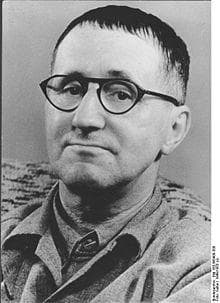
Bertolt Brecht was a highly influential German playwright, poet, and theatre director. He is best known for his epic theatre style, which aimed to provoke critical thought rather than emotional identification. His notable works include "The Threepenny Opera," "Mother Courage and Her Children," and "The Good Woman of Setzuan."
Ashley Antoinette
4.6

Mark McDonald
4.4
Luo Guanzhong
4.4

Mia McKenzie
4.3
Dorothy Parker
4.3
Joaquim Maria Machado de Assis
4.3
James Thurber
4.2

Terry Kay
4.2