“It was impossible to expect a moral response from a supernova. But it was just as impossible to expect a moral response from a civilization.”
— Reflecting on the nature of cosmic threats and the 'dark forest' theory.

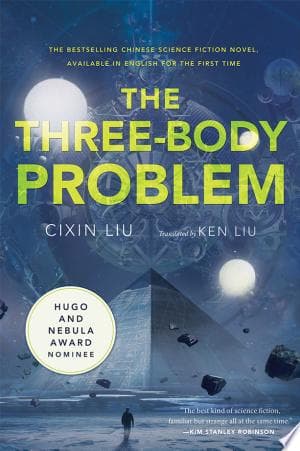
Cixin Liu (2014)
Genre
Science Fiction
Reading Time
500 min
Key Themes
See below
Sign in to track this book
Decades after a secret Chinese military project broadcasts humanity's existence into the cosmos, an alien civilization on the brink of collapse intercepts the signal and sets Earth on a collision course with an invasion that divides humanity into welcoming collaborators and desperate defenders.
The story begins during China's Cultural Revolution in 1967. Astrophysicist Ye Wenjie sees her father, a physics professor, beaten to death by Red Guards for his 'reactionary' scientific views. She is then sent to a labor camp in Inner Mongolia. Because of her science background, she is later recruited to the top-secret Red Coast Base, a military site meant to search for and send signals to extraterrestrial intelligence. There, she learns the base's true goal and, after her traumatic experiences, makes a choice that will affect Earth's future.
Decades later, in modern China, nanotech researcher Wang Miao is asked by police detective Shi Qiang to help investigate several suicides among scientists. Wang soon experiences strange things: a mysterious countdown appears only to him, and the laws of physics seem to be breaking down. He learns that many scientists doing advanced research have killed themselves, often leaving notes saying 'physics does not exist.' This situation pushes Wang into a world of hidden truths and global conspiracies, making him question reality itself.
Following clues from the dead scientists, Wang Miao gets access to a virtual reality game called 'Three-Body.' The game puts players in a world with three suns, leading to an unstable climate of 'Chaotic Eras' and 'Stable Eras.' Players, as avatars from different historical times, must figure out the three suns' orbits to help the inhabitants survive. Civilizations often rise and fall repeatedly due to unpredictable extreme heat or cold. Wang becomes increasingly obsessed with the game, which seems to hold the answer to the scientific suicides and his countdown.
Through his progress in the Three-Body game and talks with other players, Wang Miao slowly uncovers the truth. The game is not just a simulation but a history of an alien civilization, the Trisolarans, who live on a planet in a three-star system. Their world is constantly destroyed by the unpredictable gravity of its three suns. The countdown Wang sees is real: it means the Trisolaran fleet is coming to Earth. The Trisolarans, having received Ye Wenjie's signal decades earlier, are fleeing their dying home and plan to invade Earth, seeing it as their only new home.
Wang Miao discovers the Earth-Trisolaris Organization (ETO), a secret group started by Ye Wenjie. The ETO is split into factions with different ideas about the coming Trisolaran invasion. The Adventists, led by Mike Evans, fully welcome the Trisolarans, believing humanity is corrupt and should be replaced. The Redemptionists, a smaller group, want to help the Trisolarans solve their three-body problem, seeing them as superior. The Survivors just want to live through the invasion. Wang realizes that the ETO is actively trying to undermine humanity's defenses and prepare for the Trisolaran arrival.
The Trisolarans, unable to travel faster than light, sent 'sophons' ahead of their fleet. These sophons are proton-sized supercomputers unfolded into higher dimensions, then collapsed back into two dimensions, letting them interfere with Earth's particle accelerators. This interference caused the 'physics does not exist' problem and the scientists' suicides. The sophons are meant to stop humanity's basic scientific research, preventing any tech advances that could threaten the Trisolaran invasion fleet, which will arrive in 400 years. They also act as constant surveillance, reporting all human activity back to the Trisolarans.
The ETO's main contact with the Trisolarans is Mike Evans, a rich and disillusioned environmentalist. Evans uses his wealth and influence to set up a second Red Coast-like base on a giant tanker ship, the 'Judgment Day,' in the Pacific Ocean. From this ship, he talks directly with the Trisolarans. He gives them information about Earth and humanity, acting as their main go-between. His extreme environmental views have led him to believe that humanity is a plague on Earth and that the Trisolarans offer a necessary cleansing.
To get important information about the Trisolaran invasion, Earth's combined forces launch a risky operation against Mike Evans's ship, the 'Judgment Day.' They plan to capture the ship's hard drives, which hold all communications between Evans and the Trisolarans. Wang Miao's unique nanomaterial, 'flying blades,' is used as an invisible, sharp net across the Panama Canal. As the 'Judgment Day' tries to pass through, the blades cut the ship and everyone on board into thin sections, saving the ship's central computer and its data, which is then recovered and analyzed.
Analyzing the data from the 'Judgment Day' reveals the full Trisolaran plan and their true feelings about humanity. The intercepted messages, especially the Trisolarans' blunt answers to Evans's attempts to explain human culture, show that they see humans as mere insects, unable to understand or resist. They have no plan to coexist or negotiate; their goal is total conquest and extermination. This news crushes humanity's hopes and leaves the world in despair, as they realize the overwhelming odds against them and the sophons' advanced technology.
Towards the end, Ye Wenjie, now old, thinks about her choices. She explains why she invited the Trisolarans: her deep disappointment with humanity's capacity for cruelty and self-destruction, especially after the Cultural Revolution. She sees the Trisolarans as a possible force for change, even if it means humanity's enslavement or extinction. The novel ends with humanity facing the huge challenge of preparing for an invasion centuries away, yet already affecting their present through the sophons' interference and the coming threat. Detective Shi Qiang tries to offer hope, stressing humanity's ability to endure.
The Antagonist/Supporting
From a hopeful scientist, she becomes a deeply disillusioned individual who believes humanity needs an external force to either save it or destroy it, ultimately becoming the catalyst for the alien invasion.
The Protagonist
He transforms from an ordinary scientist into a central figure in uncovering the Trisolaran plot, forced to confront the collapse of his understanding of reality.
The Supporting
Remains consistently pragmatic and grounded, offering a human perspective amidst the overwhelming scientific and existential threats.
The Antagonist
From a radical environmentalist, he evolves into a willing collaborator with an alien invasion force, driven by a desire to 'save' Earth from humanity.
The Supporting
His initial despair over the breakdown of physics leads to his suicide, but his earlier observations are crucial for Wang Miao's investigation.
The Supporting
Remains a steadfast and authoritative figure, representing the organized human defense against the alien threat.
The Supporting
Provides initial scientific context for Wang Miao, remaining a source of information.
The Antagonist
As a collective, they are driven by species survival, leading them to be relentlessly aggressive and dismissive of humanity.
This theme is central, mainly through Ye Wenjie. Her experiences during the Cultural Revolution, seeing extreme cruelty, destroy her faith in humanity. This disillusionment leads her to invite the Trisolarans, believing an outside, superior force is needed to either fix or destroy humanity. Mike Evans shares this view, seeing humanity as a destructive force against nature. The ETO's existence shows how some people, given certain situations, can turn against their own species, driven by despair or a twisted sense of justice.
“It was impossible to expect a moral awakening from humankind itself, thus it was necessary to introduce an external force to achieve it.”
The sophons' ability to interfere with basic particle physics directly attacks humanity's scientific foundation. The suicides of scientists, driven by the idea that 'physics does not exist,' show how fragile human progress and understanding are. This theme explores the terrifying idea that what we see as scientific truths can be manipulated or made meaningless by advanced intelligence, pushing humanity into intellectual despair and stopping tech progress. It questions the reliability of observation when reality itself is being changed.
“Physics does not exist. Physics has never existed. Look at the stars, they are blinking at you, mocking you.”
The novel shows a pessimistic view of first contact. Instead of peace or learning, the Trisolarans' response to Ye Wenjie's signal is immediate and absolute: invasion. Their lack of empathy, their view of humans as 'bugs,' and their choice to stop Earth's scientific progress before arrival, paint a picture of alien intelligence that is purely self-serving and uncaring about other life forms. This theme explores the dangers of announcing humanity's presence in space, suggesting that advanced civilizations might be hostile predators.
“You are bugs!”
Mike Evans's character directly shows this theme. His extreme environmentalism turns into a deep hatred of humanity, making him believe that humanity is a cancer on Earth. He sees the Trisolaran invasion not as a threat, but as a necessary cleansing force to restore ecological balance. This highlights how concern for the planet can become a desire for humanity's destruction, criticizing extreme environmental ideas. His actions show how a perceived moral duty can justify working with an existential threat.
“Humanity is the disease, and the Trisolarans are the cure.”
The entire story is built on the coming conflict between humanity and the Trisolarans. This theme explores not just a physical fight, but a basic difference in values, ethics, and even ways of thinking. The Trisolarans, without deception and driven by collective survival, cannot understand human individuality or our capacity for complex emotions like love or art. This lack of mutual understanding makes any peaceful solution impossible and highlights the vast gap between two very different forms of intelligence, leading to an unavoidable, brutal fight for survival.
“The universe is a dark forest. Every civilization is an armed hunter stalking through the trees like a ghost, gently pushing aside branches that block the way and trying to tread without sound.”
A virtual reality game that serves as a historical record and recruitment tool.
The Three-Body game is a sophisticated virtual reality simulation that allows players to experience the chaotic history of the Trisolaran civilization. It functions as a brilliant exposition device, gradually revealing the Trisolarans' existence, their environmental plight, and their technological capabilities without directly stating them. Beyond being a narrative tool, it also serves as a recruitment platform for the ETO, identifying individuals with the intelligence and disillusionment necessary to understand and potentially align with the alien cause.
Proton-sized supercomputers that halt scientific progress and provide surveillance.
Sophons are a critical plot device. These highly advanced, multi-dimensional supercomputers, sent ahead of the Trisolaran fleet, serve two primary functions. Firstly, they act as omnipresent surveillance devices, reporting all human activity back to the Trisolarans, eliminating any possibility of secrets. Secondly, and more devastatingly, they interfere with fundamental particle accelerators, thereby halting humanity's scientific progress. This ensures that Earth cannot develop the technology to defend itself against the incoming fleet, creating a seemingly insurmountable technological gap and fostering despair among scientists.
A mysterious, visible countdown that appears to Wang Miao, signaling an impending event.
The countdown is a psychological plot device that creates immediate tension and mystery. Appearing only to Wang Miao, it represents the direct, personal intrusion of the alien threat into his life. Initially inexplicable, it drives his investigation and descent into the 'Three-Body' mystery. The countdown also symbolizes the limited time humanity has before the full extent of the Trisolaran threat manifests, serving as a constant, visible reminder of the impending doom and the sophons' direct interference with human perception.
The historical setting that shapes Ye Wenjie's worldview and actions.
The Cultural Revolution serves as a crucial historical backdrop, directly influencing Ye Wenjie's character and her pivotal decision. It provides the psychological justification for her deep disillusionment with humanity, showcasing an extreme example of human cruelty and irrationality. This setting is not merely flavor; it's the crucible that forges the catalyst of the entire alien invasion plot. It grounds the fantastical science fiction elements in a tangible, brutal historical reality, making Ye Wenjie's radical choices more understandable, if not forgivable.
“It was impossible to expect a moral response from a supernova. But it was just as impossible to expect a moral response from a civilization.”
— Reflecting on the nature of cosmic threats and the 'dark forest' theory.
“In the universe, the only constant is change.”
— A general philosophical observation about the nature of existence.
“The greatest fear is not of unknown, but of known, and of the known being much worse than imagined.”
— Humanity's dawning realization of the Trisolaran threat and its implications.
“Weakness and ignorance are not barriers to survival, but arrogance is.”
— A critical assessment of humanity's initial approach to interstellar contact.
“You are bugs!”
— The chilling message from the Trisolarans, demonstrating their contempt for humanity.
“The entire history of humanity is a struggle against the three-body problem.”
— A character's realization of the profound, inescapable nature of the Trisolaran predicament.
“To hell with morality. The future of humanity is at stake!”
— A character making a difficult decision, prioritizing survival over ethical concerns.
“Perhaps the only thing we should truly fear is ourselves.”
— A reflection on humanity's internal divisions and capacity for self-destruction.
“Even the mightiest sun can be extinguished by a single drop of darkness.”
— A metaphorical statement about the vulnerability of even powerful entities.
“What is the greatest punishment? To witness the end of all you hold dear, powerless to stop it.”
— A character contemplating the ultimate despair of impending doom.
“Science has no borders, but scientists do.”
— Discussing the political and nationalistic influences on scientific endeavors.
“The universe is a dark forest. Every civilization is an armed hunter, stalking through the trees like a ghost, gently pushing aside branches that block its way, trying to tread without sound.”
— Introducing the 'dark forest' theory of cosmic sociology, a cornerstone of the series.
“The universe is not a fairy tale. It's a cruel, unforgiving reality.”
— A stark realization about the true nature of the cosmos, devoid of sentimentality.
“Hope is the most dangerous thing.”
— A cynical view on the deceptive nature of hope in dire circumstances.
Ready to see how well you understood this book? Take our interactive quiz with 10 questions.

Cixin Liu is a Chinese science fiction author best known for his award-winning novel, 'The Three-Body Problem.' This novel, the first in the 'Remembrance of Earth's Past' trilogy, gained international acclaim and won the Hugo Award for Best Novel, making Liu the first Asian author to receive the honor. His work often explores grand scientific concepts and humanity's place in the universe.