“The trouble with Harry is that he's always trying to find a way back to something that doesn't exist anymore.”
— A friend's observation about Charley's fascination with the past.

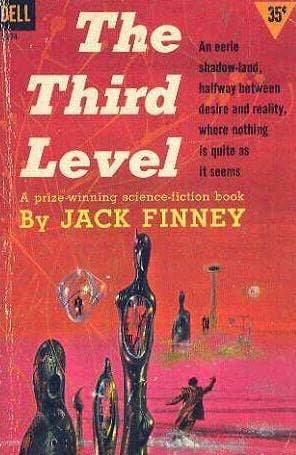
Jack Finney (1957)
Genre
Science Fiction
Reading Time
15 min
Key Themes
See below
Sign in to track this book
A collection of speculative tales where ordinary lives brush against the extraordinary, from commuters stumbling into the past to suburbanites discovering peculiar new neighbors and the chilling consequences of a man's obsession with his career.
Charley, a thirty-one-year-old man in New York, often seeks a break from the city's rush. One evening, rushing to catch a late train, he takes the subway from Grand Central Station. He gets lost, which he blames on the station's complex layout, saying that Grand Central 'is growing like a tree, pushing out new corridors and staircases like roots.' He takes an unfamiliar corridor that slopes downward and leads him to a hidden third level. This level looks old-fashioned: gaslights glow, brass spittoons line the floor, and men wear old suits with fancy mustaches. He sees a ticket counter with a man wearing a green eyeshade and a black four-button suit, and a newsstand selling a newspaper called 'The World' dated June 11, 1894.
Overwhelmed by being in the past, Charley goes to the ticket counter. He decides he wants to buy two tickets to Galesburg, Illinois, for himself and his wife, Louisa. Galesburg is his hometown, and he often imagines its peaceful past. He shows his modern money, but the clerk, suspicious of the unfamiliar bills, accuses him of trying to 'skin' him and threatens arrest. Frightened by the clerk's stern manner and the realization his money is useless in this era, Charley quickly leaves the third level, fearing he might be thrown into an 1894 jail. He hurries back through the corridor, eventually finding his way back to the modern second level of Grand Central Station.
Disturbed by his experience, Charley tells his psychiatrist friend, Sam Weiner. Charley describes the third level in detail, recounting the gaslights, old clothing, and the 1894 newspaper. Sam, however, is doubtful. He calls Charley's story a 'waking-dream wish fulfillment,' suggesting Charley is unhappy with the modern world's insecurity, war, and worry, and is looking for an escape. Sam suggests Charley's stamp collecting hobby is also a temporary escape from reality. Louisa, Charley's wife, is also concerned about his mental state but eventually accepts Sam's explanation, though with some doubts.
Despite Sam's logical explanation, Charley remains sure the third level is real. He spends many lunch hours looking for the corridor in Grand Central Station, carefully exploring every turn and hidden passage. His obsession grows, worrying Louisa more and more. He describes Grand Central as an endless maze, a place where one could easily get lost or even find a new, old-fashioned level. He is driven by the desire to escape to the peaceful past of Galesburg, a place he sees as a refuge from present-day worries. He often remembers the quiet streets, large houses, and long summer evenings of his childhood in Galesburg.
Louisa initially worries about Charley's growing obsession with the third level. She tries to stop him, fearing for his mental health, and wishes he would stop searching. However, her concern for him eventually leads her to reluctantly join him in his search for the third level. Together, they spend evenings exploring the vast passages of Grand Central Station, hoping to find the hidden entrance. Despite their efforts, they never find the specific corridor or the third level again. This shared but fruitless quest shows her underlying affection and concern for Charley, even if she does not fully believe in his discovery.
One day, Charley's stamp collection reveals a surprise. Among his oldest first-day covers—new stamps issued on their first day of sale and postmarked to prove the date—he finds one that should not be there. It is an envelope addressed to his grandfather in Galesburg, postmarked July 18, 1894, and bearing a six-cent stamp with a picture of President Garfield. Inside, there is a letter from Sam Weiner. The letter confirms Sam's presence in 1894 Galesburg, having found the third level himself. Sam describes the peaceful life there, inviting Charley and Louisa to join him and even suggesting he has set up a hay and feed business, which he always wanted to do.
Sam's letter from 1894 Galesburg proves to Charley that the third level is real, and that Sam, who had first dismissed Charley's story as a delusion, has now experienced it himself. Sam writes about the pleasant environment of 1894 Galesburg, with people playing pianos, singing, and enjoying the quiet evenings. He encourages Charley and Louisa to keep looking for the third level and join him in the past. The letter implies that Sam, despite his professional doubt, had his own desires to escape modern world pressures, and ultimately found his way to the past Charley wanted. This discovery validates Charley's experience and strengthens his resolve.
With the clear evidence of Sam's letter, Charley's belief about the third level is stronger than ever. The letter not only validates his own experience but also confirms that escape to the past is possible. He sees Sam's business venture in 1894 Galesburg—setting up a hay and feed business—as a clear sign of his friend's successful move. Charley now has a goal: to find the third level, exchange his modern money for old currency at a coin dealer, and buy tickets to Galesburg for himself and Louisa, to join Sam in that peaceful, past era. His search becomes more determined and hopeful than before, fueled by the idea of a shared escape.
The revelation of Sam's letter and his journey to 1894 Galesburg changes how the story interprets reality and escape. Initially, Sam, as a psychiatrist, represents reason and scientific explanation, dismissing Charley's experience as a delusion. However, his disappearance and the letter from the past show that even those who seem grounded in reality have a deep desire to escape modern life's anxieties and pressures. Sam's move to a quiet, simpler past suggests that the longing for a bygone era is a common human feeling, not just an individual neurosis, and that the 'third level' might be a way for anyone seeking peace.
The Protagonist
Charley begins as someone seeking an unconscious escape, then becomes a determined explorer, ultimately finding validation and renewed hope for a true escape.
The Supporting
Louisa moves from skepticism and worry to reluctant participation, showing her deep care for Charley.
The Supporting/Mentioned
Sam transforms from a figure of rational skepticism to a participant in the very escape he once dismissed.
The main theme is the human desire to escape modern life's anxieties, pressures, and perceived dangers. Charley's discovery of the third level and his longing for 1894 Galesburg show this directly. The story mentions 'insecurity, fear, war, and worry' as reasons for seeking refuge. Even Sam, the psychiatrist, who at first dismisses Charley's experience as wish fulfillment, eventually finds his own escape to the past, suggesting this desire is universal. The third level is a literal and metaphorical door to a simpler, more peaceful existence, away from present complexities.
“The modern world is full of insecurity, fear, war, and worry, and all the rest of it, and that I just want to get away.”
The story idealizes the past, especially the late 19th century, as a peaceful haven. Galesburg in 1894 is shown as a place of 'big old frame houses, huge lawns, and tremendous trees,' where people had 'time for everything.' This contrasts sharply with Charley's view of the hurried, anxious modern world. The gaslights, brass spittoons, and old clothing on the third level all add to this nostalgic vision. The past is not just a different time, but a different quality of life—one of peace, community, and leisure, which both Charley and Sam ultimately seek.
“Galesburg, Illinois, is a wonderful town still, with big old frame houses, huge lawns, and tremendous trees whose branches meet overhead and roof the streets. And in 1894, summer evenings were twice as long, and people sat out on their lawns, the men smoking cigars and talking quietly, the women waving palm-leaf fans, with the fire-flies all around, in a peaceful world.”
The story plays with what is real and what is imagined. At first, Charley's experience is seen as a possible delusion, a 'waking-dream wish fulfillment,' by his psychiatrist friend. However, finding Sam's letter from 1894 blurs the lines between reality and fantasy. It suggests that what one person sees as impossible might be another's lived experience. The 'third level' itself exists outside common understanding, challenging the fixed nature of time and space. The story leaves the reader questioning whether the third level is a physical place, a psychological escape, or a mix of both, highlighting the subjective nature of truth.
“That’s what he said, and my friends all agreed. Everything points to it, they claimed. My stamp collecting, for example; that’s a temporary refuge from reality.”
Grand Central Station itself acts as a symbol for life's complexities and hidden paths, and for time. Charley repeatedly describes it as 'growing like a tree, pushing out new corridors and staircases like roots,' implying that there are always unseen dimensions or possibilities. This maze-like quality extends beyond the physical station to represent the complex, sometimes confusing, nature of existence and the potential for unexpected turns, like finding a portal to the past. The difficulty in finding the third level again reinforces that such escapes or discoveries are not easily accessed or repeated.
“Grand Central is growing like a tree, pushing out new corridors and staircases like roots. There’s probably a long tunnel that nobody knows about, feeling its way under the city right now, on its way to Times Square, and maybe another to Central Park.”
A philatelic item that serves as irrefutable proof of time travel.
The first-day cover is a crucial plot device. It's an envelope bearing a new stamp, postmarked on its first day of issue. Charley's discovery of a first-day cover from July 18, 1894, addressed to his grandfather in Galesburg and containing a letter from Sam, provides tangible, undeniable evidence that the third level is real and that Sam has successfully traveled to the past. This object shifts the narrative from Charley's subjective experience to a verifiable event, validating his 'delusion' and propelling the story towards a more concrete (albeit fantastical) resolution.
A mundane location transformed into a gateway to another time.
Grand Central Station is not just a setting but a dynamic plot device. Its famously complex and ever-changing structure serves as the perfect, believable (within the story's context) location for a hidden 'third level.' Charley's initial reason for getting lost – the station's labyrinthine quality – makes the existence of a secret level plausible. The station acts as a liminal space, a transit hub that paradoxically allows for transit not just through space, but through time, serving as the physical manifestation of the story's central fantastical element.
A character who initially dismisses the fantastical, only to become part of it.
Sam Weiner, the psychiatrist, functions as a powerful plot device through his unexpected role reversal. Initially, he represents the voice of scientific reason and skepticism, providing a logical (though ultimately incorrect) explanation for Charley's experience. This establishes a baseline of 'reality' against which Charley's claims are measured. However, Sam's later disappearance and letter from the past subvert this role. His transformation from dismissive professional to fellow time-traveler validates Charley's experience and adds a surprising twist, suggesting that the desire for escape is universal and even the most rational minds can succumb to it.
“The trouble with Harry is that he's always trying to find a way back to something that doesn't exist anymore.”
— A friend's observation about Charley's fascination with the past.
“Sometimes you're just looking for an escape, and you find it in the most unexpected places.”
— Charley's internal reflection on why he might have found the third level.
“The world is full of people who are looking for a way out, and they find it in different ways.”
— Charley's psychiatrist friend, Sam, discussing the human need for escape.
“I’ve been to the third level, and it’s a beautiful place. A place where time stands still.”
— Charley's conviction about his experience at the third level.
“The fact is, Charley, you're unhappy. That's why you're seeing things.”
— Sam's psychological explanation for Charley's experience.
“Every time I go to Grand Central, I feel like I'm going to find it again. That third level.”
— Charley's persistent hope and obsession with finding the third level.
“It was a way of going back, a way of getting away from all the hustle and bustle of modern life.”
— Charley's understanding of the appeal of the third level.
“The third level is a waking-dream wish fulfillment.”
— Sam's professional diagnosis of Charley's experience.
“You can never really go back, not to a place, not to a time.”
— An underlying theme contrasting Charley's desires with reality.
“The past is a foreign country; they do things differently there.”
— A metaphorical statement reflecting the alien nature of the past.
“Maybe the third level is just a crack in the wall of time.”
— Charley's speculative thought about the nature of the third level.
“For a moment, I really believed it. That I had found it.”
— Charley's fleeting conviction during his initial encounter with the third level.
“The third level is a place where you can breathe, where the air is clean and the pace is slow.”
— Charley's description of the tranquil atmosphere of the third level.
“There are always two levels to everything, the one you see and the one that's hidden.”
— A broader philosophical idea suggested by the story's premise.
Ready to see how well you understood this book? Take our interactive quiz with 10 questions.

Walter Braden "Jack" Finney was an American writer. His best-known works are science fiction and thrillers, including The Body Snatchers and Time and Again. The former was the basis for the 1956 film Invasion of the Body Snatchers and its remakes.