“The unexamined life is not worth living. But what about the over-examined life?”
— Isabel Dalhousie's internal musings on the nature of philosophical inquiry.

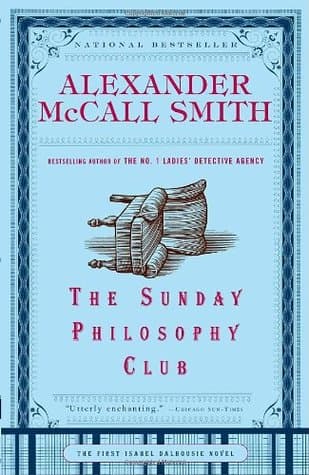
Alexander McCall Smith (2003)
Genre
Mystery / Philosophy
Reading Time
270 min
Key Themes
See below
Sign in to track this book
In the philosophical heart of Edinburgh, Isabel Dalhousie, a curious sleuth, untangles moral dilemmas and suspicious deaths, often to the chagrin of her housekeeper and the detriment of her niece's love life.
Isabel Dalhousie, a philosopher and editor of the 'Review of Applied Ethics,' attends a concert at the Usher Hall in Edinburgh. During the performance, she sees a young man, Mark Fraser, fall from the upper circle to his death. The police quickly call it a suicide, but Isabel is troubled. She observes a brief gesture from the man before he fell, and senses something unnatural. This incident sparks her curiosity and a philosophical need to understand the truth, despite the advice of her housekeeper, Grace, and the skepticism of her niece, Cat.
Isabel begins to discreetly investigate Mark Fraser's death. She learns that Mark was a successful but somewhat mysterious young man involved in business. Her first attempts to speak with people connected to him are met with reluctance or dismissal. She meets Mark's aunt, Minty, who is upset but provides little information. Isabel's philosophical nature leads her to consider the reasons for human actions and the complexities of truth, pushing her further into the mystery despite the lack of official support or a clear path forward.
Isabel gathers her informal 'Sunday Philosophy Club,' made up of herself, her niece Cat, and sometimes other friends. They discuss the ethical issues and philosophical angles of Mark Fraser's death. While the club's discussions often wander through various philosophical problems, Isabel subtly guides the conversation to the nature of truth, responsibility, and the difficulty of telling suicide from murder. These discussions, though not directly providing clues, help Isabel organize her thoughts and strengthen her resolve to find out what happened, reinforcing her belief that a deeper truth exists.
Isabel arranges to meet Pat McMartin, Mark Fraser's business partner. McMartin tells a convincing story of Mark's financial struggles and a recent failed business deal involving a large sum, suggesting a strong reason for suicide. He describes Mark as having been under great pressure. While McMartin's account seems believable, Isabel's observational skills and philosophical skepticism lead her to notice small inconsistencies in his manner and story. This creates doubt about his honesty and the true nature of Mark's financial problems.
Isabel continues her investigation, using her observation skills and understanding of human nature. She revisits the concert hall, mentally replaying the events. She notices the architecture of the upper circle and thinks about how the fall happened. She also pays close attention to the reactions and subtle cues of those she interviews, such as McMartin and others connected to Mark. Her philosophical training allows her to analyze not just facts, but also the underlying reasons and inconsistencies in human behavior, slowly building a case against the suicide theory.
At the same time as her investigation into Mark Fraser's death, Isabel is concerned about her niece, Cat, who is involved with a married man named Jamie. Isabel strongly disapproves of the affair, seeing it as morally wrong and harmful to Cat. She often offers Cat advice, which is often met with resistance. Isabel's attempts to guide Cat reflect her broader philosophical concerns about ethical living and personal responsibility, and her desire to protect those she cares about from making poor choices, even if they do not appreciate her help.
Through her persistent questions, Isabel learns that Mark Fraser had a secret girlfriend. This fact contradicts the image of a financially desperate and isolated man. She eventually finds the girlfriend, Elspeth, who is initially hesitant to speak. Elspeth reveals details about Mark's life, including his recent mood, his financial state (which she believed was stable), and his plans for the future. Her account further weakens Pat McMartin's version of events and strengthens Isabel's belief that Mark's death was not a suicide, suggesting a more sinister plot.
With new information, especially from Elspeth and her own deductions, Isabel decides to confront Pat McMartin directly. She challenges his story of Mark's financial ruin and suicide, subtly showing that she knows about discrepancies. McMartin first tries to deflect and remain calm, but Isabel's steady gaze and logical questions begin to break his composure. The confrontation is tense, with Isabel using her philosophical insights to dissect his arguments and expose the weaknesses in his alibi, pushing him closer to revealing the truth.
Under Isabel's questioning, Pat McMartin finally confesses. He admits he was responsible for Mark Fraser's death. The 'suicide' was, in fact, a murder. McMartin reveals that he had embezzled a large sum of money from their joint business venture. When Mark discovered the fraud and threatened to expose him, McMartin pushed him from the balcony at the concert. His confession confirms Isabel's suspicions and confirms her pursuit of truth, bringing closure to the mystery of Mark Fraser's death.
With McMartin's confession, the police are informed, and justice begins. Isabel thinks about good and evil, the fragility of human life, and the importance of seeking truth, even when it is uncomfortable. She also considers the impact of her actions and the role of philosophy in practical life. Meanwhile, Cat decides to end her relationship with Jamie, signifying a small victory for Isabel's ethical guidance in her personal life, along with her success in solving the murder.
The Protagonist
Isabel's arc is less about personal transformation and more about the affirmation of her philosophical approach to life and problem-solving, proving the practical value of ethical inquiry.
The Supporting
Grace's character remains consistent, serving as a stable, grounding presence in Isabel's life.
The Supporting
Cat's arc involves a gradual realization about the unsuitability of her relationship with Jamie, ultimately leading her to end it.
The Victim
Mark's arc is completed before the story begins, serving as the catalyst for the plot.
The Antagonist
McMartin's arc involves his gradual unraveling under Isabel's scrutiny, leading to his confession and exposure.
The Supporting
Jamie's arc is minor, primarily serving as the catalyst for Cat's decision to end their relationship.
The Supporting
Elspeth's arc is brief but impactful, as she helps Isabel uncover the truth.
The Mentioned
Minty's arc is static; she provides an initial emotional reaction to the death.
The novel explores how truth is seen, often subjectively, and how hard it is to find. Isabel, a philosopher, questions initial assumptions and seeks deeper meanings. The police quickly conclude Mark Fraser's death was a suicide, but Isabel's observations and philosophical skepticism lead her to doubt this 'truth.' She examines human behavior, inconsistencies in stories, and subtle cues that reveal underlying realities. This shows that truth is often hidden by self-interest or wishful thinking, as seen in Pat McMartin's deception and Cat's denial about her relationship.
“What is the truth? And what is it for?”
A main theme is the question of whether one has a moral duty to intervene in others' lives, even when unwanted. Isabel believes strongly in this, driven by her philosophical conviction that one should always strive for good and truth. Her investigation into Mark Fraser's death is an example of this, as she involves herself in a situation officially closed. Similarly, her persistent advice to Cat about her affair with Jamie shows her belief that she has a responsibility to guide her niece toward ethical choices, even if it causes discomfort. This theme highlights the tension between personal freedom and communal well-being.
“Sometimes, Isabel thought, it was impossible not to meddle. The world was full of problems that one was obliged to address.”
McCall Smith shows how philosophical thinking can be applied to practical, real-world problems. Isabel uses her philosophical training – her ability to analyze arguments, question assumptions, and observe human nature – as her main investigative tool. Her Sunday Philosophy Club discussions, though sometimes abstract, help her frame the ethical dimensions of the murder and Cat's affair. The novel argues that philosophy is not just an academic exercise but a framework for understanding human behavior, making moral judgments, and pursuing justice, proving its use beyond the academic world.
“Philosophy was not just about ideas; it was about how one lived.”
The novel often contrasts what appears to be true with the underlying reality. Mark Fraser's death first appears to be a suicide, but Isabel's investigation uncovers it as murder. Pat McMartin presents himself as a grieving business partner, but he is actually a deceptive embezzler and killer. Even Cat's relationship with Jamie, which she tries to explain, is shown to be unsatisfying and morally questionable. This theme emphasizes that surface impressions can be misleading and that true understanding often requires deep scrutiny and a willingness to look beyond the obvious.
“Things were not always what they seemed, and it was the philosopher's task to peel back the layers of deception.”
A non-professional investigator driven by intellect and curiosity.
Isabel Dalhousie embodies the classic amateur sleuth trope. She is not a police officer or private detective but a philosopher whose intellectual curiosity and strong moral compass compel her to investigate a crime that the authorities have dismissed. Her methods rely on observation, philosophical reasoning, discreet questioning, and an understanding of human nature, rather than forensic evidence or official procedures. This device allows for a more introspective and ethically driven investigation, highlighting the power of intellect and intuition over formal authority.
Isabel's frequent internal thoughts and reflections on ethical dilemmas.
A significant portion of the narrative is dedicated to Isabel's internal thoughts, where she muses on various philosophical concepts, ethical questions, and human motivations. These monologues are not simply exposition but serve as her primary method of processing information, analyzing situations, and developing her theories about the crime and the moral implications of actions. This device provides deep insight into Isabel's character and intellectual process, making the reader privy to her unique way of thinking and problem-solving, and reinforcing the novel's philosophical genre.
Misleading clues or information designed to divert the investigation.
The initial ruling of Mark Fraser's death as a suicide, supported by Pat McMartin's seemingly plausible account of Mark's financial woes, acts as a major red herring. This narrative is presented convincingly enough to satisfy the police and most characters, but Isabel's philosophical skepticism and keen observation lead her to question it. The 'failed business deal' and 'depression' are designed to divert attention from the true motive and perpetrator, highlighting the difficulty of discerning truth when deliberate deception is at play.
Two distinct narratives running concurrently, each reflecting the other's themes.
The novel features two main plotlines running in parallel: Isabel's investigation into Mark Fraser's death and her efforts to guide her niece Cat out of an ethically compromising affair with a married man. While seemingly disparate, both plots allow Isabel to exercise her philosophical mind and explore themes of truth, deception, and ethical responsibility. The personal dilemma with Cat provides a more intimate and relatable context for Isabel's broader philosophical concerns, showing her applying her principles to both a serious crime and everyday moral struggles.
“The unexamined life is not worth living. But what about the over-examined life?”
— Isabel Dalhousie's internal musings on the nature of philosophical inquiry.
“There are some people who think that if you do not have a problem, you should go out and find one.”
— Isabel reflecting on the human tendency to seek out or create drama.
“Good intentions are not enough; one has to act.”
— Isabel's belief in the necessity of action over mere thought or intention.
“The past is never really gone. It is always there, lurking, waiting for an opportunity to reveal itself.”
— Isabel contemplating the lingering impact of past events and decisions.
“One of the difficulties of life is that we are constantly having to make decisions, and very often we do not have enough information to make the right ones.”
— Isabel's reflection on the challenges of decision-making in an uncertain world.
“Friendship is a fragile thing, and it needs to be nurtured. It needs to be looked after.”
— Isabel considering the delicate nature of human relationships.
“Sometimes the most important things are not the ones that are obvious.”
— Isabel's insight into the hidden truths that often lie beneath the surface.
“We are all, in our own way, trying to make sense of the world.”
— Isabel's general observation about the universal human quest for understanding.
“The greatest truths are often found in the most unexpected places.”
— Isabel's philosophical outlook on where wisdom can be discovered.
“There is a certain satisfaction in doing the right thing, even if nobody else notices.”
— Isabel's internal reward for acting ethically, regardless of external recognition.
“The world is full of small injustices, and sometimes it is our duty to try to put them right.”
— Isabel's motivation for intervening in situations she perceives as unfair.
“It is remarkable how often coincidence plays a part in our lives.”
— Isabel reflecting on the role of chance and serendipity.
“Philosophy is not just for the academics; it is for everybody.”
— Isabel's belief in the accessibility and relevance of philosophical thought to everyday life.
“Sometimes it is better to say nothing at all than to say the wrong thing.”
— Isabel considering the prudence of silence in certain social situations.
Ready to see how well you understood this book? Take our interactive quiz with 10 questions.

Alexander McCall Smith is a celebrated author best known for his "The No. 1 Ladies' Detective Agency" series, which has garnered international acclaim. His other notable works include "The Sunday Philosophy Club" and "The Full Cupboard of Life." McCall Smith's writing is characterized by its gentle humor, philosophical musings, and insightful portrayals of everyday life, often set in Botswana.