“When you have eliminated the impossible, whatever remains, however improbable, must be the truth.”
— Holmes explains his deductive method to Watson in "The Adventure of the Bruce-Partington Plans."

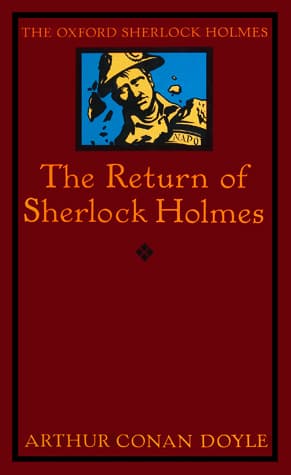
Arthur Conan Doyle (1903)
Genre
Historical Fiction / Mystery
Reading Time
480 min
Key Themes
See below
Sign in to track this book
After a three-year disappearance presumed fatal, Sherlock Holmes dramatically resurfaces, his return igniting a new era of thirteen perplexing cases, from deciphering cryptic dancing men to unmasking the assailant behind the shattered Napoleons.
Three years after his presumed death at Reichenbach Falls, Dr. Watson is called to investigate the murder of the Honourable Ronald Adair. While contemplating the case, an old bookseller visits Watson, who reveals himself to be Sherlock Holmes in disguise. Holmes explains how he faked his death to evade Professor Moriarty's network and spent the intervening years traveling and studying. He reveals that Moriarty's chief lieutenant, Colonel Sebastian Moran, is the murderer of Adair, having shot him with an air rifle because Adair discovered Moran cheating at cards. Holmes and Watson stake out an empty house opposite 221B Baker Street, where Moran attempts to assassinate Holmes. Holmes, using a wax bust as a decoy, outwits Moran, leading to his capture and the official re-establishment of Holmes's practice.
John Hector McFarlane, a young lawyer, is accused of murdering Jonas Oldacre, a builder who had recently made McFarlane his sole heir. McFarlane visited Oldacre's house the night before the alleged murder, and evidence points strongly against him. Holmes investigates and finds inconsistencies: the house is partially burned, a body is found, but the details don't add up. He discovers that Oldacre, a vindictive man, faked his own death and staged the fire to frame McFarlane, whose mother had jilted Oldacre years ago. Oldacre is found hiding in a secret compartment, and the case is resolved, clearing McFarlane's name and exposing Oldacre's elaborate revenge scheme.
Hilton Cubitt, a Norfolk squire, seeks Holmes's help regarding strange stick-figure drawings, or 'dancing men,' that appear around his estate, terrifying his American wife, Elsie. Elsie refuses to explain their origin, only saying they relate to her past. Holmes deduces the drawings are a cipher and painstakingly decodes them, realizing they are messages from an American gangster named Abe Slaney, whom Elsie knew in her past. Holmes races to Norfolk, but arrives too late to prevent tragedy: Cubitt is found dead, and Elsie is gravely wounded. Holmes deduces Slaney shot Cubitt, and Elsie, in a struggle, wounded herself. Slaney is apprehended and confesses to the murder, revealing Elsie's attempt to escape her criminal past.
Violet Smith, a young music teacher, consults Holmes about a strange man who consistently follows her on a bicycle during her weekend commutes. She also describes unusual behavior from her new employers, Mr. Carruthers and Mr. Woodley, who offered her a lucrative position after her uncle's death. Holmes investigates and discovers that Violet's uncle, Robert Smith, was actually her guardian, holding a large inheritance for her. Carruthers and Woodley are associates of her uncle's former partner, a villain named Williamson, who seeks to force Violet into marriage with Woodley to gain control of her fortune. Holmes intervenes, preventing the forced marriage, and Williamson and his accomplices are brought to justice, with Carruthers, who had genuinely grown fond of Violet, helping the police.
Dr. Thorneycroft Huxtable, the headmaster of the Priory School, enlists Holmes's aid in finding the Duke of Holdernesse's ten-year-old son, Lord Saltire, who has vanished along with a German master, Heidegger. Holmes and Watson travel to the school and discover a bicycle, a local inn, and a complex trail. Holmes eventually deduces that the Duke himself orchestrated the kidnapping to prevent his son from inheriting, favoring another child. It's revealed the Duke's estranged wife, the boy's mother, had another son with her first husband, and the Duke, in a fit of misguided loyalty and jealousy, tried to remove Lord Saltire from the line of succession. Heidegger was killed trying to protect the boy. The Duke is forced to confess, and Lord Saltire is safely returned.
Inspector Hopkins seeks Holmes's assistance in solving the gruesome murder of Peter Carey, known as 'Black Peter,' a retired whaling captain found harpooned to the wall of his cabin. The cabin, a separate hut on his property, was locked from the inside. Holmes examines the scene and discovers a tobacco pouch, a notebook, and a hidden compartment. He uses a ruse to attract a suspect, a young man named John Hopley Neligan, whose father disappeared years ago with valuable American railway bonds. Holmes deduces that Neligan, believing Carey knew of his father's fate and the bonds' location, confronted Carey. In a struggle, Neligan accidentally killed Carey with his own harpoon. Neligan confesses, revealing Carey's theft of the bonds and his father's subsequent ruin.
Holmes is hired by Lady Eva Blackwell to retrieve compromising letters from Charles Augustus Milverton, a blackmailer. Milverton demands an exorbitant sum, threatening to expose Lady Eva's past and ruin her upcoming marriage. Holmes, unable to reason with Milverton, resorts to breaking into his house with Watson. While hiding, they witness a woman, one of Milverton's previous victims, confronting and then shooting him dead. Holmes and Watson escape with Lady Eva's letters and burn Milverton's entire collection of compromising documents, ending his reign of terror. Holmes allows the police to pursue the unknown female assassin, maintaining his ethical stance against blackmail.
Inspector Lestrade brings Holmes a peculiar case: several plaster busts of Napoleon Bonaparte have been smashed across London. The first two were at a shop and a doctor's house, the third at a journalist's home, where the owner was also murdered. Holmes deduces that the perpetrator is not a maniac but is searching for something specific hidden within the busts. He links the busts to a common origin and traces them. He discovers that a valuable black pearl, the Borgia Pearl, was hidden inside one of the busts by an Italian criminal named Beppo, who had recently escaped prison. Beppo, trying to retrieve his hidden jewel, was smashing the busts. Holmes sets a trap, and Beppo is caught, confessing to the murder and the theft.
Mr. Hilton Soames, a tutor and lecturer at a university, consults Holmes after discovering that someone has broken into his office and copied parts of an examination paper for a Greek scholarship. The incident occurred shortly before the exam, and Soames suspects one of three students living on the same floor. Holmes investigates the room, finding clues like pencil shavings, clay, and a scratch on the desk. Through careful observation and deduction, he identifies the culprit as Daulat Ras, an Indian student, who was desperate to win the scholarship and had bribed a servant for access. Holmes confronts Ras, who confesses, and the scandal is contained, saving Soames's reputation and ensuring academic fairness.
Stanley Hopkins calls upon Holmes to investigate the murder of Willoughby Smith, Professor Coram's young secretary, who was found dead in the study with a golden pince-nez clutched in his hand. The study was locked from the inside. Holmes examines the scene, finding a lady's pince-nez, a hidden compartment, and other subtle clues. He deduces that the murder weapon was a knife and that the perpetrator was a woman. He identifies the woman as Anna, Professor Coram's estranged wife, a former Russian nihilist who had come to retrieve a compromising document hidden by her late brother, who was also a nihilist. Smith stumbled upon her, and she killed him in a panic. Anna is apprehended, and the dark secrets of her past are revealed.
Mr. Cyril Overton, a Cambridge rugby team captain, seeks Holmes's help in finding Godfrey Staunton, their star player, who has vanished just days before an important match. Staunton was last seen meeting a mysterious, shabbily dressed man. Holmes and Watson follow a trail from Cambridge to London, encountering strange characters and false leads. Holmes eventually deduces that Staunton was visiting a secluded cottage where his fiancée, who was terminally ill, was being cared for by a reclusive doctor. Staunton had kept their engagement secret due to his family's disapproval of her humble origins. The fiancée dies, and Staunton, grief-stricken, returns to the university, his secret revealed but his reputation intact.
Holmes and Watson are called to Abbey Grange, where Sir Eustace Brackenstall has been found murdered, apparently by burglars who also tied up his wife, Lady Brackenstall, and a maid. Holmes quickly finds inconsistencies in Lady Brackenstall's account, particularly regarding the knots used to bind her. He deduces that the 'burglary' was staged and that Lady Brackenstall's lover, Captain Croker, a former sea captain, was responsible for Sir Eustace's death. Sir Eustace was a brutal alcoholic who regularly abused his wife. Croker, enraged by the abuse, confronted and killed Sir Eustace. Holmes, sympathetic to Lady Brackenstall's plight, allows Croker to escape justice, arranging a scenario where the official report aligns with the staged burglary.
Lord Bellinger, the Prime Minister, and the Right Honourable Trelawney Hope, Secretary for European Affairs, consult Holmes regarding the theft of a crucial letter from Hope's dispatch box, which, if made public, could lead to war. The letter was stolen from a locked room, with Hope's wife, Lady Hilda Hope, being the only other person with access. Holmes suspects Lady Hilda is involved but struggles to find proof. He discovers that Lady Hilda had given the letter to a foreign agent, Eduardo Lucas, who was subsequently murdered. Holmes retrieves the letter from Lady Hilda, who confesses she took it to prevent an old indiscretion from being revealed by Lucas. Holmes, understanding the gravity, helps her restore the letter, averting a diplomatic crisis and war.
The Protagonist
Holmes returns from his 'death,' re-establishing his legendary status and proving his unparalleled intellect to a new era of crime.
The Supporting
Watson grapples with grief and loss, only to experience immense joy and renewed purpose with Holmes's unexpected return.
The Antagonist
Moran attempts to avenge Moriarty, only to be outsmarted and captured by the very detective he sought to kill.
The Supporting
Lestrade continues to be a reliable, if sometimes outmatched, presence in the face of complex crimes, consistently seeking Holmes's aid.
The Antagonist
Oldacre executes a complex revenge plot, only to be exposed and apprehended by Holmes.
The Supporting
Elsie's attempts to outrun her past fail, resulting in personal tragedy and the exposure of her secrets.
The Antagonist
Milverton's reign of terror through blackmail is abruptly ended by a vengeful victim.
The Antagonist
Beppo's elaborate plan to recover his stolen pearl is thwarted by Holmes, leading to his re-capture.
The Supporting
Lady Hilda's desperate attempt to hide a past secret inadvertently jeopardizes national security, but Holmes helps her resolve the crisis.
The Supporting
Driven by love and a sense of justice, Croker intervenes in a domestic abuse situation, leading to a murder that Holmes ultimately condones.
This collection explores the tension between legal and moral right. In 'The Abbey Grange,' Holmes allows Captain Croker to escape punishment for murder, considering it justifiable given Sir Eustace Brackenstall's abuse of his wife. Similarly, in 'Charles Augustus Milverton,' Holmes condones the blackmailer's murder and helps destroy his records, prioritizing the victims' protection over strict adherence to the law. This theme shows Holmes's personal ethics, which sometimes go beyond conventional legal boundaries.
“''I am not the law, and I am not here to administer justice in the ordinary sense. I am here to prevent a greater injustice.'”
Many stories in 'The Return of Sherlock Holmes' show how past actions, secrets, and relationships eventually affect individuals. Elsie Cubitt in 'The Dancing Men' tries to escape her criminal past, but the 'dancing men' messages from Abe Slaney bring it back, leading to tragedy. Jonas Oldacre in 'The Norwood Builder' plans an elaborate revenge plot based on a decades-old romantic slight. Even the sensitive 'Second Stain' involves Lady Hilda Hope's past indiscretion being used for blackmail. These narratives show that one's history, no matter how buried, can influence their present and future.
“'The past is like a pebble in a shoe. It may be small, but it can make the whole journey painful.'”
A recurring theme is that things are rarely as they seem; appearances can be misleading. In 'The Empty House,' Holmes's disguise as an old bookseller completely fools Watson, showing the power of outward presentation. 'The Norwood Builder' is built on a staged murder and a hidden perpetrator, where obvious evidence points to an innocent man. Even the seemingly random smashing of Napoleon busts in 'The Six Napoleons' hides a specific and valuable motive. Holmes's genius is seeing beyond the superficial to uncover the truth, often revealing that mundane or bizarre details hold the key to a deeper deception.
“'Data! Data! Data! I can't make bricks without clay.'”
This collection shows Holmes's deductive abilities and meticulous observation, which are central to his method. His ability to piece together insignificant details – a specific type of tobacco, an unusual knot, a scratch on a desk – into a coherent narrative of events is key to every case. In 'The Dancing Men,' Holmes deciphers a complex cipher, and in 'The Priory School,' he tracks a missing boy through subtle clues. This theme celebrates the triumph of intellect and rational thought over confusion and criminal cunning.
“'You see, but you do not observe.'”
Motives of revenge and retribution drive several plots. Jonas Oldacre's scheme in 'The Norwood Builder' is a direct act of revenge for a past slight. Colonel Moran's pursuit of Holmes in 'The Empty House' is fueled by a desire to avenge Moriarty. In 'Black Peter,' the discovery of the captain's killer reveals a desperate act born from a desire for retribution and answers about a father's ruin. These stories show how deep-seated grievances can lead to violent and complex criminal acts, often requiring Holmes to unravel layers of personal history to understand the true motive.
“'Revenge is a dish best served cold, and Oldacre had kept his simmering for many years.'”
A crime committed in circumstances that appear impossible, often with the room sealed from within.
Several stories in 'The Return of Sherlock Holmes' feature variations of the 'locked room' mystery. In 'The Empty House,' Ronald Adair is shot in a room with a closed window, seemingly without anyone entering or leaving, until Holmes reveals the air rifle. 'Black Peter' presents a cabin locked from the inside with the victim harpooned. 'The Golden Pince-Nez' also features a secretary murdered in a locked study. These scenarios allow Doyle to showcase Holmes's unique ability to find the logical, albeit often unexpected, explanation for seemingly impossible crimes, reinforcing his intellectual prowess.
Holmes's use of various guises to gather information or outwit criminals.
Disguise is a hallmark of Sherlock Holmes's methodology, and it is prominently featured in this collection. Most notably, Holmes's return in 'The Empty House' is marked by his elaborate disguise as an elderly bookseller, completely fooling Dr. Watson. He also uses disguise when investigating Charles Augustus Milverton. This device allows Holmes to move unnoticed in different social strata, gather intelligence directly, and confront criminals without revealing his true identity until the opportune moment, adding an element of theatricality and surprise to his investigations.
Characters provide accounts of events that are later revealed to be incomplete or deliberately false.
While Watson remains the reliable narrator of the overall story, many of the clients and witnesses Holmes encounters provide unreliable accounts of the events, either through omission, fear, or outright deception. Lady Brackenstall's staged account of the burglary in 'The Abbey Grange' is a prime example. Elsie Cubitt's withholding of information about her past in 'The Dancing Men' also drives the plot. This device creates layers of mystery that Holmes must peel back, highlighting the challenge of discerning truth from human testimony and demonstrating his skill in identifying inconsistencies.
Cryptographic messages used as a central puzzle for Holmes to solve.
The most prominent use of ciphers in this collection is in 'The Dancing Men.' The seemingly childish stick-figure drawings form a complex substitution cipher that Holmes must painstakingly decode. This device highlights Holmes's intellectual breadth beyond mere criminal investigation, showcasing his proficiency in linguistics and cryptography. The deciphering of the code is not just a plot point but the central mechanism through which the story's tragic backstory and present danger are revealed, demonstrating the power of hidden messages.
References to international espionage and political intrigue.
While not as central as in other Holmes stories, the 'Great Game' — the strategic rivalry between the British Empire and the Russian Empire for supremacy in Central Asia — subtly influences some narratives. 'The Second Stain' is a direct engagement with international espionage, where the theft of a crucial letter threatens to ignite a European war. 'The Golden Pince-Nez' also touches upon Russian nihilism and political secrets. These elements add a broader geopolitical context to some cases, reminding the reader that Holmes's work sometimes extends beyond domestic crime to matters of national and international security.
“When you have eliminated the impossible, whatever remains, however improbable, must be the truth.”
— Holmes explains his deductive method to Watson in "The Adventure of the Bruce-Partington Plans."
“I am the last and highest court of appeal in detection.”
— Holmes asserts his confidence in his abilities in "The Adventure of the Priory School."
“The game is afoot.”
— Holmes declares the start of an investigation in "The Adventure of the Abbey Grange."
“It is a capital mistake to theorize before one has data. Insensibly one begins to twist facts to suit theories, instead of theories to suit facts.”
— Holmes advises Watson on the importance of evidence in "A Scandal in Bohemia."
“The world is full of obvious things which nobody by any chance ever observes.”
— Holmes remarks on human perception in "The Adventure of the Dancing Men."
“I have a turn both for observation and for deduction.”
— Holmes describes his skills to a client in "The Adventure of the Solitary Cyclist."
“There is nothing more deceptive than an obvious fact.”
— Holmes warns against surface-level conclusions in "The Adventure of the Boscombe Valley Mystery."
“My mind rebels at stagnation. Give me problems, give me work, give me the most abstruse cryptogram, or the most intricate analysis, and I am in my own proper atmosphere.”
— Holmes expresses his need for intellectual stimulation in "The Adventure of the Bruce-Partington Plans."
“The little things are infinitely the most important.”
— Holmes emphasizes attention to detail in "A Case of Identity."
“I am a brain, Watson. The rest of me is a mere appendix.”
— Holmes downplays his physical self in favor of his intellect in "The Adventure of the Mazarin Stone."
“Education never ends, Watson. It is a series of lessons, with the greatest for the last.”
— Holmes reflects on lifelong learning in "The Adventure of the Red Circle."
“You know my methods, Watson. Apply them.”
— Holmes encourages Watson to think independently in "The Adventure of the Creeping Man."
“The most difficult crime to track is the one which is purposeless.”
— Holmes discusses criminal psychology in "The Adventure of the Norwood Builder."
“I have frequently gained my first real insight into the character of parents by studying their children.”
— Holmes shares an observation on human behavior in "The Adventure of the Copper Beeches."
Ready to see how well you understood this book? Take our interactive quiz with 10 questions.
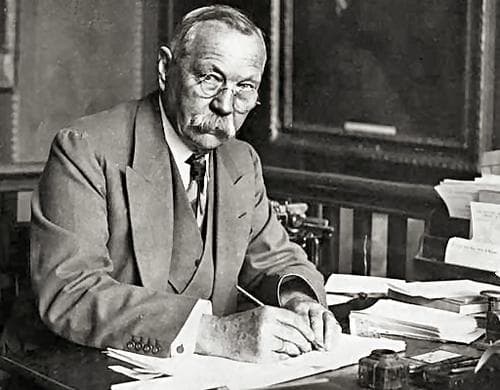
Sir Arthur Ignatius Conan Doyle was a British writer and physician. He created the character Sherlock Holmes in 1887 for A Study in Scarlet, the first of four novels and fifty-six short stories about Holmes and Dr. Watson. The Sherlock Holmes stories are milestones in the field of crime fiction.







