“I was sick—sick unto death with that long agony; and when they at length unbound me, and I was permitted to sit, I felt that my senses were leaving me.”
— The narrator describes his initial state after being sentenced by the Inquisition.

Edgar Allan Poe (2019)
Genre
Mystery
Reading Time
15 min
Key Themes
See below
Sign in to track this book
Trapped in the Spanish Inquisition, a condemned prisoner descends into madness as a pendulum swings closer and his cell walls close in.
The story begins with the narrator describing his trial and condemnation by the Spanish Inquisition in Toledo. He recounts the terrifying scene of his judges, their lips white, and the seven tall candles on the table looking like 'seven slender angels.' Overwhelmed by fear and his death sentence, he faints. He briefly wakes to hear the judges' voices and feels himself carried down into what he thinks is a tomb. He then faints again, waking to complete darkness and a deep sense of dread, unsure if he is dead or alive.
Upon fully waking, the narrator is in complete darkness, lying on a damp stone floor. He stretches out his arms, feeling masonry walls, and begins to explore his cell by shuffling along the perimeter. His first fear is that he might be buried alive, but he soon realizes the space is larger than a coffin. He tries to measure the circumference by walking, but becomes disoriented and trips, falling face-first. His chin lands on a damp, slimy edge, and he realizes he is at the edge of a deep, circular pit in the center of the dungeon, barely avoiding a fatal fall. The horror of the pit makes him faint again.
The narrator wakes from his second faint, now lying on a wooden framework, strapped down by long bandages that bind his limbs and body, leaving only his head free. He has an intense thirst and finds a pitcher of water and some spiced meat nearby, which he consumes before falling into a troubled sleep. Upon waking, he notices a faint light from a high crevice in the ceiling. Looking up, he sees a painted figure of Father Time holding a large, razor-sharp pendulum, which is slowly swinging and descending directly toward his chest. This deliberate torture fills him with a new, agonizing terror.
For days, the pendulum continues its slow descent, its sharp edge glinting and its hiss echoing in the chamber. The narrator measures its decreasing distance, knowing it will soon cut through his heart. He realizes the spiced meat he was given earlier has attracted many large, hungry rats from the pit. A desperate idea comes to him. He smears the remaining meat over the bandages that bind him, waiting patiently. As the pendulum's edge begins to graze his robe, the rats, drawn by the scent, swarm over him, gnawing at the greasy straps. They eventually cut them, allowing him to roll free just as the pendulum slices through the empty space where his chest had been.
Having barely escaped the pendulum, the narrator rises, bruised but alive. However, his relief is short-lived. He notices a strange, metallic glow from the walls, which begin to heat up and slowly, imperceptibly, move inward. The chamber, which he had first measured to be about fifty yards around, is now visibly shrinking, forcing him closer and closer to the central pit. The walls are covered with grotesque, fiery images of demons and skeletons, adding to the psychological torment. The air becomes stiflingly hot and metallic, and the walls' relentless movement speeds up, leaving him with less and less space.
The contracting walls continue their movement, pushing the narrator toward the fiery, glowing pit in the center of the cell. The intense heat from the metal walls becomes unbearable, making the air thick and suffocating. The horrific images painted on the walls seem to mock his coming death. With every inch the walls close, the pit's opening appears wider and more inviting, a terrifying choice to being crushed or burned alive. He is forced to the very edge of the abyss, looking into its depths, where he can see water gleaming and the rats he had used to escape the pendulum, now seemingly waiting for him.
With the walls pressing him toward the pit's edge, the narrator has no escape. He feels himself teetering, about to be forced into the fiery chasm. He lets out a final, desperate shriek. At that moment, he hears a loud blast of trumpets and human voices. The walls suddenly stop moving and then rapidly move back. A strong hand grabs his arm, pulling him back from the edge. General Lasalle, leading the French army, has captured Toledo, and the Inquisition's torture chambers are being freed. The narrator is saved from certain death at the last second.
The Protagonist
He transforms from a terrified, fainting victim into a resourceful survivor, only to be overwhelmed again by new horrors, until his last-second rescue.
The Antagonists
They remain static figures of oppressive power, their presence felt throughout the narrative as the source of the narrator's suffering.
The Mentioned
Static, symbolic representation of time and death.
The Supporting
They serve as a temporary means of escape, their role ending after severing the bonds.
The Supporting
Appears as a savior, representing liberation and the end of the Inquisition's reign.
The story is a study in psychological horror, focusing on the narrator's internal experience of terror. Poe details the narrator's changing fears: the dread of being buried alive, the claustrophobia of the dark cell, the slow agony of the approaching pendulum, and the terror of the contracting walls and the fiery pit. The uncertainty and gradual discovery of each new torment increase the psychological impact, making the reader feel the narrator's growing despair and mental anguish. The story has no supernatural elements, which makes the fear feel real.
“I was sick—sick unto death with that long agony; and when they at length unbarred the doors, and I became aware of a commotion without, I struggled to force myself up, but could not. My senses were leaving me. The sentence—the dread sentence of death—was the last of distinct accentuation which reached my ears.”
Despite facing torments that seem impossible to escape, the narrator consistently shows a strong will to survive. From his careful exploration of the dark cell to his clever use of the rats to escape the pendulum, he shows remarkable resourcefulness and determination. Even when pushed to despair and forced toward the pit, his final shriek is an act of defiance, a cry for life. This theme shows the resilience of the human spirit even when facing overwhelming odds and planned cruelty.
“My eye, however, had caught the faint glimmer of a far distant hope. I had been upborne by the thought of ultimately escaping by means of the pit itself.”
Time is not just a neutral passage, but an active instrument of torture. The slow, relentless descent of the pendulum shows this, extending the agony and allowing the narrator to carefully calculate his coming death. The painted figure of Father Time holding the scythe further shows this symbolic connection. The gradual nature of the torments—the slow discovery of the pit, the barely noticeable shortening of the pendulum's arc, the creeping movement of the walls—all use time to maximize psychological suffering, making waiting itself a form of pain.
“I saw that the pendulum was a gigantic scythe of steel, and that it was suspended from a beam of the ceiling by a single cord. It was already in motion, and it was descending!”
Poe uses sensory details to immerse the reader in the narrator's experience. The initial absolute darkness and silence give way to the dampness of the stone, the slimy edge of the pit, the metallic glint and hiss of the pendulum, the smell of the rats, and the suffocating heat of the contracting walls. The story moves between sensory deprivation (the initial darkness) and sensory overload (the heat, the glowing walls, the rats), each serving to increase the terror and disorientation. This focus on physical sensations makes the abstract horror of the Inquisition feel real.
“The blackness of eternal night encompassed me, and I felt around me for some clue to my fate.”
The story begins with the narrator's condemnation by the Spanish Inquisition for an unnamed crime. This lack of clarity shows injustice and arbitrary power. The Inquisition is a system that gives cruel punishment without clear cause, turning 'justice' into a terrifying, elaborate game of torture. The narrator's suffering is a result of institutionalized tyranny, where the victim is treated as less than human and subjected to calculated brutality. The rescue by the French army is a symbolic victory of external, more humane forces over such a system.
“I was sick—sick unto death with that long agony; and when they at length unbarred the doors, and I became aware of a commotion without, I struggled to force myself up, but could not. My senses were leaving me. The sentence—the dread sentence of death—was the last of distinct accentuation which reached my ears.”
Directly immerses the reader in the narrator's subjective experience of terror.
The entire story is told from the perspective of the unnamed narrator. This technique is crucial for building suspense and psychological horror, as it allows the reader to experience every fear, every thought, and every agonizing moment directly through his eyes and mind. We are privy to his disorientation, his calculations, his despair, and his surges of hope, making the terror deeply personal and immediate. The lack of an objective viewpoint intensifies the claustrophobic and subjective nature of his ordeal.
Each element represents a distinct form of existential dread and methodical torture.
The pit symbolizes the abyss of hell, eternal damnation, and the ultimate fall into nothingness. The pendulum represents the relentless, agonizing march of time towards an inevitable, gruesome death, a slow, mechanized fate. The contracting, heated walls symbolize claustrophobia, the crushing weight of oppression, and the inescapable closure of one's world. Together, these elements represent a progression of increasingly sophisticated and torturous methods designed to break the human spirit and ensure a horrific end, each targeting a different primal fear.
A sudden, unexpected intervention that resolves the seemingly inescapable conflict.
The sudden arrival of General Lasalle and the French army at the very last moment, just as the narrator is about to be forced into the pit, is a classic example of a deus ex machina. This plot device provides an abrupt and external resolution to a situation that the protagonist had no logical way of escaping on his own. While some critics view it as an artificial ending, it effectively highlights the absolute powerlessness of the individual against institutional cruelty and makes the relief of salvation all the more dramatic and unexpected.
Vivid descriptions of sights, sounds, and feelings to create an immersive, terrifying atmosphere.
Poe relies heavily on detailed sensory descriptions to make the narrator's ordeal palpable. The 'blackness of eternal night,' the 'damp, slimy stone,' the 'hiss' of the pendulum, the 'fiery eyes' of the painted demons, and the 'suffocating heat' of the walls all contribute to a vivid and horrifying mental image. This focus on sensory input, rather than supernatural elements, grounds the terror in a visceral reality, making the reader feel as though they are experiencing the dungeon's horrors alongside the narrator, amplifying the story's impact.
“I was sick—sick unto death with that long agony; and when they at length unbound me, and I was permitted to sit, I felt that my senses were leaving me.”
— The narrator describes his initial state after being sentenced by the Inquisition.
“The blackness of eternal night encompassed me.”
— The narrator awakens in complete darkness in his cell.
“I had swooned; but still will not say that all of consciousness was lost.”
— The narrator reflects on his semi-conscious state during torture.
“The sentence—the dread sentence of death—was the last of distinct accentuation which reached my ears.”
— The narrator recalls his sentencing by the Inquisition.
“I shrank from the glowing metal to the centre of the cell.”
— The narrator avoids the heated walls of his shrinking cell.
“Down—steadily down it crept.”
— The narrator observes the descending pendulum blade.
“For the moment, at least, I was free.”
— The narrator escapes the pendulum by smearing food on his bonds.
“The agony of suspense grew at length intolerable, and I cautiously moved forward, with my arms extended, and my eyes straining from their sockets, in the hope of catching some faint ray of light.”
— The narrator attempts to navigate his dark cell.
“I saw that the lips of the judges were white—whiter than the sheet upon which I trace these words—and thin even to grotesqueness; thin with the intensity of their expression of firmness—of immovable resolution—of stern contempt of human torture.”
— The narrator describes the judges during his sentencing.
“The vibration of the pendulum was at right angles to my length.”
— The narrator details the mechanics of the pendulum torture.
“I struggled no more, but the agony of my soul found vent in one loud, long, and final scream of despair.”
— The narrator resigns himself to death as the cell walls close in.
“The fiery walls rushed back! An outstretched arm caught my own as I fell, fainting, into the abyss.”
— The narrator is rescued by General Lasalle's forces at the last moment.
“I felt that I tottered upon the brink—I averted my eyes—”
— The narrator avoids looking into the pit in his cell.
“The thought came gently and stealthily, and it seemed long before it attained full appreciation; but just as my spirit came at length properly to feel and entertain it, the figures of the judges vanished, as if magically, from before me.”
— The narrator begins to lose consciousness after his sentencing.
Ready to see how well you understood this book? Take our interactive quiz with 10 questions.
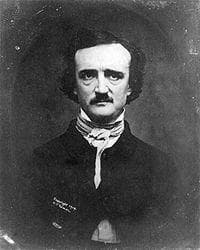
Edgar Allan Poe was an American writer, poet, editor, and literary critic who is best known for his poetry and short stories, particularly his tales of mystery and the macabre. He is widely regarded as a central figure of Romanticism in the United States, and of American literature. He was one of the country's earliest practitioners of the short story, and is considered the inventor of the detective fiction genre, as well as a significant contributor to the emerging genre of science fiction. He is the first well-known American writer to earn a living through writing alone, resulting in a financially difficult life and career.