BookBrief
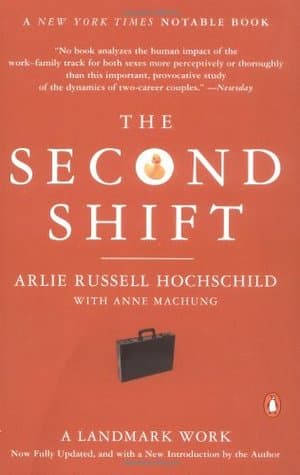
The Second Shift cover
Archivist's Choice

The Second Shift

Arlie Russell Hochschild (1989)

Genre

Relationships

Reading Time

8-10 hours

Key Themes

See below

Track Your Reading

Sign in to track this book

This book explores the hidden dynamics of dual-career homes, revealing how women still do most of the housework and childcare, even when they also work full-time.

Core Idea

Hochschild says that while many women now have jobs, men have not increased their share of housework and childcare. This creates a 'leisure gap' for women, who work an extra month of 24-hour days each year compared to men. The book shows how couples deal with this imbalance through 'gender ideologies' and 'family myths' that often hide or explain the unequal division of labor. This causes emotional stress, marital problems, and extra emotional work, mostly for women. Hochschild believes that individual solutions are not enough and that society and policy must change to achieve gender equity at home. Through detailed studies of dual-earner families, Hochschild shows how economic needs, cultural expectations, and personal desires shape home life. She explains that traditional gender roles continue even with women's increased financial independence. Both partners' 'economy of gratitude' and their adherence to 'gender ideologies' (traditional, egalitarian, or transitional) maintain these roles. The book discusses the unseen load of emotional work and the personal costs of the 'supermom' idea. It concludes that without a real redistribution of home duties and supportive public policies, gender equality will not be achieved.
Reading time
8-10 hours
Difficulty
Medium
✓ Read this if...
You are interested in the sociology of gender, family dynamics, work-life balance, or understanding the persistent inequalities within heterosexual dual-earner households. This book is essential for those seeking to understand the historical context and ongoing challenges of the 'second shift' and emotional labor.
✗ Skip this if...
You are looking for a prescriptive self-help book with quick solutions for household division of labor, or if you prefer a purely quantitative analysis without detailed qualitative case studies.

Core idea

The central argument and framework that powers the entire book.

Hochschild says that while many women now have jobs, men have not increased their share of housework and childcare. This creates a 'leisure gap' for women, who work an extra month of 24-hour days each year compared to men. The book shows how couples deal with this imbalance through 'gender ideologies' and 'family myths' that often hide or explain the unequal division of labor. This causes emotional stress, marital problems, and extra emotional work, mostly for women. Hochschild believes that individual solutions are not enough and that society and policy must change to achieve gender equity at home.

Through detailed studies of dual-earner families, Hochschild shows how economic needs, cultural expectations, and personal desires shape home life. She explains that traditional gender roles continue even with women's increased financial independence. Both partners' 'economy of gratitude' and their adherence to 'gender ideologies' (traditional, egalitarian, or transitional) maintain these roles. The book discusses the unseen load of emotional work and the personal costs of the 'supermom' idea. It concludes that without a real redistribution of home duties and supportive public policies, gender equality will not be achieved.

At a glance

Reading time

8-10 hours

Difficulty

Medium

Read this if...

You are interested in the sociology of gender, family dynamics, work-life balance, or understanding the persistent inequalities within heterosexual dual-earner households. This book is essential for those seeking to understand the historical context and ongoing challenges of the 'second shift' and emotional labor.

Skip this if...

You are looking for a prescriptive self-help book with quick solutions for household division of labor, or if you prefer a purely quantitative analysis without detailed qualitative case studies.

Key Takeaways

1

The Stalled Revolution

Women's entry into the workforce didn't translate to gender equality at home.

Quote

The stalled revolution is the situation of women having moved into the economy, but men having not moved into the home.

Hochschild created the term 'stalled revolution' to describe the ongoing imbalance in home labor even though many women now have paid jobs. Women started careers outside the home, often out of financial need or for personal satisfaction, but men mostly kept their traditional roles. This meant women took on a 'second shift' of housework and childcare after their jobs. This was not just about personal choice; it was a systemic failure of society and culture to adjust to dual-earner homes. The revolution stalled because the public sphere...

Supporting evidence

Hochschild's extensive interviews with 50 dual-earner couples over several years revealed a consistent pattern where women, regardless of their professional status, performed the majority of domestic tasks and childcare.

Apply this

Couples must actively and explicitly negotiate the division of labor, challenging ingrained assumptions about gender roles rather than passively falling into traditional patterns. Employers could also support this by promoting flexible work arrangements for both parents.


2

The Economy of Gratitude

Fairness in domestic labor is often measured by perceived effort and appreciation, not just hours.

Quote

The economy of gratitude is a way of saying that even if I do more, I still feel good about what you do, if I feel appreciated.

Hochschild noticed that couples do not always judge fairness only by how many hours are spent on chores. Instead, a 'moral economy of gratitude' often works, where partners evaluate their contributions and sacrifices based on perceived effort, appreciation, and emotional support. A wife might do much more housework but feel less upset if her husband truly recognizes her efforts and shows thanks, or if he does a task she especially dislikes. On the other hand, even a seemingly equal division could feel unfair if one partner feels unapp...

Supporting evidence

One couple, Nancy and Evan Holt, exemplified this. Nancy did the vast majority of housework, but because Evan was attentive and praised her efforts, she felt less exploited than other women whose husbands did more but were less appreciative.

Apply this

Couples should cultivate explicit expressions of gratitude and recognition for each other's contributions, both inside and outside the home. Don't just divide tasks; acknowledge the effort and care involved in performing them.

3

Gender Ideologies and Family Myths

Couples create narratives to justify their unequal division of labor.

Quote

A 'family myth' is a version of reality that obscures a truth, in order to manage a contradiction.

To deal with the conflict between equal ideals and unequal home realities, many couples create 'family myths.' These are shared, often unconscious, stories that change or downplay the actual division of labor, making it seem fairer or more 'natural' than it is. These myths often come from deep-seated gender ideas about who is 'naturally' better at certain tasks or who 'needs' more rest. For example, a couple might believe the husband 'helps out' when he sometimes washes dishes, even if the wife does 90% of the household chores. These ...

Supporting evidence

The Holts, again, are a prime example. They maintained a myth that Nancy 'loved' being at home, when in reality, she felt overwhelmed by the domestic burden. Evan's belief that he 'helped out' masked the vast imbalance.

Apply this

Couples should regularly and honestly assess the actual division of labor, perhaps by tracking tasks for a week. Challenge assumptions and 'myths' by asking: 'Is this truly fair, or are we telling ourselves a story to avoid discomfort?'

4

The 'Leisure Gap' and Time Poverty

Women often face a significant deficit in free time compared to their male partners.

Quote

For women, the total amount of time spent on work – paid and unpaid – was often fifteen hours more per week than for men.

One of the clearest results of the second shift is the 'leisure gap.' Hochschild's research showed that women, on average, worked many more total hours per week (combining paid work and home labor) than men. This difference meant women had less free time for hobbies, rest, socializing, or just relaxing. This lack of time affects women's mental and physical health, their career progress, and their overall quality of life. It is not just about doing more chores; it is about having less time for personal renewal and growth, leading to co...

Supporting evidence

Quantifiable data from time-use studies within the book's couples consistently showed women working an 'extra month' of twenty-four-hour days per year compared to men, if domestic labor was counted.

Apply this

Couples must prioritize and actively schedule leisure time for both partners, ensuring that one partner isn't consistently sacrificing their rest and personal time for the other's. This might involve outsourcing tasks or setting clear boundaries around work.

5

Emotional Labor as the 'Third Shift'

Women disproportionately manage the emotional well-being of the family.

Quote

Women often became the 'kinkeepers' and 'emotion managers,' responsible for the family's emotional life and social connections.

Beyond the paid 'first shift' and the home 'second shift,' many women also do a 'third shift' of emotional labor. This includes managing family relationships, remembering birthdays, planning social events, solving conflicts, comforting children, and generally making sure the family is emotionally stable. This work is often unseen, undervalued, and emotionally draining, but it is important for family function. While men might 'help out' with specific tasks, the mental load of anticipating and arranging the family's emotional and social...

Supporting evidence

Hochschild observed wives consistently taking on the role of 'family therapist,' managing their husbands' emotions, and acting as the primary point person for children's emotional needs, even when exhausted.

Apply this

Partners should explicitly discuss and share the emotional labor of the household. This means not just 'doing' tasks, but also 'remembering' and 'planning' them, and actively engaging in family emotional regulation.

6

The 'Supermom' Ideal and Its Costs

Societal pressure pushes women to excel in both career and domestic roles, leading to burnout.

Quote

The Supermom is a cultural ideal, not a realistic description of women's lives.

The expectation for women to succeed in their careers, keep a perfect home, raise ideal children, and be an attentive partner creates the 'Supermom' ideal. This impossible standard is a direct result of the stalled revolution, where women have entered public life without a similar change in home expectations. Trying to achieve this ideal causes chronic stress, exhaustion, and often, a feeling of failure, as no one can truly do well in all these areas without a high personal cost. It is a societal trap that makes a systemic problem see...

Supporting evidence

Many women in the study expressed feeling constantly overwhelmed and guilty, struggling to meet perceived expectations in both their professional and personal lives, often sacrificing sleep and personal well-being.

Apply this

Reject the Supermom ideal. Prioritize well-being over perfection. Be willing to let some things go, outsource tasks, or explicitly negotiate lower standards for domestic perfection with your partner.

7

The Role of Employers and Public Policy

Societal structures largely fail to support dual-earner families.

Quote

The workplace has not adapted to the reality of the two-job family.

Hochschild says that the burden of the second shift is not only a private problem for couples but a societal failure. Employers often assume that employees (implicitly, male employees) have a full-time, unpaid domestic partner managing their home lives. This leads to rigid work schedules, limited parental leave for fathers, and a lack of affordable childcare. Public policy also lags, offering little support for working families. Until workplaces become more flexible and family-friendly for both parents, and until governments invest in...

Supporting evidence

The struggles of couples to manage sick children, inflexible work hours, and the lack of affordable, quality childcare were recurring themes in the interviews, highlighting systemic rather than individual failures.

Apply this

Advocate for and support policies like paid parental leave for both parents, affordable universal childcare, flexible work arrangements, and a cultural shift in workplaces that values work-life balance for all employees.

8

The Potential for Change (and its limits)

While some progress has been made, fundamental shifts are still needed.

Quote

The hopeful side is that men are doing more than they used to, but the less hopeful side is that women are still doing the lion's share.

Fifteen years after it first came out, Hochschild notes that while there have been small changes – men generally do more housework and childcare than in past generations – the basic imbalance remains. The 'stalled revolution' has not fully unstalled. This suggests that individual efforts by couples, while important, are not enough to overcome deep-seated gender roles and societal structures. Real equality needs not just men 'helping out' more, but a complete rethinking of gendered expectations, a change in how work is structured, and ...

Supporting evidence

The updated introduction reflects on contemporary data, acknowledging some shifts in men's contributions but emphasizing the enduring 'second shift' burden on women globally.

Apply this

Recognize that individual efforts are part of a larger systemic issue. While negotiating within your relationship is crucial, also engage in advocacy for broader societal and policy changes that support equitable family structures.

Critical analysis

Notable Quotes

The second shift is the extra month of work women do each year if you add up the extra hours they put in at home.

Defining the central concept of the book

Women have not just one job but two: the first shift at the office or factory, and the second shift at home.

Explaining the dual burden on working women

The stalled revolution: women have gone into the workforce, but men have not come into the home.

Describing the societal imbalance in domestic responsibilities

The 'economy of gratitude' is the unspoken accounting system in marriages where partners measure who does more and who appreciates it less.

Introducing the concept of emotional labor in relationships

Men who share the second shift often become more emotionally involved with their children and happier in their marriages.

Highlighting benefits of equitable division of labor

The 'myth of the traditional family' obscures how much work women have always done.

Challenging nostalgic views of family life

Women's 'leisure' is often spent doing household chores or caring for children.

Questioning the concept of free time for women

The 'gender strategy' is how individuals reconcile their beliefs about gender with the reality of their daily lives.

Explaining personal adaptations to societal expectations

When men do housework, they are often 'helping' their wives rather than sharing responsibility.

Critiquing the framing of men's domestic contributions

The 'time bind' affects women more severely as they juggle multiple roles with insufficient hours.

Describing the pressure of competing demands

Marriages thrive when both partners feel their contributions are recognized and valued.

Emphasizing the importance of mutual appreciation

Children learn gender roles by observing who does what in the household.

Discussing the intergenerational transmission of norms

The 'revolution' in women's lives has not been matched by a corresponding revolution in men's lives.

Summarizing the book's central argument about incomplete social change

Women's sense of entitlement to leisure and shared domestic work is a key factor in achieving balance.

Identifying psychological barriers to change

Quiz

Test Your Knowledge

Ready to see how well you understood this book? Take our interactive quiz with 10 questions.

10
Questions
~5
Minutes
?
Best Score

Key Questions (FAQ)

The book examines how dual-career households manage domestic responsibilities, revealing that women often perform a disproportionate share of childcare and housework despite working outside the home—a phenomenon Hochschild terms 'the second shift.'

About the author

Arlie Russell Hochschild

Arlie Russell Hochschild is a renowned sociologist and author. Her seminal work, 'The Second Shift,' pioneered the study of the "second shift" phenomenon, highlighting the unequal distribution of domestic labor. Hochschild's research, often utilizing in-depth interviews and ethnography, explores the emotional dynamics of work and family life, earning her a distinguished career and significant academic recognition.