“Why do you always wear black?”
— Masha's characteristic attire.

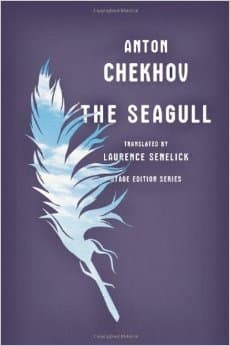
Sign in to track this book
At a lakeside country estate, artistic hopes, unrequited love, and a sad search for meaning intertwine, ending in a young woman's shattered dreams and a tragic echo.
The play starts at Sorin's country estate. Konstantin Treplev, a young writer, prepares to stage an experimental play he wrote. Nina Zarechnaya, an innocent young woman from a nearby estate and Konstantin's love interest, stars in it. The audience includes Konstantin's mother, the famous actress Irina Arkadina, her lover, the writer Boris Trigorin, and other residents like the sad Masha, the schoolteacher Medvedenko, and the estate manager Shamrayev with his wife Polina. Konstantin wants his mother's approval, but Arkadina's cynical remarks and Trigorin's disinterest interrupt the performance. Konstantin abruptly ends the play, frustrated and humiliated. Nina, however, is fascinated by Trigorin's literary fame.
After the disastrous play, the characters walk the grounds, showing their connected desires and unrequited loves. Masha tells Medvedenko, who loves her, that she loves Konstantin. She rejects Medvedenko, saying her heart belongs to Konstantin. Polina, Shamrayev's wife, expresses her long-standing affection for Dr. Dorn, who remains distant. Konstantin, still upset by his mother's criticism, tries to give Nina a dead seagull he shot, symbolizing his broken dreams and unrequited love. Nina, though, is increasingly drawn to Trigorin's charm and literary world, mostly ignoring Konstantin's gesture.
Nina actively seeks Trigorin, expressing her admiration for his writing and her own dream of becoming an actress. Trigorin, at first uninterested, is flattered by her youthful energy. He talks to her about how demanding and often unfulfilling a writer's life is, comparing it to a constant, inescapable obsession. This conversation further strengthens Nina's idealization of him. Meanwhile, Arkadina, aware of the growing connection, becomes subtly jealous and possessive of Trigorin, though she tries to act casual. Konstantin watches this developing bond with increasing despair and jealousy.
Overwhelmed by his mother's lack of support, Nina's growing affection for Trigorin, and his own perceived failures as a writer, Konstantin tries to kill himself by shooting himself. The shot is heard, causing panic. Dr. Dorn attends to him, revealing the wound is minor. This dramatic act shocks the characters, especially Arkadina, into momentary concern, but it does little to solve Konstantin's deep insecurities or change the romantic dynamics. Arkadina quickly returns to her self-absorbed nature, and Nina remains focused on Trigorin, seeing Konstantin's act as a sign of his instability.
Trigorin, interested in Nina's youth and adoration, considers leaving Arkadina. He tells Nina his feelings and even thinks about staying at the estate. However, Arkadina, sensing his hesitation, uses her charm and their long relationship to persuade him to return to Moscow with her. She appeals to his loyalty and their shared professional life, reminding him of the comforts and stability she provides. Trigorin, though briefly tempted by Nina's fresh passion, lacks the will to break free and ultimately gives in to Arkadina's influence, promising to meet Nina in Moscow later.
Two years pass. The setting is now the inside of Sorin's house, in a bleak winter landscape, reflecting the characters' emotional state. Sorin's health has worsened; he is in a wheelchair, constantly complaining about his life. Masha married Medvedenko out of resignation but remains deeply unhappy and still longs for Konstantin. Konstantin has achieved some small literary success, but he is still troubled by self-doubt and loneliness. He continues to live on the estate, isolated and sad, finding little joy in his achievements.
Nina unexpectedly returns to the estate. Her dreams of becoming a famous actress are gone; she is now a struggling, minor performer, often mocked. Her affair with Trigorin ended badly: he returned to Arkadina, and their child died. She is a shadow of her former self, matured and hardened by her experiences, but still holding on to her artistic hopes. She has suffered greatly, personally and professionally, and her return means a desperate search for comfort or a final goodbye to her past self.
Konstantin and Nina meet in the same room where his play was performed. Nina, though physically present, seems distant and somewhat confused, repeating lines from Konstantin's old play and insisting she is a seagull. She speaks of her suffering and her continued belief in art, despite her personal failures. Konstantin tries to offer comfort and renewed love, but Nina, though acknowledging his steady affection, remains focused on Trigorin and her own artistic struggles. Their conversation is full of unspoken regrets and the deep sadness of their separate paths, showing their inability to truly connect.
After their emotional meeting, Nina abruptly leaves the estate, disappearing into the winter night. Her departure leaves Konstantin in deep despair and loneliness. He must deal with his unrequited love, the failure of his artistic hopes, and the realization that Nina, despite her suffering, is still emotionally unavailable to him. Her final words and her continued attachment to Trigorin deal a final blow to his already fragile mind, pushing him further into his sad existence.
Soon after Nina leaves, a gunshot is heard from Konstantin's study. Dr. Dorn, realizing what happened, quickly investigates. He returns to inform Trigorin, Arkadina, and the others, who are playing bingo, that Konstantin has shot himself. Dorn quietly tells Trigorin to find a way to get Arkadina out of the room so she doesn't immediately discover her son's suicide, sparing her the immediate shock and grief. The play ends with the characters' lives continuing, unaware of the full weight of the tragedy, showing life's indifference to individual suffering.
The Protagonist
Konstantin begins as an idealistic, if volatile, artist, but his repeated failures in love and art lead to profound despair and ultimately, suicide.
The Protagonist/Love Interest
Nina transforms from an idealistic ingénue to a suffering, yet resilient, woman, marked by tragedy but still clinging to her artistic dreams.
The Antagonist/Supporting
Arkadina remains largely static, her self-absorption and possessiveness unchanged, continuing her theatrical life despite the tragedies around her.
The Supporting
Trigorin briefly considers a new path with Nina but ultimately returns to his comfortable, established life with Arkadina, unchanged by the emotional turmoil he causes.
The Supporting
Dorn remains a constant, detached observer, offering wisdom but never fully engaging in the emotional chaos, solidifying his role as a philosophical bystander.
The Supporting
Sorin's health steadily declines throughout the play, mirroring his unfulfilled life and eventual physical decay, ending in a state of chronic illness.
The Supporting
Masha begins as a figure of unrequited love and ends as a resigned, unhappy wife, solidifying her fate of quiet suffering.
The Supporting
Medvedenko achieves his goal of marrying Masha but remains an unhappy, complaining figure, his personal life mirroring his professional struggles.
The Supporting
Shamrayev remains a static character, his boorishness and obsession with theatre anecdotes unchanged throughout the play.
Most characters in 'The Seagull' experience some form of unrequited love or deep unfulfilled desire, creating a constant sadness. Masha loves Konstantin, Konstantin loves Nina, Nina loves Trigorin, and Medvedenko loves Masha. Polina loves Dorn, and even Sorin regrets his unfulfilled dreams. This theme is central to the play's tragic core, as characters constantly yearn for what they cannot have, leading to suffering and resignation. Konstantin's desperate love for Nina, who is focused on Trigorin, is the clearest example, directly leading to his ultimate despair.
“I love, I love, I am in despair!”
The play explores different views on art and the challenges artists face. Konstantin represents the new, seeking new forms, while Arkadina and Trigorin embody traditional, commercially successful art. Konstantin's fight for artistic acceptance, his mother's dismissal of his work, and Nina's disappointment with the harsh reality of theater show the often brutal nature of artistic life. The play questions what 'true' art is and the sacrifices artists make, often without recognition or success, as seen in Nina's sad journey.
“We need new forms. New forms are needed, and if there are no new forms, then it's better to have nothing at all.”
There is a tension between the older generation (Arkadina, Trigorin, Shamrayev) and the younger generation (Konstantin, Nina, Masha). The older characters are mostly happy with established artistic forms and social norms, often dismissing the younger generation's hopes. Konstantin's experimental play is met with Arkadina's scorn, symbolizing this clash. Nina's initial admiration for Trigorin, followed by her disappointment, also reflects a struggle to navigate the values of both generations. This conflict highlights the difficulty of creating new paths in a world resistant to change.
“I find these new forms quite incomprehensible. It's not that I don't want to understand them, but I just can't.”
Many characters are drawn to the perceived glamour of fame and success, only to find it empty or out of reach. Nina's idealized view of Trigorin's life and her dream of becoming a famous actress are shattered by the harsh realities of her affair and the struggles of a provincial actress. Trigorin himself, despite his fame, talks about the burden and emptiness of his success. Arkadina holds on to her fading fame with vanity and insecurity. The play shows that outward success and public admiration often hide inner turmoil, loneliness, and a lack of true happiness, especially for those who pursue it blindly.
“My life is a continuous, unbroken chain of mistakes.”
The natural setting of the lake and changing seasons often serve as a background to the human drama, yet they remain mostly indifferent to the characters' suffering. The beautiful summer evening gives way to a bleak winter, reflecting the characters' emotional decline, but nature itself offers no comfort or help. The dead seagull, symbolizing Konstantin's broken spirit and Nina's tragic fate, is a stark image of vulnerability against an unfeeling world. This theme suggests that individual human suffering often happens within a larger, impersonal universe, highlighting the characters' powerlessness against their destinies.
“I am a seagull. No, that's not it. I am an actress.”
A potent symbol of innocence, freedom, destruction, and artistic aspiration.
The dead seagull shot by Konstantin and presented to Nina is a central symbolic device. Initially, it represents Konstantin's love for Nina and his desire to capture and possess her, as well as his own artistic vulnerability. Later, Nina identifies herself as the seagull, first as a free spirit, then as one 'shot down' and ruined by Trigorin, mirroring her own tragic fate and the destruction of her innocence and dreams. It also symbolizes Konstantin's own artistic spirit, which is ultimately 'shot down' by his environment, leading to his suicide.
Konstantin's experimental play highlights generational conflict and artistic ideals.
Konstantin's experimental play, performed in Act I, serves several crucial functions. It immediately establishes his artistic aspirations and his desire to break from conventional forms, contrasting sharply with Arkadina's traditional views. The play's abstract, symbolic nature reflects Konstantin's inner turmoil and his yearning for a new artistic language. Its disastrous reception, primarily due to Arkadina's mocking, precipitates Konstantin's emotional breakdown and highlights the profound generational and artistic divide that drives much of the drama.
A complex web of one-sided affections driving character motivations and conflict.
The pervasive network of unrequited love – Masha loves Konstantin, Konstantin loves Nina, Nina loves Trigorin, Medvedenko loves Masha, Polina loves Dorn – is a fundamental plot device. This intricate web ensures that characters are constantly yearning for someone who does not return their affection, creating perpetual tension, jealousy, and despair. It prevents any character from finding true happiness and directly fuels the tragic outcomes, particularly Konstantin's suicide, stemming from Nina's ultimate rejection and indifference to his love.
A symbolic backdrop reflecting emotional states and the vastness of nature.
The lake, visible from Sorin's estate, serves as a significant backdrop. In Act I, it represents a place of romantic possibility and artistic inspiration for Konstantin and Nina. However, as the play progresses and the characters' lives unravel, the lake takes on a more melancholic quality, reflecting the characters' isolation and the vast, indifferent nature of the world. It is the setting for Konstantin's play, the place where the seagull is shot, and a constant, unchanging presence against the turbulent human emotions unfolding beside it.
“Why do you always wear black?”
— Masha's characteristic attire.
“People eat, drink, dress, and kill themselves.”
— Trigorin's cynical observation about life.
“One must paint life not as it is, not as it ought to be, but as it appears in dreams.”
— Konstantin's artistic philosophy.
“I am a seagull... No, that's not it. I am an actress.”
— Nina's confusion and eventual clarity about her identity.
“I love him, I love him, I love him... I love him to despair!”
— Masha's fervent confession of love for Konstantin.
“My play is finished. I have written it.”
— Konstantin's pride in completing his experimental play.
“I am dying of love for you.”
— Medvedenko's declaration to Masha.
“The stage is holy ground.”
— Arkadina's belief in the sanctity of theatre.
“We need new forms. New forms are needed, and if there are no new forms, then nothing is needed.”
— Konstantin's passionate plea for artistic innovation.
“I will be a seagull... No, that's not it. I am an actress.”
— Nina's famous lines reflecting her journey and transformation.
“You can't be an artist without having a public.”
— Trigorin's practical view on the necessity of an audience.
“Happiness does not exist, and there is no need for it.”
— Dorn's philosophical musing.
“I used to be so happy, but now I'm just an ordinary woman.”
— Arkadina's lament about her fading youth and status.
“I am a perfectly ordinary, commonplace man.”
— Trigorin's self-deprecating assessment.
Ready to see how well you understood this book? Take our interactive quiz with 10 questions.

Anton Pavlovich Chekhov was a Russian playwright and short-story writer who is considered to be one of the greatest writers of all time. His career as a playwright produced four classics, and his best short stories are held in high esteem by writers and critics. Along with Henrik Ibsen and August Strindberg, Chekhov is often referred to as one of the three seminal figures in the birth of early modernism in the theatre. Chekhov was a physician by profession. "Medicine is my lawful wife", he once said, "and literature is my mistress."

Ashley Antoinette
4.6

Mark McDonald
4.4
Luo Guanzhong
4.4

Mia McKenzie
4.3
Dorothy Parker
4.3

Joaquim Maria Machado de Assis
4.3

James Thurber
4.2

Terry Kay
4.2