“All knowledge was blotted out. We were in a new world, a primitive world, and we had to learn to live again.”
— Granser reflecting on the immediate aftermath of the Scarlet Plague.

Jack London (1910)
Genre
Science Fiction
Reading Time
90 min
Key Themes
See below
Sign in to track this book
Sixty years after a plague reclaims the world, an old man, the last link to a forgotten civilization, tries to tell his savage, ignorant descendants about the past.
The story begins with James Howard Smith, called Granser, a very old and weak man, with his three grandsons – Edwin, Hoo-Hoo, and Hare-Lip – walking through a wild, overgrown area near what was San Francisco. The grandsons are wild, uneducated, and barely understand the 'old time' before the Red Death. Granser, the last person to remember that civilization, tries to tell them about the wonders of a technologically advanced past, like houses, cities, and machines. They say his stories are 'lies' or 'dreams,' unable to imagine a world beyond their current hunter-gatherer life. Granser, feeling the weight of lost knowledge, is sad about their ignorance and humanity's decline.
Granser starts to tell about his life before the plague, specifically the year 2012. He was an English literature professor at a university and describes a world with great wealth, scientific progress, and social classes. He explains how society was strictly divided, with 'the people of the abyss' – the working class – living in poverty, while a 'handful of great capitalists' controlled everything. He remembers the luxury and intellectual pursuits of his life, a sharp contrast to his grandsons' current squalor and illiteracy. This detailed past description shows how much was lost and how little his audience understands.
Granser talks about the first news of a new disease, the 'Scarlet Plague,' appearing in New York. At first, people thought it was a small outbreak, but its fast spread and terrible symptoms soon became clear. The disease caused a red rash, then a coma, and death within hours, sometimes minutes. He describes the initial disbelief and casual attitude of people, which soon turned into widespread panic as more people died. Governments and doctors could do nothing, and the infection's speed was unheard of, stopping all attempts to control or cure it. The world was about to collapse, though few knew it yet.
The Scarlet Plague quickly overwhelms society. Granser vividly describes law and order breaking down, as police and government workers die from the disease. Streets fill with the dead and dying, and mobs of desperate people loot, riot, and commit terrible acts. He remembers seeing people drop dead in the streets, carriages full of bodies, and all public services stopping. Civilization's thin layer quickly disappears, showing the brutal instincts underneath. Granser, caught in the growing chaos, tries to understand the unprecedented breakdown around him, as his world falls apart.
Amid the rising panic, Granser, then James Howard Smith, sees San Francisco completely collapse. He sees a rich man, Mungerson, die instantly in his carriage, and his wife and children quickly follow. Desperate to survive, Granser joins a small group trying to escape the city in a car. This group includes a millionaire, a Senator, and other wealthy people. Their journey is dangerous; they find more dead bodies, abandoned cars, and the terrifying reality that the plague is everywhere. The car eventually breaks down, forcing them to leave it and walk, deeper into the wild.
As the small group of survivors travels away from the city, the Scarlet Plague continues to kill. Granser tells how group members die one by one, often suddenly and horribly. He describes the fear, the desperation, and the growing realization that humanity is dying out. He sees a mother and child die, and the millionaire and Senator also become victims. In the end, only Granser and a few others remain, alone and trying to find food and shelter. The world has become a huge graveyard, and the survivors are left to deal with the great silence and emptiness of a world without most people.
After the initial destruction, Granser describes how the few remaining survivors, spread across the land, started to form small, basic communities. He tells about meeting different groups: the Cholo, the Chinese, and the 'English-speaking' survivors, often defined by their past social status. He notes how quickly language and knowledge disappeared, as children born after the plague grew up without education or memories of the old world. These groups were often hostile, fighting for resources, and quickly dropped civilized manners, turning to tribalism and violence. Granser himself struggled to adapt to this new, brutal reality.
Granser describes how he eventually joined a group of survivors. Through a series of events, including fights with other new tribes, he found his mate, Vesta, and started a family. He details the harsh reality of this new life: hunting for food, living in simple shelters, and always watching out for other desperate humans. He remembers trying to teach his children and grandchildren about the 'old time,' but their minds, shaped by the wild, did not take it in. His current grandsons, Edwin, Hoo-Hoo, and Hare-Lip, are direct descendants of this new, primitive line, showing the complete loss of the former civilization.
As the day ends, Granser finishes his story, his voice weak with tiredness and sadness. He looks at his grandsons, who are more interested in finding grubs and fighting than his tales of a lost world. He regrets the irreversible loss of knowledge, art, and science. He knows he is the last holder of that vast human achievement, and when he dies, it will be gone forever. The boys' lack of understanding and primitive behavior show humanity's complete regression. Granser sees that mankind's future, as shown by his grandsons, is one of ignorance and barbarity, far from the past's glories.
The story ends with Granser's grandsons, completely unaffected by his deep tale, returning to their basic instincts. Edwin, the most observant, asks about some details but ultimately thinks the 'old time' is not important to their current fight for survival. Hoo-Hoo and Hare-Lip are even more dismissive, focused only on immediate wants and the hunt. They find a small animal and kill it; their actions contrast sharply with Granser's memories of a civilized world. The final scene shows the sad irony: the last man who remembers civilization is surrounded by its savage inheritors, who do not want or cannot reclaim it, sealing humanity's regressed fate.
The Protagonist
From a cultured professor, he became a survivor in a brutal world, and ultimately, a lonely oracle trying to preserve a lost legacy.
The Supporting
Remains largely primitive, but briefly grapples with concepts beyond immediate survival.
The Supporting
Remains static in his primitive, uncurious state.
The Supporting
Remains static, a symbol of humanity's savage reversion.
The Mentioned
Dies at the onset of the plague, symbolizing the end of the old order.
The Supporting
Helps establish Granser's new family line in the primitive world.
The Mentioned
Dies during the escape, symbolizing the collapse of political authority.
The Mentioned
Dies during the escape, symbolizing the collapse of economic power.
The Mentioned
Represents one of the emergent, violent tribes in the post-plague world.
The Mentioned
Represents one of the emergent, distinct tribes in the post-plague world.
The novel shows how quickly and completely civilization can collapse during a major disaster. Granser's descriptions of San Francisco's fast descent into chaos—looting, murder, and services breaking down—show how fragile human society's order is. The quick return to tribalism, violence, and ignorance among survivors shows that civilization is not natural but a delicate structure needing complex social systems, which can disappear in days. The loss of art, science, and education further highlights this fragility.
“And the Scarlet Death, in a space of a few months, had accomplished a retrogression of ten thousand years.”
A main theme is the sad loss of human knowledge and language. Granser, an English professor, tries hard to explain 'old time' ideas to his grandsons, who cannot understand things like books, cities, or even abstract numbers. Their language is simpler, focused on immediate needs, and their understanding is limited by their primitive life. This intellectual decline is worse than the physical deaths, as it means the permanent loss of human achievement and future generations' inability to build on the past. The meaning of words like 'money' or 'government' is gone.
“It was impossible for them to understand. I could not make them understand.”
London criticizes the extreme social class divisions of the pre-plague world. Granser describes a society split between a rich elite and the poor 'people of the abyss.' The plague, however, kills people from all social levels without distinction, from millionaires to the working poor. While the rich might have led initial escape attempts, their wealth did not protect them. In the post-plague world, social differences are gone, replaced by a brutal survival system. This shows how unimportant man-made hierarchies are when faced with a natural disaster.
“There were two great divisions in society, the people of the abyss and the people of the sun.”
The novel looks at human nature, asking if civilization is just a thin cover over basic savagery. The fast descent into looting, violence, and tribalism when the plague started suggests that humans, without social rules, quickly go back to basic instincts. Granser's grandsons, completely without culture or education, show this raw, unrefined human nature. The book implies that without civilization's institutions, humanity tends towards ignorance, brutality, and a constant fight for survival, rather than aiming for higher goals.
“Man had been everything, was everything, but in a day he was nothing.”
Memory is an important theme, as Granser is the last living memory of a lost world. His desperate efforts to pass this memory to his grandsons show how important history is for understanding the present and shaping the future. However, his failure also shows how vulnerable unwritten history is and how easily collective memory can disappear. The grandsons' inability to grasp the past means they are cut off from history, doomed to repeat primitive cycles without past lessons. Granser's story becomes a sad song for a lost past and a warning for a future without memory.
“I was the only one left. I was the last man. I was the last memory of the old time.”
An older character recounts past events to an audience within the story.
The entire novel is structured as a frame story. The present-day narrative shows Granser, the old man, telling the story of the Scarlet Plague and the lost civilization to his primitive grandsons. This device allows London to contrast the advanced past with the savage present directly. The grandsons' reactions (or lack thereof) to Granser's tales underscore the themes of lost knowledge and the fragility of civilization. The frame emphasizes Granser's isolation as the sole keeper of a forgotten history and amplifies the tragedy of humanity's regression.
Granser's extended recollection of the pre-plague world and the plague's onset.
The bulk of the novel's plot is presented through an extended flashback, as Granser vividly recalls the events of 2012 and the subsequent collapse of civilization. This allows London to depict the 'old time' in detail, showing its complexities, technological marvels, and social inequalities, before plunging into the horrors of the Scarlet Plague. The flashback is not merely exposition; it is a desperate act of memory, an attempt by Granser to keep the past alive, even as his audience proves incapable of truly receiving it. It creates a stark contrast between memory and present reality.
The disease that triggers societal collapse and symbolizes humanity's vulnerability.
The Scarlet Plague functions as both the primary plot catalyst and a powerful symbol. As a catalyst, it is the event that completely reshapes the world, wiping out most of humanity and leading to the regression of the survivors. Symbolically, the plague represents humanity's ultimate vulnerability to forces beyond its control, despite its technological advancements. It is an indiscriminate force that strips away all social distinctions, exposing the raw, brutal core of human nature when civilization's veneer is removed. Its swiftness and lethality underscore the fragility of human existence and societal order.
The contrast between humanity's past achievements and its primitive present.
Irony pervades the narrative, primarily through the stark contrast between the sophisticated, technologically advanced civilization Granser describes and the crude, ignorant existence of his grandsons. The irony lies in the fact that humanity, having achieved so much, is reduced to a state comparable to its earliest ancestors, with the memory of its greatness dismissed as 'lies.' The very institutions (like universities, government, and finance) that once defined the 'old time' are utterly incomprehensible to the new generation, creating a tragic irony of lost progress and a cyclical return to barbarism.
“All knowledge was blotted out. We were in a new world, a primitive world, and we had to learn to live again.”
— Granser reflecting on the immediate aftermath of the Scarlet Plague.
“It was the end of the world. Not the cosmic end, but the end of the world of man, the world of the machine, the world of the city.”
— Granser describing the societal collapse.
“Beauty and the joy of life, and love and the hope of tomorrow, were swallowed up in the Great Sickness.”
— Granser reminiscing about what was lost.
“The world was a charnel house, and the living were few and afraid.”
— Describing the immediate aftermath of the plague's peak.
“We were not men. We were beasts, and we fought like beasts for food and for women.”
— Granser's grim recollection of humanity's regression.
“And the cities, the beautiful cities, were a desolation, a jungle of brick and stone where the wild things roamed.”
— Granser describing the fate of urban centers.
“The Scarlet Death. It was swift. It was merciful. But it was absolute.”
— Granser reflecting on the nature of the plague itself.
“The few that were left were scattered, like seeds in the wind, and they knew not whither they went.”
— Describing the dispersion of the survivors.
“There was no law. There was no government. There was only the strong arm and the swift club.”
— Granser explaining the breakdown of social order.
“The books were gone. The libraries were dust. The wisdom of the ages was lost.”
— Granser lamenting the destruction of knowledge.
“And the children, they knew nothing of the old world, the world of the machine, the world of the printed page.”
— Granser observing the ignorance of the new generation.
“It was as if a great broom had swept clean the earth of all its accumulated rubbish, and left only the primal things.”
— A philosophical reflection on the plague's effect.
“I was a professor, a man of learning. Now I am a storyteller, a babbler to children.”
— Granser's personal transformation after the plague.
“The greatest minds, the noblest souls, the fairest women—all went down into the pit.”
— Granser emphasizing the indiscriminate nature of the plague.
“The greatest tragedy was not the death of men, but the death of memory, the death of all that made them men.”
— Granser's ultimate reflection on the plague's lasting impact.
Ready to see how well you understood this book? Take our interactive quiz with 10 questions.
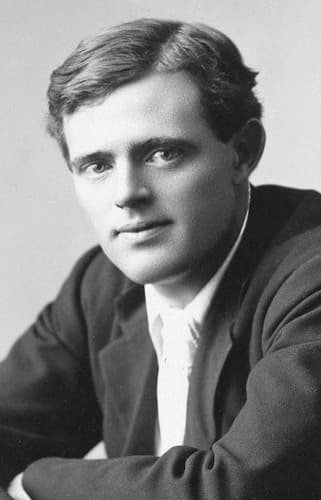
John Griffith Chaney, better known as Jack London, was an American novelist, journalist and activist. A pioneer of commercial fiction and American magazines, he was one of the first American authors to become an international celebrity and earn a large fortune from writing. He was also an innovator in the genre that would later become known as science fiction.