“We all have our ghosts. The trick is learning how to live with them.”
— Jake reflects on the haunting memories of his childhood and the lingering impact of past events.

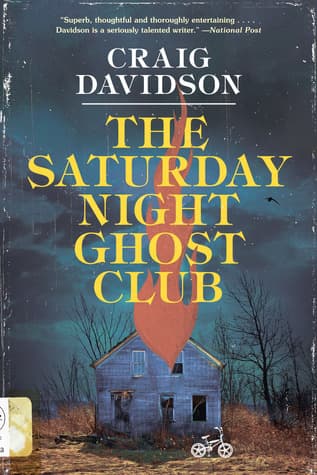
Craig Davidson (2018)
Genre
Mystery / Young Adult
Reading Time
250 min
Key Themes
See below
Sign in to track this book
In 1980s Niagara Falls, a misfit twelve-year-old and his eccentric uncle uncover bittersweet truths about memory and the spectral past while investigating local ghost stories with a new group of friends.
The story is narrated by Jake Baker, an adult neurosurgeon, who thinks back to the summer of 1988 when he was twelve in Niagara Falls. Jake lives with his parents and spends much time with his Uncle Calvin, a kind but unusual man who runs a curiosity shop called 'Calvin's Curios.' Calvin loves local folklore and ghost stories, often sharing them with Jake. This summer, Jake meets two new kids: siblings Billy and Dove. Calvin decides to invite the three children into the 'Saturday Night Ghost Club,' a group that investigates the local supernatural tales he has collected.
The Saturday Night Ghost Club begins its investigations with Calvin's guidance. Their first 'case' is the alleged haunting of the Honeymoon Suite at the local motel, where a newlywed couple supposedly died. Calvin tells the tragic, gruesome details, and the kids, though scared, are excited. Their next target is the 'Screaming Tunnel,' a local spot said to be haunted by a young girl's ghost. During this investigation, Calvin shares a disturbing story about a girl burned alive in the tunnel, and the club experiences eerie moments. These early outings show Calvin's storytelling and the growing friendship among Jake, Billy, and Dove.
The club's investigations lead them to the Whispering Woods, an unsettling area. Here, Calvin tells them the legend of a reclusive hermit who once lived in the woods and supposedly committed a horrific act before disappearing. As Calvin tells the tale, his mood changes; he becomes more intense and less playful. The kids notice a subtle change in him, a deeper connection to this story. During this trip, Calvin's memories become more fragmented, and he sometimes seems to lose his thoughts, suggesting an underlying struggle with his own past. The line between local legend and personal history starts to blur for the children.
The Saturday Night Ghost Club then goes to an old, abandoned asylum on the outskirts of Niagara Falls. This place, with its dark history, is hard for Calvin. As he tells the story of the asylum's past, focusing on a tragedy involving a patient, he becomes agitated and distressed. His stories grow more vivid and personal, almost as if he witnessed the events. The children observe Calvin's increasing memory lapses and his tendency to mix up details, sometimes referring to himself or his family when speaking about the characters in his ghost stories. The line between fact and fiction, and between Calvin's stories and his own past, becomes more blurred.
The club's next destination is the 'Bridge of Sighs,' a local bridge with a history of suicides. This location affects Calvin deeply. As he tells the story of a young man who jumped from the bridge, his emotional state worsens. He becomes withdrawn and upset, struggling to stay composed. The children see a raw glimpse into Calvin's pain, realizing that these ghost stories are not just tales but are linked to his own unresolved trauma and grief. It becomes clear that Calvin uses these ghost hunts to confront or process his past, though the children do not yet understand the full extent of it.
As summer ends, Calvin's mental health declines. His memory problems become more noticeable, and his stories blend personal history and local legend. The children worry more, sensing a shift from playful oddity to real distress. In one scene, Calvin tries to confide in Jake, giving fragmented details about a past trauma involving his family, specifically his sister and an accident. He hints at a 'ghost' he carries, suggesting guilt and sorrow, but he cannot clearly explain the full truth, leaving Jake unsettled and confused about what his uncle wants to say.
Years later, as an adult neurosurgeon, Jake thinks about that summer and his Uncle Calvin's decline. Calvin was diagnosed with early-onset Alzheimer's disease. Through his medical knowledge and his own memories, Jake finally understands. He realizes that Calvin's 'ghost stories' were not just local legends, but fragmented memories of his own traumatic past, distorted by guilt and his deteriorating mind. The 'ghosts' were the people he had lost and the guilt he carried, appearing as historical tragedies. The investigations were Calvin's desperate, subconscious attempts to process and share his fading memories before the disease took them entirely.
Jake eventually uncovers the full, tragic truth of Calvin's past. When Calvin was a young boy, he and his younger sister, Rosie, were playing near the Niagara River. Calvin, carelessly, dared Rosie to climb over a safety barrier. Rosie, trying to impress her brother, slipped and fell into the powerful rapids, drowning instantly. This accident, which Calvin witnessed and felt responsible for, was the trauma of his life. His 'ghost stories' about the Honeymoon Suite, the Screaming Tunnel, the Hermit, the Asylum, and the Bridge of Sighs were all echoes of Rosie's death and his overwhelming guilt, disguised and projected onto local legends.
Calvin carried the burden of guilt for Rosie's death his whole life. The Saturday Night Ghost Club was his subconscious way of revisiting the trauma, of trying to confess and process the pain without being able to directly say it due to his illness. Each ghost story, with its themes of accidental death, loss, and regret, was a metaphor for his personal tragedy. By sharing these stories with Jake, Billy, and Dove, Calvin was, in his fragmented way, trying to pass on his memories and perhaps find some acknowledgment, before his mind completely succumbed to Alzheimer's.
In the present, Jake, now an adult, understands his uncle's life and struggles. He sees that Calvin, despite his oddities and later illness, was a kind and loving figure who shaped his childhood. The 'ghosts' that haunted Calvin were real, but they were the ghosts of memory and trauma, not supernatural entities. Jake finds a bittersweet peace in this understanding, realizing that his uncle's storytelling, though born of pain and illness, was an act of love and a desperate attempt to be remembered. The Saturday Night Ghost Club, for Jake, becomes a symbol of memory, loss, and the bond between an uncle and his nephew.
The Protagonist
From a curious and slightly naive boy, Jake grows into an adult who understands the complex interplay of memory, trauma, and storytelling, ultimately finding peace with his uncle's legacy.
The Supporting/Central Figure
Initially a whimsical storyteller, Calvin's character arc reveals his tragic past and his desperate, subconscious attempt to process and share his fading memories before succumbing to Alzheimer's.
The Supporting
Remains a consistent, supportive friend to Jake throughout the summer's adventures.
The Supporting
Remains a consistent, adventurous friend to Jake throughout the summer's adventures.
The Mentioned/Catalyst
Her tragic death is the foundational event that sets Calvin's character arc in motion and ultimately reveals the story's deeper meaning.
The Supporting
Remain consistent, supportive figures throughout Jake's childhood.
The novel explores the changing and often unreliable nature of memory, especially regarding trauma and aging. Calvin's ghost stories show his fragmented memories, distorted by guilt and early-onset Alzheimer's. The adult Jake, a neurosurgeon, considers the scientific and personal aspects of memory, trying to find the 'truth' from his childhood memories and Calvin's disjointed stories. The book suggests that memory is not a perfect record but a constantly reinterpreted story, especially under stress. Sometimes the 'ghosts' we encounter are echoes of our own past.
““Memory… It’s a funny thing. A trickster, a charlatan. It can make you believe things that never happened, and forget things that did.””
At the core of Calvin's character is grief and guilt over his younger sister Rosie's accidental death. This unresolved trauma affects his entire life and appears in his elaborate ghost stories. Each story he tells the club, from the Honeymoon Suite to the Bridge of Sighs, subtly echoes parts of Rosie's death or his feelings of responsibility. Calvin's deteriorating mind uses these legends to process, confess, and remember his pain. The theme shows how unaddressed trauma can haunt someone, shaping their perceptions and actions for decades.
““Some ghosts… they’re not in the walls. They’re in your head. They’re in your heart.””
The summer Jake turns twelve is a coming-of-age period for him. Initially, the Saturday Night Ghost Club is a thrilling childhood adventure. However, as Calvin's condition worsens and the true nature of his 'ghosts' appears, Jake's innocence slowly fades. He learns about the complexities of adult pain, mental illness, and the impact of trauma. The shift from believing in literal ghosts to understanding the metaphorical 'ghosts' of memory and grief shows Jake's maturation and his deeper understanding of the world's sadness alongside its wonders.
““There came a point in every childhood, I think, when the world stopped being a simple place of good and evil, and became instead a shifting, complicated mess.””
Storytelling is a main element of the novel, acting as both entertainment and a way to cope and communicate. Calvin uses his ghost stories to indirectly process and express his deep trauma and guilt. For the children, these stories are adventures that bond them. The adult Jake, in narrating his past, also tells a story, trying to make sense of his memories and his uncle's life. The theme explores how narratives, whether factual or fictionalized, are essential to human experience. They let us transmit history, process emotions, and create meaning.
““Stories are how we remember. How we make sense. Sometimes, how we survive.””
The book redefines 'haunting.' While it starts with classic supernatural ghost stories, it ultimately reveals that the most profound hauntings are not by spirits but by unresolved trauma, guilt, and fading memories. Calvin is 'haunted' by the memory of his sister's death and his own role in it. His ghost club investigations are a quest to confront and externalize his internal 'ghosts.' The story shifts focus from external supernatural threats to the internal psychological burdens that can linger and affect a person's life, especially with cognitive decline.
““The real ghosts were always inside us, weren’t they? The things we couldn’t forget, the things we wished we could.””
Alternating between a child's experience and an adult's reflection.
The story is primarily told from the perspective of an adult Jake Baker, a neurosurgeon, reflecting on his childhood summer. This adult perspective provides a layer of understanding and scientific insight into Calvin's condition that the twelve-year-old Jake lacked. The narrative seamlessly moves between the immediate, sensory experiences of the child and the later analytical and emotional processing of the adult. This device allows for dramatic irony, as the reader knows more than the child protagonist, and builds suspense as the adult narrator slowly pieces together the truth.
An adult narrator introducing and contextualizing a past event.
The entire novel acts as a frame story, with the adult Jake Baker looking back on the pivotal summer of 1988. This structure allows for a retrospective analysis of events, providing depth and meaning that would be impossible from a purely linear, child's perspective. The adult Jake's medical background as a neurosurgeon adds credibility and a scientific lens to his understanding of Calvin's Alzheimer's, making the revelation of Calvin's true 'ghosts' more impactful and tragic. The frame allows for themes like memory and its unreliability to be explicitly discussed by the narrator.
Supernatural tales serving as veiled representations of personal trauma.
Initially presented as literal supernatural entities, the 'ghosts' and urban legends Calvin investigates with the club are gradually revealed to be powerful metaphors for his own unresolved trauma and guilt. Each ghost story, from the Honeymoon Suite to the Bridge of Sighs, contains elements that subtly mirror the circumstances of his sister Rosie's death and his subsequent feelings of responsibility. This device elevates the narrative beyond a simple ghost story, transforming it into a poignant exploration of psychological haunting and the ways individuals cope with profound loss and regret.
Calvin's increasing memory lapses and distress hinting at his underlying condition.
Throughout the summer, Calvin's subtle shifts in demeanor, his growing agitation when telling certain stories, and his increasing memory lapses serve as crucial foreshadowing. These details, initially perceived as mere eccentricities by the children, are later understood by the adult Jake (and the reader) as early symptoms of his Alzheimer's disease. This device builds a sense of unease and mystery, prompting the reader to question the true nature of Calvin's 'ghosts' and adding a layer of tragic inevitability to his character arc and the ultimate revelation.
“We all have our ghosts. The trick is learning how to live with them.”
— Jake reflects on the haunting memories of his childhood and the lingering impact of past events.
“The past is a ghost that haunts the present, and sometimes, it's the only thing that keeps us company.”
— Jake contemplates how childhood experiences shape adult life and relationships.
“Ghosts aren't just the dead. They're the things we can't let go of.”
— Uncle Calvin explains his perspective on hauntings during a ghost club meeting.
“Sometimes the scariest monsters are the ones we create ourselves.”
— Jake realizes how imagination and fear can distort reality during their investigations.
“We were just kids trying to make sense of a world that didn't make any sense.”
— Jake looks back on the ghost club's adventures and their naive attempts to understand mysteries.
“The truth is often buried under layers of stories we tell ourselves.”
— Reflecting on how family secrets and personal narratives obscure reality.
“Memory is a tricky thing. It bends and twists until you can't tell what's real anymore.”
— Jake discusses the unreliable nature of recollections from his youth.
“We hunted ghosts to avoid facing the ones inside us.”
— Jake admits the ghost club was a distraction from personal struggles and family issues.
“Every town has its secrets, and every secret has a ghost.”
— Uncle Calvin introduces the idea that local legends often hide deeper truths.
“Growing up means learning that not all mysteries have answers.”
— Jake's realization as he transitions from childhood to adulthood.
“The Saturday Night Ghost Club was our way of making the unknown a little less frightening.”
— Describing the purpose behind the group's supernatural investigations.
“Sometimes the bravest thing you can do is remember.”
— Jake emphasizes the courage required to confront painful memories.
“We were detectives of the invisible, solving cases that didn't want to be solved.”
— Jake humorously describes the ghost club's futile yet earnest efforts.
“The heart is a haunted house, and we're all just trying to find our way out.”
— A metaphorical reflection on emotional baggage and personal growth.
Ready to see how well you understood this book? Take our interactive quiz with 10 questions.

Craig Davidson is a Canadian author known for his visceral and often dark explorations of masculinity, memory, and trauma. His critically acclaimed novels, including "The Saturday Night Ghost Club" and "C reach," delve into gritty realism and the psychological depths of his characters. Davidson's work is lauded for its powerful prose and unflinching honesty.