“As for matrimony, I am resolved never to quit the unfashionable practice of loving my husband, when I have one.”
— Lydia Languish's declaration of her romantic ideals.

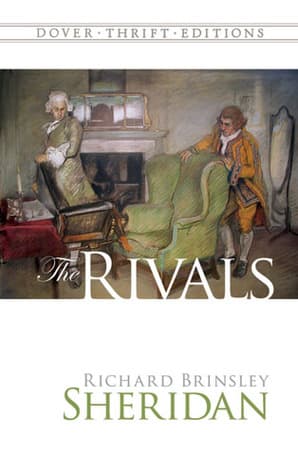
Richard Brinsley Sheridan (1775)
Genre
Fiction
Reading Time
120 min
Key Themes
See below
Sign in to track this book
Captain Jack Absolute, caught in a tangle of mistaken identities and an aunt's word mix-ups, must manage his demanding father and a hot-headed Irishman to win Lydia Languish, who only cares for romance novel fantasies.
The play begins in Bath. The wealthy Lydia Languish tells her cousin Julia Melville about her secret love for 'Beverley,' a poor soldier. Lydia, who reads many romantic novels, loves the idea of running off with a man who has no money, seeing it as the only truly romantic path. She hides forbidden books from her aunt, Mrs. Malaprop, and dreams of a dramatic elopement. Julia, being more practical, gently teases Lydia about her overly dramatic feelings, but Lydia sticks to her ideal vision of love and hardship, finding a comfortable, approved marriage completely unromantic.
Sir Anthony Absolute, a bossy but loving father, comes to Bath and immediately tells his son, Captain Jack Absolute, that he plans for Jack to marry the rich Lydia Languish. Jack, who is secretly 'Beverley,' is happy about this, as it means he can marry the woman he loves without continuing his deception. However, he pretends to be unwilling and rebellious to his father, afraid that being too eager would raise suspicion and ruin his romantic trick with Lydia. Sir Anthony, frustrated by Jack's fake disobedience, threatens to disinherit him, leading to a funny argument.
Mrs. Malaprop, Lydia's aunt and guardian, finds a love letter from 'Beverley' to Lydia. Angry about what she sees as improper behavior and the social difference in the match, she stops the letters and tries to teach Lydia proper manners, famously using the wrong words in her speeches. She thinks 'Beverley' is not a good match and actively tries to stop their union, all while unknowingly helping the very match her brother-in-law, Sir Anthony, is trying to arrange. Her grand statements and word mistakes add much humor, showing her pretentiousness and lack of real understanding.
Bob Acres, a country gentleman and an old friend of Jack Absolute's, also loves Lydia Languish and thinks he has a chance with her. He is a rather shy and easily influenced character, often trying out fashionable behaviors that don't suit him. Sir Lucius O'Trigger, a quick-tempered Irish baronet who loves dueling, convinces Acres that 'Beverley's' attention to Lydia has insulted his honor. Despite being a coward, Acres is persuaded by Sir Lucius to challenge 'Beverley' to a duel, a thought that scares him but which he feels he must do to protect his reputation.
When Captain Jack Absolute, now introduced to Lydia by Sir Anthony as her future husband, tries to tell her he is 'Beverley,' Lydia is at first angry and disappointed. She feels betrayed by the trick and, more importantly, robbed of her romantic ideal of running off with a poor lover. The idea of a normal, arranged marriage with the rich Captain Absolute goes against her novel-fueled fantasies. Jack struggles to make her romantic expectations fit with the truth of his position, realizing that his elaborate trick has created an unexpected problem for their happiness.
Julia Melville and Faulkland's relationship contrasts with Lydia and Jack's. Faulkland deeply loves Julia, but his love is troubled by extreme jealousy, insecurity, and an overly active imagination that constantly invents scenarios where she is unfaithful or uncaring. He often tests her affection, sees her innocent actions as insults, and torments himself and Julia with his baseless suspicions. Julia, a sensible and patient woman, tries to reassure him, but his constant questioning and dramatic outbursts push their relationship to its breaking point, showing how too much emotion and distrust can be harmful.
As the day of the duel gets closer, things are set for funny chaos. Bob Acres, still scared but pushed by Sir Lucius O'Trigger, arrives at the dueling ground. Sir Lucius, who has also challenged Jack Absolute over a perceived insult about a letter, is eager for the fight. Jack, meanwhile, is trying to deal with the fallout of his revealed identity with Lydia and is also getting ready for the duel with 'Beverley' — not knowing he is challenging himself in the form of Acres. The various characters, each with their own misunderstandings and complaints, meet at the chosen spot, creating a tense but funny atmosphere.
At the dueling ground, the truth finally comes out. When Bob Acres learns that 'Beverley,' his intended opponent, is his friend Captain Jack Absolute, he immediately backs out of the duel, much to Sir Lucius's annoyance. Sir Lucius, still wanting to fight, then faces Jack, but their duel is also stopped. The arrival of Sir Anthony Absolute, Mrs. Malaprop, and Lydia Languish leads to all the deceptions being fully revealed. The various misunderstandings about identities, letters, and perceived insults are finally cleared up, preventing any fighting and allowing for a resolution.
With all the tricks revealed, Lydia Languish, who first resisted a normal marriage, finally makes up with Captain Jack Absolute, realizing that his love, even without dramatic hardship, is real. Julia Melville, after a final, strong request for Faulkland to trust her, manages to make him see sense, and they fix their difficult relationship. Even Mrs. Malaprop's own secret admirer, Sir Lucius O'Trigger, is revealed, though her romantic hopes are comically dashed. The play ends with the promise of several happy marriages, bringing all the complex plots to a satisfying and humorous close.
The Protagonist
Lydia learns to value genuine affection and a stable future over idealized, dramatic suffering, accepting a conventional marriage with the man she loves.
The Protagonist
Jack successfully navigates his deceptions and parental pressures to secure his desired marriage, ultimately revealing his true self and winning Lydia's love.
The Supporting
Mrs. Malaprop remains largely unchanged, her malapropisms and social pretentions enduring throughout the play, solidifying her as a static comic figure.
The Supporting
Sir Anthony's will is ultimately satisfied as his son marries the woman he chose, despite initial resistance, reinforcing his traditional views.
The Supporting
Sir Lucius's dueling schemes are ultimately thwarted, and his romantic aspirations with Mrs. Malaprop are comically disappointed, leaving him somewhat deflated but still impetuous.
The Supporting
Acres overcomes his misguided attempts at bravery and social pretense, ultimately choosing self-preservation over a duel for honor, leading to his comedic resolution.
The Supporting
Julia's patience and enduring love ultimately help Faulkland overcome his debilitating jealousy, leading to a stable and trusting relationship.
The Supporting
Faulkland, through Julia's unwavering patience and love, begins to recognize the destructive nature of his jealousy and trust his beloved, hinting at a more secure future.
The play makes fun of the over-the-top and often unrealistic ideas of love common in 18th-century romantic novels. Lydia Languish's desire to run off with a poor lover, choosing 'romantic trouble' over comfortable reality, is the main example. Her disappointment when her secret lover 'Beverley' turns out to be the rich Captain Absolute shows the difference between fantasy and reality. Similarly, Faulkland's self-inflicted pain through extreme jealousy comes from an idealized, suffering view of love. The play suggests that true love, while passionate, also needs practicality and real understanding, not theatrical hardship.
““A circulating library in a town is as an evergreen tree of diabolical knowledge! It hath blighted many a tender blossom.””
Deception is a main part of the plot, causing much of the conflict and humor. Captain Jack Absolute's elaborate disguise as 'Beverley' to win Lydia's heart is the chief example, but there are also Mrs. Malaprop's secret letters with Sir Lucius (who thinks she is 'Delia'), and the characters' various attempts to fool each other or themselves. These deceptions often lead to misunderstandings, mistaken identities, and near-duels, ultimately showing how foolish pretense is and how important honesty is in relationships. The revealing of these deceptions makes up the play's climax.
““I am sure I have not a thought in my head that is not a disguise for my heart.””
The conflict between parents' authority and a child's right to choose their own spouse is a major theme. Sir Anthony Absolute's insistence on an arranged marriage for Jack, and Mrs. Malaprop's attempts to control Lydia's romantic life, represent the traditional view. Lydia's rebellion against these arrangements, inspired by her romantic novels, supports individual choice and passion. The play ultimately finds a funny middle ground, where the 'chosen' match turns out to be the 'desired' match, suggesting that while parental guidance can be well-meaning, real affection is most important for a good marriage.
““I desire you will represent to her, that marriage is a state of just subordination, an admirable institution, where the mind can have no doubt, and the heart no qualms.””
Sheridan cleverly uses language to show characters' pretensions and silliness. Mrs. Malaprop's famous malapropisms are the clearest example, showing her vanity and lack of real education despite her attempts at sophistication. Other characters, like Bob Acres, try to use fashionable slang or refined manners that don't suit them, which creates humor. The play criticizes the social climbing and affected behaviors of the time, suggesting that genuine character and clear communication are more valuable than superficial polish or misused words.
““I would have her instructed in geometry, that she might know something of the contagious countries; but above all, Sir Anthony, she should be mistress of orthodoxy, that she might not misspell, and mispronounce words so shamefully.””
Characters are confused about the true identities of others, leading to comedic misunderstandings.
The central mistaken identity involves Captain Jack Absolute's disguise as 'Beverley,' a penniless ensign, to woo Lydia Languish. This deception is further complicated when Jack is also introduced to Lydia as her wealthy, arranged fiancé. Another instance is Sir Lucius O'Trigger's belief that he is corresponding with a young woman named 'Delia,' who is actually Mrs. Malaprop. These mistaken identities drive the plot's comedic engine, creating situations of dramatic irony and setting up the climactic unraveling at the dueling ground.
The audience is aware of information that characters are not, enhancing the comedy.
Dramatic irony is prevalent throughout the play, particularly concerning Jack Absolute's dual identity. The audience knows that 'Beverley' is Jack, and that Jack is Lydia's intended fiancé, while Lydia and other characters remain ignorant. This creates humor in scenes where Lydia laments her fate or where Mrs. Malaprop rails against 'Beverley,' unknowingly speaking about the man she wants Lydia to marry. The audience's superior knowledge allows them to appreciate the full extent of the characters' follies and the impending comic chaos.
The humorous misuse of words by substituting similar-sounding words with different meanings.
Named after the character Mrs. Malaprop, this device is her defining characteristic and a major source of comedy. Her frequent and egregious misuse of words (e.g., 'contagious countries' for contiguous, 'orthodoxy' for orthography) highlights her pretentiousness and her attempts to appear educated, while simultaneously revealing her ignorance. These verbal blunders serve to underscore the theme of linguistic pretense and the absurdity of valuing superficial eloquence over genuine understanding, providing consistent comic relief.
A traditional plot device for resolving conflicts of honor, here used for farcical effect.
The impending duel serves as a climactic plot device, bringing all the various misunderstandings and character conflicts to a head. While traditionally a serious affair of honor, in 'The Rivals,' the duel is treated with farcical humor. Bob Acres's cowardice, Sir Lucius's eagerness, and Jack's multiple challenges (including one to himself) strip the duel of its gravity. It functions to force the revelation of identities and the resolution of the convoluted plot, ultimately preventing bloodshed and leading to a comedic rather than tragic outcome.
“As for matrimony, I am resolved never to quit the unfashionable practice of loving my husband, when I have one.”
— Lydia Languish's declaration of her romantic ideals.
“I own I am a little apt to disturb conversation, by being always so ready to beg pardon—but in fact I am so dreadfully timid, that I am for ever frightening myself with the apprehension of being rude.”
— Mrs. Malaprop's self-assessment of her social graces, an example of her malapropisms.
“Observe, Sir Anthony, I never quarrel with my wife, but on principle.”
— Captain Absolute (as Ensign Beverley) explaining his relationship with Lydia.
“No, no, that will never do. A lady should never have that look of an old maid about her, until she can no longer help it.”
— Sir Anthony Absolute advising his son on how to choose a wife.
“I am sure I have read somewhere, that the best way to keep a secret is to tell it to every one.”
— Lucy, the maid, revealing her understanding of how secrets work.
“Comparisons are odious.”
— Mrs. Malaprop's famous misapplication of a common phrase.
“My dear girl, I am not angry with you, but I am afraid you have too much feeling for a modern lady.”
— Mrs. Malaprop reprimanding Lydia for her romantic sensibilities.
“There's nothing like a good quarrel to clear the air.”
— Sir Lucius O'Trigger's philosophy on resolving disputes.
“I'll be no longer a slave to the caprice of a whimsical girl.”
— Captain Absolute expressing his frustration with Lydia's romantic demands.
“If I can but once get him to marry her, I shall be the happiest creature in the world.”
— Mrs. Malaprop's desire to see Lydia settled, despite her own romantic entanglement.
“I am not in a humour to be trifled with.”
— Sir Anthony Absolute's declaration when his patience is tested.
“Upon my conscience, I believe the lady would have been better pleased with a good comfortable house and a steady husband, than with all the fine speeches and romantic nonsense in the world.”
— Fag, Captain Absolute's servant, offering a pragmatic view of love and marriage.
“He is the very pineapple of politeness!”
— Mrs. Malaprop's accidental praise of someone's manners, intending to say 'pinnacle'.
“A circulating library in a country town is as an evergreen tree of diabolical knowledge!”
— Mrs. Malaprop's condemnation of the influence of novels on young women.
Ready to see how well you understood this book? Take our interactive quiz with 10 questions.

Biography coming soon.

Ashley Antoinette
4.6

Mark McDonald
4.4
Luo Guanzhong
4.4

Mia McKenzie
4.3

Dorothy Parker
4.3
Joaquim Maria Machado de Assis
4.3
James Thurber
4.2

Terry Kay
4.2