“My object all sublime I shall achieve in time—To let the punishment fit the crime—The punishment fit the crime.”
— The Mikado explains his philosophy of justice.

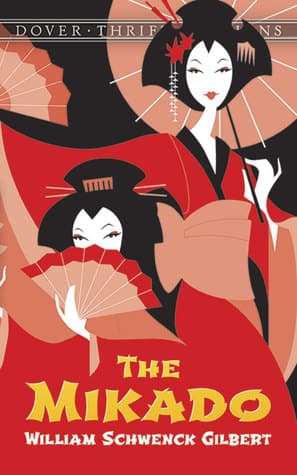
Sign in to track this book
In a Japanese town, a minstrel in love navigates a Lord High Executioner's absurd rules and Victorian society's quirks in this operatic satire of love and power.
The story begins in Titipu, where noblemen await Nanki-Poo, a minstrel. Nanki-Poo tells Pish-Tush he is the Mikado's son, disguised to avoid marrying Katisha, an older lady from his father's court. He came back to Titipu to find Yum-Yum, Ko-Ko's ward, whom he fell in love with a year ago. He learns Yum-Yum is engaged to Ko-Ko. Ko-Ko, condemned to death for flirting, was pardoned and given his job by town officials who feared he would execute them if they didn't. This makes Nanki-Poo sad, and he thinks about suicide.
Pooh-Bah, the Lord High Everything Else, tells Ko-Ko that the Mikado has ordered an execution in Titipu within a month, or the town's executioner office will be removed, and the town will become a village. This puts Ko-Ko in a difficult spot, as he does not want to execute anyone, especially himself. Nanki-Poo, still sad about losing Yum-Yum, offers to be executed in a month if he can marry and spend that month with Yum-Yum. Ko-Ko agrees, seeing a way out. Yum-Yum and her sisters, Pitti-Sing and Peep-Bo, are happy she will not marry Ko-Ko.
As Nanki-Poo and Yum-Yum's wedding preparations begin, Katisha arrives in Titipu, having found Nanki-Poo. She recognizes him despite his disguise and tries to reveal he is the Mikado's son. The townspeople, however, like Nanki-Poo and Yum-Yum and ignore Katisha. They make fun of her looks and age, making her leave in anger. Despite this, Katisha vows revenge and promises to expose Nanki-Poo to his father, ensuring the execution will happen with harsh punishment for Nanki-Poo's defiance.
The wedding of Nanki-Poo and Yum-Yum is stopped by the Mikado himself, with Katisha. The Mikado is not there for an execution but to find his missing son, Nanki-Poo, whom he believes has run away. Ko-Ko, Pooh-Bah, and Pitti-Sing are scared, realizing their plan to execute Nanki-Poo will now be seen as treason. They try to hide Nanki-Poo's identity and the execution deal, fearing the Mikado's anger. The Mikado, however, cares most about his son's location, unaware of the complicated plan.
To calm the Mikado and avoid punishment for not executing anyone, Ko-Ko, Pooh-Bah, and Pitti-Sing make up a story. They present a fake certificate of Nanki-Poo's execution, claiming he was beheaded. This document describes the execution in such vivid and funny detail that it makes the Mikado suspicious. Katisha, still there, looks at the certificate and points out mistakes, increasing the Mikado's doubt. The Mikado, initially satisfied an execution happened, now thinks his son was murdered and threatens Ko-Ko and his friends: they will be 'boiled in oil, or melted in lead, or chopped into mince-meat' if Nanki-Poo is not found alive.
Facing death, Ko-Ko, Pooh-Bah, and Pitti-Sing panic. Their only hope is for Nanki-Poo to reappear. They find Nanki-Poo and Yum-Yum, now married, and try to convince Nanki-Poo to show himself to his father. Nanki-Poo refuses, saying if he reveals himself, Katisha will claim him as her husband. He insists he will only reappear if Katisha is married to someone else, freeing him from his engagement. This puts Ko-Ko in a difficult spot; he must marry off Katisha to save his own life and the lives of his friends.
In a desperate move, Ko-Ko decides he must marry Katisha. He approaches Katisha, who is still sad about Nanki-Poo's supposed death. Ko-Ko tries to win her over with a song about love and companionship, despite his age and looks. Katisha, at first unwilling and grieving, slowly softens under Ko-Ko's persistent and somewhat silly efforts. She finds herself unexpectedly drawn to his sincerity, or perhaps his desperation, and starts to consider his proposal, seeing it as a chance for happiness, even with Ko-Ko.
After Ko-Ko's plea, Katisha agrees to marry him. With Katisha now engaged to Ko-Ko, Nanki-Poo is free from his previous engagement to her. He then shows himself to his father, the Mikado, surprising everyone. The Mikado is happy to find his son alive and well, forgiving him for his disappearance and the deception. Ko-Ko's quick thinking and willingness to sacrifice himself (by marrying Katisha) saved his own life and the lives of Pooh-Bah and Pitti-Sing, and brought order back to Titipu.
With Nanki-Poo reunited with his father and married to Yum-Yum, and Ko-Ko having married Katisha, all problems are solved. The Mikado, happy his son is safe, cancels the execution order. Ko-Ko, through his clever (and slightly dishonest) actions, satisfied everyone and avoided a bad fate. The play ends with a celebratory song, where everyone expresses happiness and relief. The couples — Nanki-Poo and Yum-Yum, and Ko-Ko and Katisha — look forward to their futures, ending the chaos in Titipu.
The Protagonist
Nanki-Poo begins as a desperate lover seeking to escape an unwanted marriage and ends happily married to Yum-Yum, having successfully circumvented his father's decree.
The Protagonist
Yum-Yum starts as a pawn in a forced marriage and ends as a happily married woman, united with her true love.
The Antagonist/Supporting
Ko-Ko begins as a reluctant executioner burdened by a decree and an unwanted betrothal, and through a series of desperate maneuvers, ends up married to Katisha and having saved Titipu from the Mikado's wrath.
The Supporting
The Mikado arrives seeking his missing son, and departs having found him, ensuring a happy resolution for all.
The Antagonist/Supporting
Katisha begins as a scorned woman seeking revenge and ends up finding unexpected companionship and marriage with Ko-Ko.
The Supporting
Pooh-Bah remains consistently self-serving and pompous, navigating the plot by adapting his principles to suit the most advantageous outcome.
The Supporting
Pitti-Sing supports Yum-Yum and Nanki-Poo's union throughout the plot, participating in the schemes to ensure their happiness and her own safety.
The Supporting
Pish-Tush primarily serves as a consistent, if minor, voice of reason and observer throughout the unfolding chaos.
The Mikado makes fun of how arbitrary law is and the people who enforce it. The Mikado's order for an execution, no matter who is executed, shows how senseless bureaucracy can be. Ko-Ko's appointment as Lord High Executioner, despite being a condemned man, shows illogical power structures. Pooh-Bah's many self-serving titles further mock power concentrated in incompetent hands. The plot involves characters trying to get around or manipulate ridiculous laws, like the 'death for flirting' offense, instead of upholding justice.
“My object all sublime / I shall achieve in time – / To let the punishment fit the crime – / The punishment fit the crime.”
A main theme is love struggling against social and legal problems. Nanki-Poo and Yum-Yum's love is blocked by Ko-Ko's claim, the Mikado's order, and Katisha's prior engagement. The play looks at different kinds of love: romantic love (Nanki-Poo and Yum-Yum), desperate, practical love (Ko-Ko for Katisha to save his life), and unwanted, possessive love (Katisha for Nanki-Poo). In the end, love wins, but only through a series of funny tricks and compromises, suggesting that even in an absurd world, love finds a way.
“Is it not lovely to be a bride, / With a man by your side?”
The play often contrasts how things seem with how they are. Nanki-Poo is disguised as a minstrel but is the Mikado's son. Ko-Ko, the Lord High Executioner, is a clumsy tailor who fears executing anyone. Nanki-Poo's 'execution' is a lie. This theme also appears in characters' self-perception, like Pooh-Bah's exaggerated sense of importance. The humor often comes from the audience knowing the truth while the characters on stage are caught in their deceptions or misunderstandings, creating dramatic irony.
“A more humane Mikado never did in Japan exist.”
Though set in a fantasy Japan, The Mikado criticizes Victorian English society. The strict class system, inefficient bureaucracy, and odd social rules of Victorian England are reflected in Titipu. The 'death for flirting' law can be seen as a jab at Victorian moral hypocrisy and overly dramatic legal statements. The characters' names (Ko-Ko, Pooh-Bah, Pish-Tush) sound English, further emphasizing the satirical goal. The play uses the foreign setting to safely critique English issues without being overtly political.
“I am, in point of fact, a particularly clean old man.”
Nanki-Poo's disguise as a minstrel drives the initial conflict and subsequent complications.
Nanki-Poo's disguise as a wandering minstrel is the foundational plot device. It allows him to escape his unwanted betrothal to Katisha and pursue Yum-Yum, but it also creates the central conflict when he is unable to reveal his true identity. This mistaken identity is crucial for the Mikado's initial search for his son and for the elaborate deception concerning Nanki-Poo's 'execution.' The humor and dramatic tension are largely derived from the characters' attempts to maintain or reveal Nanki-Poo's true status at various opportune (or inopportune) moments.
The Mikado's decree that an execution must take place serves as the central driver of the plot.
The Mikado's decree, stating that an execution must occur in Titipu within a month or the town will be reduced in rank, functions as a classic MacGuffin. It is the primary catalyst for Ko-Ko's desperate actions and the convoluted plot. While the decree itself is important for driving the action, its specific details or ultimate enforcement are less significant than the way it forces the characters to act and react, leading to comedic situations and plot twists. It provides the urgent stakes needed for the farce to unfold.
Unlikely arrivals and opportune revelations propel the plot's comedic momentum.
The play relies heavily on farcical coincidence and impeccable comedic timing. For instance, Katisha's arrival just as Nanki-Poo is about to marry Yum-Yum, and then the Mikado's arrival (not for the execution, but to find his son) at a critical moment, are perfectly timed to escalate the chaos. The repeated near-exposure of Nanki-Poo, and his eventual revelation only after Katisha is otherwise engaged, are all products of this device. These coincidences, while improbable, are essential for maintaining the play's lighthearted and absurd tone, preventing the characters from resolving conflicts too easily.
The audience's knowledge of Nanki-Poo's true identity creates humor and tension.
Dramatic irony is a pervasive element throughout The Mikado. The audience is aware from early on that Nanki-Poo is the Mikado's son, while most of the characters in Titipu are not (or only discover it later). This creates humor as characters discuss Nanki-Poo's 'execution' or the Mikado's search, unaware of the full implications. For example, when Ko-Ko presents the false execution certificate to the Mikado, the audience knows Nanki-Poo is alive, adding to the comedic tension of the scene. This device heightens the absurdity of the characters' predicaments.
“My object all sublime I shall achieve in time—To let the punishment fit the crime—The punishment fit the crime.”
— The Mikado explains his philosophy of justice.
“And I've got a little list—I've got a little list Of society offenders who might well be underground, And who never would be missed—who never would be missed!”
— Ko-Ko sings about his 'little list' of people he would execute.
“I am, in point of fact, a particularly clean-minded and high-souled young man, of a most refined nature.”
— Nanki-Poo describes himself to Yum-Yum.
“The idiot who marries a wife and doesn't know what to do with her is a bad bargain.”
— Pooh-Bah offers cynical advice.
“It is a great mistake to marry for beauty only.”
— Katisha advises Yum-Yum against marrying Nanki-Poo for his looks alone.
“When your Majesty says 'Let a thing be done,' it's as good as done—practically, it is done—because, when your Majesty says 'Let a thing be done,' it's not for us to reason why.”
— Pooh-Bah explains the Mikado's absolute authority.
“On a tree by a river a little tom-tit Sang 'Willow, titwillow, titwillow!'”
— Ko-Ko sings a humorous and somewhat morbid song to cheer up Pish-Tush.
“My brain it teems with original fancies.”
— Ko-Ko boasts about his creativity.
“Here's a how-de-do! If I marry Yum-Yum, Tra-la-la, To Ko-Ko, tra-la-la, I must die!”
— Nanki-Poo laments his predicament.
“I am, in point of fact, a particularly clean-minded and high-souled young man, of a most refined nature.”
— Nanki-Poo describes himself to Yum-Yum.
“The threatened blow is still suspended. If you don't marry Ko-Ko, you die. If you do, he dies.”
— Pish-Tush explains the grim options to Yum-Yum.
“I am Pooh-Bah. I am, in point of fact, a particularly haughty and exclusive person, of a most aristocratic nature.”
— Pooh-Bah introduces himself and his various titles.
“To say 'black' when I mean 'white'—that is the practice of a courtier.”
— Pooh-Bah explains his flexible morality as a public official.
“The Mikado's will is law.”
— A general statement about the Mikado's absolute power.
Ready to see how well you understood this book? Take our interactive quiz with 10 questions.

Biography coming soon.

Ashley Antoinette
4.6

Mark McDonald
4.4
Luo Guanzhong
4.4

Mia McKenzie
4.3
Dorothy Parker
4.3
Joaquim Maria Machado de Assis
4.3
James Thurber
4.2
Terry Kay
4.2