“If you prick us, do we not bleed? If you tickle us, do we not laugh? If you poison us, do we not die? And if you wrong us, do we not revenge?”
— Shylock's famous speech defending his humanity and explaining his desire for revenge against Antonio.

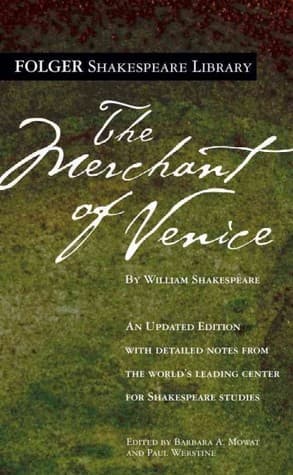
William Shakespeare (1996)
Genre
Fiction
Reading Time
150 min
Key Themes
See below
Sign in to track this book
In Venice, a desperate loan for love leads to a chilling demand for a pound of flesh, ultimately unraveling in a courtroom where cleverness triumphs over vengeful contracts.
The play starts in Venice with Antonio, a rich merchant, telling his friends Salarino and Solanio that he feels an unexplained sadness, even with his successful business. His relative and close friend, Bassanio, then arrives and admits he is in deep financial trouble, having spent all his inheritance. Bassanio wants to marry the wealthy heiress Portia of Belmont, believing her money could solve his problems. He needs funds to present himself as a suitable suitor. Antonio, whose own money is invested in his ships at sea, agrees to guarantee a loan for Bassanio, telling him to find a lender in Venice using Antonio's credit.
In Belmont, Portia talks with her waiting-woman, Nerissa, about her father's will. The will states that Portia can only marry a suitor who correctly chooses one of three caskets – gold, silver, or lead. If he chooses right, he wins her hand; if wrong, he must swear never to marry. Portia expresses her frustration with this lack of control and her dislike for the various European princes who have tried their luck. Nerissa reminds her of Bassanio, a Venetian scholar who once visited and impressed Portia, hinting at her preference for him.
Bassanio approaches Shylock, a Jewish moneylender, for a loan of three thousand ducats, with Antonio as the guarantor. Shylock holds deep resentment against Antonio for his anti-Semitic insults and for lending money without interest. He hesitates at first, recalling the many times Antonio has publicly scorned him. Despite this, Shylock agrees to the loan but proposes a 'merry bond': if Antonio fails to repay the sum on time, Shylock will be entitled to a pound of Antonio's flesh, to be cut from any part of his body. Antonio, confident his ships will return safely, foolishly agrees.
Shylock's daughter, Jessica, secretly plans to elope with Lorenzo, a Christian friend of Bassanio and Antonio. Before leaving, she disguises herself as a boy and steals a large amount of her father's money and precious jewels, including a turquoise ring her mother Leah gave him. Shylock returns home to find his daughter and his wealth gone and is heartbroken. His grief is worsened by the anti-Semitic taunts of Salarino and Solanio, who mock his loss and show little sympathy, highlighting the prejudice he faces.
In Belmont, the Prince of Morocco arrives to try the casket challenge. He chooses the gold casket, believing that Portia, being so valuable, must be inside the most precious metal. Inside, he finds a skull and a scroll advising, 'All that glisters is not gold.' He leaves, disappointed. Soon after, the arrogant Prince of Arragon tries. He chooses the silver casket, sure of his own worth. He finds a 'blinking idiot's head' and a scroll criticizing his pride. Both suitors fail, leaving Portia still unmarried, much to her relief.
Bassanio arrives in Belmont for the casket challenge. Portia, clearly in love with him, tries to delay his choice, fearing he might choose incorrectly. Bassanio, however, is eager to proceed. Unlike the previous suitors, he rejects the gold and silver caskets, seeing them as deceptive. He chooses the humble lead casket, reasoning that true worth often lies beneath a plain exterior. Inside, he finds Portia's portrait and a scroll confirming his success. Portia joyfully accepts him, and they immediately pledge their love, exchanging rings as a symbol of their commitment.
Just after Bassanio's triumph, news arrives from Venice that all of Antonio's merchant ships are lost at sea, leaving him bankrupt and unable to repay Shylock's loan. With the bond now forfeit, Shylock, still reeling from Jessica's elopement and driven by his deep hatred for Antonio, insists on enforcing the agreement: a pound of Antonio's flesh. Salarino and Solanio try to reason with Shylock, but he remains firm, declaring his intention to seek revenge for years of persecution.
Upon hearing of Antonio's trouble, Portia, now Bassanio's wife, is deeply upset. She insists that Bassanio immediately return to Venice with money to repay the debt, offering to pay it twenty times over. However, she also plans a clever strategy. She announces that she and Nerissa will pretend to go to a monastery for prayer while their husbands are away. Instead, they disguise themselves as male lawyers – Portia as 'Balthazar' and Nerissa as her clerk – and set off for Venice, intending to intervene in Antonio's trial and save his life.
In the Duke's court in Venice, Shylock strongly demands his pound of flesh. The Duke, unable to find a legal way out, is about to rule in Shylock's favor when 'Balthazar' (Portia) arrives, claiming to be a skilled lawyer. Portia eloquently pleads for mercy, but Shylock refuses. She then concedes Shylock's right to the pound of flesh but adds a crucial condition: the bond specifies flesh, not blood. If Shylock sheds a single drop of Antonio's Christian blood, his property will be taken by the state. She further states he must cut exactly one pound of flesh, no more, no less.
Cornered by Portia's precise reading of the law, Shylock tries to retract his demand and accept the offered money. However, Portia declares that since he insisted on justice, he must have nothing but justice. She cites an ancient Venetian law stating that if an alien tries to harm a citizen, half his wealth goes to the state, and the other half to the injured party, with his life at the Duke's mercy. The Duke spares Shylock's life. Antonio then proposes that Shylock must convert to Christianity and leave his remaining wealth to Jessica and Lorenzo upon his death. Shylock, broken, accepts these terms and leaves.
After the trial, Bassanio, grateful to 'Balthazar,' offers him money, which Portia (still disguised) refuses. Instead, she asks for the ring Bassanio is wearing, the very ring she gave him and made him promise never to part with. Bassanio initially refuses, citing his wife's command, but Antonio persuades him. Later, Nerissa, disguised as Portia's clerk, also gets her ring from Gratiano, who had made a similar promise to her. The women then return to Belmont, arriving before their husbands.
Bassanio and Gratiano return to Belmont, and their wives immediately confront them about the missing rings. The men, caught in a lie, struggle to explain. Portia and Nerissa playfully accuse them of infidelity, pretending they slept with the lawyers to retrieve the rings. Finally, Portia reveals her true identity as 'Balthazar' and Nerissa as her clerk, producing a letter from Bellario confirming their legal roles. She also delivers news that three of Antonio's ships have miraculously returned to port, restoring his fortune. The play ends with joy and reconciliation for everyone except Shylock.
The Protagonist
Antonio faces ruin due to his bond with Shylock, forcing him to confront the consequences of his actions, and is ultimately saved by Portia's intervention, though he shows no change in his prejudice.
The Protagonist
Initially constrained by her father's will, Portia takes control of her destiny and uses her intellect to save Antonio, proving herself a powerful and independent woman.
The Antagonist
Shylock, initially seeking vengeance, is utterly defeated and stripped of his wealth and religious identity, becoming a tragic figure rather than a triumphant antagonist.
The Protagonist
Bassanio achieves financial stability and love through Portia, and his bond with Antonio is tested and reaffirmed, solidifying his position as a respected nobleman.
The Supporting
Gratiano marries Nerissa and learns a lesson about keeping promises, but remains largely unchanged in his boisterous personality.
The Supporting
Nerissa marries Gratiano and actively participates in Portia's plan to save Antonio, showcasing her loyalty and wit.
The Supporting
Jessica escapes her father's oppressive household, converts to Christianity, and finds love and acceptance within the Christian community of Venice, albeit at the cost of her father's ruin.
The Supporting
Lorenzo marries Jessica and inherits Shylock's wealth, securing his place within the Venetian Christian society.
The Supporting
The Duke upholds the law but is swayed by Portia's legal brilliance, ultimately ruling in favor of Antonio while showing mercy to Shylock's life.
This theme is central to the trial scene, where Shylock demands strict adherence to the law ('justice') through his bond, while Portia eloquently argues for 'mercy.' Portia's 'quality of mercy' speech highlights compassion over rigid legalism. However, the play's ending complicates this, as Shylock is denied mercy and forced to convert, raising questions about whether true justice or mercy is served. This conflict explores the limits of law without humanity and the hypocrisy of those who preach mercy but deny it to others.
“The quality of mercy is not strain'd, / It droppeth as the gentle rain from heaven / Upon the place beneath: it is twice bless'd; / It blesseth him that gives and him that takes.”
The widespread anti-Semitism in Venetian society is a dominant theme. Shylock constantly faces insults, discrimination, and violence from the Christian characters, especially Antonio. This prejudice is a main reason for Shylock's vengeful actions, as he seeks revenge for the wrongs he and his people have suffered. The play makes the audience confront the effects of such bigotry, even as it arguably reinforces some stereotypes. Shylock's famous 'Hath not a Jew eyes?' speech powerfully expresses the shared humanity denied to him by his persecutors. Shylock's forced conversion at the end further shows the intolerance of the Christian community.
“Hath not a Jew eyes? Hath not a Jew hands, organs, dimensions, senses, affections, passions? Fed with the same food, hurt with the same weapons, subject to the same diseases, healed by the same means, warmed and cooled by the same winter and summer, as a Christian is?”
This theme appears in various parts of the play. The casket lottery is a clear example, where the valuable exteriors of the gold and silver caskets hide worthless contents, while the humble lead casket contains Portia's portrait. This teaches Bassanio that true worth is not always obvious. Similarly, Portia and Nerissa's disguises as male lawyers allow them to act effectively in a male-dominated society, showing that outward appearance can hide true identity and power. The 'merry bond' also initially seems harmless but hides a deadly reality. This theme warns against judging by superficial impressions and highlights how appearances can deceive.
“So may the outward shows be least themselves: / The world is still deceived with ornament.”
The play explores different sides of love and friendship. The strong bond between Antonio and Bassanio is a central relationship, with Antonio willing to risk his life for Bassanio showing deep loyalty. Romantic love is shown through Bassanio and Portia's courtship, which ends in genuine affection after the casket trial, and the parallel romance between Gratiano and Nerissa. Jessica and Lorenzo's elopement also represents a form of romantic love, though it causes pain to Shylock. The giving and taking of rings symbolize commitment and faithfulness in these relationships, which are later tested through playful deception.
“I love thee, and it is my love that speaks: / There are some shrewd contents in yond same paper / That steal the colour from Bassanio's cheek: / Some dear friend dead; else nothing in the world / Could turn so much the constitution / Of any constant man.”
Money and wealth are fundamental to the plot, driving many characters' actions. Bassanio needs money to woo Portia, leading to Antonio's bond with Shylock. Shylock's profession as a moneylender and his focus on financial gain are central to his character and his conflict with Antonio, who lends without interest. The play also explores different kinds of 'value': the monetary value of ducats and jewels, the inherent value of a person's life, and the symbolic value of rings as pledges of love. The casket lottery directly questions whether true value lies in outward display or inner worth, and Jessica's theft of her father's wealth further complicates the moral implications of money.
“Three thousand ducats; well.”
A magical test designed by Portia's father to determine her husband.
The casket lottery is a fantastical plot device that dictates Portia's marriage. It comprises three caskets—gold, silver, and lead—each with an inscription. Suitors must choose one; the correct choice (lead) wins Portia's hand, while an incorrect choice means they must swear never to marry. This device creates suspense, introduces various characters, and allows Portia to be won by Bassanio, who values inner worth over outward show. It also serves as a symbolic representation of the theme of appearance versus reality.
A legal contract with a gruesome penalty.
The 'merry bond' between Antonio and Shylock is the central inciting incident and conflict driver of the play. For a loan of three thousand ducats, Antonio agrees to forfeit a pound of his flesh if he fails to repay on time. This device establishes the high stakes, fuels Shylock's desire for revenge, and sets up the dramatic courtroom scene. It highlights the rigid nature of Venetian law and the dangerous implications of literal interpretation, ultimately serving as the catalyst for Portia's heroic intervention.
Portia and Nerissa adopt male identities to influence events.
The use of disguise, specifically Portia and Nerissa dressing as male lawyers (Balthazar and his clerk), is a crucial plot device. It allows them to enter the male-dominated legal sphere, where women would otherwise have no voice or authority. This enables Portia to outwit Shylock in court and save Antonio's life. The disguise also facilitates the 'ring trick,' a comedic element that tests the loyalty of their husbands upon their return to Belmont, adding layers of irony and wit to the resolution of the play.
Early mentions of Antonio's ships hint at future financial peril.
From the very beginning of the play, Antonio's wealth is explicitly tied to his merchant ships at sea. His friends discuss their potential perils, and Antonio himself states his fortunes are 'ventured in the seas.' This repeated mention of his ships, coupled with Antonio's unexplained melancholy, subtly foreshadows the eventual news of their loss. This device builds suspense and makes Antonio's later bankruptcy believable, creating the critical condition for Shylock's bond to be enforced.
“If you prick us, do we not bleed? If you tickle us, do we not laugh? If you poison us, do we not die? And if you wrong us, do we not revenge?”
— Shylock's famous speech defending his humanity and explaining his desire for revenge against Antonio.
“The quality of mercy is not strained. It droppeth as the gentle rain from heaven Upon the place beneath. It is twice blest: It blesseth him that gives and him that takes.”
— Portia's eloquent plea to Shylock to show mercy towards Antonio during the trial.
“All that glisters is not gold; Often have you heard that told: Many a man his life hath sold But my outside to behold: Gilded tombs do worms enfold.”
— A warning found inside the gold casket, chosen by the Prince of Morocco, who failed the test.
“I like not fair terms and a villain's mind.”
— Bassanio's observation about Shylock's seemingly generous offer of a bond, sensing a trap.
“Hath not a Jew eyes? Hath not a Jew hands, organs, dimensions, senses, affections, passions?”
— Part of Shylock's 'Hath not a Jew been fed with the same food' speech, arguing for his shared humanity.
“Thus hath the candle singed the moth.”
— Portia's comment after the Prince of Arragon chooses the silver casket and finds a fool's head.
“I hold the world but as the world, Gratiano—A stage where every man must play a part, And mine a sad one.”
— Antonio's melancholic opening lines, reflecting on his disposition.
“How far that little candle throws his beams! So shines a good deed in a naughty world.”
— Portia's observation at Belmont, reflecting on the power of good in a corrupt world.
“In sooth, I know not why I am so sad: It wearies me; you say it wearies you; But how I caught it, found it, or came by it, What stuff 'tis made of, whereof it is born, I am to learn.”
— Antonio's opening lines, expressing his inexplicable sadness.
“To bait fish withal: if it will feed nothing else, it will feed my revenge.”
— Shylock's bitter response when asked what good the pound of flesh is.
“The devil can cite Scripture for his purpose.”
— Antonio's cynical remark about Shylock's use of biblical references to justify usury.
“Love is blind, and lovers cannot see The pretty follies that themselves commit.”
— Jessica's comment as she prepares to elope with Lorenzo, reflecting on the nature of love.
“A Daniel come to judgment! yea, a Daniel!”
— Shylock's enthusiastic exclamation when he believes Portia (disguised as Balthazar) is ruling in his favor.
“I am a tainted wether of the flock, Meetest for death: the weakest kind of fruit Drops earliest to the ground.”
— Antonio's resigned acceptance of his fate before the trial, believing he is meant to die.
Ready to see how well you understood this book? Take our interactive quiz with 10 questions.
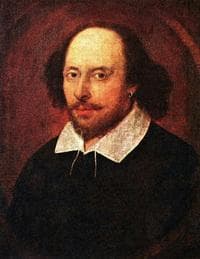
William Shakespeare was an English playwright, poet and actor. He is widely regarded as the greatest writer in the English language and the world's pre-eminent dramatist. He is often called England's national poet and the "Bard of Avon". His extant works, including collaborations, consist of some 39 plays, 154 sonnets, three long narrative poems, and a few other verses, some of uncertain authorship. His plays have been translated into every major living language and are performed more often than those of any other playwright. Shakespeare remains arguably the most influential writer in the English language, and his works continue to be studied and reinterpreted.

Ashley Antoinette
4.6

Mark McDonald
4.4
Luo Guanzhong
4.4
Mia McKenzie
4.3
Dorothy Parker
4.3
Joaquim Maria Machado de Assis
4.3
James Thurber
4.2

Terry Kay
4.2