“Beware of first-hand ideas!”
— Spoken by Vashti to Kuno, highlighting the society's fear of originality.

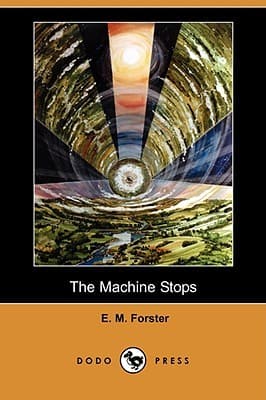
E.M. Forster (1909)
Genre
Science Fiction
Reading Time
45 min
Key Themes
See below
Sign in to track this book
In a future where humanity lives isolated beneath the earth, dependent on a Machine for every need, a mother and son face the terrifying consequences when the Machine begins to fail.
The story begins with Vashti, a respected lecturer in the underground world, bothered by a call from her son, Kuno. Kuno lives on the surface, a forbidden place. Vashti, like all inhabitants, lives in a small, hexagonal cell, connected to the world only through the Machine, which provides all needs. She is annoyed by Kuno's interruption, as physical interaction is crude. Kuno insists she visit him, a request that fills Vashti with dread. It means leaving her cell and traveling on the Machine's transport system, which she finds taxing and awkward.
Despite her aversion, Vashti agrees to visit Kuno. She prepares for the journey, which includes donning an anti-septic garment and navigating the Machine's pneumatic transport. The journey causes her great anxiety. She is unaccustomed to physical exertion, the presence of others in the tubes, and the lack of immediate access to her usual comforts. She finds the experience exhausting and primitive, which reinforces her belief in her cell-bound existence. Her discomfort grows with fleeting glances from other passengers, whom she views with pity and disdain.
Upon reaching Kuno's cell, Vashti is shocked by his appearance and his room, which has a window. Kuno, frail and distressed, explains he was 'unhoused' for breaking the Machine's rules. He confesses he went to the surface, not through the Machine's tunnels, but through an old ventilation shaft. He describes the beauty of the sun, stars, and fresh air. He also saw other humans on the surface, primitive and wild, who tried to kill him. He believes these are humanity's true ancestors, not the Machine-dependent beings underground.
Vashti returns to her cell, disturbed by Kuno's revelations but quickly dismissing them as heresy. She tries to resume her normal life, lecturing and discussing through the Machine. However, she notices subtle, unsettling changes. The Machine's perfection seems to falter; her food quality lessens, lectures are interrupted by static, and minor repairs become more frequent. The inhabitants dismiss these anomalies as temporary glitches, continuing to worship the Machine and blaming imperfections on their own lack of understanding.
As the Machine's malfunctions grow more frequent and severe, the underground society does not investigate or repair. Instead, they create a religion around it. They develop rituals, prayers, and hymns dedicated to the Machine, believing its 'spirit' suffers and needs appeasement. The 'Book of the Machine,' a collection of instructions, becomes their sacred text. Knowledge of the Machine's mechanics is lost, replaced by dogma and blind faith. Vashti, like others, accepts these new rituals, finding comfort in the collective delusion rather than confronting the Machine's decay.
The deterioration speeds up. Food supplies become scarce and unappetizing, ventilation systems falter, and automated repairs fail more often. People begin to feel physical discomfort, hunger, and respiratory issues, previously unknown. Despite the evidence, they continue to believe in the Machine's benevolence. They rationalize the failures, blaming themselves or 'unseen forces,' rather than acknowledging the breakdown. The lack of air becomes a significant problem, causing widespread panic and weakness.
One devastating failure is the communication system breakdown. The 'pneumatic post' stops. Then, the 'speaking apparatus' (like video conferencing) goes silent. This isolates individuals in their cells, cutting them off from their only social interaction. Vashti, once a celebrated lecturer, cannot connect with anyone. The silence and solitude are terrifying, as their social fabric relied on this effortless communication. The 'Book of the Machine' is also lost when its reading apparatus fails.
The ultimate catastrophe arrives when the Machine's lighting system fails. The entire underground world plunges into darkness. Panic ensues, as inhabitants have never known a world without artificial light. Vashti, terrified and disoriented, struggles in the dark. She hears others suffering and dying around her. In this despair, Kuno's voice reaches her, calling. He has found his way to her cell, guided by his understanding of the physical world and his surface experiences.
In the darkness, Kuno finds Vashti. He is weakened but driven to share the truth before the end. He tells her the Machine has stopped and humanity lost its way by abandoning the surface. He describes the 'surface people' he saw again, who are now likely the only survivors. Vashti, her mind broken by the horror, finally acknowledges his words. As they hold hands, a final groan echoes through the Machine, signaling its complete collapse. The air grows still and cold.
As the Machine dies, Vashti and Kuno lie together in darkness, accepting their fate. Kuno, despite his impending death, expresses a final hope for humanity. He believes the 'surface people,' those who never succumbed to the Machine's control, will survive and rebuild. He urges Vashti to remember the beauty of the stars and humanity's potential beyond the Machine. As the last air and light fade, they perish. Kuno's words offer a glimmer of hope that the human spirit, free from technological enslavement, might endure and return to the natural world.
The Protagonist
Vashti initially resists Kuno's warnings, but through the Machine's collapse, she is forced to confront the harsh reality and ultimately accepts Kuno's vision of humanity's past and future.
The Antagonist/Prophet
Kuno begins as a rebellious outcast, physically and socially punished for his actions, but ultimately becomes a tragic prophet whose vision is validated by the Machine's destruction.
The Antagonist/Setting
The Machine experiences a slow, inexorable decline, moving from a flawless provider to a failing, then defunct, system, symbolizing the hubris of technological utopianism.
The Supporting
They represent a static group, serving as an example of the Machine's control and punishment.
The Mentioned
Initially believed to be perfect, its increasing failures foreshadow the Machine's complete collapse.
The Mentioned
Its transformation from a guide to a sacred text, then to an unreadable relic, mirrors the society's intellectual decay and ultimate destruction.
The central theme explores the dangers of humanity's over-reliance on technology. The Machine provides every need, removing the necessity for physical effort, direct experience, or independent thought. This dependence leads to physical degeneration, intellectual stagnation, and the loss of basic human capabilities. Kuno's rebellion highlights the human desire for autonomy and connection to the natural world, contrasting with Vashti's passive acceptance of technological enslavement. The story warns about surrendering human agency to an all-encompassing system, as the Machine's failure renders its inhabitants helpless and leads to their demise.
“''Beware of first-hand ideas!' exclaimed one of the most advanced of them. 'First-hand ideas do not exist. They are but the inevitable outcome of the Machine. Obey the Machine; for in obedience lies true knowledge.'”
The story shows humanity completely estranged from the natural world. The underground inhabitants live in sterile, artificial environments, seeing the surface as a mythical, dangerous place. Kuno's accounts of the sun, stars, and fresh air are met with disbelief by Vashti and others, who have lost all appreciation for natural beauty. This separation from nature links to their physical weakness and spiritual emptiness. The Machine's failure forces a confrontation with the elements, leading to death. However, through Kuno, it also shows a desperate yearning for the lost connection, suggesting a return to nature is essential for human survival.
“'The surface of the earth is only to be contemplated by those who have been appointed to do so.'”
Forster critiques a society where intellectual discourse is superficial and conformist, mediated entirely by the Machine. People exchange abstract ideas and lecture on topics like 'Music' without real-world experience or critical engagement. Original thought is discouraged, called 'first-hand ideas' and deemed dangerous. Kuno's genuine, experiential knowledge is seen as heresy. Vashti embodies the intellectual who prioritizes received wisdom over direct observation. This intellectual isolation and pressure to conform lead to a collective inability to recognize or address the system's collapse, contributing to their destruction.
“'The Machine is much, but it is not everything. I see something like you in the darkness, but I cannot see you. I hear something like you in the darkness, but I cannot hear you.'”
The Machine world inhabitants are physically frail, sensitive to light and air, and averse to any exertion or direct interaction. Their bodies have atrophied from a life of ease and automation. Vashti's journey to Kuno is an ordeal of physical discomfort, showing how far humanity has strayed from its natural state. This physical degeneration intertwines with their loss of direct experience; they prefer mediated knowledge and virtual interaction to real-world engagement. The story suggests that a healthy human existence needs physical activity and direct engagement with one's environment, not just intellectual pursuits.
“'You are going to see a terrible thing. I have seen it already. It is the surface of the earth.'”
Early hints and warnings about the Machine's inevitable collapse.
Forster employs extensive foreshadowing to build suspense and convey the story's message. Kuno's repeated warnings to Vashti about the Machine's fragility and the importance of the surface are explicit examples. More subtle hints include the increasing 'minor breakdowns' and the diminishing quality of services provided by the Machine, which are initially dismissed by the inhabitants. These subtle and overt clues prepare the reader for the eventual catastrophic failure, emphasizing the characters' blindness and complacency.
The hexagonal room representing isolation and technological confinement.
The 'cell' in which each individual lives is a powerful symbol. Its hexagonal shape suggests both efficiency and artificiality, while its small, enclosed nature represents the physical and social isolation of the inhabitants. The cell provides all needs, but at the cost of genuine connection, freedom, and direct experience. It is a metaphor for the self-imposed prison created by over-reliance on technology, where comfort trumps true living. The characters' reluctance to leave their cells further emphasizes their confinement and dependence.
A sacred text representing dogma and the loss of true knowledge.
The 'Book of the Machine' functions as a symbolic plot device, representing the transformation of practical knowledge into religious dogma. Initially a manual, it becomes a revered, unchangeable text, replacing critical thought and scientific understanding. Its eventual unreadability due to the failure of the reading apparatus signifies the complete loss of intellectual and practical knowledge necessary to maintain their civilization. It highlights how rigid adherence to doctrine, especially in the face of changing circumstances, can lead to catastrophic ignorance.
The contrast between perceived perfection and underlying decay.
The story is steeped in irony. The Machine, designed to provide comfort and eliminate effort, ultimately leads to humanity's physical degeneration and death. The inhabitants pride themselves on their 'advanced' intellectual discussions, yet they are incapable of independent thought or problem-solving. They worship the Machine as a benevolent deity, even as it actively fails them. This pervasive irony underscores the tragic consequences of their collective delusion and highlights the disparity between their self-perception and their actual, vulnerable state.
“Beware of first-hand ideas!”
— Spoken by Vashti to Kuno, highlighting the society's fear of originality.
“A man who has been on the surface of the earth shall be punished.”
— The official rule regarding anyone who ventures outside the Machine.
“The Machine is much, much more than we are. We exist only as part of it.”
— Vashti's deep-seated belief in the Machine's superiority and humanity's subservience.
“We created the Machine, to do our will, but we cannot make it do our will now. It has created us.”
— Kuno's realization about the reversal of power between humanity and the Machine.
“The Machine is stopping, I know it, I know it, I know it.”
— Kuno's desperate and prophetic warning to Vashti as the Machine begins to fail.
“You are living in a nightmare.”
— Kuno's direct accusation to Vashti about the nature of their existence within the Machine.
“She knew that for thousands of years love had been a physical passion, and that for thousands of years it had been a social institution.”
— Vashti's detached contemplation of love, which is absent in their society.
“The earth is dying.”
— A simple yet profound statement about the state of the world outside the Machine.
“Man is the measure of all things.”
— Kuno's reassertion of human importance, contrasting with the Machine-centric view.
“We are getting to be like the ants.”
— Kuno's observation on the loss of individuality and the hive-mind mentality.
“The air-ship had been invented, and had been found to be a failure.”
— An example of a technological advancement that failed, illustrating the Machine's limitations.
“We have forgotten what the earth looks like.”
— A poignant reflection on the complete detachment from nature.
“The Machine proceeds—but not to a goal. We know not whither, we know not why.”
— A realization about the purposelessness of their technologically driven existence.
“The Machine, which had been so wonderful, had become a terror.”
— The transformation of the Machine from a benevolent provider to an oppressive force.
Ready to see how well you understood this book? Take our interactive quiz with 10 questions.

Edward Morgan Forster was an English author, best known for his novels, particularly A Room with a View (1908), Howards End (1910) and A Passage to India (1924).