“It is amazing how complete is the delusion that beauty is goodness.”
— Pondering the nature of his wife's beauty and the societal perception of it.

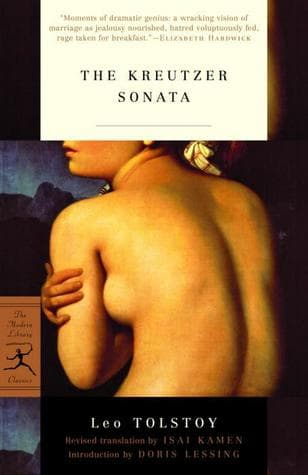
Leo Tolstoy (1887)
Genre
Fiction
Reading Time
120 min
Key Themes
See below
Sign in to track this book
Consumed by corrosive jealousy over his wife's musical partnership, Pozdnyshev murders her, exposing the hypocrisies of 19th-century marriage and Tolstoy's conflicted Christian views on lust and art.
The story begins with the narrator on a train, watching diverse passengers discuss love, marriage, and divorce. Among them are an old merchant, a lawyer, and a woman. The conversation turns to love and marriage, with different opinions expressed. A man named Pozdnyshev, initially quiet, suddenly speaks with a passionate and cynical view, claiming that love, as society understands it, is just hidden animal desire. His intensity and the dark implications of his words immediately draw the other passengers, especially the narrator, who feels uneasy and curious about Pozdnyshev's past experiences that led to such bitterness.
Pozdnyshev begins to tell his story, detailing his youth as a reckless nobleman. He describes a life of promiscuity and a careless attitude toward women, which he now deeply regrets. He confesses that he married his wife not out of true love, but mostly because of social expectations and a physical attraction he now calls lust. He describes the start of their marriage as a series of arguments and reconciliations, caused by a basic misunderstanding and a lack of true intimacy, despite appearing happy to outsiders. He laments the hypocrisy in society's views of marriage.
As Pozdnyshev's story continues, he describes his marriage falling apart. He and his wife argued constantly, often over small things, which grew into deep resentment. He blames much of this on the 'animal passion' that first brought them together, which quickly faded, leaving only irritation and mutual blame. Their life became a performance for society, while privately they were unhappy. Their children, instead of bringing them closer, added more stress, as they argued over parenting and money. Pozdnyshev reflects on the social pressure to maintain the illusion of a happy marriage, even as it crumbles, leading to a profound sense of entrapment and despair for both.
The story changes with the arrival of Trukhachevsky, a talented violinist and an acquaintance from Pozdnyshev's youth. Trukhachevsky is invited to their home, initially to play music with Pozdnyshev's wife, who is a skilled pianist. Pozdnyshev describes Trukhachevsky as charming and confident, which immediately makes him uneasy. He notices the growing closeness between his wife and the musician, seeing how their shared love for music creates a bond that excludes him. This new dynamic fuels Pozdnyshev's already growing jealousy and suspicion, setting the stage for the tragic events to come as he sees a threat to his marital authority and his wife's loyalty.
The key moment happens during a performance of Beethoven's Kreutzer Sonata by Trukhachevsky and Pozdnyshev's wife. Pozdnyshev attends the concert, trying to ignore his growing unease. However, as the music plays, he feels an overwhelming sense of dread and a powerful surge of jealousy. He describes the music as having a dangerous, intoxicating effect, able to unleash primal passions. He sees the intense connection between his wife and Trukhachevsky as they play, viewing it as more than just music but a deep, almost forbidden intimacy. The music seems to remove all pretense, revealing what Pozdnyshev sees as a sexual and emotional betrayal, pushing him to the brink of madness.
After the concert, Pozdnyshev's paranoia becomes unbearable. He is convinced his wife and Trukhachevsky are having an affair, despite no real proof. He confronts his wife, who denies any wrongdoing, but her denials only feed his suspicion. The atmosphere in their home becomes tense and distrustful. Unable to stand the situation, and driven by uncontrollable rage, Pozdnyshev decides to leave for a provincial town on a business trip, hoping distance might ease his torment. However, this departure only intensifies his obsessive thoughts, as he imagines them together in his absence, further solidifying his belief in their betrayal.
Consumed by his dark thoughts, Pozdnyshev abruptly ends his business trip and returns home unannounced. As he approaches his house, he believes his suspicions are confirmed when he sees Trukhachevsky's shoes in the hall. He enters the drawing-room to find his wife and Trukhachevsky sitting together, seemingly innocent, but to Pozdnyshev, their presence confirms his deepest fears. The sight of them together, even if just talking, sends him into a violent frenzy. The accumulated jealousy, resentment, and perceived betrayal of years erupt at that moment, overshadowing any rational thought. He feels a powerful, almost involuntary urge to act on his rage.
In a fit of uncontrollable rage and delusion, Pozdnyshev grabs a dagger and attacks his wife. He describes the act with chilling detachment, as if it were an inevitable outcome of their troubled marriage and his consuming jealousy. He stabs her repeatedly, driven by a desire to destroy what he sees as her betrayal and the source of his suffering. Trukhachevsky manages to escape, but Pozdnyshev's wife collapses and dies. The immediate aftermath is a blur of shock and a sudden, horrifying clarity for Pozdnyshev, as the reality of his actions hits him amidst the chaos and desperate cries. The violence is swift and brutal, marking the tragic climax of his story.
After the murder, Pozdnyshev describes the immediate shock and the arrival of the authorities. He is arrested and tried. During the trial, he claims he acted in self-defense, driven by intense emotional distress from his wife's perceived infidelity. He is acquitted, largely due to the circumstances and society's leniency toward men in such cases, combined with his own compelling, though self-serving, testimony. However, the legal acquittal does not bring him peace. Instead, he is left with the crushing burden of guilt and the profound realization of the irreversible harm he caused, both to his wife and to his own soul.
Pozdnyshev concludes his confession to the narrator, expressing deep remorse for his actions and the destruction of his family. He has come to believe that the root cause of his tragedy is the nature of physical love and the social institution of marriage, which he now sees as flawed and hypocritical. He advocates for a more spiritual and ascetic approach to human relationships, arguing that true love, if it exists, should go beyond physical desire. He warns against the dangers of lust and the destructive power of jealousy, reflecting on his own life as a cautionary tale. He carries the weight of his crime, finding no comfort, only a bitter understanding of his past.
The Protagonist
Pozdnyshev transforms from a seemingly ordinary, albeit cynical, husband into a murderer, ultimately becoming a remorseful, yet unrepentant, prophet of asceticism.
The Victim/Supporting
She begins as a young wife trying to navigate a difficult marriage, eventually becoming the innocent victim of her husband's unchecked jealousy and madness.
The Supporting
He remains largely unchanged, serving primarily as a catalyst for Pozdnyshev's unraveling.
The Supporting
Remains a static character, serving as a witness to Pozdnyshev's confession.
The Mentioned
A static character, representing a traditional societal viewpoint.
The Mentioned
A static character, representing a legalistic societal viewpoint.
The main theme is the destructive results of uncontrolled physical desire and jealousy. Pozdnyshev argues that 'animal passion,' not true love, forms the basis of most marriages, leading to disappointment and conflict. His own marriage, initially driven by lust, becomes a source of mutual hatred and suspicion. His jealousy over his wife's perceived infidelity, especially with Trukhachevsky, consumes him, blinding him and driving him to murder. The Kreutzer Sonata performance intensifies his paranoia, showing how art, combined with existing emotional instability, can unleash destructive forces. Tolstoy criticizes society's romanticization of passion, revealing its potential for brutality.
“What is it, this love? It is a temporary physical passion, which, to justify itself, clothes itself in various sentimental garments.”
Tolstoy sharply criticizes the institution of marriage in 19th-century society, particularly among the upper classes. Pozdnyshev exposes the hypocrisy in marriages based on social convention, money, and physical attraction rather than genuine spiritual connection. He describes how his own marriage was a facade, maintained for public appearance while privately crumbling under resentment and misunderstanding. The expectation of fidelity for women versus the quiet acceptance of male promiscuity (before marriage, at least) is highlighted. The novel suggests that this social pressure to maintain a false image of marital happiness often leads to deep unhappiness, moral corruption, and, in Pozdnyshev's case, tragedy. The 'ownership' mentality of husbands is also a key part of this criticism.
“They got married, and then they tormented each other, hated each other, and all because they had lied to themselves, to others, and to God.”
The novel explores the complex and often dangerous power of art, specifically music. Pozdnyshev views music, especially the Kreutzer Sonata, as a powerful force capable of arousing passions and blurring moral lines. He argues that music can be intoxicating and morally corrupting if not understood and controlled. The performance of the Kreutzer Sonata by his wife and Trukhachevsky is not just a musical event but, for Pozdnyshev, a deeply sensual and almost forbidden act that ignites his jealousy to a murderous level. Tolstoy suggests that art, though beautiful, can be morally ambiguous, stirring up base desires rather than elevating the spirit, especially when separated from spiritual purpose or when consumed by individuals lacking self-control.
“Music is a terrible thing. I cannot conceive of its effect on me. It acts as if something new, something terrible is being revealed to me.”
A fundamental theme is the conflict between self-denial and sensuality, reflecting Tolstoy's strong Christian ideals at the time of writing. Pozdnyshev, after his crime, adopts a radical ascetic worldview, condemning all forms of physical desire and advocating for complete abstinence, even within marriage. He believes that humanity's salvation lies in overcoming the flesh and living a purely spiritual life, seeing sexual desire as the root of all evil and suffering. This theme appears in his retrospective condemnation of his own youthful excesses and his married life. The novel grapples with the tension between human nature's inherent sensuality and the moral need for spiritual purity, questioning whether such extreme self-denial is truly possible or desirable for humanity.
“The ideal is a chaste life, and marriage is a fall, a deviation from the ideal.”
Pozdnyshev's entire story is told through his own biased and subjective perspective.
The novel is structured as a first-person confession, where Pozdnyshev recounts his life story and the murder of his wife directly to an unnamed narrator on a train. This device allows Tolstoy to delve deep into the protagonist's psychological state, revealing his obsessive thoughts, rationalizations, and profound remorse. However, it also means the reader receives a highly biased account, colored by Pozdnyshev's extreme views on marriage, women, and lust. We never hear his wife's perspective directly, forcing the reader to critically evaluate Pozdnyshev's narrative and question the reliability of his justifications for his actions.
Pozdnyshev's confession is embedded within a larger conversation among train passengers.
The story employs a frame narrative, beginning with a general discussion among several train passengers about love, marriage, and divorce. This initial conversation sets the societal context and introduces various viewpoints before Pozdnyshev, previously silent, interjects with his radical opinions. This framing device serves to highlight the contrast between conventional societal views and Pozdnyshev's extreme, post-murder perspective. It also draws the reader in by creating an atmosphere of curiosity and tension, as the narrator (and thus the reader) becomes captivated by Pozdnyshev's intensity and the dark implications of his initial statements, prompting the detailed confession that follows.
Beethoven's Kreutzer Sonata symbolizes uncontrolled passion and moral ambiguity.
Beethoven's Kreutzer Sonata functions as a powerful symbol in the novel. For Pozdnyshev, the music is not merely a piece of art but a representation of dangerous, intoxicating passion that can unleash primal instincts. When his wife and Trukhachevsky play it, he perceives it as a deeply sensual and almost illicit act, fueling his jealousy and confirming his darkest suspicions. The music symbolizes the seductive and potentially corrupting power of art when interpreted through a lens of moral decay and unchecked desire. It becomes a catalyst for his psychological breakdown, pushing him over the edge into violence, demonstrating how art can amplify human emotions to destructive ends.
Early discussions and Pozdnyshev's demeanor hint at the tragic outcome.
From the very beginning of the narrative, elements of foreshadowing are present. Pozdnyshev's initial cynical and bitter interjections in the train conversation, his dark pronouncements about marriage, and his withdrawn, intense demeanor all hint at a tragic past. His radical views on the destructive nature of love and lust immediately signal that his own experiences must have been profoundly negative. These early indications create a sense of unease and suspense, preparing the reader for the shocking confession of murder that eventually unfolds, making the violent climax feel, to Pozdnyshev, inevitable.
“It is amazing how complete is the delusion that beauty is goodness.”
— Pondering the nature of his wife's beauty and the societal perception of it.
“Love? What is love? Love is our name for the craving to be made whole.”
— Questioning the true nature of love and human desire.
“People talk of the immorality of the novel. Immorality! They are mistaken; it is not immoral, it is unnatural.”
— Discussing the societal views on marriage and relationships, criticizing their artificiality.
“Sexual desire, however much we may pretend the contrary, is the chief stimulant in life.”
— Reflecting on the powerful and often unacknowledged role of sexual desire in human actions.
“The higher a man's spiritual development, the more he avoids the complexities of marriage.”
— Arguing that true spiritual growth might lead one away from conventional marital arrangements.
“If people would only understand that there is no happiness in love, but only in marriage.”
— A somewhat ironic statement, highlighting the disillusionment with romantic love versus the reality of marriage.
“Music is a terrible thing. I mean, what is music? What does it do? It takes hold of you and hurls you into another state of mind.”
— Expressing his strong reaction to music, especially the Kreutzer Sonata, and its powerful emotional impact.
“It is not passion that makes people unhappy, but the failure to control it.”
— Considering the destructive nature of uncontrolled emotions and desires.
“What is the good of children if they are to be born only to suffer?”
— Pondering the purpose of procreation in a world filled with suffering and moral complexities.
“The doctors had told me that I could not live without a wife, and I believed them.”
— Recalling the societal pressure and medical advice that influenced his decision to marry.
“I was tormented by jealousy, as only a man can be tormented who loves without faith.”
— Describing the intense and destructive nature of his jealousy, rooted in a lack of trust.
“We are educated to look upon love as a kind of ideal, but it is often nothing more than a refined form of animalism.”
— Deconstructing the romanticized notion of love and revealing its more primal aspects.
“Marriage is a business, and a hard one at that, not a game.”
— Emphasizing the practical and often difficult realities of marriage, contrasting it with romantic ideals.
“The greatest evil is not what you do, but what you allow yourself to think.”
— Reflecting on the power of thoughts and intentions in shaping one's actions and moral state.
Ready to see how well you understood this book? Take our interactive quiz with 10 questions.

Count Lev Nikolayevich Tolstoy, usually referred to in English as Leo Tolstoy, was a Russian writer who is regarded as one of the greatest authors of all time. He received nominations for the Nobel Prize in Literature every year from 1902 to 1906 and for the Nobel Peace Prize in 1901, 1902, and 1909; the fact that he never won is a major controversy.

Ashley Antoinette
4.6

Mark McDonald
4.4
Luo Guanzhong
4.4

Mia McKenzie
4.3
Dorothy Parker
4.3
Joaquim Maria Machado de Assis
4.3
James Thurber
4.2
Terry Kay
4.2