“I wasn't trying to beat him, I was trying to beat myself.”
— Eddie Felson reflecting on his motivation during a pool game.

Sign in to track this book
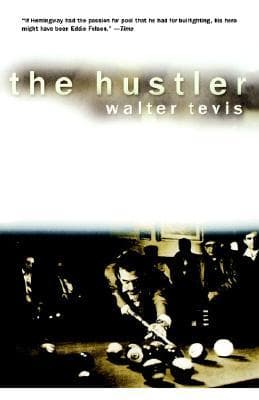
In the smoky, high-stakes world of 1950s pool halls, "Fast" Eddie Felson, a cocky young hustler, confronts his ambition and self-worth when he challenges the legendary Minnesota Fats, forcing him to reckon with the true cost of victory and defeat.
Fast Eddie Felson, a young, cocky pool hustler, arrives in Chicago with his partner Charlie Burns, intent on challenging the legendary Minnesota Fats. Eddie has a reputation for being unbeatable, and he's confident he can take down Fats, who is renowned as the best in the country. They find Fats at Ames' Pool Hall, a high-stakes establishment where Fats reigns supreme. Eddie, after observing Fats's play, challenges him to a game of straight pool. The initial stakes are small, but as Eddie's confidence grows and Fats demonstrates his formidable skill, the betting escalates, drawing a large crowd and the attention of the hall's owner, Bert Gordon.
The match between Fast Eddie and Minnesota Fats turns into an epic, two-day marathon. Eddie initially gains a significant lead. However, Eddie's arrogance and a critical mistake, drinking bourbon during the game, begin to erode his focus and precision. Fats, with his unwavering composure and seemingly endless stamina, slowly chips away at Eddie's lead. Despite Charlie's desperate attempts to get Eddie to quit while ahead, Eddie's pride compels him to continue. After twenty-five grueling hours, Eddie, physically and mentally exhausted, makes a series of errors, losing all his money and suffering a humiliating defeat to Fats.
After his crushing loss, Fast Eddie is emotionally shattered and financially ruined. He rejects Charlie Burns's offer to stake him again, feeling betrayed by Charlie's caution during the match. Eddie wanders aimlessly, eventually finding solace in a bus station where he encounters Sarah Packard, a lonely, alcoholic woman. Sarah is drawn to Eddie's vulnerability, and they strike up a conversation that leads to them spending the night together. This encounter marks a significant turning point for Eddie, offering him a chance at a life outside the pool hall and a different kind of connection than he's ever known.
Eddie and Sarah move in together, sharing a small room. Eddie attempts to find regular work, taking a job as a dishwasher, but he finds the mundane tasks unfulfilling. His mind constantly drifts back to the pool hall and his desire for redemption against Minnesota Fats. Sarah, recognizing his internal struggle, tries to encourage him to pursue his passion, despite her own fears about his self-destructive tendencies. Their relationship deepens, providing Eddie with a sense of stability and emotional support he's never experienced, yet the allure of the green felt table and the challenge of Fats continue to haunt him.
While hustling small games to make ends meet, Fast Eddie is approached by Bert Gordon, a wealthy and powerful gambler who observed his marathon match with Minnesota Fats. Bert sees potential in Eddie but also recognizes his fatal flaw: a lack of character. Bert offers to bankroll Eddie, providing him with the money and connections to challenge Fats again, but under strict conditions. Bert demands total control over Eddie's games, his winnings, and his personal life, requiring Eddie to forfeit his independence and play according to Bert's cold, calculating rules, stripping Eddie of his self-respect.
Bert Gordon takes Eddie to the Kentucky Derby, a high-society event, to hustle wealthy marks. Eddie, under Bert's strict guidance, wins a considerable sum of money. However, during a game, Eddie, fueled by a resurgence of his old pride and a desire to prove his independence, deliberately disobeys Bert's instructions to lose a specific game, instead winning it outright. This act of defiance infuriates Bert. As punishment, Bert's enforcers brutally break Eddie's thumbs, crippling his ability to play pool and sending a clear message about the consequences of disobeying Bert's will, leaving Eddie in excruciating pain and despair.
After the brutal beating, Fast Eddie returns to Sarah Packard, his hands bandaged and his spirit crushed. Sarah is horrified by his injuries and the realization of the violent world he inhabits. She sees the extent of Bert Gordon's control over Eddie and the destruction it has wrought upon him. Already struggling with her own alcoholism and a sense of hopelessness, Sarah's despair deepens. Unable to cope with Eddie's brokenness and the bleakness of their future, she leaves him a note and tragically commits suicide, leaving Eddie utterly alone and burdened by immense guilt and grief.
Devastated by Sarah's death and his physical injuries, Fast Eddie hits rock bottom. He spends weeks recovering, both physically and emotionally. The pain in his thumbs gradually subsides, and with it, a renewed, more mature determination begins to form. Sarah's memory, though painful, also acts as a catalyst for change. He realizes that his previous arrogance and lack of character were major factors in his downfall. Eddie begins to practice again, slowly regaining his touch and developing a newfound patience and control, understanding that true mastery requires more than just raw talent.
With his thumbs healed and his spirit tempered by loss and suffering, Fast Eddie returns to Ames' Pool Hall to challenge Minnesota Fats once more. This time, Eddie is different. He's no longer the cocky, self-destructive hustler; he's a man who has faced his demons and emerged with a deeper understanding of himself and the game. The match is intense, but Eddie plays with a new level of focus, composure, and strategic brilliance. He avoids his previous mistakes, demonstrating not just superior skill, but also a newfound mental fortitude that was absent in their first encounter.
Fast Eddie, demonstrating almost Zen-like concentration, systematically dismantles Minnesota Fats's game. He plays with a precision and control that Fats cannot match. The crowd, initially skeptical, becomes captivated by Eddie's transformed play. He finally defeats Fats, achieving the victory he so desperately sought. However, the triumph is bittersweet. Bert Gordon, still present, demands a percentage of Eddie's winnings, reminding him of the controlling nature of the game and the moral compromises he's had to make. Eddie has proven himself as the best player, but the journey has cost him Sarah and his innocence, leaving him with a hollow victory.
The Protagonist
Eddie transforms from a cocky, self-destructive hustler to a more mature, disciplined player who understands the true cost of victory and the importance of character.
The Antagonist/Rival
Fats remains a consistent, formidable presence throughout, serving as a benchmark against which Eddie measures his own growth and skill.
The Supporting
Sarah's initial hope for a stable life with Eddie is tragically crushed by the harsh realities of his world, leading to her suicide.
The Antagonist
Bert remains a constant, manipulative force, demonstrating the unchanging nature of greed and control within the hustling world.
The Supporting
Charlie attempts to guide Eddie but ultimately separates from him due to Eddie's self-destructive pride.
The Mentioned
Not applicable, a static background character.
The Mentioned
Not applicable, a static background character.
The novel explores the idea that winning is not solely about skill, but also about character, mental fortitude, and self-control. Eddie's initial loss to Minnesota Fats is not due to a lack of talent, but a lack of discipline and an arrogant self-destructive streak (drinking during the game, refusing to quit while ahead). His eventual victory comes only after he has endured profound personal loss and learned to control his pride and emotions, demonstrating that true mastery encompasses more than just physical ability. The book questions what it truly means to win, suggesting it's about inner strength as much as external triumph.
“He knew that he had lost not because Fats was a better player, but because he, Eddie, was a better loser.”
Eddie's journey is heavily influenced by his overwhelming pride, which frequently leads him to self-sabotage. His initial defeat to Minnesota Fats is a direct result of his inability to walk away when ahead, driven by an arrogant desire to utterly humiliate Fats. This pride also manifests in his defiance of Bert Gordon, leading to his brutal punishment. It is only when Eddie is stripped of everything – his money, his ability to play, and tragically, Sarah – that he begins to shed this destructive pride and develop a more mature, disciplined approach to life and the game.
“He had to prove it, had to prove it to himself, and to Fats, and to the whole goddamned world.”
The novel illustrates the steep personal cost of pursuing one's ambition, especially in a ruthless environment like the world of high-stakes hustling. Eddie's relentless quest to defeat Minnesota Fats leads him through physical violence, emotional devastation, and the tragic loss of Sarah Packard. His redemption isn't a simple triumph; it's a hard-won victory achieved through immense suffering and self-reflection. The story suggests that while ambition can drive greatness, it can also demand profound sacrifices, questioning whether the ultimate reward is always worth the price paid.
“He had paid for it, all right, paid for it with Sarah, and with his hands, and with his soul.”
Bert Gordon embodies the corrupting influence of power and money. He is a character who views people as instruments to be controlled and exploited for profit. His offer to bankroll Eddie comes with the explicit demand for total control, stripping Eddie of his autonomy and self-respect. The brutal breaking of Eddie's thumbs is a stark reminder of the violent consequences for those who defy this power. The novel suggests that in certain environments, the pursuit of wealth and dominance can dehumanize individuals and foster a morally bankrupt system.
“Money isn't everything, but it buys everything.”
An extended, high-stakes pool game used to reveal character flaws.
The initial marathon match between Fast Eddie and Minnesota Fats is a crucial plot device. Its extended duration and escalating stakes strip away Eddie's façade, exposing his arrogance, lack of stamina, and self-destructive tendencies (drinking bourbon, refusing to quit). The match serves as a crucible, highlighting Eddie's fatal flaws and setting the stage for his subsequent downfall and journey of self-discovery. It's not just a game; it's a psychological battle that reveals the true nature of the players.
A manipulative figure who offers opportunity at a moral cost.
Bert Gordon functions as both a twisted mentor and a primary antagonist. He provides Eddie with the means to challenge Fats again but demands a moral price for it. Bert's character allows the novel to explore themes of control, corruption, and the dehumanizing aspects of the gambling world. He forces Eddie to confront the compromises required for success and serves as an external force that brutally punishes Eddie's defiance, catalyzing his most profound personal growth through suffering.
A brutal consequence that forces a protagonist's re-evaluation.
The breaking of Eddie's thumbs is a pivotal plot device. It is a direct, visceral consequence of his defiance against Bert Gordon, symbolizing the physical and psychological pain inflicted by the ruthless world he inhabits. This injury physically incapacitates Eddie, forcing him away from the pool table and into a period of introspection and recovery. It serves as a catalyst for his rock bottom, leading to Sarah's death and ultimately, his transformation into a more disciplined and mature player.
A character who represents an alternative life and whose loss fuels the protagonist's growth.
Sarah Packard serves as a crucial plot device, representing a potential alternative life for Eddie outside the cutthroat world of pool. Her vulnerability and love offer Eddie emotional solace and a chance at genuine connection. Her tragic suicide, directly resulting from the violence and despair inherent in Eddie's chosen path, becomes the ultimate sacrifice. Her death profoundly impacts Eddie, stripping him of his last emotional anchor and forcing him to confront the true cost of his ambition, ultimately fueling his final, more mature quest for redemption.
“I wasn't trying to beat him, I was trying to beat myself.”
— Eddie Felson reflecting on his motivation during a pool game.
“Fast Eddie Felson. That's what they call me. Fastest cue in the west.”
— Eddie introducing himself, establishing his early reputation.
“He ain't a loser. He's a winner who hasn't won yet.”
— Bert Gordon describing Eddie's potential to Sarah.
“You got to have character to be a winner.”
— Bert Gordon explaining his philosophy to Eddie.
“The money isn't important. It's the winning.”
— Eddie Felson's core belief about playing pool.
“He played a game, not just with the balls, but with me, too.”
— Eddie's realization about Minnesota Fats' psychological play.
“I felt like I was being watched, not just by him, but by the whole room.”
— Eddie describing the pressure of playing against Minnesota Fats.
“It isn't enough to be good. You have to be lucky.”
— Eddie's reflection on the role of luck in success.
“You're a born loser, Eddie. You're a natural-born loser.”
— Bert Gordon's harsh assessment of Eddie after a defeat.
“I didn't want to just win. I wanted to destroy him.”
— Eddie's intense desire for revenge in a rematch.
“The table was a green ocean, and I was the only ship on it.”
— Eddie's immersive experience while focused on playing pool.
“You can't buy class, Eddie. You either got it or you don't.”
— Bert Gordon's commentary on inherent qualities versus acquired ones.
“The worst thing you can do is quit.”
— A recurring theme about perseverance in the face of defeat.
“The hustler doesn't just play the game. He plays the player.”
— A description of the psychological aspect of hustling.
Ready to see how well you understood this book? Take our interactive quiz with 10 questions.

Biography coming soon.