“How can I be good when everything is so expensive?”
— Shen Teh's initial struggle to maintain goodness while facing economic hardship.


Bertolt Brecht (1953)
Genre
Fiction
Reading Time
90-120 min
Key Themes
See below
Sign in to track this book
In a world where goodness means death, a kind woman in Communist China creates a ruthless male alter ego to survive the people she tries to help.
The play starts with Wong, a water seller, waiting for three Gods. Rumor says they are looking for a good person on Earth. Wong, often poor and exploited, hopes their visit will bring change. When the Gods arrive, tired from their search in other cities, people ignore them. Most refuse them lodging, claiming poverty or no space. Only Shen Teh, a kind prostitute, takes them in, offering her small home and food. The Gods are relieved and call her the 'good woman of Setzuan.' They give her money to leave her profession and live a good life.
With the Gods' money, Shen Teh buys a small tobacco shop, hoping to live a good and generous life. However, her kindness quickly hurts her. Relatives, friends, and strangers immediately come to her, asking for lodging, food, and money. They take advantage of her good nature. The carpenter, the unemployed, the struggling family—all see Shen Teh as a endless source of help. She cannot refuse anyone, and her new business quickly nearly fails as she gives away more than she earns. Her attempts to be good meet constant exploitation, pushing her to despair.
Overwhelmed and about to lose her shop, Shen Teh realizes that pure goodness cannot last in Setzuan. She invents a new identity: a strict, practical, and ruthless male cousin named Shui Ta. Wearing a mask and a man's suit, Shen Teh becomes Shui Ta. This persona can make the hard, practical decisions Shen Teh cannot. Shui Ta immediately evicts the freeloaders, bargains hard with suppliers, and collects debts, saving the tobacco shop from ruin. This change allows Shen Teh to protect her business and herself from constant exploitation, but it costs her natural kindness.
As Shen Teh, she falls deeply in love with Yang Sun, an unemployed pilot who dreams of flying again but lacks money. Despite his apparent selfishness, Shen Teh is drawn to him, seeing hope. She is willing to give up everything for his dreams, even her shop. Shui Ta, however, sees Yang Sun's manipulative nature and tries to protect Shen Teh from him. The conflict between Shen Teh's loving heart and Shui Ta's practical mind becomes central as Shen Teh considers selling her shop to help Yang Sun buy a pilot's license, a decision Shui Ta strongly opposes.
Shen Teh, blinded by love, agrees to sell her shop to fund Yang Sun's pilot job in Peking. A wedding is planned, but Yang Sun's true intentions appear. He insists on getting the money before the wedding, making it clear he only cares about the funds, not Shen Teh. Shui Ta, sensing disaster, tries to stop it. Yang Sun, focused only on money, does not even wait for the bride. The wedding fails when Shen Teh (as Shui Ta) refuses to give over the money without a firm commitment. Yang Sun, angry, leaves, humiliating Shen Teh and showing his heartlessness to the community.
After the failed wedding, Shen Teh relies more on her Shui Ta identity. Shui Ta, now fully in charge, turns the small tobacco shop into a successful tobacco factory. This expansion employs many of Setzuan's poor, including Yang Sun, who, despite his past, gets a supervisory role. Shui Ta runs the factory with ruthless efficiency, prioritizing profit and output. While the business grows and creates jobs, workers face harsh conditions and long hours. The factory's success is built on the same exploitative ideas Shen Teh first tried to escape, showing the contradiction of 'goodness' in a capitalist society.
Shen Teh discovers she is pregnant with Yang Sun's child. This makes her even more dependent on Shui Ta, as she needs to protect her unborn child from Setzuan's harsh life. Shui Ta's appearances become more frequent and longer, as he takes on running the factory and managing growing demands. The line between Shen Teh and Shui Ta blurs, and Shen Teh finds it harder to return to her kind self. The pressure of providing for her child forces her to accept Shui Ta's cold practicality, fearing her child would suffer if she remained purely Shen Teh.
As Shui Ta's business grows, Shen Teh is seen less often. Her long absence raises suspicions among the townspeople, especially after a rumor spreads that Shui Ta murdered his cousin to gain full control of the factory. The townspeople, led by Wong, demand an investigation. Yang Sun, now working for Shui Ta, also suspects something and wants to know what happened to Shen Teh. Eventually, Shui Ta is accused of wrongdoing and brought before a makeshift court, where the three Gods, disguised as judges, oversee the proceedings, unaware they are judging the very person they once tried to help.
During the trial, evidence against Shui Ta grows. The townspeople accuse him of cruelty and exploitation, detailing harsh factory conditions and Shen Teh's disappearance. Cornered, Shui Ta dramatically reveals his true identity: he tears off his mask and suit, showing himself to be Shen Teh. She confesses she created Shui Ta out of necessity, to survive and protect herself and her unborn child in a world where goodness is constantly exploited. She explains that she could not be good to others without being cruel to herself, and that helping some meant being ruthless with others.
The Gods are shocked by Shen Teh's revelation. They acknowledge her goodness but cannot reconcile it with her harsh reality. They praise her efforts to be good but offer no practical solution to her problem. They preach that the world must change for goodness to thrive, but they offer no way to achieve this change. Unable to provide an answer or change the conditions that forced Shen Teh to create Shui Ta, the Gods return to the heavens, leaving Shen Teh alone with her impossible choice and the ongoing struggle to survive while trying to stay human. The play ends with the audience thinking about the systemic issues that stop goodness from flourishing.
The Protagonist
Shen Teh transforms from a purely good and exploited individual into a complex figure who embodies both kindness and ruthless pragmatism to survive. She learns that pure goodness is unsustainable in her world.
The Alter Ego/Supporting
Shui Ta evolves from a temporary disguise to a dominant and almost permanent aspect of Shen Teh's existence, symbolizing the pervasive nature of economic pressures.
The Supporting/Antagonists (unwittingly)
The Gods begin with hope and end with disillusionment and an admission of their own powerlessness to change the world's conditions.
The Supporting
Wong remains a consistent observer and victim of the harsh world, his hopes for divine intervention repeatedly dashed.
The Antagonist
Yang Sun consistently acts out of self-interest, ultimately revealing his mercenary nature and failing to achieve true happiness or success.
The Supporting
Mrs. Shin remains a consistent representation of self-interest and survival within the community.
The Supporting
The Carpenter remains a static representation of the exploiting public.
The Supporting
The Family remains a collective representation of the burden Shen Teh carries, their demands growing until Shui Ta's intervention.
This is the play's main idea. Shen Teh's first attempts to live a purely good and generous life quickly lead to her being taken advantage of and losing her money. The play suggests that in a society driven by greed, pure goodness is not only impossible to maintain but also actively punished. Creating Shui Ta is a direct result of this, showing that survival often means sacrificing one's morals. The Gods' inability to find a solution supports this idea, suggesting that individual virtue cannot fix systemic societal problems. For example, Shen Teh's shop is immediately filled with freeloaders the moment she opens it, showing how her kindness is instantly exploited.
“How can I be good when everything is so expensive?”
The split self is shown by Shen Teh creating Shui Ta. This dual identity highlights the internal struggle between morality and practicality, compassion and ruthlessness. Shen Teh's 'good' self is weak and exploited, while Shui Ta's 'bad' self is strong and practical, able to survive and even succeed. This split suggests that a complete, moral self cannot exist in a flawed society; one must adopt different roles for different demands. The blurring lines between Shen Teh and Shui Ta show the psychological cost of this division. The change from Shen Teh to Shui Ta is a physical representation of this internal split.
“To be good to some, I must be evil to others.”
Brecht uses Setzuan to criticize the unfairness of a capitalist system. Poverty, exploitation, and the struggle to survive force people to act selfishly and often cruelly. The play shows how economic pressures corrupt human nature, turning people into exploiters or the exploited. The Gods' command to 'be good' is an empty phrase when faced with the conditions that make goodness impossible. Shui Ta's successful factory, built on harsh labor practices, shows how 'success' in this system often comes at the cost of human dignity, pointing to systemic issues rather than individual moral failures.
“The gods' decrees are beautiful, but they don't help much in Setzuan.”
The Three Gods represent an abstract, detached morality or religion that ultimately cannot solve real-world problems. They preach goodness but offer no practical way for it to thrive in a corrupt world. Their inability to solve Shen Teh's problem, and their retreat, criticizes divine indifference or the inadequacy of spiritual solutions for material problems. They symbolize the failure of idealistic principles when faced with harsh realities, leaving humanity to deal with its own impossible choices. Their departure at the end leaves Shen Teh, and the audience, with no easy answers.
“We cannot interfere with your economic affairs.”
Shen Teh's love for Yang Sun is a strong emotion, at first inspiring hope and sacrifice. However, this love also makes her vulnerable to exploitation, almost leading to her ruin. Yang Sun's manipulative use of her affection shows how love can be twisted for selfish ends in a world where survival is most important. The play suggests that even genuine emotion can become a weakness in a ruthless society, forcing Shen Teh to suppress her loving self (as Shen Teh) and rely on Shui Ta's cynical practicality to protect her and her future child from more heartbreak and exploitation.
“I want to be a good woman. And I want to love.”
Brechtian technique to make the familiar seem strange and encourage critical thought.
This device is central to Brecht's epic theatre. In 'The Good Woman of Setzuan,' it is achieved through various means: the episodic structure, direct address to the audience (like Wong's narrations), songs that comment on the action rather than advance it, and the explicit use of Shen Teh's transformation into Shui Ta (often involving visible costume changes on stage). The audience is not meant to empathize blindly with Shen Teh but rather to critically analyze the social conditions that force her impossible choices. This prevents emotional immersion and encourages intellectual engagement with the play's themes, particularly the critique of capitalism.
The entire play functions as a moral and political allegory.
The play itself is a parable, using the specific story of Shen Teh in Setzuan to illustrate universal truths about goodness, survival, and societal corruption. Setzuan is not a real place but a symbolic setting representing any capitalist society. The Gods are allegorical figures representing abstract morality or religion. Shen Teh and Shui Ta represent the conflicting demands placed on an individual. This allegorical structure allows Brecht to explore complex philosophical and political ideas in a simplified, yet profound, narrative, inviting the audience to draw broader conclusions about human nature and social systems beyond the specific plot.
The Gods' intervention initially provides a solution but ultimately fails to resolve the core conflict.
The arrival of the Three Gods and their gift of money to Shen Teh initially appears to be a classic 'deus ex machina' – a divine intervention that solves the protagonist's problem. However, Brecht subverts this device. The Gods' 'solution' is superficial; the money only exposes Shen Teh to greater exploitation, and their moralizing offers no practical guidance for living virtuously in a corrupt world. Their final departure, leaving Shen Teh with her dilemma unresolved, highlights the inadequacy of external, miraculous solutions for deep-seated social problems, thereby critiquing the very concept of divine intervention as a true fix.
The audience is aware of Shen Teh's dual identity, while most characters are not.
A significant element of dramatic irony is present throughout the play, as the audience is privy to Shen Teh's secret identity as Shui Ta, while the other characters (except perhaps Wong, who suspects) remain oblivious. This creates tension and allows the audience to understand the full extent of Shen Teh's struggle and the impossible choices she faces. When characters praise Shui Ta's shrewdness or condemn his cruelty, the audience understands these are facets of Shen Teh's necessary survival mechanism, deepening the critique of a society that demands such a split.
“How can I be good when everything is so expensive?”
— Shen Teh's initial struggle to maintain goodness while facing economic hardship.
“To be good and yet to live!”
— Shen Teh's core dilemma, expressing the conflict between moral ideals and the necessity of survival.
“The gods are silent. Their light is gone.”
— The townspeople's observation of the gods' apparent withdrawal after granting Shen Teh money.
“My cousin, he is the one who does the dirty work. I am the good one.”
— Shen Teh explaining the necessity of creating the Shui Ta persona to deal with harsh realities.
“I need my cousin. I am not wicked enough.”
— Shen Teh realizing she cannot survive by being purely good and needs the ruthless alter ego.
“The world is not good, so why should I be good?”
— A reflection on the difficulty of maintaining personal virtue in a corrupt society.
“What kind of world is it where a good deed makes you poorer?”
— Shen Teh's frustration after her generosity leads to further financial strain.
“The rich are good, but the poor are bad. That's how it is.”
— A cynical observation by a character, highlighting societal biases based on wealth.
“Only when you are rich can you afford to be good.”
— A recurring theme, suggesting that true goodness is a luxury in a capitalist society.
“We are not gods, we cannot change the world.”
— The gods' admission of their limited power and their inability to solve human problems directly.
“How can you keep a shop and be good?”
— A direct challenge to Shen Teh's aspiration, pointing out the conflict between business and morality.
“Pity is poison. It poisons the one who gives it and the one who takes it.”
— Shui Ta's harsh philosophy, rejecting sentimental compassion in favor of hard-nosed pragmatism.
“All that glitters is not gold, but all that glitters is not necessarily bad.”
— A nuanced perspective on appearances and judgment.
“The times are bad, but man is good.”
— A hopeful, yet challenged, statement about inherent human nature despite difficult circumstances.
Ready to see how well you understood this book? Take our interactive quiz with 10 questions.
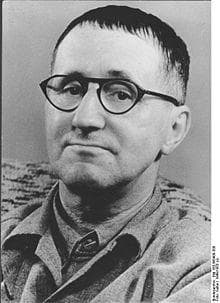
Bertolt Brecht was a highly influential German playwright, poet, and theatre director. He is best known for his epic theatre style, which aimed to provoke critical thought rather than emotional identification. His notable works include "The Threepenny Opera," "Mother Courage and Her Children," and "The Good Woman of Setzuan."

Ashley Antoinette
4.6

Mark McDonald
4.4
Luo Guanzhong
4.4

Mia McKenzie
4.3

Dorothy Parker
4.3

Joaquim Maria Machado de Assis
4.3

James Thurber
4.2

Terry Kay
4.2